

📌 Key Takeaways
Supplier verification prevents brand damage by requiring measurable evidence before orders, not relying on brochure promises after problems surface.
- Specifications Beat Adjectives: Convert “strong” and “premium” into ISO-named tests with tolerances (burst strength 2.5 kPa ±5%) to eliminate interpretation gaps.
- Production Samples Reveal Truth: Pre-production samples show intent; production samples from real runs expose actual consistency capability under volume constraints.
- Four-Point Certification Check: Verify status, scope, site coverage, and product categories—not just logos—because certificates may exclude your specific grades or facilities.
- Drift Monitoring Protects Brands: Track on-time delivery, defect themes, and COA completeness across shipments; three consecutive delays signal systemic problems requiring corrective action.
- Traceability Separates Capable Suppliers: Strong suppliers map complaints to specific paper lots, production shifts, and machine settings; vague “we’ll check records” responses predict future disputes.
Evidence-first sourcing transforms supplier relationships from hopeful transactions into verifiable partnerships.
Procurement and operations teams at e-commerce retailers and food delivery platforms will gain a systematic framework here, preparing them for the detailed implementation protocol that follows.
A torn paper bag at the customer’s doorstep. That single moment can undo months of careful brand building.
For procurement managers at e-commerce retailers and food delivery platforms, this scenario represents more than a packaging failure. It signals a breakdown in the sourcing process itself. Understanding the hidden costs of unverified suppliers reveals why systematic verification protects both budget and brand reputation. The customer doesn’t see a supplier quality issue. They see your brand failing to deliver on its promise.
The greatest risk in wholesale paper bags sourcing is not price. It is opacity and spec inconsistency, which silently breaks brand consistency and delivery reliability. When suppliers cannot demonstrate how they maintain quality across batches, or when a “120 GSM” specification lacks an agreed tolerance (e.g., ±5% per ISO 536), allowing suppliers to ship 110 GSM paper without penalty.
With a systematic verification methodology, procurement teams can transform supplier relationships from hopeful transactions into evidence-based partnerships. This means moving beyond brochure claims toward measurable specifications, verifiable certifications, and documented consistency controls.
The 5-Step Supplier Verification Protocol
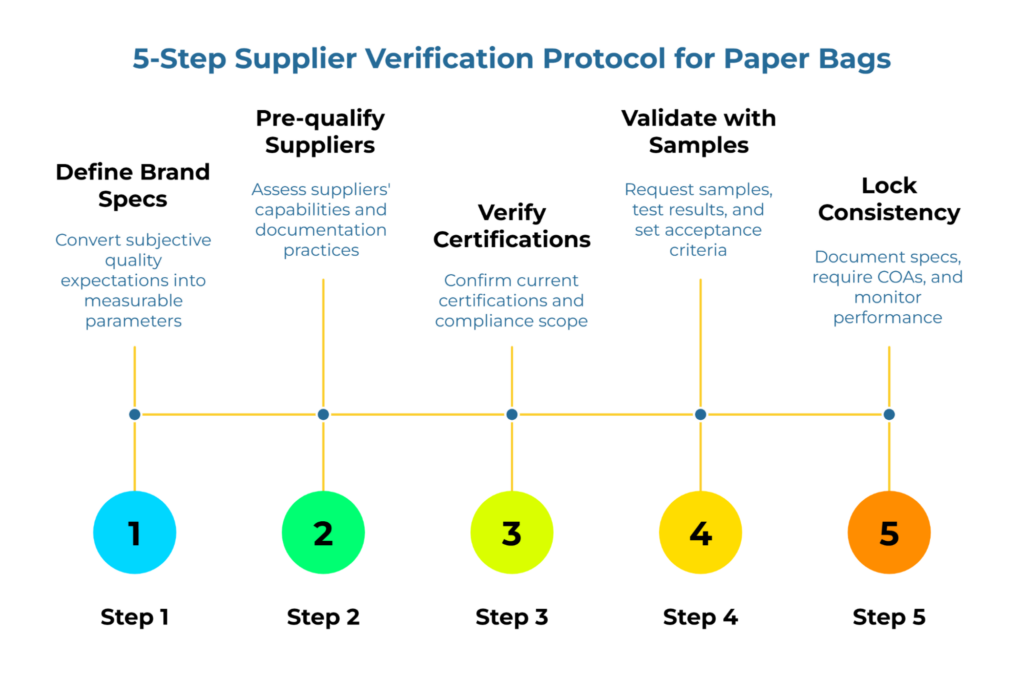
Before diving into the detailed methodology, here is the complete verification framework in a format ready for immediate use:
Step 1: Define brand consistency requirements as measurable specs. Convert subjective quality expectations into specific, testable parameters. “Strong enough” becomes “burst strength minimum 250 kPa per ISO 2758.” “Good print quality” becomes “no visible scuffing after 50 strokes at 4lb weight per ASTM D5264.”
Step 2: Pre-qualify suppliers using capability and evidence signals. Assess whether potential suppliers have the production infrastructure, quality systems, and documentation practices to deliver consistent results at your required volume.
Step 3: Verify certifications and compliance scope. Confirm that certifications are current, that the specific site producing your bags is covered, and that the product categories listed actually include your specifications.
Step 4: Validate with samples plus method-named test results plus acceptance criteria. Request samples from actual production runs, require test results that name the specific testing methods used, and establish clear pass/fail thresholds before placing orders.
Step 5: Lock consistency with onboarding, control checks, and drift monitoring. Document specifications in contracts, establish certificate of analysis requirements for each shipment, and track performance metrics to catch quality drift before it affects customers.
This protocol reduces supplier opacity by requiring verifiable evidence before ordering. Each step builds on the previous one, creating a systematic approach to sourcing that prioritizes consistency over initial cost savings.
Step 0: Define Spec-True Requirements for Your Bag Use-Case
Effective verification begins before contacting any supplier. The pre-work involves translating your operational needs into the technical language that suppliers understand and can deliver against.
Load, Size, Handle, and Delivery Stress Profile
Paper bags must survive a specific journey. That journey differs significantly between a boutique retail purchase carried to a nearby car and a food delivery order transported by motorcycle across a city.
Consider the maximum weight the bag will carry under normal use. Factor in whether contents shift during transport, whether the bag will be set down on wet surfaces, and how many times it changes hands before reaching the customer. A bag rated for 5 kg in a controlled retail environment may fail at 3 kg when subjected to the vibration and handling typical of last-mile delivery.
Handle attachment points represent a common failure location. Twisted paper handles, flat paper handles, and die-cut handles each have different stress tolerances. The attachment method, whether glued, reinforced, or integrated into the bag construction, affects durability under load.
The stress profile should capture expected load range and typical load distribution, handle type preference and comfort requirements, drop likelihood from bike delivery or doorstep placement, climate exposure including humidity and rain events, and storage time in warehouses before use. Performance failures frequently attributed to paper quality may instead result from design-to-use mismatches, such as inadequate handle patch size, adhesive application, or fold geometry. Understanding kraft paper grades for paper bags helps match substrate properties to application requirements.
Print and Brand Requirements
Brand consistency on paper bags extends beyond the substrate to the printing itself. Color matching across production batches requires documented standards such as Pantone references or CMYK specifications with acceptable variance ranges.
Rub resistance matters for bags that will be handled multiple times or stacked against other items. Ink setoff, where ink transfers to other surfaces or to the inside of stacked bags, can damage both product presentation and the items inside. Water-based inks and solvent-based inks perform differently under humidity and handling stress.
Surface treatment affects print adhesion and appearance. Corona treatment levels, coating types, and paper smoothness all influence how ink sits on the substrate and how it holds up through the supply chain. Define color expectations as tolerance approaches rather than perfection promises, clarify rub and scuff expectations given real delivery friction, specify ink setoff risk controls, and distinguish where print defects are unacceptable versus non-critical zones.
Food-Contact Versus Non-Food-Contact Needs
Requirements for food-contact packaging vary significantly by jurisdiction. The European Union, United States, and various Asian markets each maintain different regulatory frameworks for materials that directly contact food products.[1]
For food delivery applications, the relevant question is often whether the bag contacts food directly or serves as secondary packaging around already-wrapped items. This distinction affects which compliance standards apply. Bags intended for direct food contact require Declarations of Compliance (DoC) confirming migration limits are met for your specific food type (dry, fatty, or aqueous) under relevant regulations (e.g., FDA 21 CFR or EU 1935/2004). For comprehensive guidance on compliance frameworks, see our article on sustainable packaging compliance.
Avoid assuming that a “food-safe” claim covers your specific use case. Request documentation of the specific standards the supplier’s product meets, and verify that those standards align with your market requirements. Compliance is not a single checkbox but depends on food type, temperature, contact time, and destination market. Professional regulatory advice is often warranted for definitive compliance decisions.
Step 1: Build a Shortlist That Can Realistically Stay Consistent at Scale
Not all suppliers have equal capability to deliver consistency. The goal of shortlisting is identifying which potential partners have the infrastructure and systems to maintain specifications across multiple orders over time.
Manufacturer Versus Converter Versus Integrated Supplier
Understanding supplier structure helps predict consistency capability. A manufacturer operates paper-making equipment and controls the substrate from pulp forward. To explore options across the supplier ecosystem, browse kraft paper manufacturers,kraft paper companies, and packaging paper manufacturers to compare integrated versus specialized operations. A converter purchases paper rolls and transforms them into finished bags through printing, cutting, and assembly. An integrated supplier combines both functions.
Each model presents different consistency considerations. Manufacturers control substrate variables but may lack finishing flexibility. Converters can often respond faster to specification changes but depend on their paper suppliers for substrate consistency. Integrated operations offer end-to-end control but may have higher minimum order quantities.
Suppliers with vertical integration, controlling both paper manufacturing and converting, possess direct oversight of raw material inputs, which facilitates tighter management of specification drift. Integration alone is not a guarantee. Controls and transparency matter more than organizational structure. The key question is which entity controls the variables that matter most for your application. If substrate consistency is critical, understanding the manufacturer relationship becomes essential regardless of who you contract with.
Capacity, QA Maturity, Export Experience, and Lead-Time Discipline
Production capacity relative to your order size affects consistency. A supplier running at 95% capacity may struggle to maintain quality standards under pressure. Conversely, if your order represents a tiny fraction of their output, your specifications may receive less attention than larger customers.
Quality assurance maturity shows in documentation practices, testing frequency, and how suppliers handle deviations. Mature QA operations can produce certificates of analysis for each batch, maintain calibrated testing equipment, and demonstrate corrective action procedures when problems occur.
Export experience matters for international sourcing. Suppliers accustomed to export documentation, shipping requirements, and communication across time zones typically provide smoother transactions. They understand that delays in responding to specification questions or documentation requests cascade into delivery problems.
Lead-time discipline, the gap between promised and actual delivery dates, predicts future reliability better than initial promises. Request references or look for verifiable track record indicators.
For supplier discovery without treating any directory as the complete solution, use tools as inputs: browse paper bag suppliers and kraft paper bag suppliers for options, review product context through paper bags and kraft paper bags listings, and access workflow tools through Find Suppliers when ready to connect.
Red Flags That Predict Spec Drift Across Batches
Certain patterns suggest a supplier will struggle to maintain consistency:
Vague specification language in quotes, such as “approximately 120 GSM” or “standard kraft quality,” indicates either capability limitations or communication problems. Precise suppliers provide precise specifications.
Reluctance to share test methods or sample documentation suggests either that testing is informal or that results would not support marketing claims.
Unusually low prices relative to market norms may indicate corner-cutting on materials or processes. While competitive pricing is legitimate, significant outliers warrant deeper investigation.
High staff turnover in quality or customer service roles disrupts institutional knowledge and relationship continuity.
Limited traceability, inability to identify which production batch or paper lot went into a specific order, makes root cause analysis impossible when problems occur.
Step 2: Verification Beyond the Brochure
Marketing materials and certifications create initial credibility, but verification requires looking behind the documentation to understand what it actually covers.
Certification Verification Logic
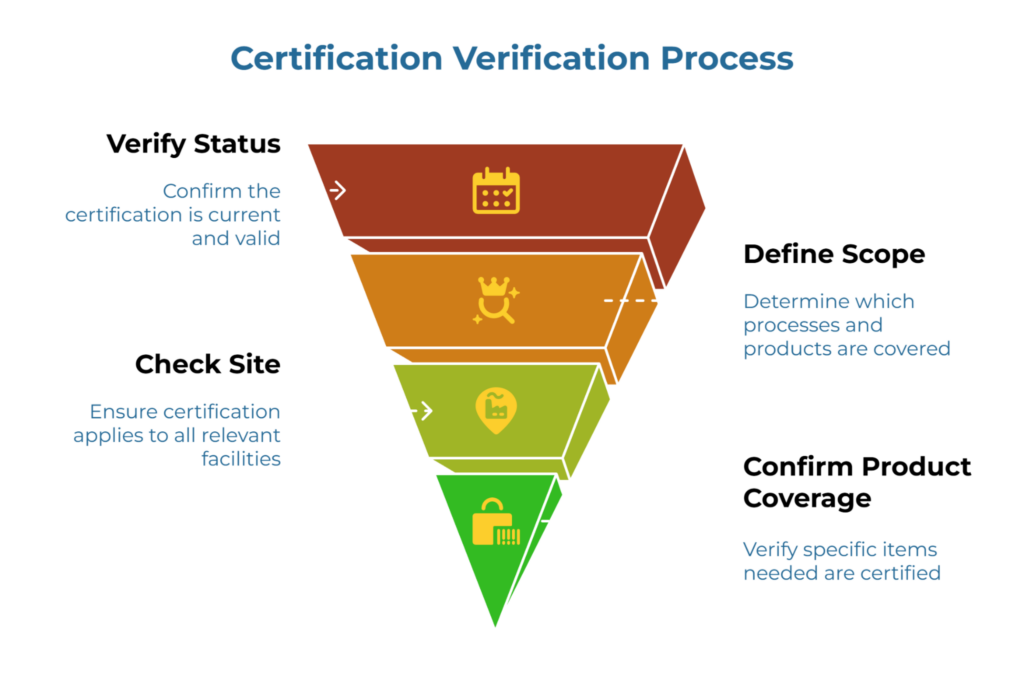
Certifications require four-point verification: status, scope, site, and product coverage.
Status means confirming the certification remains current. Certifications expire, and the period between expiration and renewal can be significant. Most certification bodies maintain public registries where status can be verified directly.[2]
Scope defines what the certification actually covers. An ISO 9001 certificate demonstrates that a quality management system exists, but the scope statement specifies which processes and products fall under that system. A supplier may hold certification for one product line while producing your bags under a different, uncertified operation.
Site matters for suppliers with multiple facilities. A certification for the headquarters or primary factory does not automatically extend to satellite production locations.
Product coverage determines whether the specific items you need fall within certified categories. Food-contact certifications, for instance, may apply to certain paper grades while excluding others produced at the same facility.
Traceability Questions That Expose Weak Controls
Traceability questions reveal operational maturity. Ask suppliers to explain how they would trace a quality complaint back to the specific paper lot, production shift, and machine settings used for that order.
Strong suppliers can describe their lot numbering system, explain how long they retain production records, and demonstrate how they link finished goods to incoming material certificates. They can identify how each batch is labeled and how that label maps to paper lots and production dates, describe documented procedures when paper supply changes including mill, grade, or fiber mix, explain how adhesives and inks are controlled and recorded by batch, and provide evidence that approved samples match ongoing production.
Weak suppliers respond vaguely about “checking their records” or deflect to general quality assurances.
Paper sourcing traceability matters for consistency. Ask whether the supplier uses single-source paper or multiple mills, and how they manage transitions between paper suppliers. Substrate changes represent a common source of batch-to-batch variation.
Evidence You Can Request in One Email
A single, well-structured request can efficiently gather verification evidence. Consider requesting:
Current certification copies with scope statements clearly visible. Recent test reports for products similar to your specification, with testing methods identified. A brief description of the quality control process including testing frequency and equipment calibration schedule. Reference contacts for customers with similar order profiles. Standard lead times and minimum order quantities for your specification range.
A practical email template you can adapt:
Subject: Verification request for paper bag consistency (spec + evidence)
Hello [Name],
To evaluate fit for long-term supply, please share the information below. The goal is brand consistency and repeatable specs across batches.
Role: Are you the manufacturer, converter, or an integrated producer? Which steps are in-house?
Site + capacity: Which facility will produce this item? What monthly capacity can be committed for this spec?
QA + traceability: How are lots/batches identified, and how are nonconformities handled?
Paper details: Paper type/grade, grammage (g/m²), and any known variation range you control.
Test evidence: Please provide method-named test results for the key properties you recommend for this use-case (and the test standard used).
Certifications: Share certificate numbers and the scope/site coverage (not only logos).
Sampling: Can you provide both a pre-production sample and a production sample from a real run?
Change control: What triggers notification to buyers (paper source changes, adhesive changes, ink changes, etc.)?
Thank you,
[Name]
[Company]
[Delivery/use-case in one line]
Suppliers who respond completely and promptly to such requests demonstrate both capability and commercial seriousness. Incomplete or delayed responses suggest either disorganization or reluctance to share information.
Step 3: Sample Verification and Test-Method Clarity
Samples bridge the gap between specification documents and physical products. However, sample evaluation requires structure to generate useful conclusions.
Pre-Production Versus Production Samples
Pre-production samples, sometimes called approval samples or proofs, demonstrate what the supplier intends to produce. Production samples come from actual manufacturing runs and represent what customers will receive.
Both serve verification purposes, but production samples provide stronger evidence of consistency capability. A supplier may produce excellent approval samples through special attention that cannot be replicated at volume. Pre-production samples validate design intent, print approach, and basic feel, but they may not reflect the manufacturing variables and machine tolerances present during a full production run.
For initial supplier evaluation, pre-production samples confirm that the supplier can meet specifications under ideal conditions. For ongoing verification, periodic production samples reveal whether those specifications hold across normal operations. Production samples show what the line actually produces under real constraints and represent the truth sample for brand consistency.
Require Method-Named Results and Tolerances
Material grades and specifications prevent quality variance by converting subjective claims into measurable tests and tolerances. The phrase “our paper is 120 GSM” provides less useful information than “basis weight 120 g/m² ±5% per ISO 536.”
Method naming matters because different test methods can yield different results for the same property. Burst strength measured per ISO 2758 and TAPPI T 403 use different apparatus and procedures. Results are not directly comparable without understanding which method was used.[3]
Tolerances acknowledge that manufacturing involves variation. A specification without tolerance implies either perfect consistency, which is unrealistic, or undefined acceptance criteria, which guarantees disputes. Professional suppliers provide specifications with stated tolerances and can explain how those tolerances relate to their process capability. Tolerances are not concessions to inferior quality but recognition of inherent manufacturing reality.
For kraft paper bags, key specifications typically include basis weight, burst strength, tear resistance, moisture content, and Cobb value for water resistance. Print-related specifications add color density, rub resistance, and adhesion testing.
Acceptance Approach for SMEs
Small and medium enterprises often lack dedicated quality laboratories. A practical acceptance approach works within resource constraints while still providing protection.
Define pass/fail criteria before receiving samples. Document what “acceptable” looks like in measurable terms, even if measurement relies on simple tools or visual standards rather than laboratory equipment. A lightweight approach includes defining a small set of checks that can be repeated every shipment, photographing defects and labeling them consistently such as tear, handle failure, print rub, or glue bleed, and retaining one approved sample and one sample from each incoming batch for comparison.
Retain reference samples from approved batches. Future shipments can be compared against these physical standards even without sophisticated testing. Store retained samples in conditions that prevent degradation, as paper properties change with humidity and temperature over time.
Record observations systematically. A simple log noting shipment dates, batch numbers, visual observations, and any customer complaints creates data for trend analysis and supplier discussions.
When testing capability is limited, consider specifying that suppliers provide certificates of analysis for each shipment, with the understanding that you will conduct periodic verification testing through an independent laboratory.
Step 4: Contracting for Consistency
Contracts formalize expectations and establish recourse when those expectations are not met. For brand consistency purposes, specification clarity in contracts matters more than complex legal language.
The Minimum Spec Appendix That Prevents Ambiguity
A specification appendix attached to purchase orders or supply agreements should contain:
Complete material specifications with units, test methods, and tolerances. For detailed guidance on GSM and burst factor specifications, consult our specifier’s guide to paper bag strength. Include bag geometry such as width × gusset × height in millimeters, flatness, squareness, and opening tolerance. Document paper specifications including grammage in g/m², grade description such as kraft, white kraft, or recycled, fiber mix preference if any, and moisture-related performance needs. Detail strength and construction requirements including ply count, handle type whether twisted paper or flat paper, handle patch, adhesive type class, fold style, and bottom construction. Specify print and brand requirements with color targets, registration tolerance, rub/scuff resistance expectations, and ink setoff risk controls. Describe use-case stress profile covering load range in kilograms, carry duration, drop/impact likelihood, rain/humidity exposure, and storage time.
Avoid specifications that reference “supplier standard” or “industry typical” without defining those terms.
Packaging and labeling requirements, including how bags should be packed for shipment, maximum stack heights, moisture protection during transit, and any labeling needed for inventory identification.
Documentation requirements specifying which certificates or test reports accompany each shipment and what information those documents must contain.
Sample retention expectations stating how long both parties retain reference samples and production records.
Certificates of Analysis and Handling Deviations
Certificates of analysis should accompany each shipment, documenting that the specific batch meets agreed specifications. Effective COAs identify the test methods used, the equipment calibration status, and the date testing occurred. At minimum, include batch identification, date of production, key checks performed, and who approved release.
Establish deviation procedures before problems occur. Define what happens if incoming material falls outside specification: who receives notification, what timeframe applies for investigation, and what remedies are available. Options typically include return for credit, acceptance at reduced price, or rework by the supplier.
Corrective action expectations should be proportional to deviation severity. A single minor deviation might require only acknowledgment and explanation. Repeated deviations or significant quality escapes warrant formal corrective action documentation, root cause analysis, and preventive measures. When deviations occur, require evidence such as photos, measurements, or test results if relevant, root cause analysis, corrective action plan, and prevention plan for recurrence.
Communication Rhythm and Escalation
Regular communication prevents small issues from becoming large problems. Establish expected response times for routine inquiries versus urgent quality concerns. Define response owners on both sides, evidence expectations, timeline for triage and corrective action, and a routine cadence for performance review monthly or quarterly depending on volume.
Define escalation paths for both organizations. Know who has authority to approve specification changes, who handles quality disputes, and how to reach decision-makers when standard channels are not resolving issues.
Consider periodic business reviews for significant supplier relationships. These structured discussions address performance trends, upcoming requirement changes, and continuous improvement opportunities beyond day-to-day transactions. For buyers managing working capital, our cash gap calculator and guide on negotiating payment terms provide frameworks for optimizing financial arrangements with suppliers.
Step 5: Monitor Drift After the First Order
Initial verification establishes baseline capability. Ongoing monitoring detects changes before they affect customers.
Lightweight Scorecard
A verification methodology enables brand consistency by controlling spec drift across batches. Simple metrics tracked consistently provide early warning of deterioration:
On-time delivery percentage measures reliability. Calculate actual delivery date against promised delivery date, not against revised dates after delays are announced.
Defect themes categorize quality issues by type. Tracking whether problems cluster around specific failure modes, such as handle failures, print issues, or substrate problems, guides investigation and improvement focus.
Evidence quality assesses documentation completeness and accuracy. Are COAs provided for every shipment? Do they contain all required information? Do test results match specification ranges?
Responsiveness measures communication performance. How quickly does the supplier acknowledge inquiries? How thoroughly do they address questions?
Early Warning Signals and Corrective Actions
Trend detection matters more than individual measurements. A single slightly-late shipment may reflect logistics issues. Three consecutive shipments with increasing delays suggests systemic problems.
Watch for changes in supplier behavior. New personnel handling your account, changes in documentation format, or shifts in communication patterns sometimes precede quality changes. Early warnings include same spec but different feel, often indicating paper source or fiber changes, more dusting, odor changes, or unusual stiffness, new print scuffing patterns, and handle failure pattern changes.
When metrics indicate problems, address them promptly and specifically. Reference the data when discussing concerns. For structured approaches to supplier performance management, see our guide on verifying international paper bag suppliers and strategies for building reliable sourcing frameworks. Seek root cause understanding rather than accepting general assurances. Corrective actions should include comparing to the golden sample, requesting batch traceability, and pausing repeat orders until a production sample matches the approved reference.
Document supplier performance discussions and agreed actions. This record supports decisions about continuing, expanding, or transitioning supplier relationships.
Common Failure Modes: A Diagnostic Mini-Guide
When paper bag failures occur, systematic diagnosis guides both immediate response and long-term prevention.
Tears During Delivery
Tears typically originate from stress concentration points: handle attachments, fold lines, or print registration marks that create weak spots. Overloading relative to bag capacity is the most common immediate cause, but underlying factors often include insufficient burst strength, poor handle attachment, or paper grain orientation that places stress perpendicular to fiber direction.
Investigation questions: What weight was the bag carrying? Where did the tear originate? Was the paper visibly thinner or weaker at the failure point? Did the failure occur during normal handling or after unusual stress?
Performance failures frequently attributed to paper quality may instead result from design-to-use mismatches such as inadequate handle patch size, adhesive application, or fold geometry. Verify handling construction details and consistency controls, conduct production sample carry tests aligned to real loads in kilograms, and review method-named paper strength evidence when needed.
Ink Rub-Off and Scuffing
Print durability failures show as ink transfer to hands, other bags, or packaged products. Contributing factors include inadequate ink curing, unsuitable ink formulation for the paper surface, or surface contamination that prevented proper adhesion. Likely contributors also include ink system mismatch to paper surface, insufficient curing/drying time, and high friction in delivery handling.
Rub resistance testing per ASTM D5264 or equivalent methods quantifies this property. If specifications include rub resistance requirements, test results for problem batches can be compared against baseline. Verify print process controls, ensure rub resistance expectation is written as an acceptance check, and review storage/packing conditions that prevent setoff.
Moisture Weakening and Storage Issues
Paper strength decreases as moisture content increases. Bags stored in humid conditions or exposed to rain during transit lose structural integrity. The Cobb test measures water absorption rate, indicating how quickly moisture penetrates the paper surface.
Storage conditions throughout the supply chain affect performance. Bags may leave the supplier within specification but arrive weakened due to improper warehousing or shipping conditions. Packaging and desiccant requirements can mitigate these risks. Verify moisture protection in shipping cartons and pallet wrap, review water absorptiveness evidence where relevant, and confirm storage/packing conditions prevent moisture exposure.
Same Spec, Different Feel
Perhaps the most frustrating quality issue occurs when bags meet documented specifications but nonetheless feel or perform differently than previous batches. This typically indicates that the specification does not capture all variables affecting perceived quality.
Paper from different mills, different fiber blends, or different machine configurations can meet identical basis weight and strength specifications while differing in stiffness, surface texture, or handling characteristics. When this occurs, consider whether specifications need refinement to capture additional parameters, or whether supplier sourcing practices have changed. Verify change control commitments, confirm batch mapping to paper lots, and consider tighter tolerances with more frequent sample comparisons.
Supplier-Side Appendix: Build an Evidence Pack Buyers Trust
This section addresses suppliers seeking to work with quality-conscious buyers. Understanding buyer verification expectations helps suppliers prepare documentation that demonstrates capability and builds confidence.
Five Evidence Categories Buyers Verify
Procurement professionals evaluating paper bag suppliers typically assess:
Certifications and their scope. Not just whether certifications exist, but whether they cover the relevant products, processes, and facilities. Prepare scope statements and registry verification links.
Test methods and results. Documentation showing which standards govern your testing, what equipment you use, calibration status, and typical results for products in the buyer’s specification range.
Traceability systems. Explanation of how you track materials from incoming paper through production to finished goods, and how long you retain records enabling investigation of any quality issues.
Quality assurance controls. Description of inspection points, testing frequency, and procedures for handling out-of-specification material. Evidence of corrective action processes and continuous improvement activities.
Shipment consistency history. Track record data showing on-time delivery rates, defect rates, and customer complaint resolution.
Presenting Method-Named Tests and Scope Clarity
Buyers appreciate documentation that clearly identifies testing methods rather than simply stating results. Instead of “burst strength 2.8 kPa,” provide “burst strength 2.8 kPa per ISO 2758, equipment calibrated January 2024.” Put the test method name and standard reference next to each result, date-stamp results and tie them to a production batch, clarify whether testing is internal or third-party, and avoid mixing methods across documents without explanation.
When presenting certifications, include the certificate itself, the scope statement, and a link to the certification body’s public registry where buyers can verify status independently.
For capabilities that span multiple specifications, create summary documentation showing which specifications you can produce, associated tolerances, and minimum order quantities. This helps buyers quickly assess fit.
Avoiding Evidence Gaps That Trigger Disputes
Common documentation gaps that create buyer hesitation:
- Certificates without visible scope statements leave buyers uncertain what is actually certified.
- Test reports without method identification prevent comparison to buyer specifications.
- Sample results without indication of whether samples came from special preparation or production runs raise questions about representativeness.
- Missing or outdated calibration records undermine confidence in test result accuracy.
Vague traceability explanations suggest investigation capability may be limited if problems occur.
Proactively addressing these gaps in initial communications differentiates suppliers who understand professional procurement requirements from those who rely on price competition alone. For ongoing education on verification concepts and sourcing discipline, refer teams to PaperIndex Academy.
Frequently Asked Questions
Which specifications matter most for brand consistency in paper bags?
The critical specifications depend on application, but most brand consistency issues trace to basis weight consistency, burst and tear strength, moisture resistance as measured by Cobb value, and print-related properties including color accuracy and rub resistance. Rather than focusing on single parameters, effective verification addresses the combination of specifications that affect how the bag performs in your specific use case.
How do certifications differ from proof of consistent production?
Certifications verify that systems and processes exist. They confirm capability rather than actual performance on specific orders. Proof of consistent production comes from track record data: historical on-time delivery rates, defect trends, certificate of analysis compliance, and reference feedback from other customers. Both matter. Certifications indicate baseline capability; performance data indicates whether that capability translates to consistent results.
What should be included in an RFQ to prevent incomparable quotes?
Effective RFQs include complete specifications with units, test methods, and tolerances. They state order quantities and frequency, delivery requirements including packaging and labeling, documentation expectations, and sample requirements. They ask suppliers to indicate which specifications they can meet, which they cannot, and which require clarification. Structured RFQs that request specific information in specific formats enable true comparison rather than interpretation of varying response styles.
To streamline this process, buyers can submit RFQs through established platforms that connect them directly with verified suppliers.
How can SMEs verify without a full QA department?
Small and medium enterprises can implement verification through several approaches: requiring supplier-provided certificates of analysis with method-named test results for each shipment, retaining reference samples from approved batches for visual comparison, maintaining simple logs of shipment quality observations, and conducting periodic independent laboratory testing on selected batches. The PaperIndex Academy provides educational resources on verification approaches suited to various organizational capabilities, including our comprehensive guide on how to vet wholesale paper bag suppliers. Focus on documentation and systematic observation rather than sophisticated equipment.
Disclaimer:
This article provides general information about wholesale paper bags sourcing verification methodology for educational purposes. Individual circumstances vary significantly based on factors like bag size and load profile, handle and construction choices, printing and branding requirements, food-contact expectations, local regulatory requirements, and shipping and storage conditions. For personalized guidance tailored to brand consistency and delivery reliability needs, it is recommended to consult with a qualified professional.
References
[1]: U.S. Food and Drug Administration. “Packaging & Food Contact Substances.” FDA.gov. https://www.fda.gov/food/food-ingredients-packaging/packaging-food-contact-substances-fcs
[2]: International Organization for Standardization. “Certification and conformity.” ISO.org. https://www.iso.org/certification.html
[3]: TAPPI – Technical Association of the Pulp and Paper Industry. “Test Methods.” TAPPI.org. https://www.tappi.org/publications-standards/standards-methods/
Our Editorial Process:
Our expert team uses AI tools to help organize and structure our initial drafts. Every piece is then extensively rewritten, fact-checked, and enriched with first-hand insights and experiences by expert humans on our Insights Team to ensure accuracy and clarity.
About the PaperIndex Insights Team:
The PaperIndex Insights Team is our dedicated engine for synthesizing complex topics into clear, helpful guides. While our content is thoroughly reviewed for clarity and accuracy, it is for informational purposes and should not replace professional advice.