

📌 Key Takeaways
Landed cost calculation normalizes quotes to a single delivery basis, preventing invoice disputes and enabling defensible supplier comparisons.
- Lock the Quote Basis First: Specify Incoterm, named place, and scope before comparing—FOB Shanghai differs fundamentally from CIF Los Angeles.
- Build a Complete Cost Stack: Include every charge from factory gate to warehouse door, treating destination THC as a forced line item.
- Calculate Duty from Dependencies: Confirm HS code classification and check for Anti-Dumping duties before locking budget estimates.
- Stress-Test Freight Scenarios: Model baseline, surge, and relief freight rates to identify which quotes flip rankings under volatility.
- Log Every Assumption: Document freight rates, FX timing, and surcharge basis with review triggers to prevent post-award disputes.
Normalized quotes eliminate hidden costs and turn procurement debates into evidence-based decisions.
Procurement and logistics teams sourcing paper bags internationally will gain a repeatable worksheet for comparing mixed-basis quotes, preparing them for the step-by-step calculation methodology that follows.
Procurement selects the lowest unit price. Logistics flags missing destination charges. Finance rejects the request because the delivered number isn’t defensible. This stalled-approval scenario plays out whenever teams compare quotes on different bases—FOB from one port, CIF to another, DDP to somewhere undefined. Understanding how to compare quotes across different Incoterms is essential for true comparability.
The factory price is just the ticket; landed cost is the full trip. And until everyone calculates that trip the same way, the debate continues.
“The cheapest price at the factory gate isn’t always the cheapest price at your warehouse door.”
What follows is a step-by-step methodology to build a defensible, apples-to-apples landed cost per bag. By the end, you will have a repeatable worksheet that normalizes quotes to a single to-door basis, a checklist of every charge from factory gate to your receiving dock, and an assumption log that prevents internal disputes by making the math transparent.
What “Landed Cost” Means for Paper Bags (and Why FOB Price Is Not the Answer)
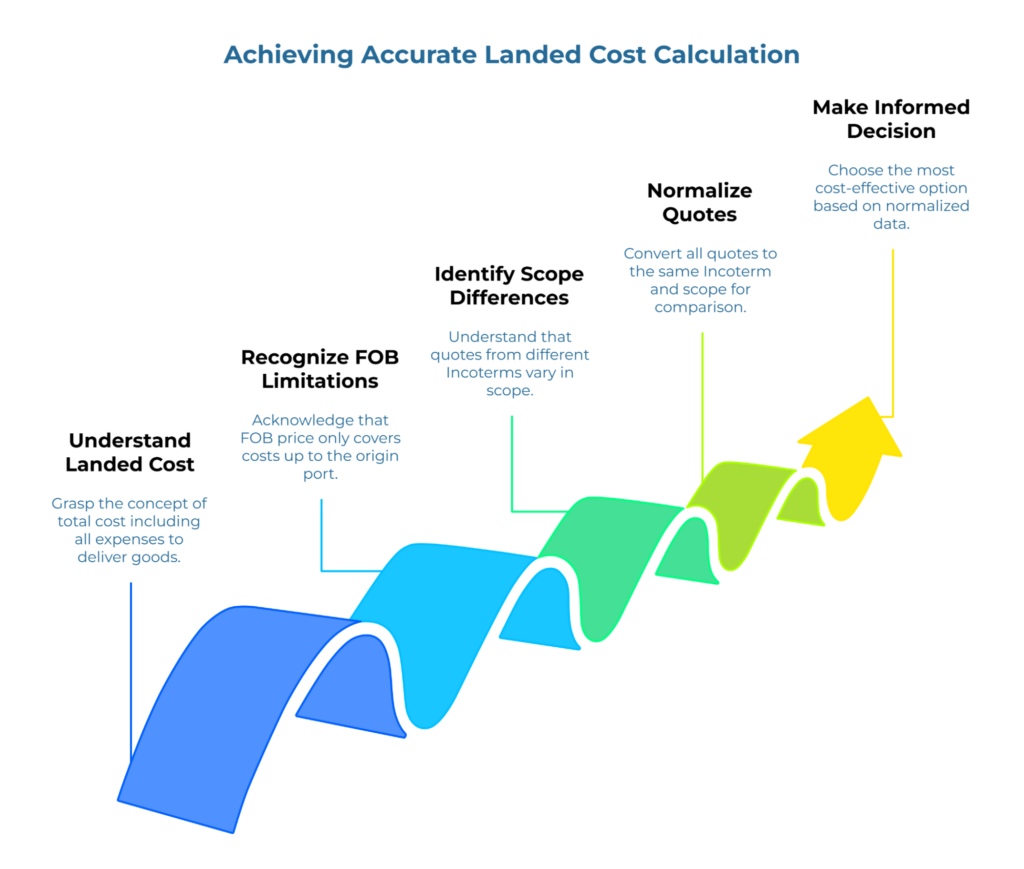
Landed cost is the total amount you pay to have sellable paper bags at your receiving location, on a defined scope. It includes the product price plus every cost incurred to move those bags from the supplier’s facility to your warehouse door—freight, insurance, duties, taxes, handling, and any ancillary charges along the way.
FOB price, by contrast, is a quote basis to a named port. It tells you what you pay up to the point the goods cross the ship’s rail at the origin port. Everything after that—ocean freight, destination handling, customs clearance, inland delivery—falls outside that number.
The problem arises when procurement teams compare an FOB Shanghai quote against a CIF Los Angeles quote against a DDP quote to an unnamed warehouse. These are fundamentally different scopes. Without normalization, the “lowest price” often becomes the highest total cost once all the missing charges surface.
The normalization principle is straightforward: convert every quote to the same Incoterm, the same named place, and the same scope of inclusions. Only then can you make a defensible comparison.
Step 1: Lock the Quote Basis—Incoterm, Named Place, and Scope
An Incoterm alone is insufficient. FOB means nothing without knowing which port. DDP means nothing without knowing which destination. The named place determines where cost and risk transfer, and that single detail can shift thousands of dollars between buyer and seller.
The Incoterms® rules, published by the International Chamber of Commerce, define eleven terms governing the transfer of costs, risks, and responsibilities. For paper bag sourcing, four appear most frequently:
- EXW (Ex Works): The buyer assumes all costs and risks from the supplier’s premises. You arrange and pay for everything—inland haulage, export clearance, freight, insurance, import clearance, and delivery.
- FOB (Free on Board): The supplier delivers goods onto the vessel at the named port of shipment. From that point, you bear freight, insurance, destination charges, duties, and inland delivery.
- CIF (Cost, Insurance, and Freight): The supplier pays freight and insurance to the named destination port. You take over at the destination port, covering terminal handling, customs clearance, duties, and inland delivery.
- DDP (Delivered Duty Paid): The supplier delivers goods cleared for import at the named destination. In principle, this covers everything—but scope and named place still matter. Confirm exactly which destination charges are included. The responsibility for VAT, GST, or other indirect taxes must be explicitly defined in DDP contracts, as buyers often prefer to pay these locally to ensure tax reclaimability rather than having the supplier include them in the delivered price.
For a deeper treatment of how these terms affect your delivered price, see incoterms for paper supply: the six clauses that change your delivered price more than you think.
Incoterms Responsibility Snapshot
| Charge Category | EXW | FOB | CIF | DDP |
| Origin inland haulage | Buyer | Seller | Seller | Seller |
| Export documentation | Buyer | Seller | Seller | Seller |
| Origin terminal handling (THC) | Buyer | Seller | Seller | Seller |
| Main freight | Buyer | Buyer | Seller | Seller |
| Cargo insurance | Buyer | Buyer | Seller | Seller |
| Destination THC | Buyer | Buyer | Buyer | Seller |
| Customs broker fees | Buyer | Buyer | Buyer | Seller |
| Import duty and taxes | Buyer | Buyer | Buyer | Seller (confirm VAT/GST responsibility) |
| Inland delivery to warehouse | Buyer | Buyer | Buyer | Seller |
Note: Always confirm the named place. “FOB China” is ambiguous; “FOB Shanghai Port” is specific.
Common scope traps include packaging and palletization assumptions, export documentation fees, terminal handling charges at origin, brokerage fees, and whether insurance is included at replacement value or a lower basis. Ask suppliers to state explicitly what is included and excluded.
Step 2: Build the Cost Stack—Every Charge from Factory Gate to Your Dock
Once you have locked the quote basis, build the full cost stack. This checklist ensures nothing is missed.
Landed Cost Components Checklist
| Cost Component | Description | Who Pays? (Varies by Incoterm) | Your Amount |
| Product price | Unit price × quantity | Per quote | |
| Packing/palletization | Cartons, pallets, wrapping; affects CBM and freight class | Confirm with supplier | |
| Origin inland haulage | Factory to origin port/terminal | EXW: Buyer; FOB/CIF/DDP: Seller | |
| Export documentation | Commercial invoice, packing list, certificates | EXW: Buyer; Others: Seller | |
| Origin terminal handling (THC) | Port charges at origin | EXW: Buyer; Others: Typically Seller | |
| Main freight | Ocean or air carriage | EXW/FOB: Buyer; CIF/DDP: Seller | |
| Carrier surcharges | PSS, GRI, BAF, CAF, etc. | Follows main freight | |
| Cargo insurance | Coverage during transit | EXW/FOB: Buyer; CIF/DDP: Seller | |
| Destination THC | Terminal handling at destination port | EXW/FOB/CIF: Buyer; DDP: Seller | |
| Customs broker fees | Clearance processing | EXW/FOB/CIF: Buyer; DDP: Seller | |
| Import duty | Based on HS code and customs valuation | EXW/FOB/CIF: Buyer; DDP: Seller | |
| VAT/GST/other taxes | Varies by destination country | EXW/FOB/CIF: Buyer; DDP: Seller | |
| Demurrage/detention (risk item) | Port storage or container delays; probabilistic | Buyer (include as contingency) | |
| Inland delivery to warehouse | Trucking from port to final destination | EXW/FOB/CIF: Buyer; DDP: Confirm |
Packing assumptions deserve particular attention. The way goods are packed affects cubic volume (CBM), which drives freight costs on volumetric shipments. A quote based on loose cartons will yield different freight than one based on palletized, stretch-wrapped units. Proper packaging and protection specifications prevent damage and affect overall freight calculations. Confirm packing method, dimensions, and gross weight before locking freight estimates.
Demurrage and detention represent probabilistic costs—charges that may or may not occur depending on port congestion, customs delays, or container return timing. Include these as a line item with an assumption note (for example, “Assume 3 days free time; budget 2 additional days at estimated daily rate as contingency”).
Destination terminal handling charges warrant particular attention. Require suppliers to explicitly state whether destination THC is included or excluded, and maintain this as a forced line item in your cost stack even when quotes claim “all-in” pricing. This single omission causes more invoice disputes than any other line item.
Step 3: Calculate Duty and Taxes Without Surprises
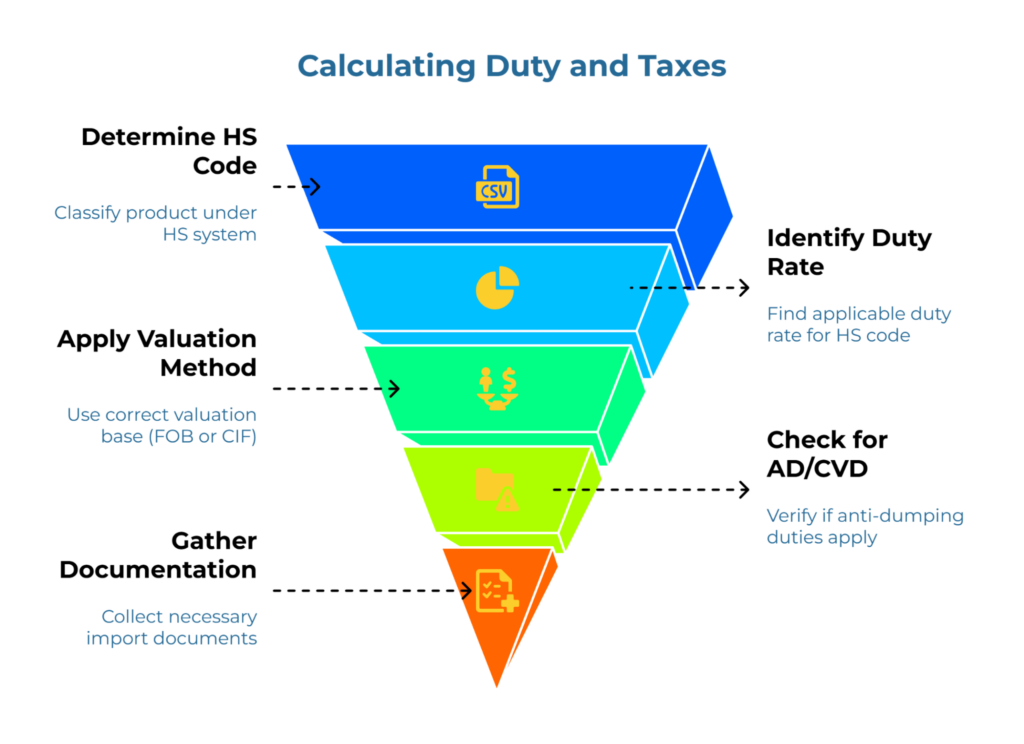
Duty and tax calculations follow a dependency chain: product description and material composition determine the Harmonized System (HS) code, which determines the applicable duty rate, which is applied against the customs valuation base to compute the duty amount.
The Harmonized System, maintained by the World Customs Organization, provides the standardized classification framework used globally. Paper bags typically fall under HS Chapter 48 (Paper and paperboard; articles of paper pulp), but the specific six-digit or eight-digit code depends on material (kraft, recycled, coated), construction, and intended use.
Customs valuation—the base against which duty is calculated—varies by jurisdiction: the United States typically uses the Transaction Value (FOB basis), excluding international freight and insurance, while the European Union and many other nations use the CIF value. Using the wrong base can lead to a 5–15% variance in your projected duty cost. Understanding this matters because a quote in FOB terms requires you to add freight and insurance before computing duty.
Rather than memorizing country-specific rates, focus on what you need from a customs broker:
- Confirmed HS code classification for your specific product
- Applicable duty rate and any preferential trade agreements
- Check for Anti-Dumping (AD) and Countervailing Duties (CVD): In 2025, paper bags from countries like China, India, and Vietnam are subject to specific trade enforcement actions. These ‘penalty duties’ can exceed 100% of the product value, making them the single most important variable in your cost stack
- Valuation method and required documentation
- Estimated clearance timeline and any compliance requirements
The documents that drive this process include the commercial invoice (showing product description, value, and Incoterm), packing list, bill of lading or airway bill, certificate of origin (if claiming preferential rates), and any product-specific certifications.
For general background on how tariffs work globally, the WTO Tariffs page provides a neutral overview.
Step 4: Convert to Unit Economics—Cost per Bag and Cost per 1,000 Bags
With the total landed cost calculated, convert to unit economics for budgeting and comparison.
Formulas:
- Total Landed Cost = Product Cost + All Charges (origin, freight, duty, destination, delivery)
- Cost per Bag = Total Landed Cost ÷ Total Bags in Shipment
- Cost per 1,000 Bags = Cost per Bag × 1,000
Worked Example Worksheet (Illustrative—Hypothetical Numbers)
| Line Item | Amount (USD) | Notes |
| Product price (100,000 bags) | $4,500.00 | FOB Shanghai; $0.045/bag |
| Packing/palletization | Included | Confirmed with supplier |
| Origin charges | Included | FOB basis |
| Ocean freight (Shanghai–Los Angeles) | $1,200.00 | 8 CBM; illustrative rate |
| Carrier surcharges (BAF, PSS) | $180.00 | Illustrative; varies by carrier |
| Cargo insurance | $85.00 | 110% CIF value basis |
| Destination THC | $320.00 | LA port; illustrative |
| Customs broker fee | $150.00 | Illustrative |
| Import duty (6.5% on CIF value) | $388.00 | HS code–dependent; illustrative |
| Inland delivery (LA port to warehouse) | $275.00 | 50 km; illustrative |
| Demurrage contingency | $100.00 | 2 days buffer |
| Total Landed Cost | $7,198.00 | |
| Cost per Bag | $0.072 | |
| Cost per 1,000 Bags | $71.98 |
All figures are illustrative examples for methodology demonstration only.
Optional line items to consider, depending on your situation: bank fees for letters of credit or wire transfers, pre-shipment inspection costs, and compliance verification (such as FSC certification checks if sustainability claims affect supplier selection).
For buyers concerned about how payment terms affect working capital, the ‘cash gap’ calculator for paper bag buyers provides a complementary framework.
Step 5: Stress-Test the Estimate and Log Assumptions
A landed cost estimate is only as good as its assumptions. Freight rates shift. Currency moves. Surcharges spike during peak season. Build scenarios to understand your exposure.
Three-Scenario Template
| Scenario | Freight Adjustment | Duty Adjustment | FX Adjustment | Resulting Cost per 1,000 Bags |
| Baseline | As quoted | As calculated | Spot rate | $71.98 |
| Surge (+30% freight, +5% FX) | +$360 | — | +5% | ~$78.50 |
| Relief (−15% freight) | −$180 | — | — | ~$70.20 |
Illustrative example. Adjust percentages based on your route volatility and historical patterns.
For kraft paper buyers dealing with price volatility, understanding how cost drivers affect your landed price helps refine these scenario assumptions with market-specific data.
The assumption log is your dispute-prevention tool. Every input that could change—and affect your number—should be documented with its source, date, owner, and trigger for review.
Assumption Log Template
| Assumption | Value | Source | Date | Owner | Next Review Trigger |
| Ocean freight rate | $150/CBM | Forwarder quote | [Date] | Logistics | Rate validity expires / route change |
| FX rate (USD/CNY) | 7.25 | Treasury desk | [Date] | Finance | Weekly update / movement >3% |
| Duty rate | 6.5% | Broker confirmation | [Date] | Procurement | HS code reclassification / trade policy change |
| Demurrage assumption | 2 days @ $50/day | Industry estimate | [Date] | Logistics | Shipment-specific actuals |
| Surcharge basis | PSS $15/TEU | Carrier schedule | [Date] | Logistics | GRI announcement |
Refresh the model when any trigger fires: route change, Incoterm change, carrier change, significant FX movement, surcharge update, or before each supplier award decision.
Ready to compare paper bag suppliers on a true to-door basis?
Use the checklist and assumption log above, then shortlist suppliers who can quote with clear Incoterms, packing details, and documentation scope. Browse verified paper bag suppliers or explore kraft paper bag suppliers for specific material sourcing.
Common Pitfalls That Cause Invoice Disputes
Even with a solid methodology, certain errors recur. Understanding why they happen helps prevent them.
| Pitfall | Why It Happens | How to Prevent |
| Named-place mismatch | Quote says “FOB China” without specifying port; actual origin differs | Require Incoterm + specific named place on every quote |
| Missing destination THC | Buyer assumes CIF includes port handling; it typically does not | Explicitly confirm destination charges in writing; maintain as forced line item |
| Demurrage/detention surprises | Free time exceeded due to customs delays or slow container pickup | Budget contingency; track free time proactively |
| Weight/volume assumption errors | Actual CBM exceeds estimate due to packing changes | Confirm final packing dimensions before booking |
| FX timing mismatch | Quote locked at one rate; payment made at another | Document FX assumption date; consider forward contracts for large orders |
| Valuation Base Error | Applying duty to freight/insurance costs in FOB-basis countries (like the US) | Confirm with your broker if duty is assessed on the ‘Entered Value’ (FOB) or ‘CIF Value’ before finalizing the model |
For additional guidance, see common pitfalls in landed-cost estimates of kraft paper (and how to avoid invoice disputes).
The RFQ Data Pack to Request from Paper Bag Suppliers
To receive comparable quotes, provide suppliers with—and request back—a consistent data pack. This eliminates ambiguity and enables true apples-to-apples evaluation.
Request List for RFQs:
- Product specifications: Material, GSM and burst factor, dimensions, print/finish requirements, tolerances
- Quantity and order frequency: Total bags, shipment cadence
- Incoterm and named place: Specify exactly (e.g., “FOB Shanghai Port” or “CIF Los Angeles”)
- Packing and palletization: Carton configuration, pallet dimensions, stretch-wrap requirements
- Weights and volumes: Gross weight per carton, CBM per pallet or shipment
- Documentation scope: Commercial invoice, packing list, certificate of origin, any certifications required
- Exclusions list: What is explicitly not included in the quoted price
- Lead time: Production days, booking-to-ETD, transit time
- Payment terms: Deposit, balance timing, accepted methods
When suppliers respond on the same basis, your landed cost worksheet becomes a reliable comparison tool rather than a source of ongoing debate. To ensure you’re working with capable suppliers, see how to verify supplier capability (when the price list isn’t the risk).
Turn the worksheet into apples-to-apples quotes
Submit one RFQ with your exact bag specs, Incoterm, named place, and packing assumptions so suppliers respond on the same basis. For international suppliers, follow this verification checklist for safe online sourcing before placing orders.
Frequently Asked Questions
What’s the difference between FOB price and landed cost?
FOB is a quote basis to a named port; landed cost includes every cost to your receiving location on a consistent scope.
Does DDP always mean the supplier pays everything?
In principle, DDP includes delivery duties paid, but scope and named place still matter. Confirm which destination charges are included, and explicitly define VAT/GST responsibility since buyers often prefer to pay these locally for tax reclaimability.
How do I estimate duty if I don’t know the HS code?
Start by confirming product description and materials, then consult a customs broker to confirm classification and check for any Anti-Dumping or Countervailing Duties before locking budgets. For comprehensive logistics guidance, see navigating global logistics: duty and freight factors in sourcing paper bags.
Which charges cause the most landed-cost surprises?
Destination handling/THC, carrier surcharges, demurrage/detention risk, FX timing, and missing packing assumptions.
How often should I update my landed-cost model?
Update when freight rates, surcharges, FX, route, or Incoterm/named place changes—or before each award decision.
Disclaimer:
This article provides general information about calculating landed cost for paper bags for educational purposes. Individual circumstances vary significantly based on factors like Incoterms, shipping lane, transport mode, customs classification, duties and taxes, port and carrier charges, insurance terms, and currency movements. For personalized guidance, consult a qualified customs broker, freight forwarder, or trade finance professional.
Our Editorial Process:
Our expert team uses AI tools to help organize and structure our initial drafts. Every piece is then extensively rewritten, fact-checked, and enriched with first-hand insights and experiences by expert humans on our Insights Team to ensure accuracy and clarity.
About the PaperIndex Insights Team:
The PaperIndex Insights Team is our dedicated engine for synthesizing complex topics into clear, helpful guides. While our content is thoroughly reviewed for clarity and accuracy, it is for informational purposes and should not replace professional advice.