

📌 Key Takeaways
Professional-looking certificates can be expired, out of scope, or belong to different entities than the supplier sending them.
- Two-Lane Verification Prevents Costly Mistakes: Visual screening catches obvious mismatches in under two minutes, while registry confirmation validates current status and scope in five minutes.
- Certificate Possession Doesn’t Equal Certified Claims: A supplier holding a valid ISO or FSC certificate doesn’t automatically mean your specific shipment, site, or activity is covered by that certificate’s scope.
- Ten Fields Must Align Exactly: Legal name, certificate number, dates, scope statement, sites covered, and certification body details must match between the PDF and supplier’s commercial documents.
- Registry Databases Reveal What PDFs Hide: Official FSC, PEFC, and IAF registries confirm active status and catch mid-cycle suspensions that expired PDFs cannot show.
- Document Every Verification Step: Saving timestamped screenshots of registry checks creates an audit trail demonstrating due diligence before accepting supplier certificates.
Visual screening plus registry verification separates confident procurement from hopeful guessing.
Procurement professionals and quality managers sourcing certified materials will gain actionable verification steps here, preparing them for the detailed implementation workflow that follows.
Executive summary
A certificate PDF can look official while the underlying claim is false, expired, or out of scope. The practical approach is “trust but verify”: screen the document for mismatches, then confirm status and scope in the official directory before relying on it.
- Check identity, number, dates, and scope on the PDF.
- Confirm holder, status, and scope in the directory.
- Save a dated note or screenshot of what matched.
The 7:00 AM Decision
The PDF arrives at 7:00 AM. Stock is running low, production needs materials, and the supplier’s certificate looks legitimate—professional letterhead, a certification body logo, dates that appear current.
But that polished document might be expired. It might cover a different facility. It might not belong to the company sending it.
Suppliers can send a certificate that looks certified while the underlying document is expired, out of scope, or belongs to a different legal entity. Common issues include fabricated or edited PDFs, real certificates used by the wrong entity, and real certificates that do not cover the activity or site being relied on. These challenges are part of a broader supplier verification framework detailed in our Trust Protocol guide.
Why a Certificate PDF Isn’t Proof (and Why Visuals Still Matter)
A certificate proves something specific: that a certification body audited a particular legal entity, at defined sites, for certain activities, and found them compliant with a standard—at a moment in time. What it does not prove is that your shipment or invoice today falls within that certificate’s scope.
A supplier might hold a valid ISO 9001 certificate for headquarters while shipping your order from an uncertified warehouse elsewhere. An FSC chain-of-custody certificate might cover “trading” but not “manufacturing”—and if the supplier converts raw materials, the certificate does not cover what arrives.
This is where the two-lane approach becomes essential. Visual inspection serves as triage: a quick screen catching obvious inconsistencies. Registry verification serves as confirmation: the official lookup validating status, scope, and holder identity.
| Step | Pros | Cons |
| Screen the PDF | Fast; catches mismatched names, missing appendices, inconsistent numbers | Cannot prove authenticity or current status |
| Confirm in a Directory | Confirms holder and status; may show scope/sites | Some cases require issuer confirmation |
Think of it as “trust but verify.”
Know What You’re Looking At: ISO vs. FSC/PEFC
ISO management system certificates (ISO 9001, ISO 14001, ISO 22000) confirm that an organization has implemented documented systems meeting international standards. They prove systems exist—not that every product meets a particular threshold.
FSC and PEFC chain-of-custody certificates track materials through supply chains, enabling claims like “FSC Mix” on specific products. The certificate authorizes holders to make claims on invoices—but only when proper documentation flows through each transaction.
The critical misconception: holding a certificate is not the same as having a certified claim on your paperwork. A supplier can possess a valid certificate and still send materials that do not qualify for certified claims. For deeper explanation, see Chain-of-custody vs forest management: the difference that breaks proof requests.
The Real Certificate Checklist: 10 Fields That Should Match
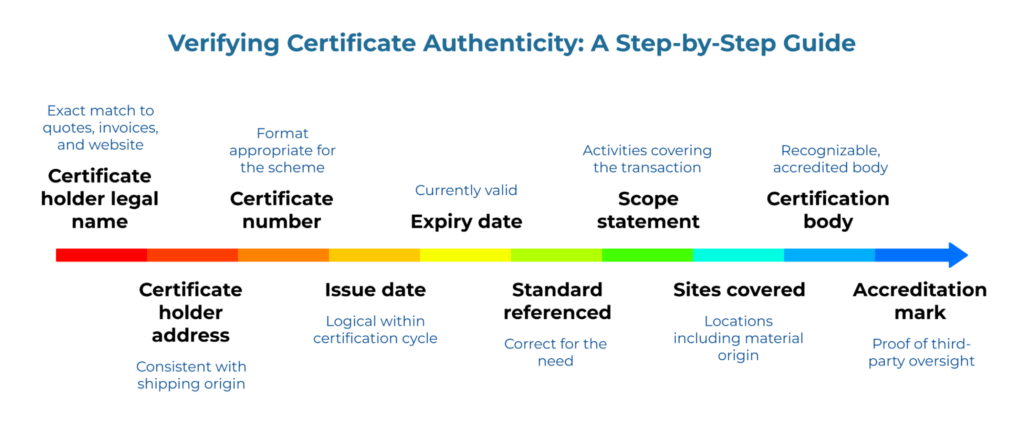
| Field | What to Verify |
| Certificate holder legal name | Exact match to quotes, invoices, and website |
| Certificate holder address | Consistent with shipping origin |
| Certificate number | Format appropriate for the scheme |
| Issue date | Logical within certification cycle |
| Expiry date | Currently valid |
| Standard referenced | Correct for the need |
| Scope statement | Activities covering the transaction |
| Sites covered | Locations including material origin |
| Certification body | Recognizable, accredited body |
| Accreditation mark | Proof of third-party oversight by a National Accreditation Body (e.g., ANAB, UKAS). This confirms the issuer has the technical competence to grant the specific certification |
When these fields align, the certificate passes the visual screen. When they do not, the registry cross-check becomes mandatory.
For sourcing managers working with kraft paper specifically, our certification verification guide for kraft paper manufacturers provides detailed checklists covering FSC, ISO, and food-contact certifications with product-specific verification criteria.
Annotated Certificate Gallery: What to Highlight
For visual learners, focus on six critical areas when examining a certificate:
- Holder name – Must match supplier’s legal entity exactly
- Certificate number – Should be consistent across all pages
- Dates/status – Issue and expiry dates must be clearly visible and current
- Scope statement – Activities should explicitly cover what you’re sourcing
- Sites/appendix reference – Any mentioned site lists must be provided
- Issuer details – Certification body name should match official listings
Each frame shows what “normal” looks like and what requires directory confirmation.
Red Flags That Should Trigger Stop-and-Verify
Legal entity mismatch. The certificate holder name differs from the company on quotes or purchase orders. The invoicing entity typically matches the certificate holder. If they differ—such as when a parent company holds the certification for a subsidiary—you must request a formal ‘Letter of Relationship’ or an updated appendix that explicitly links the invoicing legal entity to the certified scope.
Missing or vague scope statements. Legitimate certificates clearly state covered activities. Absent scope or generic language like “general operations” raises questions.
Expired dates or unclear status. Expired certificates still circulate. Certificates can also be suspended mid-cycle, which the PDF will not show.
Claims broader than scope indicates. A supplier claims “FSC Certified” but their scope covers only “trading,” not “manufacturing.” If they process materials, the claim does not hold. See Certificate scope explained: how to spot out-of-scope FSC/PEFC claims.
Missing issuer context. Legitimate certificates identify the certification body and reference their accreditation. Documents lacking these details deserve scrutiny.
Inconsistent numbers or formatting. Certificate codes that change across pages or formatting that appears altered (blurred edits, font inconsistencies) signal potential manipulation.
Referenced appendices not provided. When a certificate mentions a site list or scope appendix but the supplier doesn’t include it, the certificate’s coverage cannot be verified.
Note: Certificate verification is a critical defense against greenwashing claims. For industry-specific guidance on verifying FSC claims in packaging applications, see our greenwashing alert guide for paper bags.
The 5-Minute Registry Cross-Check (FSC, PEFC, ISO)
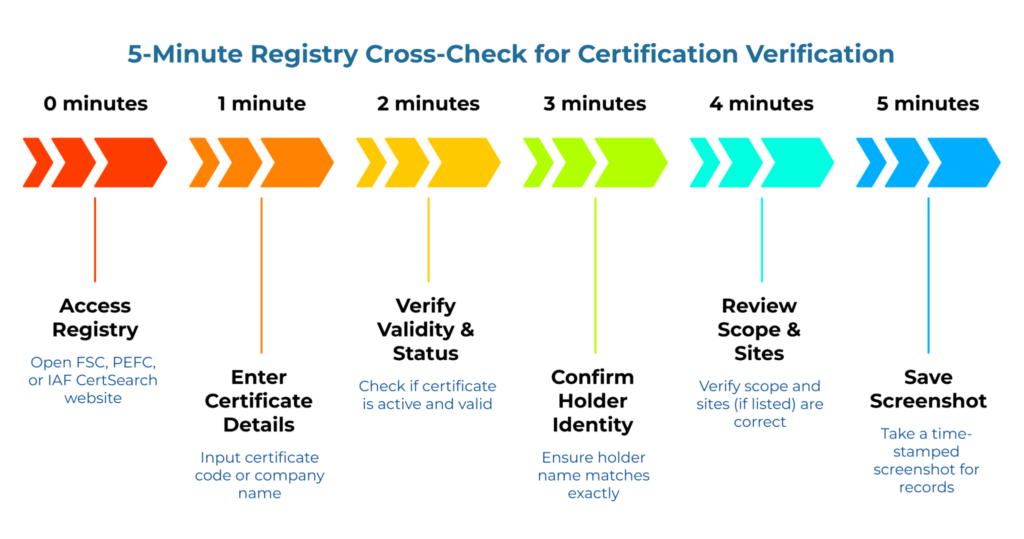
Visual inspection reveals whether a certificate looks legitimate. Registry verification reveals whether it actually is.
Verify four items: validity, current status, holder identity, and scope (and sites, if listed). Use these authoritative sources:
For FSC certificates: FSC Search accepts certificate codes. Verify holder name matches exactly, status shows “Active,” scope includes relevant activities, and sites include material origin.
For PEFC certificates: PEFC Find Certified allows searches by company name or certificate number. Confirm holder, status, scope, and sites.
For ISO certifications: Consult IAF CertSearch, the global database for accredited certifications. While it is the primary tool for international validation, note that participation by Certification Bodies (CBs) is not yet 100% universal; if a certificate is missing, you must manually verify it via the issuing CB’s own website or contact their office directly to confirm validity.
Save a time-stamped screenshot for your files. This creates a verification trail demonstrating due diligence. For detailed guidance, see How to run a quick registry check for FSC/PEFC certificates.
Decision Rule: Accept, Escalate, or Walk Away
- Accept when visual fields and registry align. Document verification and proceed.
- Escalate when registry confirms but minor inconsistencies exist. Request supplier clarification before proceeding.
- Walk away when the registry cannot confirm, scope does not cover the transaction, or entity details conflict. Legitimate suppliers expect verification questions and respond promptly.
Certificate verification is especially critical when working with international suppliers. For a comprehensive framework covering identity verification, capability assessment, and documentation requirements, explore our guide to verifying international suppliers without travel.
Once you’ve verified a supplier’s certifications, you can explore additional options through verified paper suppliers and paper manufacturers to build a resilient supply base.
Make It Repeatable: A Simple Intake Workflow
- Log the certificate with supplier name and date received
- Screen the 10 fields against supplier records
- Verify in the official registry
- Document the result with screenshot
- Decide to accept, escalate, or reject
- File evidence with supplier records
This verification workflow applies across all paper product categories. For product-specific guidance, see our detailed guides on verifying paper bag suppliers and kraft paper manufacturers. Assign ownership to procurement, quality, or compliance. Store evidence by supplier for audit readiness.
Build certification requirements directly into your sourcing process by incorporating verification checkpoints into your RFQ templates. When requesting quotes, you can submit RFQs that clearly specify required certifications and documentation formats, setting expectations before suppliers respond.
Frequently Asked Questions
What are common signs a supplier certificate is fake or altered?
Unexplained holder-name mismatches, inconsistent numbers, blurred edits around dates, missing appendices, and issuer details that do not match official listings. These signals indicate verification is required.
How do you verify an FSC or PEFC certificate number?
Search the certificate code or holder name in the FSC or PEFC directory, then confirm status and scope. Save a dated note or screenshot. For a comprehensive verification workflow including invoice documentation requirements, see our FSC/PEFC buyer workflow guide.
How can you validate an ISO certificate and accreditation?
Use IAF CertSearch where coverage exists and confirm holder and scope. If it is not listed, confirm through the certification body’s official directory or written confirmation.
Why can a real certificate still be wrong for your order (scope issues)?
A certificate can be genuine but not cover the relevant activity, claim type, or site. Applicability depends on scope and covered locations.
What should you ask a supplier if something looks off?
Ask for the certificate number, exact legal holder name, covered sites (including the appendix), and the directory reference. Request a short statement confirming the specific activity and site are within scope.
Visual screening plus registry verification. That two-lane approach separates confident procurement from hopeful guessing.
For deeper guidance on verification workflows, explore more guides in the PaperIndex Academy. When you’re ready to source from pre-verified suppliers with documented certifications, you can find suppliers on our B2B marketplace.
Disclaimer: This content is for informational purposes only.
Our Editorial Process:
Our expert team uses AI tools to help organize and structure our initial drafts. Every piece is then extensively rewritten, fact-checked, and enriched with first-hand insights and experiences by expert humans on our Insights Team to ensure accuracy and clarity.
About the PaperIndex Insights Team:
The PaperIndex Insights Team is our dedicated engine for synthesizing complex topics into clear, helpful guides. While our content is thoroughly reviewed for clarity and accuracy, it is for informational purposes and should not replace professional advice.