
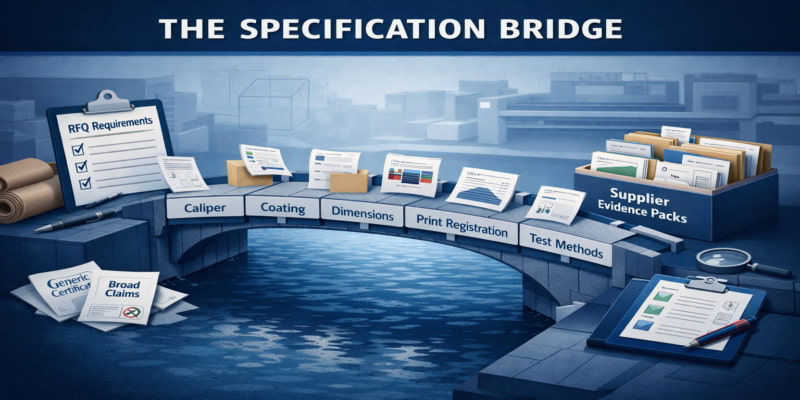
📌 Key Takeaways
Defining what proof you need before suppliers respond prevents false comparisons and wasted time.
- Define Proof Before Quotes Arrive: Lock your specification fields first—vague requests invite vague evidence that can’t be compared fairly.
- Link Evidence to Specific Requirements: Each document a supplier sends should answer a named field in your RFQ, not just prove they have paperwork.
- Separate Three Proof Types: Requirement-linked proof shows they can hit your specifications; capability-linked shows they can do it repeatedly; validation-linked shows they’re ready for the next step.
- Certificates Alone Don’t Qualify: A quality system certificate proves the supplier has a process—not that their process produces what you actually need.
- Price Comparison Comes Last: Only compare pricing between suppliers whose evidence packs demonstrate equal capability against your requirements.
Proof discipline turns supplier selection from persuasion into evidence.
Procurement managers and packaging engineers sourcing folding cartons will gain a clear framework for structuring RFQ evidence requests, preparing them for the detailed specification guidance that follows.
~ ~ ~ ~ ~ ~ ~ ~ ~ ~ ~ ~ ~ ~ ~ ~ ~ ~
RFQ-stage proof is the documented evidence a supplier provides alongside their quote to demonstrate they can meet your specific folding carton requirements.
The real danger at the RFQ stage is not missing files. It is allowing supplier claims to arrive before your team has defined what counts as acceptable proof—a problem that compounds when vendor-led data sheets shape your baseline instead of buyer-owned specifications.
When that happens, comparison becomes misleading. One supplier sends a general quality certificate. Another sends requirement-matched test results. Both appear qualified on paper, but the evidence behind each response answers different questions using different assumptions. The difference surfaces later, often after a purchase order is already in place.
When evidence and requirements are disconnected, qualification relies on persuasion rather than technical verification. When you design your proof requests before quotes arrive, technical evaluation and procurement review happen on the same factual basis.
Why RFQ-Stage Proof Matters Before Supplier Comparison Starts
You are not trying to collect documents in the abstract. You are trying to prevent false equivalence.
Supplier qualification becomes misleading when proof requests are vague or generic. If you haven’t specified what evidence you need, suppliers will interpret your silence as permission to send whatever they have on hand. Some will send more, some will send less, and none of it will line up for comparison. Quote comparability is already weakened before price, lead time, or commercial fit are even discussed.
Late proof definition creates this problem. Early proof discipline solves it. When every supplier responds to the same evidence requests tied to the same named requirement fields, your team can evaluate responses side by side without translating between different documentation formats and scopes. Early discipline creates calmer cross-functional review, reduces argument over interpretation, and makes controlled exceptions visible sooner.
Define Named Requirement Fields Before Inquiry
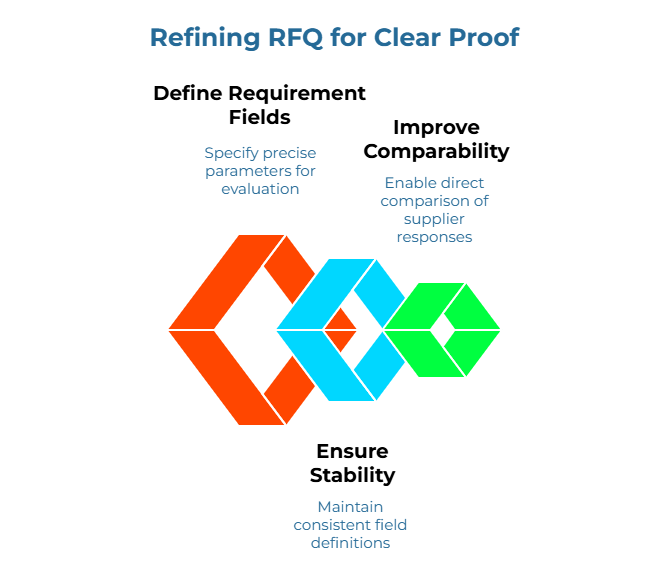
Proof only works when the requirement fields it answers are stable and named. A vague RFQ invites vague evidence.
A named requirement field is a specific, measurable parameter that appears in your baseline folding carton specification checklist. Examples include board calipers with tolerance bands, specific coating types, defined structural dimensions, and print registration limits. Each field should be precise enough that two suppliers reading it would interpret it the same way.
Broad folding carton language creates proof gaps. Asking for “high-quality board” or “food-safe coating” without defining the parameters leaves room for interpretation. The supplier sends what they consider proof of quality, which may not address the specific performance characteristics your product requires.
Requirement naming improves quote comparability. When your RFQ specifies a caliper within a stated range tested per a named test method, the supplier knows exactly what evidence to provide. Their response either matches that requirement or it doesn’t.
If your requirement fields aren’t locked yet, pause the RFQ. The proof request framework below assumes you already have a buyer-owned house specification in place. Without a house specification, the RFQ asks suppliers to validate performance against an undefined baseline.
Soliciting Requirement-Linked Proof
Requirement-linked proof answers your actual folding carton definition rather than broad supplier claims.
For material and structural requirements, request documentation that confirms the supplier can meet your stated parameters. If you’ve specified a caliper range, ask for recent production data or test certificates showing their output falls within that range. If you’ve defined a board grade, ask for evidence that traces back to the specific grade, not just a general product family. Understanding board-grade tolerances across suppliers helps illustrate why this specificity matters.
For tolerances, ask for test method-named results where applicable. A tolerance without a test method is difficult to verify. When you specify how the measurement should be taken, the supplier’s evidence becomes directly comparable to your acceptance criteria.
For print, finish, and fit-for-use expectations, request samples or production records that demonstrate the supplier has achieved similar results before. A capability claim is not the same as proof of delivery.
Make acceptance expectations explicit in your RFQ. State clearly what evidence format you need, which requirement field it should answer, and how recent the documentation should be. This prevents the supplier from substituting a generic certificate for requirement-specific documentation. The pattern here follows the same logic explained in why vendor-led data sheets create proof gaps.
Capability-Linked Proof Assessment
Capability-linked proof answers a different question: can the supplier repeatedly produce to the named requirement set?
Strategy: Request the minimum viable evidence set required to invalidate unsubstantiated claim.
Request evidence of consistent production rather than one-time results. This might include production run records across multiple batches, process control summaries, or quality system documentation showing how they monitor and maintain output within your specified parameters.
Generic declarations do not replace requirement-specific evidence. A supplier’s ISO certification confirms they have a quality management system. It doesn’t confirm their system produces the specific output you need. An FSC certificate confirms chain-of-custody participation—but as detailed in our guide on verifying green folding carton claims, it doesn’t confirm the board grade or structural characteristics you’ve specified.
Ask for evidence that helps procurement and engineering review the same facts. One team should not be reading a commercial assurance while another is trying to infer technical risk from an attachment that was never tied clearly to the RFQ fields. When the evidence pack includes both commercial documentation and technical documentation, both teams can evaluate the supplier without relying on separate information sources. This supports cross-functional alignment—as outlined in our framework for aligning sustainability directors and procurement managers—and reduces the disagreement that slows decisions.
Validation-Linked Proof Assessment
Validation-linked proof creates review readiness without forcing full approval too early.
Objective: Establish preliminary confidence in supplier readiness without triggering full-scale qualification protocols.
Request sample or trial proof that’s reasonable for the RFQ stage. Pre-production samples, trial run results, or reference samples from similar jobs all serve this purpose. These help your team assess readiness without requiring full production validation upfront.
Recency and version matching matter. A test certificate from two years ago may not reflect current production. A sample from a different board grade may not predict performance on your specific requirement set. Specify that evidence should reflect current capabilities and match the specific materials and specifications in your RFQ.
Review readiness is different from full approval. At the RFQ stage, you’re determining whether the supplier is worth advancing to the next stage. Evidence that supports this decision includes recent production records, relevant samples, and documentation that demonstrates the supplier understands your requirements and can respond to them specifically.
Detailed process audits, full production trials, and extended capability studies are deferred to post-shortlist qualification. These belong in deeper qualification after you’ve shortlisted based on RFQ-stage proof.
RFQ-Stage Proof Request Framework
Use this checklist to structure your proof requests before sending your next RFQ.
Requirement-Linked Proof
| What to Request | What Requirement It Answers | Why Ask at RFQ Stage | What It Does Not Prove Alone |
| Board caliper test results within your tolerance band | Material specification | Confirms supplier output matches your stated range | Does not prove consistency across production runs |
| Coating type confirmation with technical data | Functional performance requirements | Verifies the coating matches your barrier or finish needs | Does not prove application consistency |
| Structural dimension records for similar folding carton formats | Physical specification | Shows capability to produce your required format | Does not prove they can hit your exact dimensions |
| Print registration samples or records | Visual and brand requirements | Demonstrates print quality capability | Does not guarantee your specific artwork will match |
Capability-Linked Proof
| What to Request | What Requirement It Answers | Why Ask at RFQ Stage | What It Does Not Prove Alone |
| Production consistency records across batches | Repeatability | Shows the supplier can maintain output, not just hit it once | Does not prove they can maintain it on your specific job |
| Quality system documentation relevant to your requirements | Process control | Confirms they have a system to monitor output | Does not prove the system is effective for your parameters |
| Reference list for similar requirement sets | Experience relevance | Indicates relevant production history | Does not guarantee performance on your job |
Validation-Linked Proof
| What to Request | What Requirement It Answers | Why Ask at RFQ Stage | What It Does Not Prove Alone |
| Pre-production or reference samples | Fit-for-use assessment | Allows early physical review | Does not replace production-run validation |
| Recent test certificates within defined recency window | Current capability | Confirms evidence reflects current production | Does not prove future consistency |
| Documentation of similar successful trials | Readiness indicator | Supports advancement decision | Does not guarantee your trial will succeed |
Quick Reference Bullets
- Name the RFQ fields before requesting evidence.
- Ask suppliers to map each attachment to a specific requirement field.
- State what counts as acceptable proof for each field.
- Separate requirement-linked, capability-linked, and validation-linked proof.
- Require version matching across quotation, drawing, and supporting files.
- Ask suppliers to state controlled exceptions openly.
This checklist works as a stand-alone reference. It also supports cross-SKU material standardization by ensuring proof requests remain consistent across product families.
What Not to Mistake for Qualification
Generic certificates alone still leave major proof gaps.
A quality management certificate confirms the supplier has a system. It doesn’t confirm the system produces what you need—a distinction explored further in auditing the lifecycle ecosystem of sustainable folding cartons. A food-safety certification confirms compliance with a regulatory framework. It doesn’t confirm the specific migration performance or barrier characteristics your product requires.
Document presence is not the same as requirement proof. Receiving a thick folder of certifications can feel reassuring. But if none of those documents directly answer your named requirement fields, you haven’t qualified the supplier. You’ve confirmed they have paperwork.
Price comparison should not lead to qualification. The temptation is to shortlist based on price and then verify proof later. This approach reverses the logic. Evidence-based qualification determines shortlist eligibility. Price comparison only makes sense between suppliers whose evidence packs demonstrate equivalent capability against your requirements.
What Comes Next After RFQ-Stage Proof Design
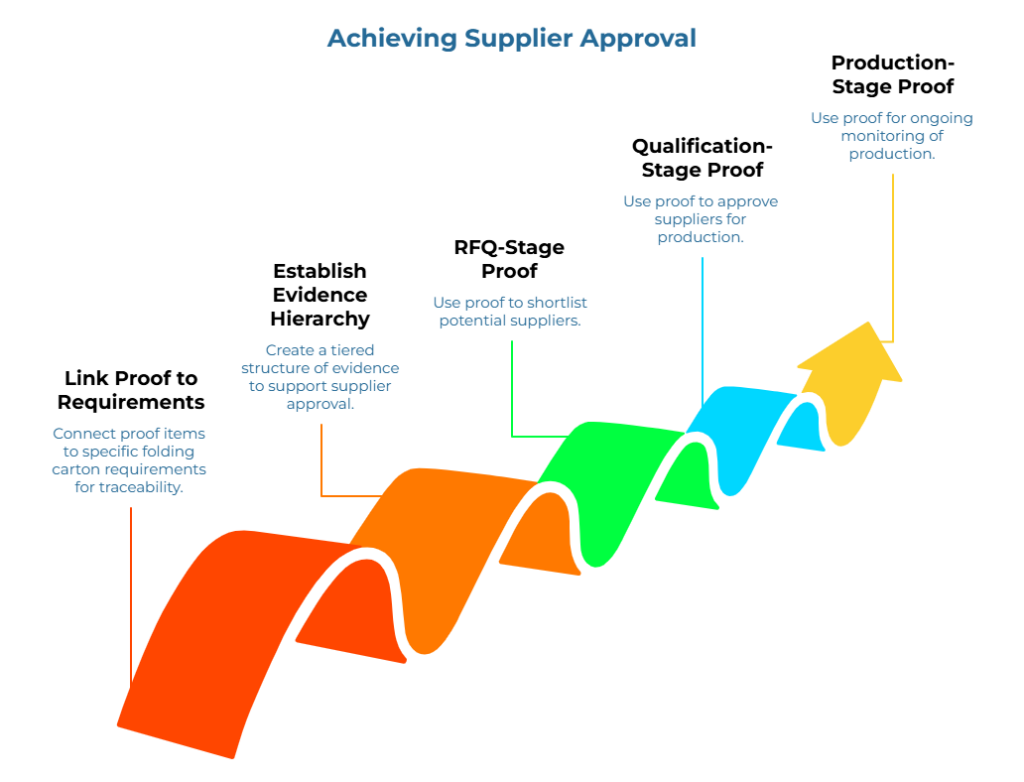
Once your proof requests are named and categorized, two natural next steps follow.
First, link each proof item back to specific folding carton requirements. This creates traceability between your specification and the evidence you receive. When a supplier’s response arrives, you can map each document to the requirement field it’s meant to answer. Gaps become visible immediately.
Second, establish a tiered evidence hierarchy that scales through the qualification lifecycle. RFQ-stage proof supports shortlisting. Qualification-stage proof supports supplier approval. Production-stage proof supports ongoing monitoring. Each stage requires progressively deeper evidence, but the structure established at RFQ stage carries through.
Where regulated use, food-contact expectations, or chain-of-custody claims are relevant to a specific folding carton program, official reference points may also help shape what supporting evidence should be requested. These include the FDA’s packaging and food-contact materials guidance, the European Commission’s food-contact materials guidance, the FSC chain-of-custody overview, and ISO’s paper and board standards resources.
When you’re ready to connect with verified folding carton suppliers, having your proof request framework in place ensures you start the conversation on stable ground. You can also explore folding cartons to review category options before finalizing your RFQ.
Disclaimer:
This article is for educational purposes only.
Our Editorial Process:
Our expert team uses AI tools to help organize and structure our initial drafts. Every piece is then extensively rewritten, fact-checked, and enriched with first-hand insights and experiences by expert humans on our Insights Team to ensure accuracy and clarity.
About the PaperIndex Insights Team:
The PaperIndex Insights Team is our dedicated engine for synthesizing complex topics into clear, helpful guides. While our content is thoroughly reviewed for clarity and accuracy, it is for informational purposes and should not replace professional advice.