

📌 Key Takeaways
Certifications prove a supplier joined a system—they don’t prove the supplier can survive a full lifecycle audit.
- Badges Aren’t Audits: A valid certificate shows participation in traceability, not that mills, coatings, or paperwork are actually under control.
- Audit in Lanes: Break supplier reviews into clear tracks—material origin, process controls, documentation flow, and end-of-life outcomes in each market.
- Test Document Survival: Claims that appear in marketing but vanish from purchase orders and invoices signal weak discipline that auditors will catch.
- Recyclability Needs Proof by Market: “Recyclable” means nothing without evidence showing the folding carton meets recovery rules in each destination country.
- Approval Starts the Work: Once you approve a supplier, schedule certificate renewals, quarterly spot-checks, and change-notification rules to keep compliance current.
A certificate proves participation—a lifecycle audit proves readiness for scrutiny.
Procurement leaders and sustainability directors sourcing folding cartons for strict EPR markets will gain a concrete audit framework here, preparing them for the detailed verification workflow that follows.
~ ~ ~ ~ ~ ~ ~ ~ ~ ~ ~ ~ ~ ~ ~ ~ ~ ~
A supplier shortlist often looks settled right before it becomes risky.
The certificate file is clean. The sustainability language sounds familiar. Internal stakeholders are ready to move. Yet none of that fully answers the real question facing a buying committee: can this supplier withstand lifecycle scrutiny once the folding carton moves from sourcing claim to production reality, shipment documentation, and post-consumer outcomes?
Basic material certifications like FSC are foundational, not comprehensive.
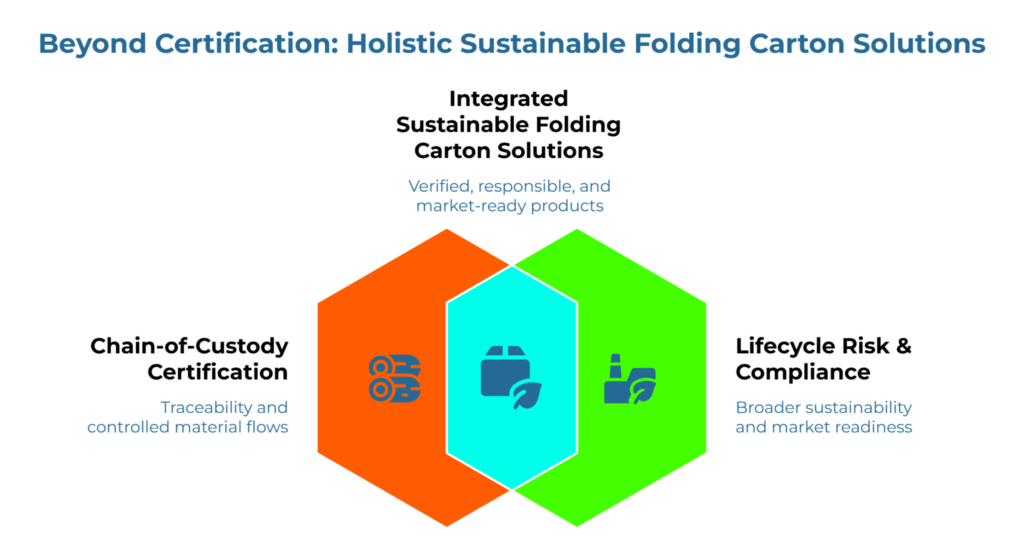
That distinction matters because chain-of-custody credentials are designed to support traceability. They help show that claimed material flows are being controlled through the supply chain. But they do not, by themselves, prove that every broader lifecycle risk has been addressed, nor do they guarantee that a finished folding carton is ready for market-specific recovery expectations, conversion controls, or documentation continuity. FSC describes chain of custody as a system for tracking certified material through the supply chain, and PEFC similarly frames chain of custody around traceability with ongoing surveillance and recertification requirements. Those are important controls. They are not the entire audit.
That is why sustainable folding carton solutions should be treated as a methodology problem, not a badge-collection exercise. For procurement leaders, the safer framing is not “Which certification is best?” It is “What must be audited after the certification box has been checked?” That shift turns the conversation from passive reassurance into active supplier validation.
Why certifications alone stop short
A certification can confirm one important layer of discipline. It can support a claim that fiber inputs or forest-based material streams are being tracked within a recognized system. That is useful, and for many sourcing programs it is non-negotiable.What it does not automatically prove is just as important. It does not prove that mill process controls are stable, that coatings and adhesives align with your sustainable sourcing requirements, that documentation will remain consistent from quote to invoice, or that the folding carton’s recyclability story holds up in the destination market. In practical terms, a certified supplier is not the same as an audit-ready supplier—which is why procurement teams benefit from platforms that enable rigorous supplier discovery beyond surface-level credentials.
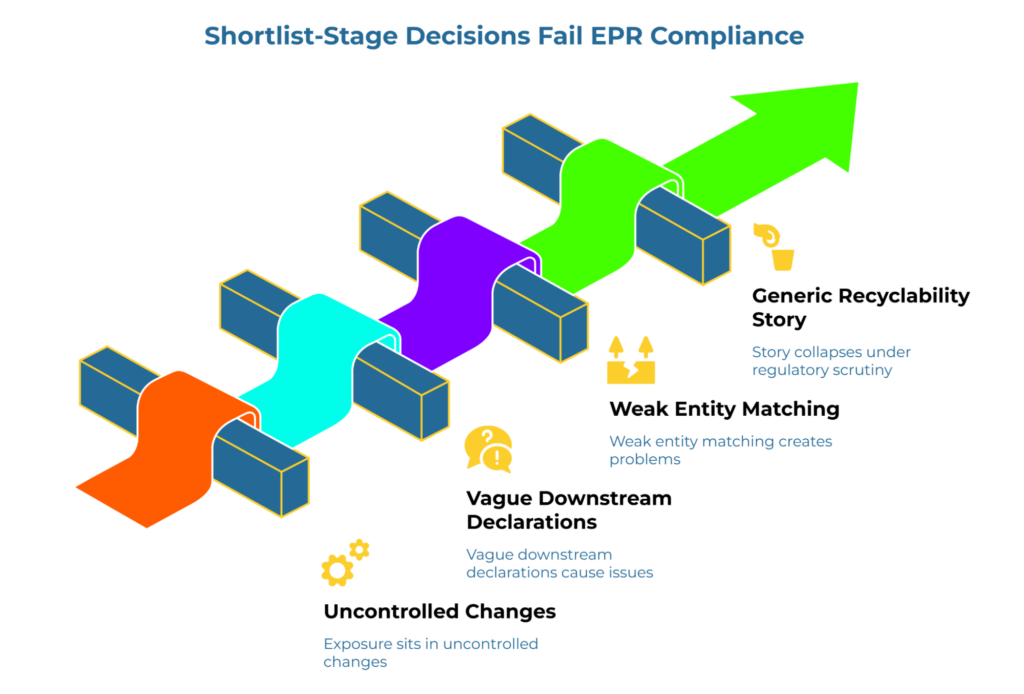
This is where shortlist-stage decisions fail. Teams relax once the logo check is complete, while the real exposure sits in uncontrolled changes, vague downstream declarations, weak entity matching, or a generic recyclability story that collapses under real regulatory scrutiny. The EU Packaging and Packaging Waste Regulation and broader Extended Producer Responsibility frameworks typically place responsibility on the designated ‘producer’—which generally encompasses brand owners, importers, or manufacturers depending on the specific market—for outcomes extending throughout the post-consumer stage, including collection and recycling. Generic claims like “eco-friendly” may appear sufficient early on, but once products enter strict EPR markets, those claims fail legal scrutiny. As the OECD explains, Extended Producer Responsibility is a lifecycle-oriented policy approach that extends responsibility into the post-consumer stage, and the European Commission’s packaging rules increasingly focus on packaging design, waste reduction, reuse, and recyclability outcomes rather than surface-level sustainability language alone.
Define the lifecycle ecosystem you are actually auditing
A lifecycle ecosystem audit becomes manageable once it is broken into lanes.
For sustainable folding cartons, those lanes usually include raw material origin, certificate continuity, mill inputs and process controls, energy or process profile, conversion discipline, governance of inks, coatings, and adhesives, documentation continuity from quote to invoice, and end-of-life fit in the markets where the folding carton will circulate. In general, that is the level of structure required to move from initial supplier screening to robust procurement standards.
This is also where buyer-owned controls become essential. A supplier may present polished data sheets, but the buyer still needs an internal standard for what must be evidenced, matched, and retained. Specification drift can compromise certified material claims just as easily as outright substitution. That is why it helps to connect this audit with earlier specification work such as the baseline packaging parameter checklist, the danger of vendor-led data sheets, board grade tolerances explained, and cross-SKU material standardization.
The first 48 hours: how to start the audit on a new supplier
The first two days should reduce anxiety, not increase it.
Start by requesting the minimum evidence pack. In most cases, that means the current certificate, certifying body details, legal entity name, production site, product scope, board specification, coating or adhesive declaration, and a sample set of commercial documents that show how claims are carried through quoting and invoicing. Exact document lists may vary by folding carton design, destination market, and internal policy, but the principle is stable: verify audit trails rather than marketing claims.
Then run the first-pass checks. Match the certificate holder against the selling entity. Confirm that the producing site is actually in scope. Confirm that the product type aligns with the claim being made. Separate marketing language from auditable controls. At that point, a practical buying committee decision becomes possible: advance the supplier, pause for additional proof, or stop the process.
A step-by-step lifecycle audit workflow for folding carton suppliers
Use the following as an advanced lifecycle audit framework:
1. Verify material and certificate integrity. Confirm certificate validity, scope, entity match, site coverage, and the exact material claim being made. This is also the point to test whether the claim can survive documentation across the commercial chain. Helpful supporting guidance already exists in the article: stop treating FSC/PEFC as a badge: a buyer workflow to verify paper claims.
2. Audit process and manufacturing controls. Move upstream from the certificate. Ask how the mill or converter controls changeovers, segregates materials where required, approves chemistry changes, and records deviations. A supplier that can explain labeling but not operating control is still high risk.
3. Test specification fidelity and documentation continuity. Match the sustainability narrative to the actual folding carton specification. Board grade, caliper range, test methods, coatings, print treatments, and tolerance controls should not be left to supplier interpretation. This is where procurement leaders protect both brand risk and automated procurement processes from silent drift.
4. Evaluate end-of-life compatibility by market. Do not accept “recyclable” as a universal conclusion. Recovery outcomes depend on folding carton construction, coatings, contamination profile, and local waste-management conditions. Verify that a documented recovery pathway exists for each destination market. In markets with stricter EPR compliance expectations, recyclability stories lacking market-specific proof fail to protect against enforcement action.
5. Define change triggers and ongoing monitoring. Approval is not the end of the audit. It is the beginning of controlled trust. Set revalidation triggers for site changes, board substitutions, chemistry changes, revised claim language, and new market entry. For sustainability directors, this is where carbon footprint reduction goals and compliance controls stop competing and start operating inside one review framework.
Advanced lifecycle audit checklist
Use this checklist to structure supplier evaluation before finalizing procurement decisions.
| Audit Stage | Verification Points |
| Material & Certificate | ☐ Certificate current in registry |
| ☐ Scope covers product and site | |
| ☐ Entity names match | |
| Process Controls | ☐ QMS documented |
| ☐ Environmental certifications verified | |
| ☐ Controls auditable | |
| Documentation | ☐ Specifications consistent quote-to-invoice |
| ☐ Claims appear on transactional documents | |
| ☐ Traceability evidence available | |
| End-of-Life | ☐ Market-specific recyclability verified |
| ☐ Coatings compliant | |
| ☐ Recovery pathway documented | |
| Ongoing Monitoring | ☐ Change triggers defined |
| ☐ Re-verification scheduled | |
| ☐ Escalation path established |
Red flags that should pause or disqualify the supplier
Some failures are too serious to smooth over. A scope mismatch between the certificate and the actual product or site is a hard stop. So is claim discontinuity between the quotation, purchase order, and invoice. Unclear site ownership, generic “green” language with no market-specific proof, and the absence of change-control evidence all signal that the supplier may be selling confidence rather than control.
Another warning sign is when answers stay at badge level but never reach system level. If every response returns to the certification logo without addressing process discipline, material governance, Incoterms application, or document survival, the audit has not reached the depth required for defensible sourcing.
How to turn findings into a vendor decision
Approve when the supplier demonstrates continuity across material origin, scope, production controls, specification discipline, documentation, and end-of-life fit.
Approve with conditions when the system is mostly credible but still needs specific proof, such as market-specific recovery support, tighter claim wording, or documented change-control rules. Set a documented re-verification date to close the gap within a defined timeline.
Reject when the supplier depends on generic sustainability language, cannot resolve scope gaps, or fails to show that claims can survive real operational scrutiny.
Once approved, establish initial compliance checkpoints: certificate renewal dates, quarterly documentation spot-checks, and escalation paths for change notifications. These routines transform approval from a one-time gate into ongoing assurance.
The shift from badge-checking to systems-checking is mandatory for organizations operating in jurisdictions with rigorous EPR compliance requirements. A certificate proves participation. A lifecycle audit proves readiness for scrutiny.
For readers ready to move from methodology to action, explore folding cartons, review folding carton suppliers, or visit the PaperIndex Academy for deeper audit-oriented guidance.
Disclaimer:
This article is for informational and operational planning purposes only. It does not constitute legal advice, certification advice, or jurisdiction-specific regulatory counsel.
Our Editorial Process:
Our expert team uses AI tools to help organize and structure our initial drafts. Every piece is then extensively rewritten, fact-checked, and enriched with first-hand insights and experiences by expert humans on our Insights Team to ensure accuracy and clarity.
About the PaperIndex Insights Team:
The PaperIndex Insights Team is our dedicated engine for synthesizing complex topics into clear, helpful guides. While our content is thoroughly reviewed for clarity and accuracy, it is for informational purposes and should not replace professional advice.