

📌 Key Takeaways
AI helps paper buyers organize scattered data — but the actual buying decision still needs human judgment.
- Organize, Don’t Predict: AI can sort your quote history, flag deadlines, and track inventory — but it cannot reliably forecast where paper prices are heading.
- Log Decisions Before You Make Them: Writing down what you know, what you decided, and why turns a stressful call into a reviewable, defensible record.
- Watch Multiple Clocks: Quote deadlines, budget approvals, warehouse levels, and supplier lead times rarely line up — tracking them together prevents reactive buying.
- Price Alone Misleads: A lower quote may just reflect different delivery terms, payment terms, or order sizes — always compare the full picture before comparing the number.
- Start Small, Build the Habit: Review your last three purchases, note the gaps, and add one new input each cycle — discipline beats complexity.
Document the reasoning, review the outcomes, and the next decision gets sharper.
Procurement managers juggling supplier quotes, inventory risk, and internal approvals will gain a repeatable decision-making structure here, preparing them for the detailed overview that follows.
~ ~ ~ ~ ~ ~ ~ ~ ~ ~ ~ ~ ~ ~ ~ ~ ~ ~
The clock is ticking.
Finance hasn’t approved the budget request. The warehouse count from last Thursday may already be stale. A spreadsheet of scattered historical pricing data sits across three tabs and an email thread no one has consolidated. Do we buy now, or do we wait?
That question carries real cost when the answer is reactive instead of deliberate. A procurement manager who buys impulsively after a single price movement risks tying up capital in unnecessary inventory—a dynamic explored in depth in Is “Inventory Overload” the silent killer of your working capital?. One who waits too long may face a stockout that forces emergency purchasing at a premium. Either way, when a stakeholder asks three months later why that decision was made, the absence of documented reasoning makes the answer harder to defend.
Paper procurement timing sits at the intersection of price volatility, supplier availability, internal approval cycles, and inventory risk — and AI will not resolve that intersection for you. It cannot tell you when to buy, and it should not be trusted to predict where prices are heading. What AI can do is help organize the signals you already track — quote history, validity deadlines, reorder triggers, inventory levels — so the decision you make is more structured and easier to defend.
What Makes Paper Procurement Timing So Difficult
A procurement manager evaluating a supplier quote faces a specific kind of uncertainty: the information needed to make the call exists, but it is incomplete and decaying at the same time.
Consider a common scenario. A buyer receives a quote for a paper grade the business needs, valid for a short window. But the demand forecast is still being finalized by operations and budget approval is in a queue. By the time both inputs align, the quote may have expired or the supplier’s allocation may have shifted. This is not a failure of judgment — it is a coordination problem that responds well to better information structure, not better guesses.
Fragmented visibility often obscures the true shelf-life of a quote. While finance reviews a budget, supplier availability may fluctuate, yet the historical pricing context required to validate the offer remains trapped in siloed spreadsheets or email archives. Pulling it together during an active buying window — the period when conditions align for a purchase to make sense — takes effort most teams don’t have.
Inventory decisions compound the pressure. Buying too early ties up capital. Buying too late risks supply gaps. And internal stakeholders — operations wanting continuity, finance wanting budget predictability — may each define “too early” and “too late” differently.
Several clocks run at once, and they rarely synchronize. The supplier has a quote-validity window. The warehouse has an inventory clock. Operations manages usage schedules, while finance operates on rigid approval cycles. The supplier relationship owner may also hold context that never appears in the price column — whether a supplier has been reliable during tight availability periods, for instance, or whether a verbal commitment about lead times should be factored in.
When those clocks do not line up, the buyer carries the pressure. And that is where many teams drift into reactive buying. One supplier update gets too much weight. One old purchase price becomes the benchmark. One internal stakeholder pushes for speed while another pushes for restraint. The buyer is left to reconcile the decision after the fact. A decision log prevents that drift — but the terminology needs to be clear first.
Standardizing Timing Parameters
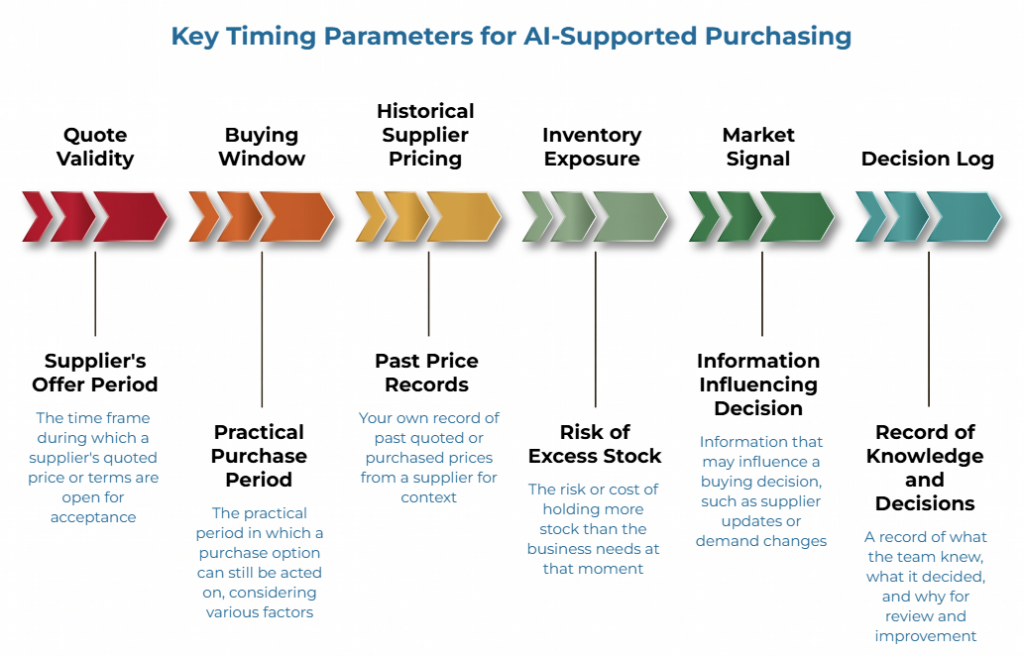
Vague inputs produce vague outputs. Before using AI to support timing decisions, the team must establish shared definitions for the inputs that matter most.
Quote validity is the period during which a supplier’s quoted price or terms remain open for acceptance. The exact period varies by supplier, product, market conditions, and agreement terms, so it should be recorded from the quote itself rather than assumed.
A buying window is the practical period in which a purchase option can still be acted on. It encompasses quote validity, approval timing, stock position, expected usage, and supplier availability. A buying window is narrower than it appears — it closes when any one of those inputs falls out of alignment.
Historical supplier pricing means your own record of past quoted or purchased prices from a supplier. It gives context to a current quote — whether today’s offer sits above, below, or within the range of previous offers — but it does not prove what the next quote will be.
Inventory exposure is the risk or cost of holding more stock than the business needs at that moment. It can involve cash tied up in inventory, storage limits, handling risk, and the chance that needs change before the stock is used.
A market signal is information that may influence a buying decision. It could come from a supplier update, freight note, demand change, public industry source, or internal forecast. A signal is not a conclusion by itself — it is one input among several.
A decision log is a record of what the team knew, what it decided, and why. It is not paperwork for its own sake. It is a tool that makes timing decisions easier to explain, review, and improve over successive purchasing cycles.
Where AI Can Support Better Buying-Timing Decisions
AI’s usefulness in paper procurement timing is not about prediction — it is about organization. The signals that inform a timing decision already exist in most operations; they are just scattered and hard to evaluate quickly.
For a broader AI governance context, the NIST AI Risk Management Framework (AI RMF 1.0) provides a flexible basis for managing AI risks—such as bias and lack of transparency—in ways that fit an organization’s goals and priorities. Simultaneously, the OECD AI Principles, which were updated in May 2024 to address generative AI challenges, continue to focus on promoting trustworthy, human-centered AI that respects human rights and democratic values. In procurement, that translates into a simple rule: use AI to support review, not to remove accountability.
Tracking Supplier Quote Changes Over Time
When quotes arrive by email, phone, or portal across weeks and months, evaluating them side by side is slow work. AI can help consolidate quote data into a structured format — supplier, grade, price, date, validity — so patterns become visible. That structured view shows what a supplier has offered before and whether today’s quote sits above, below, or within that range. Historical supplier pricing adds context no single offer provides. It is a reference point, not a forecast.
Before making any timing comparison, though, the underlying data needs to be comparable. A quote can look better simply because the product specification, order quantity, delivery term, payment term, lead-time assumption, or validity date differs. Normalizing these fields before evaluating price is the step most teams skip — and the one that prevents false comparisons from driving premature decisions. For a detailed walkthrough, see how to standardize paper supplier quotes before using AI to compare them.
Here is a practical sequence to follow before making any timing decision:
- Confirm the paper category, grade, specification, and intended use.
- Record the supplier quote date and validity date.
- Normalize delivery terms, payment terms, and order quantity where relevant.
- Add supplier availability and lead-time notes.
- Compare the current quote with historical supplier pricing.
- Check current inventory and expected usage.
- Record the decision, reasoning, and follow-up date.
This method does not make volatility disappear. It makes the timing decision more defensible. The most important step is often the least dramatic one: write down why the team acted. If the decision is challenged later, the record shows what was known at the time.
Flagging Quote Validity Deadlines
A quote expiring in 72 hours creates a different decision dynamic than one that holds for two weeks. AI can flag approaching deadlines across open quotes, preventing the common mistake of letting a reasonable offer lapse because no one tracked the clock. Quote validity should be treated as a timing input, not an administrative detail — a quote that expires before internal approval is complete is not a usable buying option.
Surfacing Reorder Timing and Inventory Exposure
If a system tracks current inventory, consumption rates, and supplier lead times, AI can surface reorder signals before a stockout becomes urgent. Inventory exposure — the degree to which cash and operational continuity are at risk based on current stock levels — shifts with every buying decision. The goal is not to automate the purchase but to ensure the buyer sees the signal early enough to evaluate options calmly. The connection between inventory planning and procurement timing is direct: late visibility creates late decisions.
Procurement timing usually comes down to two competing risks. Waiting may preserve cash and avoid unnecessary inventory — but it may also increase stockout risk, expose the business to a lost quote window, or force a rushed purchase later. Buying early may protect production continuity — but it may also increase inventory exposure, consume working capital, and create storage pressure. Neither choice is automatically right.
Four questions sharpen this tradeoff before the decision is made:
- What happens if the quote expires before approval?
- What happens if usage increases before the next buying cycle?
- What happens if the supplier cannot maintain availability?
- What happens if buying now creates more inventory than the business can comfortably carry?
Finance, Operations, and Procurement may answer these questions differently. That is normal. The buyer’s job is not to make every stakeholder see the same risk — it is to make the tradeoff visible before the decision is made. AI-supported summaries can prepare a cleaner internal review, but the business still chooses the risk it is willing to carry.
Synthesizing Market Intelligence
Price indices, freight rate movements, regional supply disruptions, seasonal demand shifts — these signals exist in different places and formats. AI can aggregate and timestamp them into a single reference layer. While AI aggregates disparate signals, it remains a tool for organization rather than a hedge against market volatility.
Building and Maintaining a Decision Log
This is where AI moves from operationally helpful to genuinely important. A decision log records the reasoning behind each purchasing decision: what the quote was, what alternatives existed, what the inventory position looked like, and what the buyer decided — and why.
Use the log before the decision, not after it. If the log is filled out later, it becomes a justification tool. If it is filled out during the decision, it becomes a thinking tool.
Over time, that log becomes a review tool. You can check whether assumptions about availability held up, see whether waiting cost more or paid off, and show stakeholders exactly why a decision was made — turning decision fatigue into documented discipline. That documentation builds organizational memory that improves the next decision.
Managing Internal Escalations
Not every quote change deserves escalation. Escalate when the timing risk can affect cost control, supply continuity, or internal accountability.
A buyer should raise the decision when quote validity may expire before approval, when inventory is approaching a reorder trigger, when supplier availability changes, or when Finance and Operations are pulling in different directions. Escalation is also warranted when the decision would create unusual inventory exposure — if buying early would tie up more stock than normal, Finance should see the reasoning before the order is placed. If waiting could create stockout risk, Operations should confirm the acceptable level of exposure.
This is not about slowing the process. It is about preventing silent risk transfer. A buyer should not carry a cross-functional timing decision alone when the consequences belong to several teams.
What AI Cannot Decide for Paper Buyers
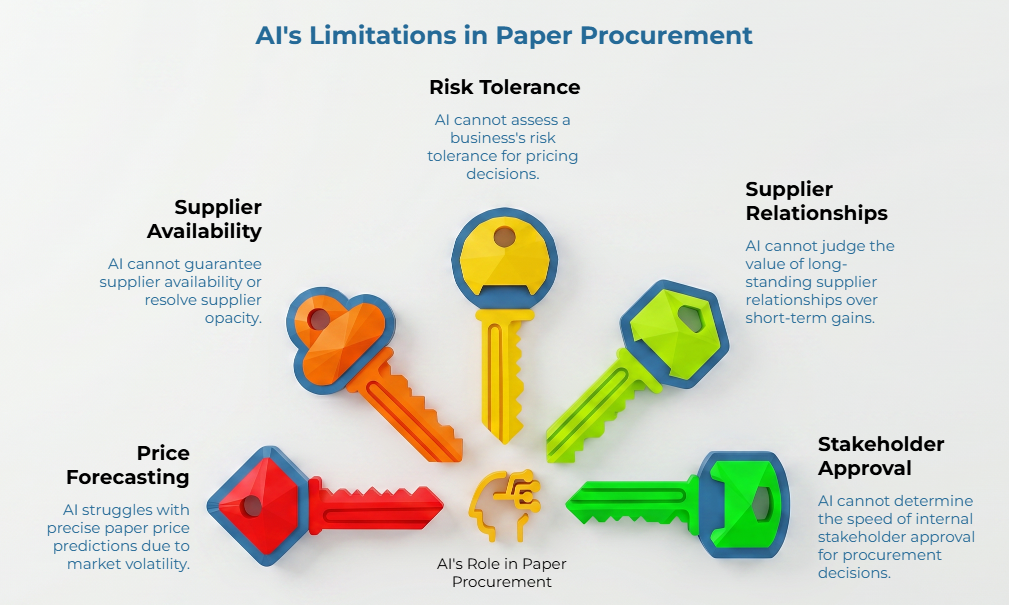
The line between “AI can support” and “AI should decide” is where most procurement technology content loses credibility.
Current predictive models typically struggle to provide a guaranteed, ‘single-point’ forecast for paper prices due to the extreme volatility of upstream costs. While advanced machine learning can analyze historical pricing to generate probabilistic ranges or ‘most likely’ scenarios, these should be treated as estimates rather than certainties. Global paper markets remain highly susceptible to unpredictable shifts in pulp supply, energy surcharges, and regional logistics disruptions that no model can fully account for in real-time. Markets respond to geopolitical events, raw material shifts, energy costs, and logistics disruptions that no model can reliably anticipate within a specific buying window.
AI cannot tell you whether a supplier will maintain availability. Supplier opacity — the gap between what a supplier claims and what they can actually deliver — is a relationship-level risk that structured data alone does not resolve. A phone call revealing a production delay sometimes carries more weight than a dashboard of historical fill rates.
AI cannot weigh your business’s risk tolerance. Whether to lock in a price now or wait depends on inventory coverage, cash flow, supplier terms, and how much uncertainty the operation can absorb.
AI cannot judge whether a long-standing supplier relationship should be disrupted for a short-term price advantage. Procurement teams managing single-source dependencies already know the cheapest quote and the soundest decision are rarely the same.
And AI cannot determine whether internal stakeholders will approve quickly enough to act on a window that is closing. That is an organizational workflow question, not a data question.
| AI Can Support | AI Should Not Decide Alone |
| Organizing supplier quote history | The exact future price of paper |
| Flagging quote-validity deadlines | Whether to buy solely based on a forecast |
| Reviewing historical supplier pricing | Supplier relationship tradeoffs |
| Tracking reorder signals and inventory exposure | Business risk tolerance and capital allocation |
| Logging decision rationale and reasoning | Final purchasing approval |
AI insights should be used as decision support, not as a substitute for supplier communication, inventory planning, budget constraints, and procurement judgment.
A Practical Method for AI-Supported Buying Timing
The most actionable output here is a structure, not a concept. The Paper Procurement Timing Decision Log gives procurement teams a repeatable format for capturing the inputs that matter each time a buying-timing call comes up. A shared spreadsheet works. The discipline is in the habit: fill in the row before deciding, and revisit it after the outcome is known.
| Field | Why It Matters |
| Date of decision | Shows what information was available at the time |
| Product or category | Keeps the decision tied to a specific paper grade, product, or use case |
| Supplier quote, grade, and date | Establishes the current buying option |
| Quote validity deadline | Prevents missed windows |
| Historical supplier price reference | Adds context — is today’s offer high, low, or typical for this supplier? |
| Current inventory level | Shows stockout or overstock risk at the moment of the decision |
| Expected usage or reorder trigger | Connects timing to actual demand, not assumptions |
| Availability or lead-time note | Captures supply-side risk the data cannot see alone |
| Market signal observed | Records external context (price index shift, supply disruption, seasonal pattern) |
| Decision made | Documents action: buy, wait, request re-quote, split order, escalate, or monitor |
| Reasoning | The specific logic behind the decision — in plain language |
| Follow-up date | When to revisit whether the reasoning held up |
| Outcome review | Helps the team improve future timing decisions |
Use this log to review your next paper procurement decision more consistently. It does not require a complex system. It requires the team to stop relying on memory when the decision pressure is high.
Over three to four purchasing cycles, something valuable emerges: not what the market did, but how well your assumptions held up. A team that reviews prior timing decisions develops a sharper sense of which signals actually matter — and which ones generated noise. That feedback loop is the foundation of procurement discipline.
Common Mistakes When Using AI for Procurement Timing
Before relying on any AI-supported output for a timing decision, check these five points:
- AI output is decision support, not a purchase order.
- Stale supplier data produces misleading signals — verify inputs are current.
- A lapsed quote is a missed window, not a data point — track validity deadlines.
- Price is one factor; availability, lead time, and supplier reliability deserve equal weight.
- An undocumented decision cannot be reviewed, improved, or defended — log the reasoning.
Beyond these, subtler errors deserve attention. Overbuying to avoid uncertainty is common — the instinct to purchase more than needed when prices seem volatile. That locks up capital and shifts risk from price exposure to inventory exposure, a trade that often costs more than it saves — a pattern unpacked in the ‘inventory trap’: why buying mill direct is bankrupting small paper converters.
Another frequent misstep: treating structured data as the full picture. AI can organize what is in the system, but it cannot capture a supplier’s verbal commitment about a production delay, a relationship dynamic affecting allocation priority, or a lead-time shift communicated informally. The best procurement decisions combine structured data with intelligence from verifying supplier capability directly.
Treating historical pricing as a forecast is a related trap. Historical supplier pricing gives useful context — it does not tell you what the next price will be. And comparing price without comparing terms leads to false conclusions. A quote can look better because the delivery term, payment term, or order quantity differs, not because the supplier is actually offering a better deal — a trap examined in why paper RFQs are hard to compare manually and where AI can help first.
Ignoring supplier conversations altogether — treating the dashboard as the sole source of truth — compounds these errors over time. Data tells you what happened. Conversations tell you what is about to happen. Treating any single AI output as a recommendation, rather than as one input among several, erodes the judgment the tool is supposed to support.
How to Start Without Overcomplicating the Process
Most procurement teams already have the raw material for better timing decisions — it just hasn’t been structured yet.
Pick three recent paper purchases. Pull the quotes, the dates, and whatever inventory data existed at the time. Write down what was decided and why. That is the decision log — retroactively. This initial audit quickly highlights the informational gaps that existed when those calls were made.
Once those three entries expose the gaps, expand the scope. Conduct a structured audit of 15 to 20 past timing decisions, capturing verifiable fields such as Quote-to-Order Lead Time and Price Variance from Baseline. If specific internal data points are missing, leave them blank to highlight systemic gaps in your reporting. This audit typically reveals whether volatility is being driven by external market shifts or internal approval bottlenecks. If quote-validity dates are often missing, fix the RFQ or supplier-response process. If historical supplier pricing is hard to find, create a standard reference field. If lead-time notes are informal, start recording them in the decision log. Small cleanup beats a large unfinished data project.
From there, track quote validity on the next buying cycle. See whether any offers lapsed because no one was watching the clock. Then layer in one more input: review the current offer against what the same supplier quoted six months ago.
Each layer adds context without adding complexity. The goal is not to build a model but to build a routine that makes the next buying decision more deliberate than the last. Teams that already use spreadsheets can still benefit — the issue is not whether a spreadsheet exists, but whether it captures the right decision inputs, keeps them current, and creates a reviewable record.
How Often Should Buying Timing Be Reviewed?
Review timing decisions at three points.
First, review before every material reorder decision. The goal is to check quote validity, inventory, expected usage, and supplier availability before committing.
Second, review when a major input changes. That could mean a supplier updates availability, internal demand shifts, approval is delayed, or inventory drops faster than expected.
Third, review after the buying cycle closes. Compare the original reasoning with the outcome. Did the quote expire? Did stock run tight? Did the supplier hold availability? Did buying early create excess inventory?
This review does not need to be long. A short, consistent review is more useful than a perfect review that never happens. The lesson is usually in the pattern — if the same problem appears repeatedly, the process needs adjustment.
Disciplined Preparation, Not Perfect Prediction
Price volatility will not disappear. Supplier availability will continue to shift. Those are conditions of the work, not problems a tool eliminates.
Better paper procurement timing comes from better inputs, clearer criteria, and documented reasoning. AI can help organize those inputs, flag approaching deadlines, and preserve a record of why each call was made. The decision itself still belongs to the procurement professional who understands the business, the supplier relationship, and the risk.
Consider where this leads. The procurement manager who started this piece staring at a quote on-screen now has a structured process. The next quote triggers a documented review, not an anxious reaction. That is the shift: from reactive guesswork to disciplined, documented decision-making.
Document the reasoning. Review the outcomes. Adjust the criteria. The fog does not lift — but the instruments get sharper.
Explore how AI-supported procurement workflows can help your team organize timing inputs and review buying decisions more consistently. When you are ready to compare available options, use marketplace platforms to find suppliers or submit an RFQ and receive supplier quotes directly from suppliers.
Frequently Asked Questions
Can AI predict the best time to buy paper?
No. AI can help organize pricing history, quote changes, and market signals into a structured format that supports better evaluation. It should not be presented as a tool that guarantees the best buying moment. Markets are influenced by too many unpredictable variables — from raw material supply shifts to logistics disruptions — for any model to deliver reliable price-timing predictions in paper procurement.
What data do I need before AI can help with buying timing?
Start with supplier quote history, quote validity dates, purchase history, current inventory levels, reorder triggers, lead-time notes, and decision outcomes. These inputs form the foundation of a useful decision log. You do not need a complete dataset to begin — even partial records from the last three to four purchasing cycles can reveal patterns and gaps worth addressing.
Should AI replace supplier conversations?
No. Supplier conversations remain essential because availability, lead times, and relationship context may not be fully captured in structured data. A supplier mentioning an upcoming capacity constraint on a call provides intelligence that no historical dataset contains. AI can organize what is recorded; it cannot replace the unrecorded insights that come from direct communication.
How can a decision log improve paper procurement timing?
A decision log records the reasoning behind each buying decision — what the quote was, what the inventory position looked like, what signals were considered, and what was ultimately decided. Over time, reviewing these entries reveals whether assumptions about pricing, availability, and timing held up. This feedback loop reduces reactive purchasing and helps teams build defensible, repeatable buying criteria.
How should buyers compare quotes across suppliers?
Compare product specifications, delivery terms, order quantity, payment terms, validity dates, availability notes, and historical supplier pricing before comparing the price number alone. A quote that appears lower may simply reflect different terms — not a genuinely better offer.
What should teams do when Finance and Operations disagree on timing?
Use the decision log to make the tradeoff visible. Finance may focus on working capital and budget predictability. Operations may focus on continuity and stockout risk. The timing decision should present both risks clearly so the buyer is not forced to reconcile conflicting priorities after the fact.
What should I avoid when using AI for procurement timing?
Avoid using incomplete or outdated supplier data as the basis for evaluation. Avoid ignoring quote validity deadlines. Avoid focusing exclusively on price while overlooking availability, lead time, and supplier reliability. Avoid treating AI output as a final answer rather than one input among several. And avoid skipping the decision log — undocumented decisions cannot be reviewed, improved, or defended when stakeholders ask questions later.
Disclaimer:
This article is for educational purposes only
Our Editorial Process:
Our expert team uses AI tools to help organize and structure our initial drafts. Every piece is then extensively rewritten, fact-checked, and enriched with first-hand insights and experiences by expert humans on our Insights Team to ensure accuracy and clarity.
About the PaperIndex Insights Team:
The PaperIndex Insights Team is our dedicated engine for synthesizing complex topics into clear, helpful guides. While our content is thoroughly reviewed for clarity and accuracy, it is for informational purposes and should not replace professional advice.