

📌 Key Takeaways
Backup paper bag suppliers prevent stock-outs when activated early through clear trigger rules, not last-minute expediting.
- Trigger Rules Force Early Action: Set lead-time thresholds (e.g., >7 days beyond baseline) that activate backup suppliers before stock-outs become operational crises.
- Critical SKUs Need Dedicated Backups: Identify the 1–2 bag families that halt fulfilment if unavailable, then qualify strategic alternates for those specific risks.
- Spec Discipline Enables Plug-Compatible Switches: Version-controlled specifications with tolerances (±2mm dimensions, named test methods) let backup suppliers step in without re-engineering delays.
- Pre-Approved Decision Rights Accelerate Response: Procurement managers execute Level 1 pre-alerts and Level 2 partial shifts without approval delays when documented triggers fire.
- Days of Cover Beats Subjective Judgment: Calculate inventory ÷ daily usage to determine when triggers should fire, ensuring backup lead times fit within remaining stock windows.
Resilience requires tested readiness before disruption arrives, not scrambling during crises.
E-commerce operations managers and retail procurement teams will gain immediately actionable trigger thresholds and decision frameworks here, preparing them for the copy-paste playbook and supplier communication templates that follow.
Supply chain disruptions in paper bag procurement often manifest at the point of fulfillment, where a twelve-day delay in primary supplier delivery directly impacts unboxing experience and order aging. Fulfillment is now scrambling, customer orders are stacking up, and the branded bags that define your unboxing experience are sitting in a container somewhere, waiting.
This moment is familiar to procurement and operations teams across e-commerce and retail. A “good” supplier can still fail. Capacity crunches happen. Print queues back up. Ports congest. And when they do, the absence of a backup plan becomes painfully visible.
Treat backup sourcing as active insurance: an idle asset that requires periodic testing to ensure instant ‘switch-over’ capability. The goal is not to run on generator power indefinitely. The goal is to keep operations stable during outages—because the generator was tested, fueled, and ready before the storm arrived. Backup paper bag suppliers work the same way: you identify them, qualify them, and maintain their readiness so that when your primary source falters, you can shift volume without scrambling.
Once sourcing is treated as a program rather than a series of isolated purchases, resilience becomes the next design requirement. For the broader program framework, see from fragmented quotes to a sourcing program: a framework for wholesale paper bag sourcing.
This guide provides five practical rules for building that resilience—rules that can be agreed upon quickly and refined over time.
Why Paper Bag Stock-Outs Happen Even When a Supplier is “Good”
Common Failure Modes
Reliable suppliers fail for reasons that have nothing to do with their quality or intentions. The most common failure modes include:
Capacity crunches occur when a supplier’s production schedule fills up, often during peak seasons when multiple customers increase orders simultaneously. Your supplier may be excellent, but if three other major accounts also ramped orders, your timeline suffers.
Lead-time drift is subtle and dangerous. A supplier who once delivered in four weeks starts delivering in five, then six. The drift happens gradually, and by the time it becomes visible, your safety stock assumptions—statistically calculated based on historical lead time variance—are often rendered obsolete.
Material or component constraints can halt production even when capacity exists. Shortages of secondary components—such as twisted-paper handles, water-based inks, or corrugated shipping cartons—can halt orders regardless of how much production time was allocated.
Print queue bottlenecks affect branded bags disproportionately. Custom artwork requires plate changes, colour matching, and quality checks. When print capacity is constrained, your order waits behind others.
Quality drift that triggers rework or holds may indicate production strain. Defect rates increase, requiring inspection holds, rework cycles, or customer complaint investigations that extend lead times.
Logistics disruption sits entirely outside supplier control. Port congestion, container shortages, and customs delays can add weeks to delivery windows regardless of how efficiently the bags were produced.
Sudden demand spikes on your side—a successful promotion, a viral product, a seasonal surge—can outpace what your supplier can accommodate on short notice.
Why “Just Expedite” Is Not a Plan
When stock-outs loom, the instinct is to expedite. Pay more for air freight. Push the supplier to prioritise your order. Accept partial shipments.
This approach carries hidden costs. Expedited freight can double or triple logistics expenses. Rushed production increases the likelihood of spec deviations—bags that arrive with slightly different handle placements, colour shifts, or structural inconsistencies. Brand managers notice. Customers notice. And the operational disruption of receiving fragmented shipments creates its own chaos in the warehouse.
Expediting treats symptoms. Backup sourcing addresses the underlying vulnerability.
Rule #1: Define What “Stock-Out Risk” Means for Your Operation
Before building backup capacity, define what you’re protecting against. Stock-out risk translates into specific operational and financial consequences.
Identify Critical SKUs
Not all paper bags carry equal risk. A stock-out of your standard shipping bag—the one used for 70% of orders—stops fulfillment. A stock-out of a specialty gift bag used for seasonal promotions is inconvenient but survivable.
Map your bag families by criticality. Which bags, if unavailable, would halt order processing? Which would force substitutions that damage brand perception? Which could be temporarily replaced with acceptable alternatives?
Set Tolerance Bands
Define your thresholds in concrete terms. Days of cover—how many days your business can operate before service breaks—provides the clearest operational metric. If you process 5,000 bags daily and hold 35,000 units in inventory, you have seven days of cover. For detailed guidance on calculating reorder points and safety stock thresholds, see inventory management 101: preventing paper bag stockouts during peak retail seasons.
What lead-time extension triggers concern—three days beyond normal? Seven days? At what point does a delayed shipment become an operational emergency?
These tolerance bands become the foundation for trigger rules later. Without them, decisions remain subjective and reactive.
Name the Failure-Cost Categories
Quantifying failure costs, even roughly, clarifies priorities. Consider three categories:
Operational downtime: What does it cost when fulfilment slows or stops? Labour sitting idle, delayed shipments, expedited freight to catch up.
Customer experience impact: What happens to customer satisfaction when orders arrive in generic packaging or are delayed entirely? How does this affect repeat purchase rates?
Brand damage: For retail and e-commerce operations where packaging is part of the brand experience, inconsistent or substitute bags carry reputational weight that extends beyond the immediate order.
You need not calculate precise figures for each category. The exercise of naming and roughly sizing them focuses attention on what matters most.
Calculate the Total Cost of Failure (TCF):
TCF = (D × Cao) + (Ef) + (L × Mv) + Cbrand
where:
D is days of delay,
Cao is the attributed daily operating cost,
Ef is total expedited freight cost,
L × Mv represents the lost margin from churned volume, and
Cbrand represents the intangible cost of brand equity erosion (often estimated at 10–15% of the total event cost in retail contexts)
Note: This is a heuristic model; finance teams may apply strictly amortized cost bases.
Rule #2: Backup Sourcing Is Not a Duplicate—It Is a Designed Fallback
A common misconception frames backup sourcing as requiring a mirror image of the primary supply chain. This is neither practical nor necessary.
The 1–2 Strategic Alternates Model
For most operations, backup sourcing means identifying one or two strategic alternates for your highest-risk bag families—not replicating your entire supplier base.
If your primary supplier handles five distinct bag types, you might qualify a backup for your two highest-volume, highest-criticality SKUs. The remaining three may be lower risk, or acceptable substitutes may exist.
This approach contains costs and complexity while addressing the exposures that matter most.
Split-by-Risk Logic
Assign backup coverage based on the criticality assessment from Rule #1. Critical SKUs—those that halt fulfilment if unavailable—receive dedicated backup suppliers. Non-critical SKUs may share a backup or rely on temporary substitutes. Understanding the full spectrum of single-source procurement risks helps prioritize which SKUs demand immediate backup coverage.
This split-by-risk logic prevents over-engineering. You are building reasonable resilience, not preparing for every conceivable scenario.
Keep the Supplier Base Manageable
Adding suppliers creates administrative overhead: additional relationships to manage, more specs to maintain, more quality checks to coordinate. The goal is not to accumulate suppliers but to ensure the right coverage exists for genuine risks.
A practical target for many mid-sized operations: one primary plus one qualified backup for each critical bag family. This provides fallback capacity without fragmenting attention across too many supplier relationships.
Rule #3: Use Trigger Rules That Force Early Action
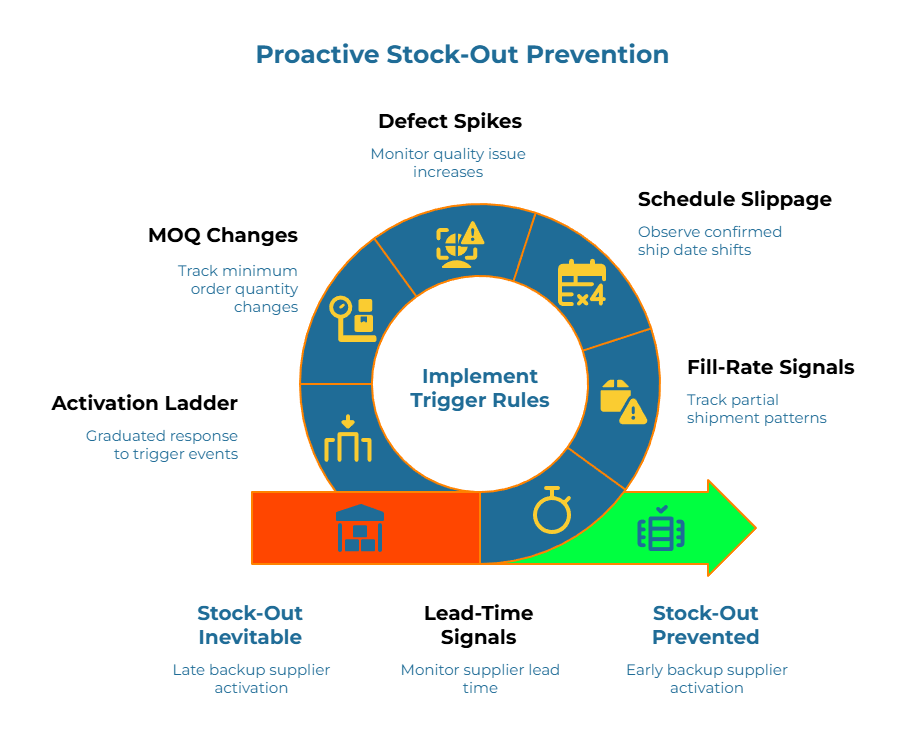
Backup suppliers help only if they are activated in time. This requires clear trigger rules that prompt action before a stock-out becomes inevitable.
Trigger Types
Effective triggers monitor leading indicators rather than lagging outcomes. Consider these categories:
- Lead-time signals: Your primary supplier’s quoted lead time extends beyond an agreed threshold. If normal is 28 days and they quote 42 days, that is a trigger.
- Fill-rate signals: Partial shipments become the pattern rather than the exception. If your supplier repeatedly delivers 80% of ordered quantities, reliability is eroding.
- Schedule slippage: Confirmed ship dates shift repeatedly. One delay may be circumstantial; a pattern indicates systemic issues.
- Defect spikes: Quality issues increase, requiring rework, returns, or customer complaints. This may indicate production strain.
- MOQ changes: The supplier raises minimum order quantities significantly, potentially signalling capacity constraints or a strategic shift away from smaller accounts.
A Simple 3-Level Activation Ladder
Not every trigger requires immediately shifting volume. A graduated response allows proportionate action:
Level 1 – Pre-alert: Notify the backup supplier that activation may be needed. Confirm their current lead times and available capacity. No orders placed yet, but readiness is verified.
Level 2 – Partial shift: Place a portion of upcoming orders with the backup supplier while maintaining the primary relationship. This hedges risk without abandoning a supplier who may resolve their issues.
Level 3 – Full bridge / bridge buy: Shift all volume to the backup supplier for the affected SKUs. This is appropriate when the primary supplier cannot meet requirements for an extended period. For teams facing immediate stockout crises, panic buying vs. strategic sourcing: how to fix paper bag stockout crisis fast provides a 30-90 day recovery roadmap.
Design for Time-to-React
Triggers must fire early enough for the response to work. If your backup supplier requires four weeks to deliver, and your trigger fires when you have two weeks of stock remaining, the backup cannot arrive in time.
Build buffers into trigger thresholds. If you need four weeks to activate and receive from a backup, set triggers to fire when you have six or seven weeks of cover remaining.
For a complementary inventory lens, especially around peak periods, see inventory management 101: preventing paper bag stockouts during peak retail seasons.
Rule #4: Make Backups “Plug-Compatible” with Spec Discipline
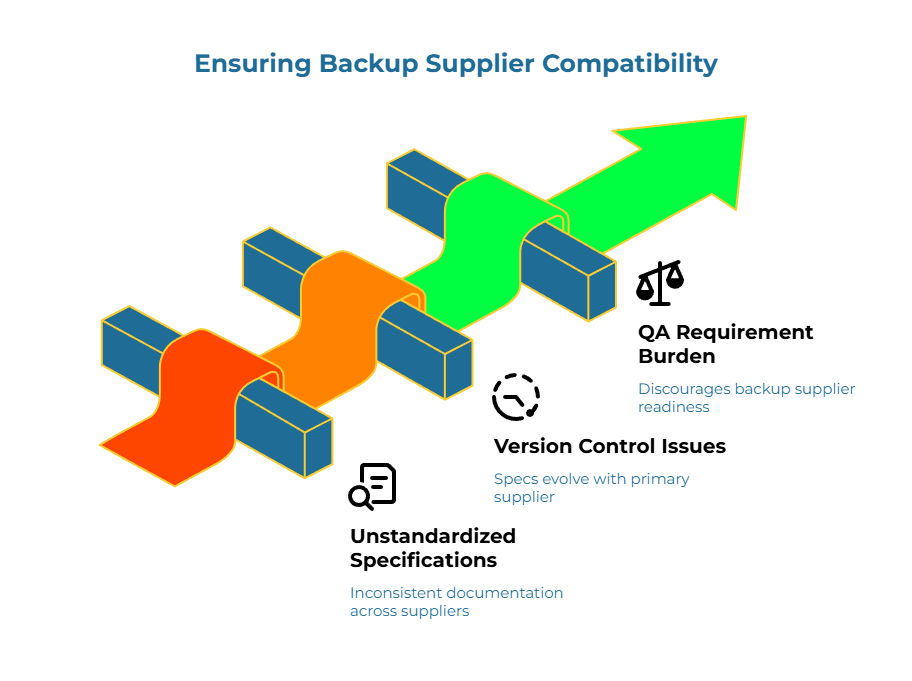
A backup supplier is only useful if they can produce bags that meet your requirements without extensive re-engineering. This requires spec discipline—clear, standardised documentation that allows any qualified supplier to step in.
What Must Be Standardised
For backup suppliers to be truly interchangeable, the following elements need consistent documentation:
Bag dimensions and construction: Exact sizes, material weights (GSM and burst factor specifications), handle types and attachment methods, gusset specifications. Tolerances should be explicit (e.g., ±2mm on dimensions).
Print specifications: Artwork files in approved formats, colour specifications using Pantone or CMYK references, print positioning with tolerances, surface treatment requirements.
Pack-out requirements: Bags per carton, carton dimensions and labelling, palletisation patterns, shipping marks.
Version Control Prevents “Silent Drift”
Spec drift is a quiet risk. Your primary supplier has made three rounds of minor adjustments over two years; your backup supplier has the original spec sheet from initial qualification.
Silent drift occurs when specifications evolve with one supplier but documentation remains frozen. The result: backup suppliers quote and produce to outdated specs, delivering “almost the same bag”—which is not the same bag.
Maintain version-controlled spec documents. When specs change, update all qualified suppliers—primary and backup. This prevents the surprise that emerges when a backup is activated and produced to specifications that no longer match current requirements.
Minimum QA Expectations
Define what evidence you require from a backup supplier before accepting a shipment. Evidence packs—standardised documentation bundles—streamline this process. A basic evidence pack might include:
- Certificate of Analysis confirming material specifications
- Print proof approval before production run
- Pre-shipment inspection photos or third-party inspection report
Keep these expectations realistic. Overly burdensome QA requirements for backups may discourage suppliers from maintaining readiness for orders that may never come.
For a deeper supplier verification framework tied to brand consistency, see wholesale paper bags sourcing: a verification methodology for brand consistency.
Rule #5: Operationalise—Who Decides, Who Executes, Who Communicates
Rules exist on paper. Operationalisation ensures they work in practice.
Defined Authority Matrix
Clarify who has authority to trigger each activation level. A common structure:
- Procurement Manager: Authority to issue Level 1 pre-alerts and Level 2 partial shifts. Can act without additional approval when triggers are met.
- Operations Manager or Director: Required to approve Level 3 full bridge activations, given the relationship and commercial implications.
- Escalation threshold: If a Level 3 activation extends beyond a defined period (e.g., 60 days), executive review is triggered to assess whether the primary supplier relationship should be restructured.
What to Pre-Approve
Waiting for approvals during a crisis slows response. Pre-approve the following for each qualified backup supplier:
- Sample approval sign-off (documented and on file)
- Print proof approval for each SKU
- Standard pack configuration acceptance
- Commercial terms framework (pricing bands, payment terms that maintain working capital flexibility)
- Basic CAPA (Corrective and Preventive Action) workflow for handling quality issues
With these approvals in place, an activation order can proceed without delays for internal reviews.
Two Supplier Email Templates
Communication templates ensure consistent, professional engagement with suppliers during activation events.
Pre-Alert Template:
Subject: Capacity Check – Potential Order for [SKU/Bag Family]
We are monitoring a supply situation with our primary supplier and may need to activate backup orders within the next [timeframe]. Could you please confirm:
- Your current lead time for [SKU specifications]
- Available capacity for [estimated volume]
- Any changes to previously agreed pricing or terms
This is a readiness check only; no order is being placed at this time.
Activate Now Template:
Subject: Order Activation – [SKU/Bag Family]
We are activating backup supply for [SKU specifications] effective immediately. Please proceed with production for [quantity] units per the attached approved specifications (version [X]).
Requested delivery: 2026 Shipping terms: [Incoterm and destination]
Please confirm receipt and provide a production schedule within 48 hours.
How PaperIndex Fits (Without Replacing Your Controls)
Building a backup supplier shortlist requires discovery—identifying potential suppliers who might meet your requirements. This is where B2B marketplaces serve a practical function.
Discovery Lane, Not Decision Shortcut
Discovery through a marketplace accelerates the identification phase. It does not replace the qualification, sampling, and approval processes that make a backup supplier truly ready. A practical approach:
- Browse the paper bag supplier directory to identify candidates in relevant regions
- Send initial inquiries to assess responsiveness and capability claims
- Request samples and documentation for serious candidates
- Run small qualification orders before granting backup status
- If you have a spec sheet ready, submit an RFQ to receive quotes directly from suppliers
All negotiations and transactions occur directly between buyer and supplier.
The One-Page Playbook: Backup Supplier Activation Rules
Use this as a copy/paste reference for internal documentation.
Trigger Rules
| Signal | Threshold | Action |
| Lead time extension | >7 days beyond baseline | Level 1 Pre-alert |
| Fill rate decline | <90% for two consecutive orders | Level 1 Pre-alert |
| Schedule slippage | Ship date moves twice in one order cycle | Level 2 Partial shift |
| Defect rate spike | >3% rejection rate | Level 2 Partial shift |
| Capacity refusal | Supplier cannot accept order volume | Level 3 Full bridge / bridge buy |
| Force majeure event | Supplier facility offline | Level 3 Full bridge / bridge buy |
Note: Thresholds shown are illustrative. Adjust based on your operational tolerances.
Activation Ladder
- Level 1 – Pre-alert: Contact backup supplier. Confirm lead times and capacity. No order placed.
- Level 2 – Partial shift: Place 20–40% of upcoming orders with backup. Maintain primary relationship. Monitor resolution.
- Level 3 – Full bridge / bridge buy: Shift 100% of affected SKU volume to backup. Communicate timeline expectations to primary supplier.
Readiness Prerequisites Checklist
- [ ] Spec sheets version-controlled and shared with backup supplier
- [ ] Artwork files transferred and print proofs approved
- [ ] Sample approval documented and on file
- [ ] Pack-out configuration confirmed
- [ ] Minimum QA evidence requirements defined (evidence packs)
- [ ] Commercial terms framework agreed
- [ ] Logistics routing confirmed (Incoterms, destination, forwarder contacts)
Decision Rights
| Level | Authorised Role | Escalation Point |
| Level 1 | Procurement Manager | None required |
| Level 2 | Procurement Manager | Notify Operations Manager |
| Level 3 | Operations Manager/Director | Executive review if >60 days |
Return-to-Primary Rules
When the primary supplier resolves their constraints:
- Verify resolution with a test order (standard volume, standard timeline)
- Confirm quality matches pre-issue baseline
- Gradually shift volume back (e.g., 50% first order, then 100%)
- Thank backup supplier; maintain relationship for future readiness
- Document lessons learned; adjust trigger thresholds if needed
Resilient, Not Complicated
The backup generator does not run the warehouse. It keeps the lights on when the grid fails—because someone tested it, fuelled it, and documented the switch-over procedure before the storm arrived.
Backup sourcing for paper bags works the same way. Five rules:
- Define what stock-out risk means for your operation
- Design fallbacks for critical SKUs, not duplicates for everything
- Use trigger rules that force early action
- Maintain spec discipline so backups can step in cleanly
- Operationalise with clear decision rights and communication templates
Simple rules and maintained readiness beat last-minute panic buying. The goal is reasonable resilience—not an overly complex supplier base, but a tested, fuelled backup ready before the next supply disruption arrives.
Operational Governance and Compliance: This framework aligns with the core principles of ISO 22301:2019 (Business Continuity) and ISO 31000:2018 (Risk Management). While these international standards provide the foundational logic, tactical execution—including approval thresholds and supplier feasibility—remains contingent upon product specifications and internal service-level expectations.
Note: All quantitative trigger thresholds are currently classified as illustrative and must undergo empirical validation against realized demand and supplier performance before full-scale adoption..
Related Reading from PaperIndex Academy:
- From Fragmented Quotes to a Sourcing Program: A Framework for Wholesale Paper Bag Sourcing
- Inventory Management 101: Preventing Paper Bag Stockouts During Peak Retail Seasons
- The Hidden Risks of Single-Source Procurement for E-commerce Packaging
- Panic Buying vs. Strategic Sourcing: How to Fix Paper Bag Stockout Crisis Fast
- How to Vet Wholesale Paper Bag Suppliers: A Remote Audit Checklist
- Wholesale Paper Bags Sourcing: A Verification Methodology for Brand Consistency
Disclaimer:
This article is for informational purposes only.
Our Editorial Process:
Our expert team uses AI tools to help organize and structure our initial drafts. Every piece is then extensively rewritten, fact-checked, and enriched with first-hand insights and experiences by expert humans on our Insights Team to ensure accuracy and clarity.
About the PaperIndex Insights Team:
The PaperIndex Insights Team is our dedicated engine for synthesizing complex topics into clear, helpful guides. While our content is thoroughly reviewed for clarity and accuracy, it is for informational purposes and should not replace professional advice.