

📌 Key Takeaways
A cupstock grade that looks right on a data sheet can still fail on the line if buyers skip the right questions about coating weight and board structure.
- Numbers Need Context First: A coating weight figure means little until you confirm whether it’s per side or total, and how the supplier controls batch-to-batch consistency.
- Same Weight, Different Results: Two boards with identical GSM can perform very differently because caliper, stiffness, ply structure, and formation all shape how blanks feed, fold, and seal.
- Test on the Line, Not the Desk: Supplier samples that pass a visual review may still crack, spring back, or misalign under real forming speeds, temperatures, and pressures.
- Storage Can Undo Good Specs: Curl, moisture uptake, and dimensional shifts between warehouse staging and the converting line can wreck feeding and sealing repeatability.
- Gate the Trial, Don’t Rush It: A structured proceed-or-hold decision — with clear ownership across procurement, QA, production, and compliance — prevents costly mid-run surprises.
Ask the hard questions before the trial, not after the waste.
Procurement managers, packaging engineers, and QA leads evaluating new cupstock suppliers will find a ready-made question framework here, guiding them into the grade-specific review details that follow.
~ ~ ~ ~ ~ ~ ~ ~ ~ ~ ~ ~ ~ ~ ~ ~ ~ ~
A new coated barrier paperboard may check the right boxes on a supplier’s technical data sheet yet still cause forming failures, seal inconsistency, print defects, or curl-related waste once it reaches a converting line. The gap between what a specification describes and what a production environment demands is where avoidable trial failures originate.
This guide provides procurement teams, packaging engineers, QA reviewers, and production managers a structured question framework for reviewing coating weight and board structure before approving or trialing new barrier cupstock. The focus is on helping buyers translate supplier-provided technical fields into production-readiness questions — not on recommending coating types or ideal values. No single field should be reviewed in isolation; coating weight means little without board structure context, and board structure means little without converting-line validation.
Start by Asking What the Supplier Means by Coating Weight
Coating weight is one of the first specification fields a buyer encounters on a cupstock technical data sheet, but the number alone does not confirm production fit. Two cupstock suppliers may quote similar coating weights while describing different measurement bases, coating constructions, or application methods.
Before comparing quotes, ask the supplier:
- Is the stated coating weight per side or total?
- Does the value apply to the exact grade, coating type, and cup application being quoted?
- Is the coated side — intended for product contact or heat sealing — clearly identified?
- Is the quoted figure a nominal target, a range, or a production tolerance?
- How does the supplier monitor variation across web width and between batches?
Sidedness deserves particular attention. Ask which side is coated, which side is intended for cup contact, which side is used for sealing, and whether the print side is the same as or different from the barrier-coated side. If the seal side is assumed rather than documented, the issue may appear later as side-seam, bottom-seal, or forming inconsistency.
Uniformity should be discussed before samples are approved. Ask how the supplier monitors variation across the web and between batches, and whether the technical data sheet reflects the quoted grade or a broader product family. These questions matter because coating weight variation can affect barrier consistency, sealing behavior, and line performance in ways a single nominal value does not predict. Normalize the measurement basis across quotes before comparing, and treat coating weight as a starting point for dialogue rather than a standalone approval criterion.
Coating Weight and Board Structure Supplier Question Matrix
| Review Area | Questions to Ask Supplier | Internal Reviewer | Evidence to Request | Why It Matters |
| Coating weight | What is the specified coating weight? How is it measured? Per side or total? | Procurement + QA | TDS, test basis, grade-specific declaration | Prevents mismatched comparisons across quotes |
| Coating distribution | How is uniformity controlled across web width and between batches? | QA + Production | QC range documentation, batch records, production-like samples | Variation may affect sealing, barrier behavior, and run consistency |
| Board structure | What are GSM, caliper, stiffness, formation, and ply details for the exact quoted grade? | Packaging engineer | TDS with named test methods | Same GSM does not guarantee equivalent forming behavior |
| Forming and sealing | What forming and heat-sealing conditions has this grade supported? | Production | Trial notes, line compatibility guidance | Reduces desk-only approval risk |
| Print and surface | Which printing methods and inks are validated on this surface? | Print / Production | Print trial records, surface treatment data | Prevents scuffing, holdout, registration, or drying issues |
| Storage and dispatch | What storage conditions and shelf-life assumptions apply? | Warehouse + QA | Handling and storage guidance | Manages curl, moisture uptake, and blocking risk |
This matrix does not include numeric acceptance criteria. Thresholds should come from buyer specifications, supplier documentation for the exact quoted grade, or applicable verified standards.
Review Board Structure Alongside GSM, Caliper, and Stiffness
Grammage (GSM) — the mass per unit area of paper or board — is a starting specification, not a performance guarantee. ISO 536 is a recognized standard for determining paper and board grammage. That supports grammage as a measurable property, but it does not predict whether a specific cupstock grade will run well on a buyer’s line.
Caliper describes thickness; stiffness describes resistance to bending. Formation, ply structure, grain direction, and surface quality also influence how a blank feeds, folds, forms, and holds shape. Structural variations in caliper, stiffness, ply distribution, and formation quality mean that identical mass per unit area rarely translates to identical converting performance.
Ask the supplier:
- What are the GSM, caliper, stiffness, formation, and ply details for the exact grade being quoted?
- Are machine direction and cross direction properties provided?
- Is the board single-ply or multi-ply, and how does ply structure affect the print side and seal side?
- Are caliper and stiffness consistent with the intended cup size and forming process?
- Does the supplier provide named test methods (ISO, TAPPI, or equivalent) for reported values?
Packaging engineers should review these fields together rather than treating any one as a proxy for board quality. Understanding how GSM, caliper, and stiffness interact — especially where cupstock specification trade-offs affect yield and negotiation leverage — becomes a procurement advantage, not just a technical exercise. The practical question is not whether one number looks stronger on paper; it is whether the board structure fits the intended cup, machine, and approval process.
Ask How Coating and Structure Behave During Forming, Scoring, and Sealing
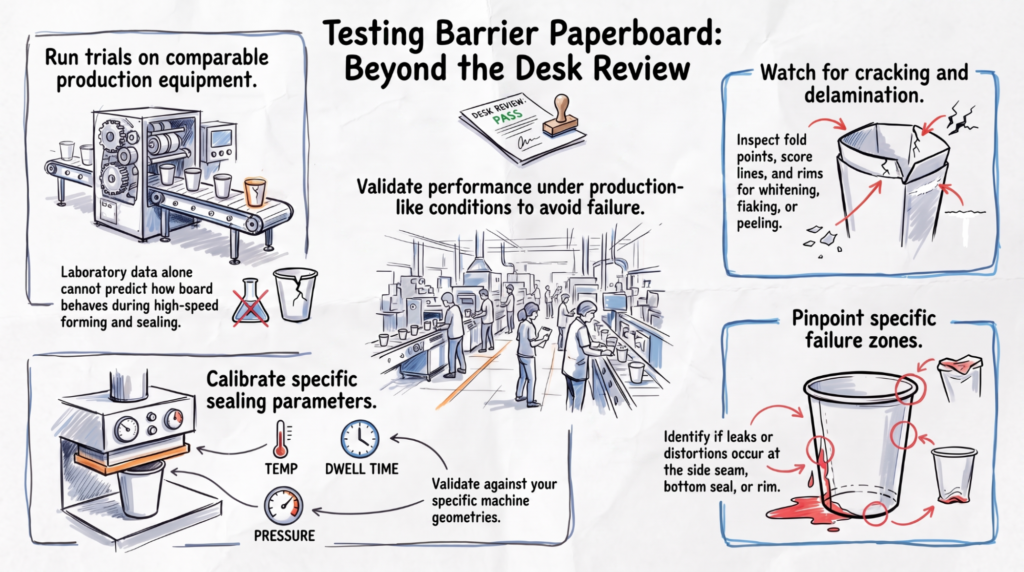
A barrier paperboard that passes a desk review still needs to perform under production-like conditions. Rim forming, side seam sealing, bottom sealing, blanking, folding, and scoring each place different mechanical and thermal demands on the coated board. Key questions for the supplier and production team:
- Has this exact grade been run on comparable cup-forming equipment?
- What sealing temperature, dwell time, and pressure assumptions were used in prior trials?
- Does the coating crack, whiten, or delaminate at score or fold points?
- Does the board hold its formed shape, or does it spring back or distort?
- Where do failures tend to appear — side seam, bottom seal, rim, or print surface?
- Are compatibility recommendations based on laboratory data, production-like trials, or both?
Sealing behavior depends on the interaction between coating type, coating weight, board caliper, and the buyer’s specific machine parameters. A supplier’s sealing guidance may reflect different equipment, line speeds, or cup geometries. A general “suitable for cups” statement is less useful than evidence tied to a similar cup format and converting process, so production teams should validate under their own converting conditions before signing off.
Scoring and folding behavior deserves the same attention. Ask whether the coating cracks, whitens, flakes, or delaminates at score lines, blank edges, rim areas, or bottom-forming zones. Each failure location points to a different review path.
Check Curl, Moisture, and Dimensional Stability Before Scheduling the Trial
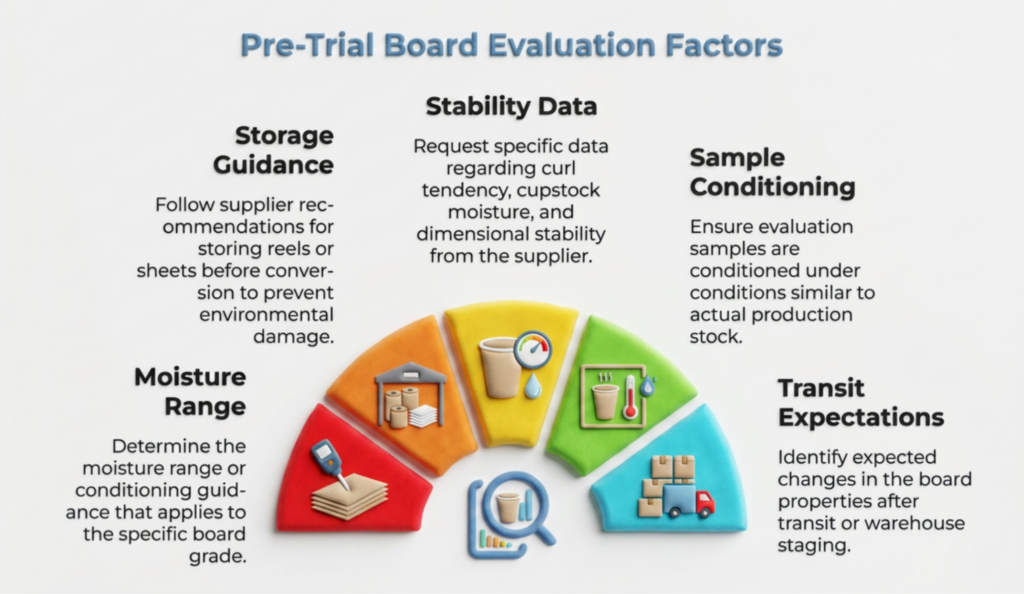
Dimensional stability — the board’s ability to maintain size and shape under relevant handling and environmental conditions — can determine whether a board that matches coating and structure specifications actually performs once it reaches the converting line. Curl, moisture uptake, and dimensional change affect feeding consistency, registration accuracy, forming precision, and sealing repeatability. Ask the supplier:
- What moisture range or conditioning guidance applies to this grade?
- How should reels or sheets be stored before conversion?
- Does the supplier provide curl tendency or cupstock moisture, curl, and dimensional stability data?
- Were evaluation samples conditioned under conditions similar to production stock?
- What changes should the buyer expect after transit or warehouse staging?
Storage assumptions should be documented before the trial. Ask whether reels should remain wrapped until use, whether sheets require protection from humidity shifts, and what staging conditions the supplier recommends before printing or forming. If couriered sample sheets are reviewed differently from the reels or palletized sheets that production will actually use, the sample review may miss handling risks that only appear at production scale.
Dimensional instability often reveals itself during feeding and forming, not during sample inspection. If warehouse conditions differ from recommended storage parameters, the trial may not reflect real production behavior. TAPPI publishes standards for measuring paper and board properties — including moisture, thickness, stiffness, Cobb water absorptiveness, roughness, curl, and conditioning—that buyers can reference when requesting test data.
Include Print and Surface Compatibility in the Board Review
Print quality on coated cupstock depends on the relationship between the barrier coating, the board surface, and the printing process. A coating change or supplier switch can alter ink holdout, drying behavior, scuff resistance, and registration — even when the board meets all structural specifications. Questions to include:
- Which print methods (flexographic, offset, digital) has the supplier validated on this surface?
- Is the print side the same as, opposite to, or affected by the barrier coating?
- Are production-like printed samples available?
- What surface treatment, dyne level, wettability, or ink compatibility data is available?
- Could a change in coating weight or type alter print appearance or scuff resistance compared to the buyer’s current material?
If the print side is opposite the barrier-coated side, verify whether coating balance, moisture behavior, or curl could still affect print registration. Print and surface issues often surface after production ramp-up rather than during small-scale sample review. Including print compatibility in the pre-trial review helps prevent post-approval surprises that disrupt scheduling and create waste.
Turn Supplier Answers into a Production-Trial Decision Gate
Gathering supplier answers is only useful if they feed a structured proceed-or-hold decision. A simple framework helps procurement, QA, production, and compliance align before committing trial resources.
| Decision | Use This When | Next Action |
| Proceed to trial | Documentation covers the exact grade, coating type, board structure, intended cup application, storage guidance, and trial acceptance criteria. No critical gaps remain. | Run a production-like trial with agreed checks and owners. |
| Proceed with limits | Some details are incomplete but can be verified through a controlled sample run or limited line trial with defined pass/fail criteria. | Limit approval scope until missing evidence is resolved. |
| Hold | Coating weight, board structure, sealing guidance, or documentation quality is unclear enough that a trial would not produce reliable results. | Request additional documentation before scheduling. |
| Escalate | Food-contact, sustainability, or performance claims are unsupported, inconsistent, or missing documentation that compliance or regulatory teams need to review before material enters the facility. | Route to compliance, QA leadership, or qualified external technical review. |
Ownership should be explicit: procurement gathers supplier answers, QA reviews documentation and test basis, production validates runnability, compliance reviews food-contact or market-access claims, and product development confirms cup-use requirements match the quoted grade.
Food-contact references should be treated as market-specific documentation questions, not generic assurances. U.S.-specific paper and paperboard food-contact review may involve resources such as 21 CFR 176.170, while European food-contact documentation may require different references, such as EDQM guidance on paper and board used in food contact materials and articles. These sources should not be generalized across all markets without qualified review.
A cupstock sample review checklist can help teams coordinate without relying on informal handoffs.
Questions Buyers Should Not Skip Before Approval
Some review questions carry disproportionate risk if overlooked. Before approving new barrier paperboard or scheduling a converting trial, confirm clear answers to these:
- Does the documentation match the exact grade, coating, and application being quoted — not a generic product family sheet?
- Does the coating match the intended hot-cup or cold-cup use, with that distinction documented?
- Are trial samples production-equivalent in coating, caliper, conditioning, and storage history?
- Are storage and handling assumptions documented and compatible with the buyer’s warehouse?
- Are food-contact, recyclability, compostability, PFAS-free, plastic-free, or other sustainability claims supported by separate, market-specific documentation?
Skipping any of these creates a gap that may not surface until production is underway, at which point the cost of correction far exceeds the cost of asking one more question before approval.
Frequently Asked Questions
Is higher coating weight always better for cupstock?
Not necessarily. Higher coating weight may improve barrier properties in some applications, but it can also affect sealing behavior, forming, cost, surface behavior, and equipment compatibility. The right coating weight depends on the cup application, barrier requirements, coating type, and production-line parameters — higher is not inherently better.
Can two cupstock grades with the same GSM perform differently on the same line?
Yes. GSM measures mass per unit area, but forming, sealing, and print behavior also depend on caliper, stiffness, formation, ply structure, coating type, moisture content, and surface properties. Two grades with identical GSM may perform differently if their board structure or coating construction varies.
Should procurement approve cupstock based on supplier samples alone?
Supplier samples are a useful starting point but may not reflect full-production conditions. A sample that looks acceptable on a desk may still behave differently during printing, scoring, sealing, or cup forming. Approval should include documentation review covering coating, board structure, storage guidance, and compliance claims, followed by validation under production-like converting conditions.
Who should review coating weight and board structure questions internally?
Internal review should follow an integrated workflow where each department signs off on its respective operational domain rather than reviewing parameters in silos. Shared ownership reduces the chance that a critical question falls between departmental responsibilities.
Conclusion
Coating weight and board structure are not paperwork fields to check off during supplier onboarding — they are production-readiness indicators that connect what a supplier quotes to what a converting line experiences. Reviewing them through a structured question framework helps buyers reduce avoidable trial failures, compare suppliers fairly, and protect production schedules.
Before contacting suppliers, prepare a shared question set that procurement, QA, production, and compliance can each contribute to. Engage with cupstock manufacturers, suppliers or exporters after defining your technical review questions, or submit an RFQ once your coating, caliper, sealing, and trial requirements are defined.
Disclaimer:
This article is for general informational purposes only and does not constitute compliance, safety, technical, or professional advice. Requirements, risks, and best practices may vary by context, jurisdiction, system, provider, or use case. Confirm important decisions with the appropriate qualified professional, authority, or technical expert.
Our Editorial Process:
Our expert team uses AI tools to help organize and structure our initial drafts. Every piece is then extensively rewritten, fact-checked, and enriched with first-hand insights and experiences by expert humans on our Insights Team to ensure accuracy and clarity.
About the PaperIndex Insights Team:
The PaperIndex Insights Team is our dedicated engine for synthesizing complex topics into clear, helpful guides. While our content is thoroughly reviewed for clarity and accuracy, it is for informational purposes and should not replace professional advice.