

📌 Key Takeaways
Cupstock that passes every spec check can still cause production problems if moisture, curl, and size behavior aren’t planned for before the run starts.
- Plan Before Production, Not After: Moisture, curl, and dimensional stability should be discussed, documented, and assigned to owners before the first full run — not investigated after a rejected lot.
- Spec Sheets Don’t Tell the Whole Story: A board that tests fine at the supplier’s facility may behave differently after transit, humid storage, or premature unwrapping — context matters as much as the number.
- Document Curl With Enough Detail to Act: Recording “the board curled” isn’t useful — note when it appeared, which direction, how severe, and what the storage and humidity conditions were.
- Heavier Board Won’t Fix Behavior Problems: Higher GSM means more mass per area, not better moisture balance or curl control — adding weight adds cost without solving the real issue.
- Align Internally Before Questioning Suppliers: Production, QA, procurement, and warehouse teams should agree on requirements and document their own handling conditions before escalating concerns to a supplier.
When teams plan for board behavior, supplier conversations get sharper and production disruptions get fewer.
Production heads, QA leads, procurement managers, and warehouse teams evaluating or switching cupstock sources will find a structured planning framework below, guiding them into the behavior-specific details that follow.
~ ~ ~ ~ ~ ~ ~ ~ ~ ~ ~ ~ ~ ~ ~ ~ ~ ~
A cupstock lot can satisfy every line on a specification sheet and still require careful planning before it runs on a cup-forming line. Paperboard behavior depends on more than what a data sheet captures at a single point in time.
Moisture content, curl, and dimensional stability are three variables that can influence how cupstock performs across storage, conditioning, feeding, forming, and printing. For production heads and technical buyers — along with QA, procurement, and warehouse teams — understanding these variables before approving a source or scheduling a run can reduce avoidable friction between departments and with suppliers.
Evaluating cupstock means verifying material standards, analyzing how the board responds under environmental stress, and validating line performance through structured trials.
This article provides a planning framework — not a blame guide — to help production, QA, procurement, and warehouse teams document the right observations and ask better questions before problems surface.
Why Moisture, Curl, and Dimensional Stability Belong in Cupstock Planning
Cupstock is a converting material, not just a paperboard category. It moves through multiple stages before it becomes a finished cup — shipping, warehouse storage, line staging, unwinding, forming, sealing, and possibly printing. At each stage, environmental conditions and handling practices can shift how the board responds.
That single-point-in-time record may not reflect how the board behaves after transit, after sitting in an unconditioned storage area, or after a shift in ambient humidity.
Procurement may select a source based on price, availability, or basic specification match. QA may check incoming material against a certificate of analysis. Production, however, often encounters runnability friction under conditions neither the incoming check nor the data sheet anticipated. Aligning on material-behavior expectations before supplier approval — not after the first rejected lot — makes those conversations more productive.
Standards such as ISO 187, which defines conditioning and testing atmospheres for paper, board, and pulps, exist because test results depend on the conditions under which they are generated. If teams or suppliers condition and test samples under different atmospheres, direct comparisons may be unreliable. A recurring principle applies here and throughout this article: ISO and TAPPI standards support comparability, but they do not define the correct tolerance for every paper cup operation. That tolerance should be agreed upon by the buyer and supplier based on the specific grade and production requirements.
A stronger approval process connects cupstock supplier documentation, sample conditioning, lot traceability, warehouse conditions, and trial observations — closing the gap between incoming specs and actual converting behavior.
Moisture: Why the Same Board can Behave Differently After Storage or Transit
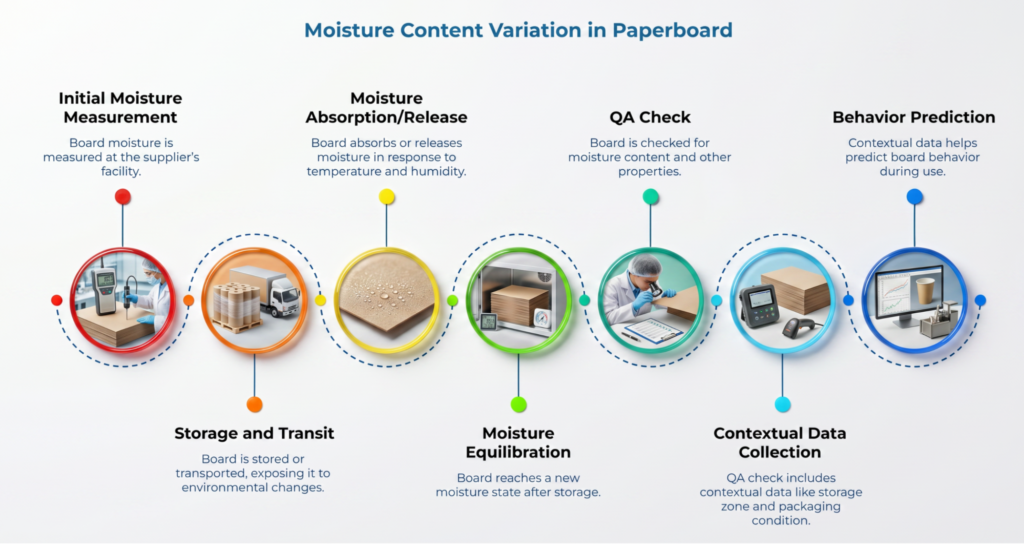
Moisture content describes how much water the board holds relative to its total initial mass. Because paperboard is hygroscopic, that value shifts as the board absorbs or releases moisture in response to temperature and humidity changes.
What matters is whether the board arrives, stores, and conditions in a way that keeps behavior predictable. A roll that tests within tolerance at the supplier’s facility may equilibrate to a different moisture state after days in a humid warehouse or after wrapping is removed prematurely. Without controlled conditioning or clear quarantine triggers in the warehouse, the shift becomes harder to attribute — to the supplier, to storage, or to handling.
Moisture variation can influence stiffness perception, flatness, curl tendency, and feeding behavior. These effects may not surface during incoming QA checks if the board has not yet equilibrated to the storage environment.
For incoming QA, a moisture result becomes more useful when it is tied to context. The record should identify the lot, roll or sheet condition, packaging condition, time since receiving, storage zone, and any visible signs of exposure. A roll that looked acceptable at receiving may behave differently after extended storage in a humid area.
ISO 287 specifies an oven-drying method for determining moisture content in lots of paper and board. The buyer-supplier tolerance agreement described earlier applies here. Document when the reading was taken, under what storage conditions, and how long the board had been exposed to the plant environment — not just the number itself. Teams should confirm the current version of any referenced standard before using it in RFQs, specifications, or supplier agreements.
Curl: Why Sheet or Roll Profile can Create Planning Friction
Curl is among the most visible material-behavior issues in cup converting, yet it is routinely under-documented. Describing the board as “curled” without recording direction, timing, severity, and ambient conditions does not give the supplier enough to act on.
Depending on the converting setup, curl may show up as feeding inconsistency, alignment difficulty, stacking problems, or forming friction. Contributing factors include moisture imbalance between the two sides of the sheet, coating asymmetry, tension history from winding and unwinding, storage orientation, and ambient humidity shifts.
Production and QA teams should ask when curl appeared. Was it seen before conditioning, after conditioning, during unwinding, after sheet cutting, after warehouse staging, or near the feeding stage? Was it observed in a small sample, retained sample, trial roll, or production lot?
A desk sample may sit flat after conditioning while a production lot from the same grade shows curl after warehouse staging or unwinding under different tension. The approval record should capture both conditions so discrepancies can be traced to specific handling or environmental variables.
TAPPI’s physical-property test methods for paper and paperboard include methods related to conditioning, moisture, bending resistance, stiffness, and curl — useful as a standards-reference starting point. A desk review can be useful, but curl should be assessed under conditions resembling actual conversion. The approval record should connect sample condition, lot identity, roll or sheet orientation, storage history, curl direction, and trial feedback.
Dimensional Stability: Why Size Behavior Matters Beyond Nominal Dimensions

Cellulose fibers swell as they absorb moisture and contract as they release it, and this movement is not always uniform. The technical term is hygroexpansivity — the tendency of paper or board to change dimensions in response to relative humidity variation.
ISO 8226-2 addresses the measurement of hygroexpansivity under relative humidity change.
The distinction between humidity-related dimensional change and water-immersion behavior should remain clear. ISO 5635 concerns dimensional change after immersion in water and notes that this property should not be confused with hygroexpansivity. For cupstock used in dry-forming and printing, humidity-driven dimensional behavior is typically the more relevant planning concern.
If blanks shift size between conditioning and converting, registration may drift and stacking consistency may suffer. Whether these effects emerge depends on the magnitude of change, equipment sensitivity, and the tolerances required.
Grammage (mass per unit area, per ISO 536) characterizes sheet yield but does not predict environmental responses such as hygroexpansivity.
Teams should ask how dimensional tolerances are measured, under what conditioning parameters, and whether production trials confirm the board holds dimensions within the range the line needs. Where tight alignment is required — printed cup blanks, forming operations — dimensional movement under humidity change may need documented tolerances and production-like trials to validate.
Cupstock Behavior Planning Matrix for Production, QA, and Procurement
The matrix below connects each behavior factor to planning relevance, documentation needs, internal owners, a starting supplier question, and the type of verification needed.
| Behavior Factor | What It Can Influence | What to Check Before Approval | Who Should Review | Supplier Question | Verification Needed |
| Moisture content | Conditioning needs, storage risk, stiffness perception, flatness, curl tendency, runnability | Moisture test method, storage conditions, lot condition at receiving, packaging condition, conditioning time | QA + Production + Warehouse | What moisture tolerance and test method apply to this grade? What storage guidance do you provide? | Supplier documentation, buyer requirements, applicable standards, and qualified technical review |
| Curl | Feeding consistency, alignment, forming behavior, stacking friction | Curl direction, timing of appearance, sample vs. production lot condition, severity, roll/sheet orientation, storage history | Production + QA | How is curl controlled and measured before shipment? What documentation is available for production-representative lots? | Agreed observation method, retained samples, and production-like trial notes |
| Dimensional stability | Forming alignment, print registration, cutting accuracy, blank consistency | Conditioning method for dimensional measurement, stated dimensional tolerance, humidity-related movement data, trial observations | Production + Packaging Technologist | What dimensional-change data is available under humidity variation? How are tolerances defined? | Buyer process requirements, supplier tolerances, and trial confirmation |
Numerical tolerances should not be assigned without support from the buyer’s internal standard, a supplier document, or a current external standard. The matrix makes assumptions visible before production pressure builds — not a universal pass/fail rule.
Link every sample review to conditioning procedures, lot traceability, storage exposure, and production-like trial observations.
Questions to Ask Before Approving or Switching a Cupstock Source
The goal is to convert vague concern into supplier-ready evidence. Procurement may not know which technical questions matter until production or QA defines the risk. QA holds the incoming inspection records; production holds the runnability observations. Warehouse teams know whether a roll sat near a dock, a humid zone, or an extended staging area.
Internal readiness checks
Before approaching a supplier, teams should confirm their preparation. Has production reviewed the material under conditions resembling the actual converting environment, with the conditioning procedure documented? Teams should also verify that storage and handling conditions between receiving and use were recorded, that moisture, curl, and dimensional observations are tied to specific lot IDs, and that a known-good reference lot is available for comparison.
Supplier questions
When engaging a supplier, frame questions around documentation and process — specific questions normalize comparisons across suppliers who may describe cupstock differently. A specification matching checklist can support this process.
- What moisture content test method and tolerance apply to this cupstock grade?
- How is curl monitored and controlled before shipment?
- What storage, handling, and conditioning guidance applies?
- Are dimensional tolerances stated after a defined conditioning procedure?
- Are production-equivalent samples available, rather than only hand-selected samples?
- How should the buyer document observations if a lot behaves differently in production than expected?
These questions work best when internal teams have already aligned on requirements. A paper specification matching approach — documented in a mill spec sheet — helps ensure the right questions are asked before a problem occurs.
What Teams Should Not Overinterpret
Before escalating a concern, check whether the observation is isolated or repeatable and whether internal variables have been documented.
A single curled sample does not prove that all lots from that supplier will curl. A moisture value without a sampling method, conditioning context, and agreed tolerance is incomplete — not necessarily evidence of a problem. Machine settings, storage environment, handling practices, and material properties interact. Attributing an issue to the board before documenting these other variables risks an unproductive supplier dispute.
A heavier board does not automatically solve behavior problems. GSM measures mass per unit area — not moisture balance, curl tendency, or dimensional response. If the issue traces to moisture balance, curl direction, dimensional movement, coating structure, or storage exposure, increasing grammage adds cost without addressing the actual planning gap.
Isolating the root cause requires auditing the entire processing chain—from storage conditions to machine tension settings—rather than assessing the board in isolation. Documentation helps teams decide whether to approve, retest, hold, escalate, or revise the specification.
Plan Cupstock Behavior Before Production Pressure Builds
The difference between a predictable run and an avoidable disruption often comes down to whether moisture, curl, and dimensional stability were discussed, documented, and assigned before the first full run.
Before the first full production run, teams should work through these checks:
- Confirm moisture test method and tolerance with the supplier
- Record sample conditioning conditions
- Review curl direction and severity under production-like conditions
- Confirm dimensional tolerance language in supplier documentation
- Document warehouse storage conditions
- Run a production-like trial where feasible
- Assign clear owners across QA, production, procurement, and warehouse
After defining moisture, curl, dimensional stability, storage, and sample-review requirements, use those details to compare cupstock suppliers and exporters and prepare clearer RFQs. Once internal alignment is in place, submit an RFQ or explore cupstock manufacturers to begin focused supplier conversations.
Frequently Asked Questions
Does higher GSM prevent cupstock curl?
No. Curl is driven by hygroscopic forces, structural tension history, and coating imbalance. Increasing grammage adds cost without resolving the underlying moisture differential.
Should cupstock samples be conditioned before approval?
Generally, yes. Defining sample conditioning and testing atmosphere makes comparisons between lots or suppliers more meaningful. ISO 187 provides a standard procedure, but buyer approval criteria still need to fit the grade and production context. Without a shared conditioning baseline, two teams reviewing the same board may reach different conclusions.
Can moisture content alone predict production performance?
No. Moisture is one input among several. Teams should review it alongside storage history, packaging integrity, curl observations, dimensional checks, lot traceability, and production trial results.
What should buyers ask suppliers about dimensional stability?
Ask what dimensional tolerances apply, how samples are conditioned before measurement, whether humidity-related movement data is available, and how production-equivalent lots should be reviewed before wider approval. Tolerances provided without conditioning context may not be directly comparable to the production environment.
Disclaimer:
This article is for general informational purposes only and does not constitute compliance, safety, technical, or professional advice. Requirements, risks, and best practices may vary by context, jurisdiction, system, supplier, storage condition, production setup, or use case. Confirm important decisions with the appropriate qualified professional, supplier documentation, applicable standards, or technical expert.
Our Editorial Process:
Our expert team uses AI tools to help organize and structure our initial drafts. Every piece is then extensively rewritten, fact-checked, and enriched with first-hand insights and experiences by expert humans on our Insights Team to ensure accuracy and clarity.
About the PaperIndex Insights Team:
The PaperIndex Insights Team is our dedicated engine for synthesizing complex topics into clear, helpful guides. While our content is thoroughly reviewed for clarity and accuracy, it is for informational purposes and should not replace professional advice.