

📌 Key Takeaways
Paper bag shortages show up as patterns in daily operations long before shelves go empty — and catching those patterns early turns a crisis into a routine reorder.
- Count by Bag Type, Not Totals: Total carton counts hide the real risk because one specific bag size can run out while overall stock still looks fine.
- Watch for Rising Daily Usage: Three or four days of higher-than-normal bag use can quietly cut your remaining stock coverage in half.
- Staff Workarounds Signal Trouble: When teams start double-bagging, grabbing wrong sizes, or borrowing from other locations, the shortage has already started.
- Match Stock to Lead Time: Divide your usable bags by recent daily usage — if that number is close to your supplier’s delivery timeline, the reorder window may already be tight.
- Walk the Storage Path: Bags listed on a count sheet but stuck in back rooms or split across locations may not reach the counter fast enough during a rush.
Spotted early, these signals turn into a calm reorder — not a scramble.
Cafe managers, food service operators, and small retail teams running seasonal rushes will find a ready-to-use warning checklist and reorder framework in the detailed guide that follows.
~ ~ ~ ~ ~ ~ ~ ~ ~ ~ ~ ~ ~ ~ ~ ~ ~ ~
A paper bag stock shortage risk often appears before inventory reaches zero. It shows up as a pattern — usage climbing faster than expected, specific bag types vanishing while total carton counts still look comfortable, and reorder timing that no longer fits the pace of a seasonal rush.
For food service operators, cafe managers, and small retail teams responsible for paper bag inventory during busy periods, the challenge lies in recognizing when original order assumptions have fallen behind. Seasonal retail sales, holiday promotions, food delivery surges, festival traffic, and event-driven footfall all shift how quickly paper bags move — and which types move fastest.
The warning signs below are observable across daily service operations:
- Daily bag usage is accelerating beyond what the original order assumed
- Certain bag sizes or types are depleting faster than the rest
- Staff are substituting, double-bagging, or borrowing stock between locations
- Storage counts no longer reflect what is actually accessible during service
- Remaining stock no longer covers the time needed to receive a new order
Each of these signals deserves a closer look, because spotting them early is the difference between a planned reorder and a rushed one.
Daily Bag Usage Starts Moving Faster Than Your Original Order Assumed
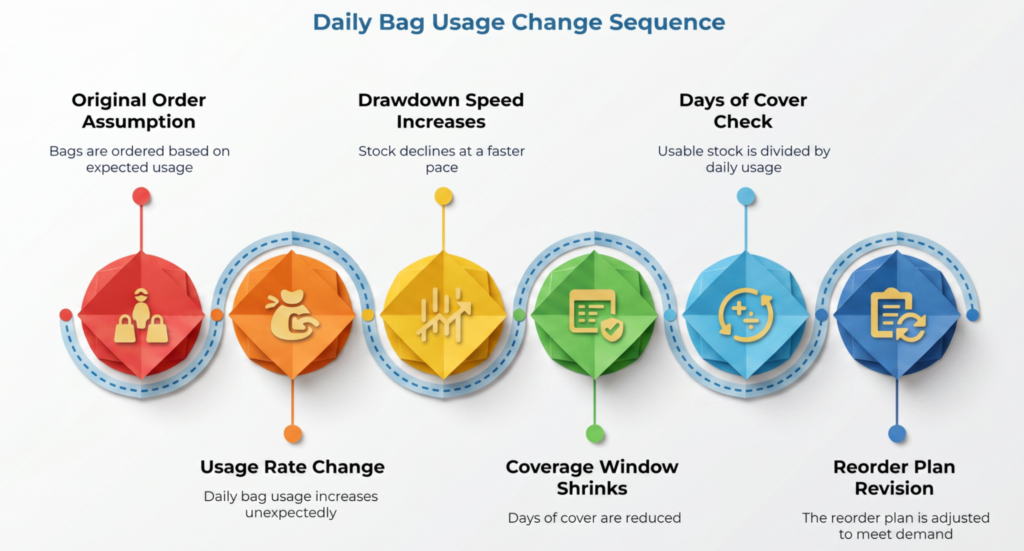
The clearest warning sign is a change in usage rate. “Usage rate” means how many bags your operation goes through per day or per service shift. “Drawdown” describes the speed at which total stock declines. During a seasonal rush, a paper bag order that looked adequate at the start may become tight if daily use rises faster than expected — whether from a retail sale, a festival period, a food delivery promotion, a local footfall spike, or an unexpected increase in takeaway orders.
This shift tends to happen gradually. A cafe running a holiday takeaway promotion might move from using 120 medium bags a day to 200 over the course of a week, without anyone revising the reorder plan. Three or four consecutive days of higher-than-expected drawdown can quietly cut a coverage window in half.
A practical way to gauge this is a simple “days of cover” check:
Days of cover = Usable stock on hand ÷ recent daily usage
For example, if a store has 1,200 medium bags and uses 200 per day, it has six days of cover before factoring in any reorder lead time. (This is an illustrative example to show how the calculation works, not a benchmark for any specific operation.)
For general inventory terminology, the ASCM Supply Chain Dictionary is a useful reference. For broader operations-management context, MIT OpenCourseWare provides inventory management lecture material that supports the general concept of monitoring inventory and usage, though neither source provides paper-bag-specific lead times or seasonal demand figures.
The key distinction is between a single busy day and a sustained trend: one high-traffic afternoon may not require action, but when elevated usage repeats across several consecutive days, the seasonal pace has likely shifted your planning assumptions.
The Wrong Paper Bag SKUs Are Disappearing First
Total carton counts can create a false sense of security when different bag types deplete at different rates.
A SKU (Stock-Keeping Unit) is simply a specific bag type or size within your inventory. A small flat bag, a medium bag with twisted handles, and a printed kraft paper bag are three separate SKUs, even if they share a shelf. During a seasonal rush, one menu item, gift set, or promotion can drive heavy demand for a specific size that the rest of your stock cannot replace.
This is a common source of stockout surprise — the overall carton count looks fine, but the bags needed for the highest-volume orders are the ones running low.
Check whether:
- One size is being opened more often than others
- Handled bags are moving faster than flat or plain bags
- Printed bags are being used outside their intended campaign
- One counter, outlet, or service area is consuming a specific bag type faster
- Staff are reaching for a backup size because the preferred bag is hard to find
Count by bag type, not only by total cartons. Kraft paper bags, printed bags, handled bags, and flat takeaway bags should be reviewed as separate planning items — treating them as one general ‘paper bags’ category can hide the actual shortage risk. If a particular SKU is depleting faster than expected, check whether the bag specification still fits the use case. Matching paper bag specifications to basket size and handling conditions can help prevent the same mismatch next time.
Staff Start Substituting, Double-Bagging, or Borrowing Stock
Front-line teams — packers, counter staff, kitchen teams, outlet managers — often detect shortage pressure before any count sheet does. When the right bag size is unavailable, staff adapt: they reach for a larger bag, double-bag a heavier order, or borrow cartons from another outlet.
These workarounds keep operations moving, but they also accelerate consumption in ways that are easy to miss. Double-bagging increases usage per order. Borrowing from another location masks one site’s constraint while creating another.
A better question than “Is stock low?” is: “Where are we using a different bag than usual?”
That question helps locate the pressure point. It may reveal that the shortage is not across all paper bags but concentrated in one size, one handle type, one counter, or one outlet. Substitution frequency and location reveal which bag type is already constrained. Treat this as operational data, not a staffing issue.
If substitutions are frequent, the issue may also involve packing workflow, not just stock quantity. Understanding how bag size and handle specifications affect pack-out efficiency can clarify why certain substitutions cause more waste than others — a bag that technically holds the item but slows packing, stands poorly, or pushes staff toward workarounds is a specification problem as much as a supply one.
Storage Counts Stop Matching What Teams Can Actually Use
Bags may appear on a count sheet, but the count may not reflect what is accessible during service hours. This visibility gap tends to worsen during busy periods when no one has time to reconcile storage areas.
Common gaps include: stock split across the counter, prep stations, back room, event storage, overflow shelving, or a second outlet. Partial cartons counted as full. Mixed cartons, damaged cartons, or unlabeled back-room stock sitting unopened. Bags in overflow areas that cannot reach the counter quickly enough during a rush.
Walk the stock path: physically check every storage location, from the service counter through prep and overflow. Separate the count into three categories: sealed cartons, open cartons, and counter-ready stock. If the usable count is meaningfully lower than the number on paper, the coverage window is shorter than it appears.
This is a generally accepted inventory-control practice: stock needs to be visible, identifiable, and available at the point of use. For broader supply-chain terminology, the CSCMP Supply Chain Management Definitions and Glossary provides a useful reference, although it is not specific to paper bag operations.
Your Remaining Stock No Longer Covers Lead Time at the Current Rush Rate
This is where earlier warning signs converge into a timing question. The issue is not, “Do we still have bags?” It is, “Will what remains last until replenishment arrives?”
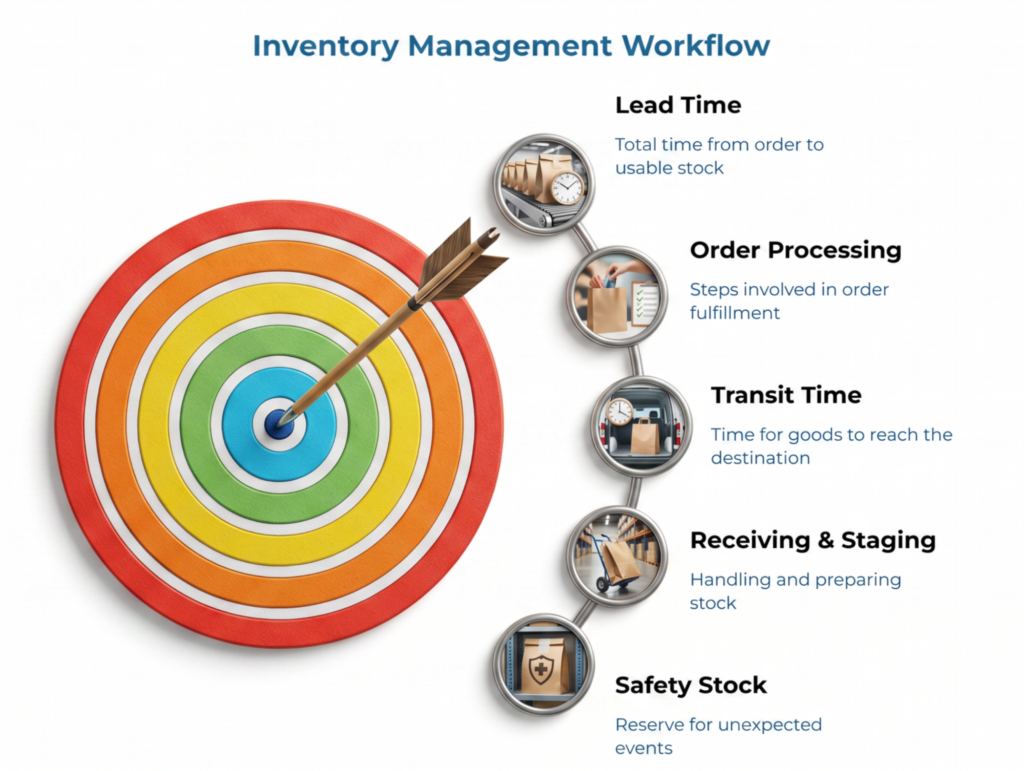
Lead time means the total elapsed time between placing an order and having usable stock on your shelf. In a paper bag workflow, that may include supplier confirmation, internal approval, purchase order processing, payment or account steps, transit time, receiving, and staging. Use your supplier’s confirmed lead time, or the actual order-to-delivery cycle observed on your last purchase, rather than an assumed number.
Answering the coverage question requires three inputs: the current daily usage rate, the number of days remaining stock will last at that rate, and the total time from order placement to delivery.
A qualitative check: recent daily usage × total lead-time days + a buffer for delays. If the stock on hand is close to or below that number, the reorder window may already be tight. The buffer depends on how predictable demand is, whether the SKU can be substituted, how critical the bag is to service, and how quickly the supplier can respond.
Safety stock, if used, is an extra reserve held to absorb unexpected demand or delivery delays. During a seasonal rush, both safety stock and lead-time awareness matter more because the margin for error shrinks.
The Paper Bag Stockout Early-Warning Checklist
This early-warning checklist converts operational signals into actionable reviews. Use this checklist during seasonal sales, event periods, food-service peaks, takeaway promotions, or any period when paper bag usage is moving faster than normal.
| Warning Sign | What to Check | What It May Mean | Next Action |
| Daily usage is rising | Compare recent daily usage to your normal off-season rate | Seasonal demand may be outpacing the original order | Recalculate days of cover at the current rate |
| One bag size is disappearing first | Count by SKU, not total cartons | A specific promotion, menu item, or use case is driving uneven demand | Rebalance stock or reorder that SKU specifically |
| Staff are substituting bags | Ask front-line teams where substitutions happen and how often | The correct bag type may already be constrained | Confirm critical SKU stock levels |
| Double-bagging increases | Check which items need two bags | Bag fit, load, or availability may be affecting consumption | Review the bag choice and packing method |
| Cartons are spread across areas | Walk all storage points and separate sealed, open, and counter-ready stock | Reported counts may overstate accessible inventory | Consolidate into one usable count sheet |
| Open cartons are not tracked | Separate sealed cartons, open cartons, and counter stock | Visual checks may be hiding a faster drawdown | Update the daily count method |
| Outlet transfers increase | Track which location borrows from which | One location’s shortage may be creating pressure elsewhere | Rebalance stock before reordering |
| Remaining stock is near or below lead-time coverage | Compare days of stock on hand to your supplier’s confirmed order-to-delivery timeline | The reorder window may already be tight or closed | Start the supplier or internal order discussion |
| Reorder based on last order, not current usage | Check whether the last order quantity assumed off-season demand | The order may not cover the rush-period rate | Update the reorder quantity using recent daily usage |
Any numbers applied from this checklist should reflect your own operation’s data. The examples above are illustrative.
What to Do When Two or More Warning Signs Appear Together
A single warning sign may call for closer monitoring. Two or more appearing together usually call for action.
If daily usage is rising and staff are also substituting larger bags, the issue may be more than a temporary spike. If one SKU is disappearing quickly and remaining stock no longer covers lead time, the team may need to start a reorder discussion. If the count sheet looks healthy but outlet transfers are increasing, the stock may be in the wrong place.
A practical sequence when multiple signals overlap:
- Recount by SKU. Separate stock by bag type and count what is actually accessible — not just what exists in the building.
- Check current daily usage. Base this on the last three to five rush-period days, not the off-season average.
- Confirm lead-time coverage. Compare usable stock against the full order-to-delivery timeline, including internal approvals.
- Identify critical bags. Determine which SKUs cannot be substituted without affecting service, packing, or customer experience.
- Redistribute stock. If one counter or outlet is under pressure, rebalance available inventory before placing a new order.
- Start a reorder discussion. If coverage is too tight, begin the supplier or internal order conversation immediately.
- Update the reorder trigger for the rest of the season. A reorder trigger is the stock level at which a team decides to review or place the next order. It should reflect current rush-period usage, supplier timing, and critical SKU availability — not only the quantity ordered last time.
For operations managing multiple outlets, asking the right supplier qualification questions for paper bag consistency can help set clearer expectations before the next busy period arrives.
Frequently Asked Questions
How often should small businesses count paper bag stock during a seasonal rush?
More frequently than during normal periods. For critical bag types — the ones tied to your highest-volume menu items or promotions — a daily count during peak periods can catch depletion trends before they become urgent. The count does not need to be complicated: a short SKU-level check of sealed cartons, open cartons, and counter stock may be enough to reveal whether the situation is stable or tightening. Less critical SKUs may need only a weekly check.
Should total paper bag stock or SKU-level stock matter more?
SKU-level stock matters most when bag types are not interchangeable. If a customer order requires a specific bag size or handle type, having plenty of a different size does not solve the problem. Total stock helps with broad storage planning, but SKU-level stock helps prevent practical service problems. When bag types can be freely substituted, total stock is a reasonable shortcut.
What is the simplest way to estimate whether paper bags will last through a rush?
Divide current usable stock by recent daily usage to get days of cover. Then compare that number to the total order-to-delivery timeline, including internal approvals and processing — not just the supplier transit time. Use current rush-period usage, not the off-season average. If the days of cover are close to or below the lead time, the reorder window is already tight.
What if we already ordered enough but one bag size is running short?
Check whether the order mix matched the actual demand pattern during the rush. A holiday takeaway promotion, a seasonal gift set, or a limited-time menu item can shift demand toward a bag type that was not weighted heavily in the original order. Recount the affected SKU, review substitution patterns, redistribute available stock if possible, and update the future order mix based on SKU-level usage data from this period.
Turn Warning Signs Into Your Next Reorder Trigger
Paper bag stockouts during seasonal rushes usually become visible through operational patterns well before shelves are empty. Faster drawdown, uneven SKU depletion, staff workarounds, fragmented storage counts, and shrinking lead-time coverage are signals that a small team can spot without specialized tools or complex forecasting. The best next step is to update counts, usage rate, lead-time assumptions, and SKU-level reorder triggers.
Use the checklist above to review your current bag counts, daily usage, and supplier lead-time coverage before the next rush period.
If you need to review supplier options, browse paper bag suppliers on PaperIndex. If you are ready to compare quotes, coordinate with your procurement team or standard vendor network to submit an RFQ with your specific paper bag requirements.
Disclaimer:
This article is for general informational purposes only. It is not a substitute for advice from a qualified professional, provider, supplier, or official source relevant to your situation. Always verify important procurement, inventory, and supplier decisions with the appropriate expert, authority, or service provider.
Our Editorial Process:
Our expert team uses AI tools to help organize and structure our initial drafts. Every piece is then extensively rewritten, fact-checked, and enriched with first-hand insights and experiences by expert humans on our Insights Team to ensure accuracy and clarity.
About the PaperIndex Insights Team:
The PaperIndex Insights Team is our dedicated engine for synthesizing complex topics into clear, helpful guides. While our content is thoroughly reviewed for clarity and accuracy, it is for informational purposes and should not replace professional advice.