

📌 Key Takeaways
Currency volatility erodes profit margins just like freight surcharges—but only if you leave it unmanaged.
- FX Behaves Like Silent Freight: The gap between your quote-day rate and settlement-day rate can add unexpected costs that rival the savings from negotiated discounts, yet most contracts treat currency movement as someone else’s problem.
- Two Safeguards Create Predictability: A transparent buffer (typically ±2-3%) absorbs routine daily fluctuations, while a pass-through clause with defined thresholds activates only when movements exceed normal ranges over consecutive business days.
- Public Sources Eliminate Disputes: Referencing official rates from central banks (like RBI or ECB) and documenting a 5-consecutive-day trigger transforms subjective arguments into mechanical, audit-ready adjustments that both parties can verify.
- Integration Beats Isolation: FX management works best as a fifth tile on your existing cost-driver dashboard alongside pulp, freight, and energy—quarterly reviews with fixed calendar dates prevent both crisis reactions and administrative overload.
- Procedural Control Requires Documentation: A one-page checklist capturing currency pair, threshold percentage, lookback period, buffer size, and evidence logging location turns FX from a vague anxiety into a repeatable operational discipline.
Declared buffers plus neutral pass-through clauses equal predictable landed costs and zero blame games.
SMB converters, importers, and finance controllers managing international kraft paper procurement will find practical implementation guidance here, setting the stage for the step-by-step framework detailed below.
Foreign exchange volatility sits alongside freight, fiber, and energy as a critical cost driver in kraft paper procurement—yet it’s the one most kraft paper buyers leave unprotected. An Indian importer is quoted $850 per metric ton in January. By the time payment is due in March, the rupee has weakened by 4% against the USD. The $850 price is unchanged, but the importer’s landed cost in rupees has jumped by 4%—an unplanned cost increase equivalent to $34 per ton. No surcharge was negotiated. No buffer existed. The finance team asks what happened, and procurement has no answer.
The real problem is the gap between the quote-day rate and the settlement-day rate. This timing difference acts exactly like an unplanned freight surcharge, silently inflating costs while both parties assume the original price still holds. You don’t need a Bloomberg terminal to stay in control of FX risk. What you need is a lightweight, two-part method that turns currency exposure into a managed, predictable line item: a transparent buffer built into every quote and a pass-through clause that activates only when movements exceed a defined threshold.
The Often-Missed Cost Driver: FX as Silent Freight
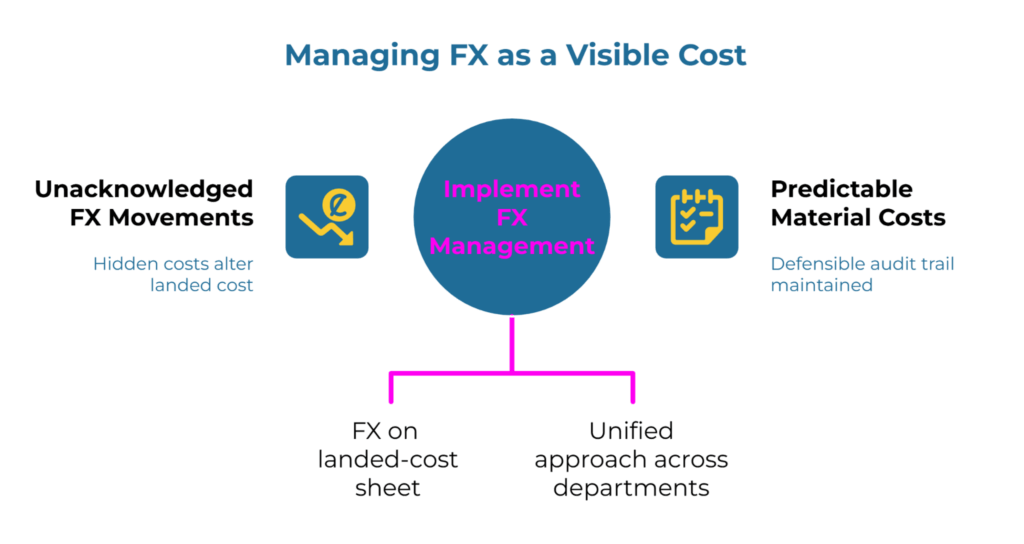
Currency fluctuations behave much like fuel surcharges or port congestion fees—they directly alter your landed cost, but unlike those factors, FX movements often go unacknowledged in contracts. A converter importing kraft paper from Southeast Asia might negotiate hard on the base price and Incoterms, only to discover that a 3% shift in the USD/INR pair quietly added more cost than the freight discount they fought to secure.
This problem compounds when multiple stakeholders are involved. Procurement teams focus on per-ton pricing. Finance controllers track budget variance. Operations managers need predictable material costs for production planning. Without a shared FX management method, each department reacts to currency swings in isolation, creating internal friction and making it impossible to maintain a defensible audit trail.
The solution lies in converting FX from a vague anxiety into a visible, rule-based cost driver that sits alongside pulp, energy, and freight on your landed-cost sheet. This supports the same to-door comparability logic discussed in our guide on containerboard cost stack explained.
Build a Transparent FX Buffer
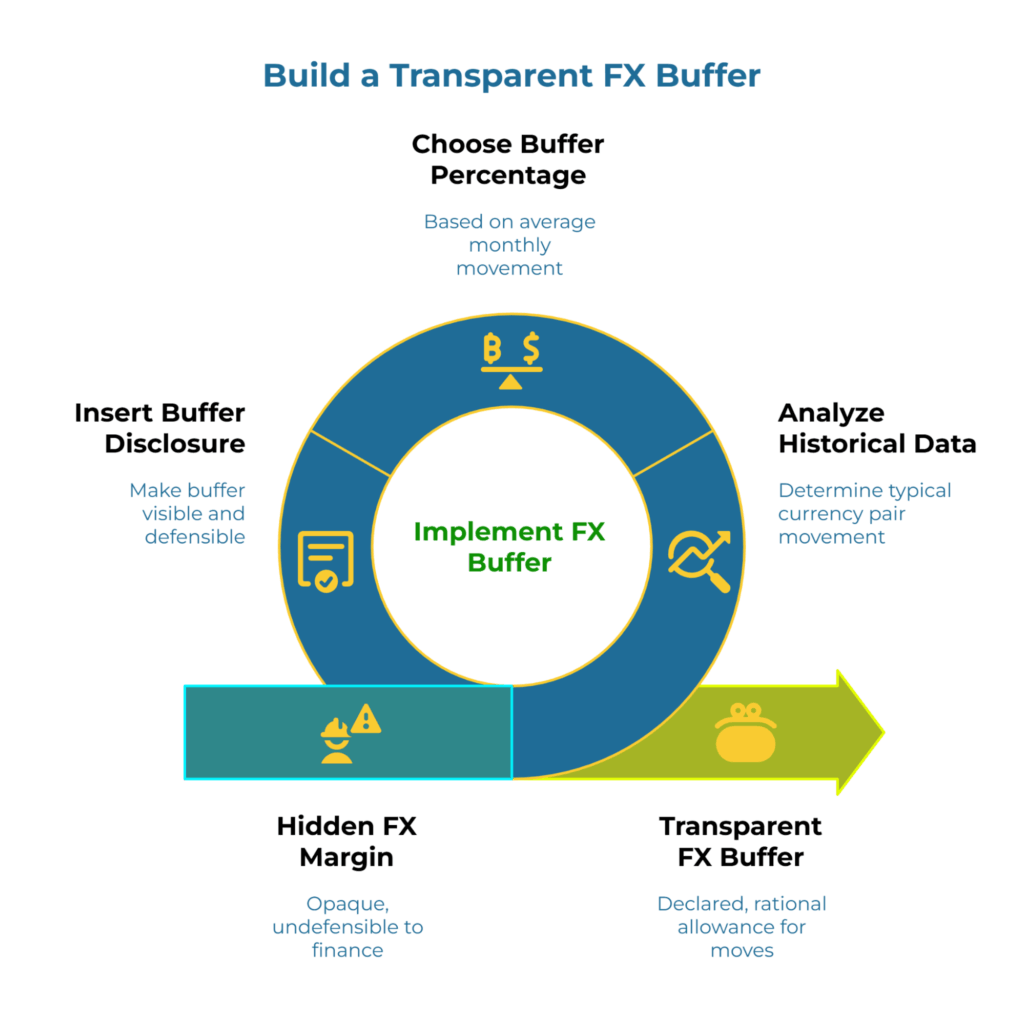
The first safeguard is a declared buffer—a small percentage added to the base quote specifically to absorb routine currency movements within an agreed review window.
Signal: Historical daily corridor analysis reveals that most major currency pairs experience movements of ±1-2% within any given month. A 12-month lookback at daily reference rates for your specific pair provides the foundation. For USD/INR transactions, the Reserve Bank of India’s reference rate archive offers reliable historical data. European transactions can reference the European Central Bank’s euro reference rates. The objective isn’t a perfect statistical model—just understanding whether your pair typically moves within a ±1-2% corridor over a month or experiences larger swings.
Guardrail: Choose a buffer percentage using your selected currency pair’s historical average monthly movement. For moderate-volatility pairs like USD/INR or EUR/USD, a buffer of ±2-3% is a common and effective starting point. Document the exact band, the lookback period used to calculate it, and the public source you’re referencing.
Action: Insert a buffer disclosure line in your quote footer or contract terms. This might read:
“Prices include a standard FX buffer of 2.5% intended to absorb routine currency moves within the agreed quarterly review window. The buffer is calculated using a 12-month average of daily USD/INR movements sourced from RBI Reference Rates.”
This single line accomplishes three goals. It makes the buffer visible and defensible to finance teams. It sets a shared expectation with suppliers about what level of FX movement is already priced in. It eliminates the post-award argument about whether a 1.5% currency shift justifies a price renegotiation.
The key is transparency. The buffer is not a hidden margin. It’s a declared, rational allowance based on verifiable historical data that both buyer and supplier agree reflects normal market conditions.
Add a Pass-Through Clause Beyond the Window
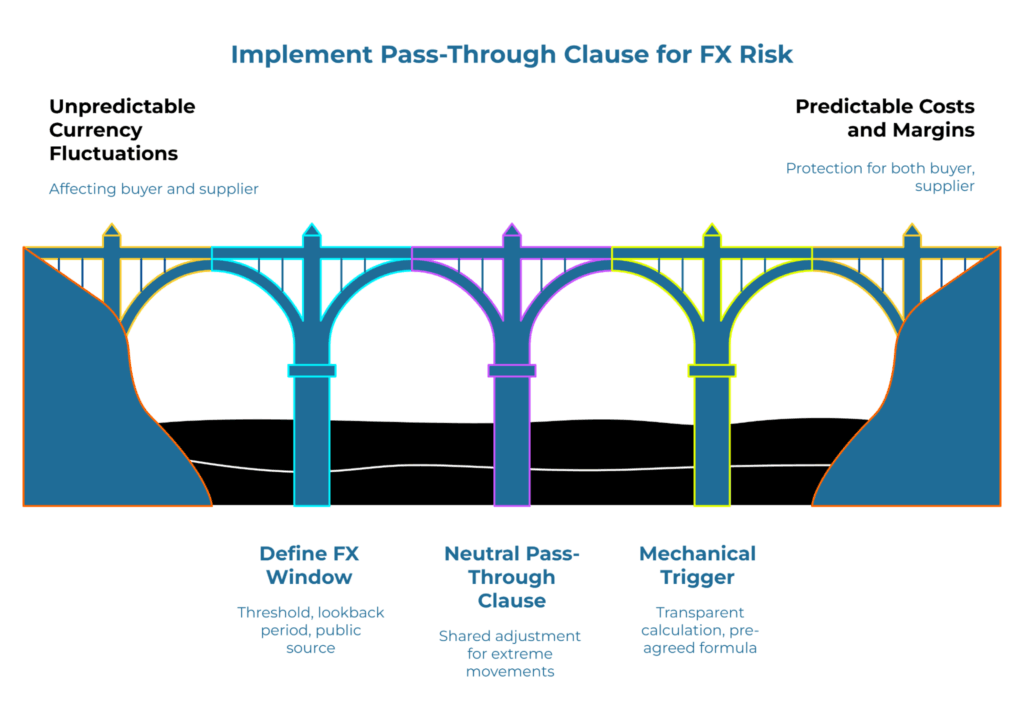
The buffer handles routine fluctuations. The pass-through clause addresses extraordinary movements—those that exceed your defined threshold and genuinely alter the economic fundamentals of the transaction.
Signal: Even with a buffer in place, currency pairs can experience sustained shifts. A 5% move over two months, for instance, falls well outside the normal range and materially impacts both the buyer’s landed cost and the supplier’s realized margin.
Guardrail: Define a clear FX window with three components—the threshold percentage, the lookback period, and the named public source. A typical structure might specify: “If the daily USD/INR midpoint published by the Reserve Bank of India changes by ±3% or more, and remains outside this band for 5 consecutive business days, then…” This consecutive-day requirement prevents a single-day spike from triggering unnecessary adjustments.
Action: Use a buyer-supplier neutral pass-through clause. A balanced template might state:
“If the daily [Currency Pair] midpoint published by [Named Public Source] changes by ±[X%] or more from the baseline rate and remains outside this band for 5 consecutive business days, the contract price will be adjusted proportionally. The adjustment will reflect 50% of the movement beyond the threshold, shared equally between buyer and supplier. Adjustments apply only to orders placed after the trigger date and will be reviewed [monthly/quarterly] on [specific calendar day].”
This structure protects both parties. The buyer gains cost predictability within the defined band. The supplier avoids margin compression from severe currency swings. The 50/50 split acknowledges that FX exposure is a shared reality of international trade, not a risk to be borne unilaterally. Organizations managing broader FX risk frameworks can reference guidance from institutions like the Bank for International Settlements to contextualize these bilateral arrangements within sound financial risk management principles.
Most importantly, the clause removes ambiguity. There’s no mid-order negotiation. The trigger is mechanical, the calculation is transparent, and the adjustment formula is pre-agreed.
Sync Review Cadence With Other Cost-Driver Checks
FX management works best when it’s integrated into your broader cost-driver discipline, not treated as a standalone concern. If you already conduct quarterly reviews of freight rates, fiber costs, and energy surcharges, add FX status as a fifth tile on that same dashboard.
Set a fixed review calendar—perhaps the first Monday of each quarter—and use it consistently. On that day, your team checks four inputs: the current spot rate from your named public source, the rolling average over your defined lookback period, the distance from your threshold, and whether the buffer remains appropriate given recent volatility patterns.
This cadence prevents two common mistakes. The first is ignoring FX until a crisis forces attention. The second is reacting to every daily movement, which creates unnecessary administrative churn. A quarterly rhythm strikes the right balance: frequent enough to catch meaningful shifts, infrequent enough to maintain operational efficiency.
The review output should be a simple status update: “Inside window – no action required” or “Triggered threshold – adjustment applied per clause.” Store this status in the same location where you track other cost components, ensuring finance and operations teams have unified visibility. For related guidance on managing multiple cost variables, explore when freight flips the winner.
Communicate and Log: One-Page Internal Checklist
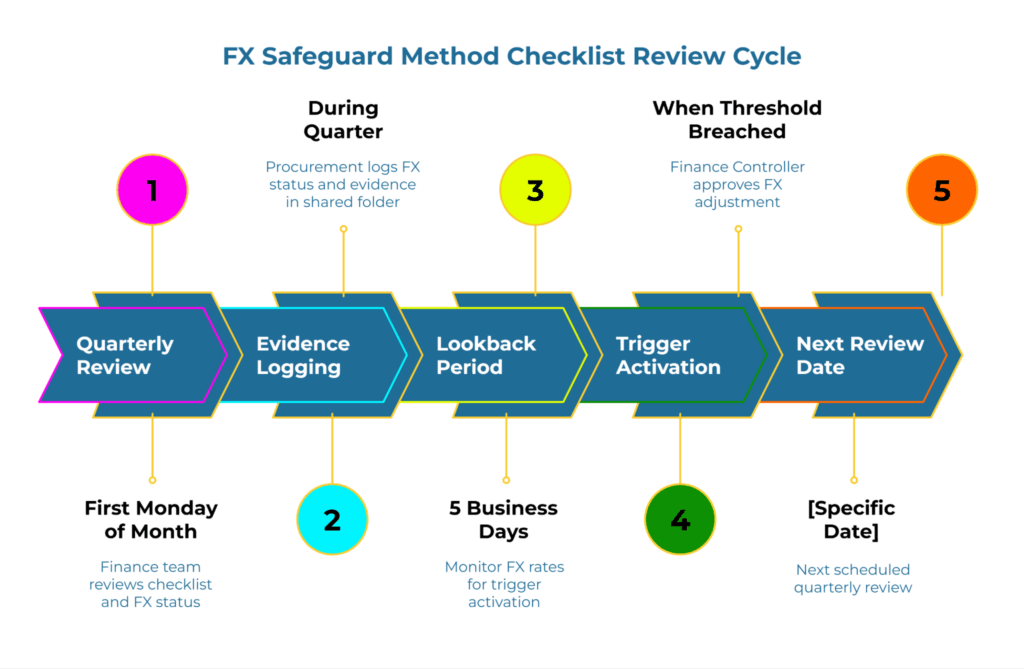
Procedural control requires documentation. Create a single-page internal checklist that captures every decision point in your FX safeguard method. This checklist becomes your audit trail and your onboarding tool for new team members.
Essential fields include:
- Currency pair and corridor: USD/INR, ±3% threshold
- Named public source: Reserve Bank of India Reference Rate (daily midpoint)
- Buffer size and placement: 2.5% buffer disclosed in quote footer
- Lookback period: 5 consecutive business days for trigger activation
- Review frequency: Quarterly, first Monday of month
- Evidence logging location: Shared procurement folder, “FX_Status_Q[X]_[Year].xlsx”
- Approval authority: Finance Controller signs off on triggered adjustments
- Next review date: [Specific date]
This checklist serves three audiences. Procurement uses it to standardize quote requests. Finance uses it to verify cost variance explanations. Suppliers reference it to understand adjustment timing and methodology.
The goal is to make FX management as routine as checking a shipment’s bill of lading. When the process is systematized, it stops being a negotiation and becomes a shared operational discipline.
Illustrative Example: Applying the Method
Consider a converter importing 200 metric tons of kraft paper monthly from a Vietnamese mill. The supplier quotes $900 per MT, FOB Haiphong, with payment in USD. The parties agree to a ±2% FX buffer and a ±2% pass-through threshold, using the relevant reference rate with a 5-consecutive-day trigger.
On contract signing, the baseline rate is ₹83.00 per USD. The agreed comfort band is ±2%, which translates to a corridor of ₹81.34 to ₹84.66 per USD.
Three months later, the rate moved to ₹84.50. This sits within the defined band, so no adjustment applies. The buffer absorbs the variance, and the dashboard shows “Inside window.”
By month six, the rate reaches ₹86.00 and remains above ₹84.66 for 5 consecutive business days. The pass-through clause activates. The movement from baseline is approximately 3.6%. Since the threshold was ±2%, the excess movement is 1.6%. With a 50/50 split, the price increases by 0.8%, or approximately $7.20 per MT for orders placed after the trigger date.
Both parties receive a one-page notification: “FX threshold triggered. Rate movement: 3.6% from baseline. Adjustment per clause: +0.8%. Effective date: orders placed after 2026.” No surprise. No debate. The contract language handled it.
Dashboard Integration: FX as Part of Your Cost-Driver Framework
The most effective buyers treat FX as one component of a unified cost-monitoring system. Your procurement dashboard might display four tiles: Freight Status, Fiber Index Movement, Energy Surcharges, and FX Position.
The FX tile shows three data points at a glance: Inside Window or Triggered (status indicator), Current vs. Threshold (2.1% of 2.0% threshold used), and Next Review Date (March 5). This visual integration reinforces that FX management is not a separate workstream—it’s part of your standard cost governance.
When all four cost drivers are tracked on a single view, stakeholder conversations improve dramatically. Instead of finance asking “Why did costs increase?” and procurement responding with a long explanation, the dashboard provides the answer instantly. This shared visibility reduces internal friction and accelerates decision-making.
For foundational guidance on aligning cost components, see our article on incoterms for paper supply.
Next Actions and Resources
Converting FX awareness into operational discipline requires three immediate steps. First, select your currency pair, buffer percentage, and threshold based on historical data from a public source. Second, draft your buffer disclosure and pass-through clause using the templates outlined above. Third, integrate FX reviews into your existing cost-driver calendar and assign a single owner for logging and communication.
For ongoing learning, the PaperIndex Academy offers related resources on landed cost comparability and Incoterms application. When you’re ready to apply these principles to live procurement, find kraft paper suppliers or submit an RFQ to connect with verified mills and exporters.
Disclaimer: All illustrative figures in this article are for demonstration purposes. Currency movements and buffer sizing should be determined based on your specific circumstances and verified data sources. Consult qualified financial or procurement professionals for advice tailored to your situation.
Our Editorial Process
Our expert team uses AI tools to help organize and structure our initial drafts. Every piece is then extensively rewritten, fact-checked, and enriched with first-hand insights and experiences by expert humans on our Insights Team to ensure accuracy and clarity.
About the PaperIndex Insights Team
The PaperIndex Insights Team is our dedicated engine for synthesizing complex topics into clear, helpful guides. While our content is thoroughly reviewed for clarity and accuracy, it is for informational purposes and should not replace professional advice.