
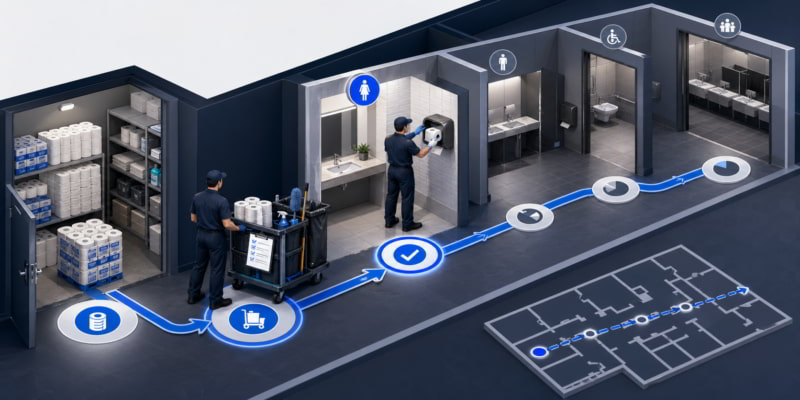
📌 Key Takeaways
Toilet tissue runs out when refilling isn’t built into daily custodial routes — not because the supply closet is empty.
- Route It, Don’t Wing It: Assign every restroom to a cleaning route, a shift, and a specific person so none get skipped.
- Refill Before Empty: Set a clear “swap it now” point — like a quarter-roll left — instead of waiting until the last sheet is gone.
- Shift Handoffs Need Notes: A written log beats a verbal update because the next crew needs to know exactly which restrooms still need attention.
- Load the Cart First: Stock the cleaning cart with enough rolls to finish the full route before leaving the supply closet.
- Check Patterns, Not Just Calendars: Review which restrooms run out most often and adjust how frequently they’re checked based on real use, not old guesses.
Stock on the shelf only matters when it reaches the dispenser before the guest does.
Facilities managers, custodial supervisors, and operations teams overseeing commercial restrooms will find a ready-made workflow framework here, preparing them for the detailed implementation steps that follow.
~ ~ ~ ~ ~ ~ ~ ~ ~ ~ ~ ~ ~ ~ ~ ~ ~ ~
While toilet tissue stockouts in commercial facilities can occasionally result from procurement oversights, delayed purchase orders, or broader supply chain disruptions, at the facility operations level, they typically happen because replenishment is not connected to the daily routines that custodial staff actually follow. Facilities that need a structured approach to preventing emergency orders can start by learning how to set commercial toilet tissue reorder points and replenishment cycles.
Operational success is measured by the guest’s seamless experience during peak hours—facilitated by the invisible handoff and pre-route preparation. Without a plan, the cases sitting in storage three floors down might as well not exist. The custodial cart that started its morning route left the supply closet without backup rolls. Nobody checked that restroom since Friday’s closing shift because the handoff note between day and evening crew was never written.
Away-from-home operators need more than inventory sitting in a storage room. They need a repeatable process that tells staff when to check restrooms, when to refill dispensers, how to prioritize high-traffic areas, and how to communicate low-stock conditions before they become service failures. Restroom tissue availability directly affects the experience of every guest, tenant, patient, employee, and student who walks through a facility’s doors — and when replenishment operates as an occasional emergency task rather than a built-in part of daily service routes, the gaps show up quickly.
Why Toilet Tissue Replenishment Needs to Be Part of the Restroom Servicing Workflow
Procurement teams calculate usage rates, set reorder points, and negotiate case quantities with bath tissue suppliers. Those calculations only produce results when custodial teams execute replenishment consistently at the restroom level.
A restroom servicing workflow is the sequence of checks, cleaning tasks, restocking actions, condition reporting, and shift handoffs that custodial staff follow throughout an operating day. When toilet tissue replenishment sits outside that sequence — treated as a separate purchasing concern rather than an embedded step — the result is a disconnect between what has been ordered and what has actually been placed where users need it.
The distinction between inventory availability and dispenser availability makes this concrete. A facility may have sufficient cases in its supply closet and still experience empty dispensers on the third floor because check routines are informal, refill thresholds are undefined, or shift responsibilities were never documented. Toilet tissue functions as both an inventory item managed by procurement and a service-critical consumable managed by operations. Bridging those two roles constitutes the core challenge.
Effective planning synchronizes inventory volume with point-of-use availability — a process that begins with forecasting commercial toilet tissue usage before stockouts occur. The first question belongs to procurement. The second belongs to operations. A well-designed servicing workflow connects them.
The regulatory landscape reinforces why this connection matters. OSHA frames sanitary and immediately available toilet facilities as part of workplace sanitation expectations in the United States. Facilities outside the U.S. should confirm the applicable local rules, but the operational message is broadly relevant: restroom availability and condition are not minor details. They affect health, dignity, and service continuity.
How Often Should Commercial Restrooms Be Checked for Toilet Tissue Replenishment?
No single check frequency works for every restroom. A small office restroom serving eight employees and a hospital lobby restroom open around the clock to visitors, patients, and staff require fundamentally different service intervals. Check frequency should be based on traffic patterns, facility type, peak usage windows, and dispenser capacity.
CDC guidance on cleaning and disinfecting facilities recognizes that high-traffic areas may require more frequent cleaning because use level affects risk and cleaning need. The same principle applies to restroom supply checks: high-utilization zones require proportional service frequency.
A practical starting point is to classify every restroom in the facility by usage tier — and then assign check intervals accordingly.
| Restroom Tier | Typical Examples | Replenishment Approach |
| Low Traffic | Back-office restrooms, small staff areas, executive suites, remote corridors | Check during standard cleaning rounds, but assign clear ownership so they are not skipped |
| Medium Traffic | Shared-floor office restrooms, employee restrooms, secondary retail restrooms, school wing restrooms | Check at least once during each main operating period and confirm dispenser status |
| High Traffic | Hotel lobby restrooms, cafeteria restrooms, retail customer restrooms, conference-area restrooms, school hallway restrooms | Check before, during, and after predictable peak windows |
| Critical | Patient-adjacent restrooms, visitor restrooms in healthcare, transport hub restrooms, event restrooms, high-volume retail locations | Monitor closely because stockouts create immediate complaints, hygiene concerns, or service disruption |
A small office may only need checks at opening, mid-day, and closing. A school may need checks before morning arrival, after lunch, and after afternoon dismissal. A hotel may need tighter checks during breakfast service, check-in periods, and conferences. A retail facility may need more attention near fitting rooms, food courts, customer service areas, or main entrances.
Check frequency is not a set-it-and-forget-it decision. Intervals should be reviewed whenever occupancy levels change, event schedules shift, or operating hours expand. A seasonal resort operating at peak capacity during summer months requires a different service cadence than it does during the shoulder season. Similarly, retail environments must adjust for holiday surges, and academic institutions must pivot for exam cycles.
Turning Check Frequency Into a Daily Refill Schedule
Usage tiers provide the classification. A toilet tissue refill schedule translates that classification into daily action.
The schedule does not need to be complicated. It should answer four questions for every restroom: when it is checked, who checks it, what refill trigger applies, and how exceptions are reported.
A medium-traffic office restroom may be checked during the morning round, after lunch, and before closing. A hotel lobby restroom may be checked before breakfast, during late morning turnover, before check-in, and after evening event traffic. A healthcare facility may require more continuous monitoring in visitor and patient-adjacent areas because restroom access often extends across shifts.
The refill schedule should also change when conditions change. Review it after occupancy shifts, event schedule changes, altered operating hours, seasonal peaks, patient volume fluctuations, school calendar changes, or repeated stockout complaints. A fixed schedule is useful. A reviewed schedule is better.
Building Restroom Replenishment Routes for Janitorial Teams
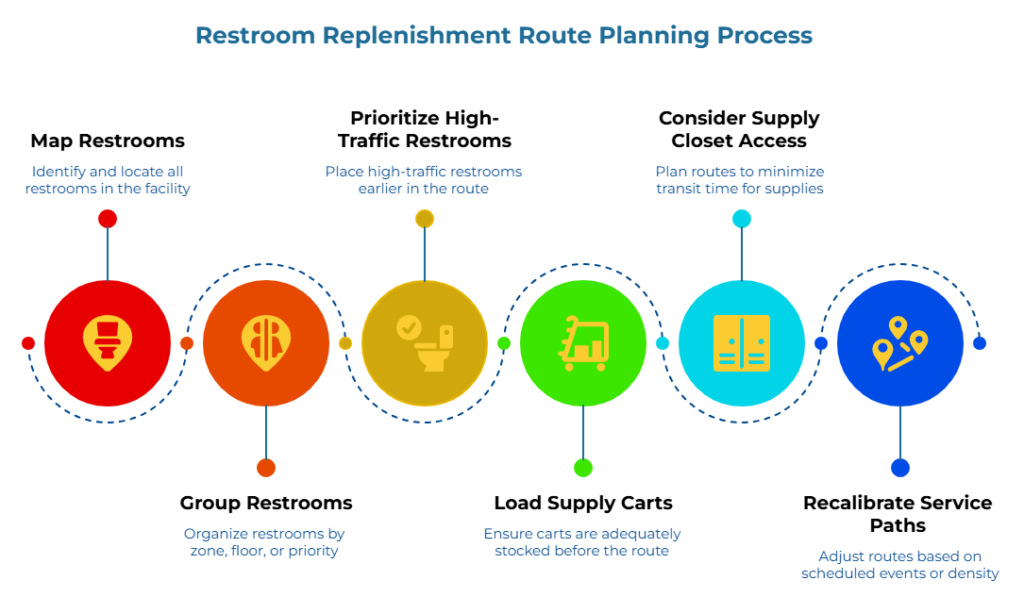
Route planning helps custodial teams check restrooms in a logical sequence rather than responding randomly to complaints or last-minute calls. The goal is straightforward: reduce wasted walking time while making sure high-demand restrooms are serviced before stockouts occur.
Routes should account for six factors: restroom location, traffic level, floor plan layout, supply closet access, staff availability, and shift timing. Different shifts may need different routes because the restrooms that are open, the traffic patterns, and the staff available all change between day, evening, and overnight periods.
Start by mapping every restroom in the facility. Group them by zone, floor, building wing, department, or service priority. Place high-traffic restrooms earlier in each route so they receive attention first. A commercial office building, for example, might assign one route for lobby and shared-tenant restrooms, a second for upper-floor restrooms near conference rooms and open offices, and a final closing route to reset all dispensers before the next business day. A school might group restrooms by academic wing, cafeteria area, gym area, and after-school activity zones. A hotel might have separate lobby, restaurant, conference, public-area, and back-of-house restrooms.
Supply-cart loading before the route begins is a step that frequently gets skipped. A custodial cart that leaves the supply closet without enough toilet tissue rolls to complete the full route forces a mid-route return trip — doubling the time investment and leaving downstream restrooms unserviced.
Supply closet access matters more than it first appears. If a high-traffic restroom is far from the main closet, the route may need a better-loaded cart, a nearby backup storage point, or a mid-route restock stop. A 9-minute transit for supplies constitutes ‘non-value-added time’ in Lean custodial workflows.
Service paths require recalibration to account for scheduled events, fluctuating inpatient counts in clinical settings, or shifting student density during extracurricular blocks. Building flexibility into the route structure prevents ad hoc adjustments from becoming the norm.
Setting Clear Refill Triggers for Custodial Staff
Without clear refill rules, one employee may replace a roll when it is half-used while another waits until nearly empty. This inconsistency causes waste, stockouts, and poor user experience — sometimes all at once.
The distinction between empty roll replacement and preventive refill is the foundation. Empty roll replacement is reactive: staff act only when a roll is fully spent. Preventive refill is proactive: staff top off or swap a roll before it reaches a critical low point, especially ahead of peak periods or overnight gaps.
Facilities benefit from defining a visual threshold that staff can apply quickly during a route — a specific remaining diameter, a marked line on the dispenser, or a simple “less than a quarter-roll remaining” rule. The threshold should be documented and consistent across all team members.
Dispenser type affects refill logic directly. Jumbo-roll dispensers, standard-roll holders, coreless systems, and multi-roll dispensers each present different visual cues and capacity profiles. For a deeper look at how format selection drives replenishment planning, see how toilet tissue dispenser format and roll type affect replenishment planning. A trigger designed for a standard two-roll holder does not translate to a three-roll jumbo system. Multi-roll dispensers may still have backup capacity when one roll is low, while a single-roll dispenser may require faster action. Match the trigger to the hardware.
This is where product specification and workflow meet. Procurement teams comparing toilet tissue specifications should consider not only sheet count, roll size, and dispenser fit, but also how the chosen format affects refill decisions during real service routes.
Practical trigger examples for most commercial environments:
- Replace or refill when the active roll falls below the facility’s defined minimum remaining level.
- Refill before known peak periods, even if the dispenser is not yet at the threshold.
- Always reset high-traffic restrooms before an overnight gap or before the next major usage period.
- Report abnormal consumption if a restroom repeatedly needs earlier-than-expected refills — the pattern may indicate a dispenser capacity issue, a traffic classification that needs updating, or a maintenance problem such as a jammed mechanism wasting product.
Defining the trigger removes the guesswork that produces both problems.
Shift-Based Toilet Tissue Replenishment Planning
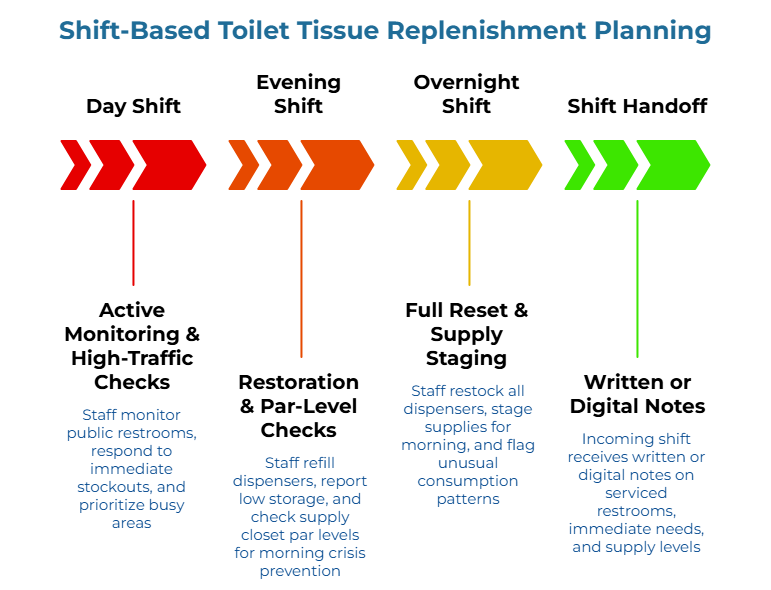
Assigning specific replenishment responsibilities to each shift reduces ambiguity and prevents the assumption gaps that cause between-shift stockouts. When the only instruction is “everyone restocks as needed,” accountability disappears.
Day shift responsibilities typically focus on active monitoring, high-traffic checks, and response to immediate stock concerns. Staff should prioritize public-facing restrooms and areas with peak daytime use. In retail environments, this includes customer-facing restrooms near entrances and fitting rooms. In office buildings, it means shared-floor and lobby restrooms.
Evening shift responsibilities center on restoration after the main operating period. Staff should refill dispensers, report low storage levels, and prepare restrooms for after-hours users or the overnight reset. This is the shift where par-level checks in supply closets matter most — if stock is running low, the evening team flags the gap before it becomes a morning crisis.
Overnight shift responsibilities, where applicable, focus on a full reset. This may include restocking all dispensers to capacity, staging supplies for morning routes, and flagging restrooms with unusual consumption patterns for the incoming day shift to investigate.
High-availability environments—including acute care centers, hospitality hubs, and transit terminals—must maintain active replenishment cycles during the third shift to prevent morning service deficits. These environments need active overnight servicing routes, not just a reset before the morning.
Industry standards for high-stakes environments emphasize rigorous scheduling, clear ownership, and the utilization of job aids to ensure procedural adherence. That principle applies beyond healthcare: every shift should know what it owns and what the next shift needs to know.
The vulnerability point sits between shifts. A verbal-only handoff during a busy transition is unreliable. Written or digital handoff notes — even a simple form taped to the supply closet door — give the incoming shift the information it needs: which restrooms were serviced, which need immediate attention, and whether backup supplies are running low.
Managing Toilet Tissue Replenishment Across Multiple Restrooms
The more restrooms a facility operates, the more important it becomes to standardize routes, supply staging, documentation, and escalation procedures. A facility managing 15, 30, or 60 restrooms across multiple floors and buildings needs coordination — not just individual restroom checks.
Common challenges are predictable. Some restrooms run out faster than others. Staff may prioritize visible restrooms over remote ones. Supply closets may not be evenly stocked across different zones or floors. Usage may vary significantly by department, building wing, or time of day.
Assign every restroom to a route, a shift, or a responsible team. No restroom should be unowned — if a location does not appear on any route sheet or checklist, it is effectively invisible to the replenishment process. Restroom-level tracking for high-traffic or complaint-prone areas reveals which locations consistently need more attention, earlier checks, or higher-capacity dispensers.
Some facilities benefit from decentralized storage points — placing satellite supply caches closer to high-demand zones to shorten restocking trips. Guidance on structuring these storage areas is covered in commercial toilet tissue roll storage requirements for commercial janitorial programs. Others centralize supply control for tighter inventory visibility. The right approach depends on building layout, staff distribution, storage security, and how closely inventory must be controlled. Either way, standardizing dispenser types where possible simplifies restocking, reduces training complexity, and eliminates the need to carry multiple toilet tissue roll formats on a single cart. When one building uses too many dispenser formats, staff must carry more product types, make more refill decisions, and remember more exceptions — increasing the risk of cart-loading errors and wrong-product placement.
Not every facility can standardize immediately. That may depend on existing contracts, mounted hardware, budget, and supplier availability. Still, dispenser variation should be treated as an operational factor, not only a purchasing detail.
When problems exceed what custodial staff can resolve on the spot — a broken dispenser, a fully depleted storage point, or a sustained spike in consumption from an unplanned event — clear escalation procedures ensure the issue reaches someone who can act on it rather than lingering as an unresolved complaint.
Review stockout complaints by location regularly. Adjust service frequency based on actual usage, not assumptions made six months ago.
Housekeeping Handoff Procedures for Hotels, Schools, and Healthcare Facilities
Handoffs are especially important in environments where multiple teams, shifts, or departments touch restroom servicing. The more people involved in the process, the more structured the handoff needs to be.
A handoff log or digital task system should capture the details the next shift needs: restroom location, current tissue status, refill completed or still needed, dispenser jam or damage or access issue, abnormal consumption, nearby backup supply status, urgency level, and assigned follow-up owner. The difference between a useful handoff and a useless one often comes down to specificity. “Restrooms checked” is too vague. “Lobby women’s restroom refilled at 3:40 p.m.; conference restroom low before evening event; dispenser jam reported in second-floor staff restroom” is something the next shift can act on.
Hotels. Housekeeping, public-area attendants, and event staff may all interact with restroom supplies. Handoffs should cover lobby restrooms, conference areas, restaurant restrooms, and public restrooms affected by occupancy or events. A hotel running a large banquet on a Saturday evening needs a specific handoff plan for the restrooms nearest the event space — separate from the standard daily handoff covering guest floors and pool areas.
Schools. Custodial teams need to plan around predictable usage spikes during morning arrival, lunch, passing periods, assemblies, and extracurricular activities. The morning crew should hand off to the mid-day crew with notes on which restrooms saw heavy use. The mid-day crew flags restrooms that need attention before afternoon dismissal. If after-school programs run late, the evening crew inherits responsibility for restrooms that might otherwise have been locked.
Healthcare facilities. Replenishment may need to align with infection control expectations, patient flow, visitor areas, and 24/7 restroom access. Handoffs should prioritize public restrooms, patient-adjacent areas, visitor areas, and any restrooms requiring stricter hygiene oversight. Staff restrooms in clinical areas also need coverage — a stockout in a nurse station restroom during a 12-hour overnight shift is a morale issue the team remembers.
Across all three environments, handoffs should include supply levels, problem restrooms, unusual consumption, dispenser issues, and emergency restock needs. A simple handoff log or digital task system outperforms verbal-only communication, particularly during busy shifts or periods of staff turnover. Verbal handoffs can fail when the person receiving the information is managing three other priorities.
Using Checklists to Standardize Restroom Replenishment
Checklists help make replenishment consistent across staff members, shifts, and facility zones. A well-designed checklist should be simple enough to complete in seconds per restroom but specific enough to confirm that tissue supply was actually reviewed — not assumed.
A practical restroom replenishment checklist captures:
- Restroom location
- Time checked
- Dispenser status (full, partial, or empty)
- Roll replacement or refill completed
- Backup supply available nearby, if applicable
- Dispenser damage or jam reported
- Unusual usage or repeated low-stock condition
- Staff initials or digital confirmation
The checklist should not become so detailed that staff stop filling it out. If completing the form takes longer than the actual restroom check, it needs simplification. In many facilities, routine completion can be confirmed quickly while exceptions get more detailed notes. That keeps the process useful during busy service periods.
Over time, checklist data reveals patterns. The same restroom appearing repeatedly with low-stock flags signals a route frequency problem, a dispenser capacity mismatch, or a traffic classification that needs updating. That diagnostic value is what makes the checklist worth maintaining.
Beyond accountability, checklists also serve as a training tool. New custodial staff can use a completed checklist as a reference for what a proper restroom check involves, what to look for, and what to report. Tying checklist usage to both accountability and training reinforces the habit across the team.
Common Workflow Gaps That Cause Toilet Tissue Stockouts
While raw material shortages and supplier lead-time variability remain baseline risks for procurement teams, day-to-day dispenser stockouts typically come from internal process breakdowns. The following problem-fix pairs help facilities managers diagnose and address the most frequent operational gaps.
Staff only replace fully empty rolls. Set preventive refill thresholds for high-traffic restrooms so that rolls are swapped before the last sheets disappear.
Public restrooms receive attention, but staff-only restrooms are skipped. Assign every restroom — including back-of-house and staff-only locations — to a route and a checklist entry. If a restroom is not on the list, it will eventually run out.
Evening staff assume the day shift is already restocked. Use handoff notes with restroom-specific supply status so that each incoming shift knows exactly which restrooms need follow-up. Assumptions between shifts are the single most common handoff failure.
Supplies are in storage but not loaded onto carts. Add pre-route cart loading to the replenishment process as a required first step. A full supply closet does nothing for a restroom if the rolls never make it onto the cart.
Traffic assumptions are outdated. A restroom classified as medium-traffic six months ago may now be high-traffic after an occupancy change, schedule shift, or new tenant. Fixed restocking logic that does not adapt to these changes is a common root cause explored in why linear AFH toilet tissue restocking leads to washroom outages. Review check frequency monthly or after major changes.
Dispenser problems are mistaken for stockouts. A jammed mechanism or incorrect roll format can look like a supply issue. Including dispenser condition in checklist fields helps separate true supply gaps from maintenance problems.
Each of these gaps is fixable. The pattern behind them is the same: a step that was never formalized into the workflow, left to individual judgment or habit.
| Workflow Gap | Likely Result | Practical Fix |
| No clear refill trigger | Staff refill inconsistently | Define visual thresholds by dispenser type and usage tier |
| Random restroom checks | Complaints drive the route | Build janitorial restroom routes by zone, floor, and traffic level |
| Remote restroom has no owner | Low-use areas still run out | Assign every restroom to a shift, route, or team |
| Cart loading is informal | Stock exists in storage but not on the route | Add pre-route cart loading to custodial replenishment procedures |
| Handoff is verbal only | Follow-up tasks are forgotten | Use a short handoff log or digital task note |
| Traffic assumptions are old | High-use restrooms run out early | Review check frequency monthly or after major changes |
| Dispenser problems are not reported | Jams look like stockouts | Include dispenser condition in checklist fields |
How Procurement and Custodial Teams Should Work Together
Procurement teams and custodial teams need feedback loops. Procurement manages purchasing, supplier lead times, and par levels. Custodial teams see real consumption patterns every day — which restrooms burn through rolls faster than expected, which dispensers jam, and which shifts struggle to keep up.
When procurement sets reorder points based solely on aggregate facility consumption, it misses restroom-level variation. If certain restrooms require frequent emergency refills, the issue may be dispenser capacity, route frequency, traffic assumptions, or reorder planning. Custodial teams hold the diagnostic data that procurement needs to distinguish between these causes.
A monthly review where the custodial supervisor shares recurring stockout locations, exception-flagged restrooms, and dispenser issues gives procurement the data to adjust reorder points and safety stock levels. For a step-by-step method to structure these adjustments, see commercial toilet tissue inventory management for janitorial operations. That same information helps distributor buyers recommend better case quantities, dispenser formats, or delivery schedules aligned to actual consumption rather than calendar-based defaults. If a buyer is also reviewing supplier fit across hospitality, healthcare, and education locations, a multi-site AFH toilet tissue supplier verification process can help connect product suitability with real facility conditions.
Regular communication between procurement and operations does not need to be elaborate. A shared spreadsheet, a standing 15-minute monthly check-in, or a simple report from checklist data can close the feedback gap.
The best replenishment programs connect purchasing data with restroom-level service observations. Neither team holds the complete picture alone.
Practical Steps to Improve a Toilet Tissue Replenishment Workflow
The following steps are designed to be converted directly into a standard operating procedure and adapted to each facility’s specific needs.
- Map every restroom by location, traffic level, dispenser type, and route owner. Include public, staff-only, remote, high-risk, and event-affected restrooms. No restroom should be undocumented.
- Assign each restroom to a route, shift, or responsible team.
- Define refill triggers by dispenser type and usage tier. Document the triggers so every staff member applies the same standard.
- Build supply-cart loading into the start of each route. Staff should begin with the right roll types, enough backup supply, and any special products required for specific dispenser formats. If product specifications are inconsistent across locations, procurement may need to normalize AFH toilet tissue specification inputs so teams are not managing avoidable variation at the service level.
- Use checklists for high-traffic or high-risk restrooms.
- Create handoff procedures between shifts.
- Track recurring stockouts by restroom location.
- Review usage patterns monthly or after major occupancy changes.
This is not a one-time setup. The process should be reviewed and adjusted over time as occupancy shifts, facility layouts change, and new data from checklists and stockout tracking reveals where the workflow needs tightening. Each review cycle brings replenishment closer to the actual rhythm of the facility’s restroom usage.
Conclusion
Toilet tissue replenishment is not just a purchasing task. It is an operational workflow that depends on check frequency, route design, refill triggers, shift responsibilities, and clear communication between teams.
Facilities that treat restroom supply availability as part of service quality — rather than as a side effect of good purchasing — gain something that inventory management alone cannot deliver: predictable restroom conditions that guests, tenants, patients, employees, and students never have to think about. When replenishment is integrated into custodial workflows, operators can reduce complaints, avoid emergency orders, control waste, and maintain a more consistent restroom experience across every shift and every floor.
The lobby restroom at 8:47 AM does not need more cases in the stockroom. It needs a route that reaches it before peak traffic, a trigger that replaces the roll before the last sheet, a handoff note from Friday’s closing crew, and a cart that left the supply closet fully loaded. Not more stock. Better flow.
Frequently Asked Questions
How often should commercial restrooms be checked for toilet tissue?
Commercial restrooms should be checked based on traffic level, operating hours, and dispenser capacity. Low-traffic restrooms may be checked during standard cleaning rounds, while high-traffic or public-facing restrooms may need checks before, during, and after peak usage periods. Classifying restrooms by usage tier provides a practical foundation for setting intervals that match actual demand.
What is the best way to plan restroom replenishment routes?
The best approach is to group restrooms by location, floor, traffic level, supply access, and service priority. High-traffic restrooms should be prioritized earlier in the route, and each restroom should have a clear service owner by shift or zone. Adjust routes when occupancy, event schedules, or operating hours change.
When should custodial staff replace or refill toilet tissue rolls?
Staff should follow a defined refill trigger instead of waiting for rolls to become completely empty. Many facilities use preventive thresholds for high-traffic restrooms, especially before long gaps between service checks or before peak usage periods. The trigger should match the dispenser type — a rule designed for a standard two-roll holder does not translate to a multi-roll jumbo system.
How can facilities prevent toilet tissue stockouts between shifts?
Facilities can prevent between-shift stockouts by using handoff notes, route checklists, shift-based responsibilities, and clear escalation procedures. Each shift should know which restrooms were serviced, which ones need follow-up, and whether backup stock is running low.
Why do restrooms run out of toilet tissue even when inventory is available?
This often happens when inventory planning is disconnected from custodial workflow. Supplies may be available in storage, but dispensers can still run empty if routes are skipped, carts are not stocked, refill triggers are unclear, or shift handoffs fail.
How should hotels, schools, and healthcare facilities handle restroom supply handoffs?
Hotels should account for guest areas, event spaces, and public restrooms. Schools should plan around arrival, lunch, dismissal, and after-school use. Healthcare facilities should prioritize 24/7 access areas, public restrooms, patient-adjacent locations, and hygiene-sensitive spaces. In all cases, written handoff logs outperform verbal-only communication.
What should be included in a restroom replenishment checklist?
A restroom replenishment checklist should include restroom location, time checked, dispenser status, refill action taken, dispenser issues, unusual usage, and staff confirmation. High-traffic facilities may also track recurring low-stock areas to adjust service frequency.
Disclaimer:
This article is for educational and informational purposes only. The operational guidance provided here is intended to help facilities professionals improve their restroom servicing workflows and does not constitute professional consulting advice. Specific facility requirements may vary based on building codes, occupancy regulations, and organizational policies.
Our Editorial Process:
Our expert team uses AI tools to help organize and structure our initial drafts. Every piece is then extensively rewritten, fact-checked, and enriched with first-hand insights and experiences by expert humans on our Insights Team to ensure accuracy and clarity.
About the PaperIndex Insights Team:
The PaperIndex Insights Team is our dedicated engine for synthesizing complex topics into clear, helpful guides. While our content is thoroughly reviewed for clarity and accuracy, it is for informational purposes and should not replace professional advice.