

📌 Key Takeaways
Switching from plastic to folding cartons works only when you treat it as a translation project—not a simple material swap.
- Translate, Don’t Copy: Folding cartons and plastic protect products through different methods, so copying dimensions won’t copy performance.
- Audit Before You Shop: Document what your plastic pack actually does—structure, barrier, line behaviour—before picking a folding carton.
- Write Down Your Numbers: Define exact targets and tolerance ranges for thickness, stiffness, and moisture before asking suppliers for quotes.
- Looks Can Deceive: A folding carton that looks perfect in the sample room can still jam at production speed if structural specifications don’t match.
- Sustainability ≠ Compatibility: Meeting green goals and running cleanly on your line are separate problems that need separate solutions.
Translation beats substitution—define what must be true, measure it, then verify it.
Packaging engineers, procurement managers, and sustainability leads planning material transitions will find a clear methodology here, preparing them for the detailed workflow that follows.
~ ~ ~ ~ ~ ~ ~ ~ ~ ~ ~ ~ ~ ~ ~ ~ ~ ~
A packaging change sounds simple enough: swap out the rigid plastic tub for a folding carton, update the artwork, and check the sustainability box.
Folding cartons behave differently under compression. They respond differently to humidity. They run differently on automated filling lines calibrated for plastic’s predictable rigidity. A transition that ignores these realities will fail—not because the intention was wrong, but because the packaging was never re-engineered for the new material.
This guide treats the plastic-to-folding carton transition as what it actually is: a structured translation exercise. Rather than seeking a drop-in replacement, engineers must map current plastic performance, translate those functions into paperboard variables, and normalize specifications before any supplier conversation begins.
A word-for-word translation produces nonsense. A thoughtful translation preserves meaning while respecting the rules of the new language. A folding carton that merely mimics the dimensions of a plastic tub will not replicate its performance. The folding carton needs its own structural logic, defined in paperboard terms.
| Myth | Reality |
| A folding carton is a drop-in replacement for rigid plastic. | A folding carton is a different structural system that must be translated and normalized before comparison. |
| A good-looking sample proves technical fit. | Visual approval may hide structural mismatch, especially on high-speed lines. |
| Supplier outreach comes first. | Supplier comparability begins only after the buyer defines variables, tolerances, and validation logic. |
| A sustainability claim proves suitability. | Sustainability intent and structural compatibility are separate questions. |
Why a Plastic-to-Folding Carton Transition Is Not a Simple Material Swap
Rigid plastic and folding cartons protect products through fundamentally different mechanisms. Plastic holds its shape through material stiffness—the polymer itself resists deformation. A folding carton holds its shape through board structure, caliper, and the geometry of the folding carton design.
When teams treat the transition as a material swap, they inherit a hidden problem. The plastic pack’s performance was never documented in terms that translate to paperboard. The result is a folding carton that looks correct but behaves unpredictably on the filling line, in the warehouse, or on the retail shelf.
A pack that looks close in dimension may still behave very differently in magazine feeding, panel stability, erecting, gluing, filling, or stacking. High-speed automated lines amplify small material differences into larger operating failures.
Start with the Job the Plastic Pack Is Actually Doing
Before selecting a board grade or contacting suppliers, document what the current plastic packaging actually does. This is not about what the pack looks like. It is about what the pack survives.
In most CPG formats, the current pack carries several responsibilities at once. It may provide rigidity. It may help control compression during stacking. It may contribute to moisture or grease resistance. It may protect the product during transport. It may also support shelf shape, opening feel, and line behavior. Unless those roles are made explicit at the start, later conversations tend to drift into opinion rather than specification.
| What the rigid plastic pack is currently doing | Folding-carton variable that must be controlled | Failure that often appears when the variable is ignored |
| Holding shape during filling and shelf display | Caliper plus bending resistance | Panels soften, collapse, or feed inconsistently |
| Resisting load during stacking and handling | Board structure, stiffness, and tolerance control | Crush, lean, or deformation in warehousing and transit |
| Supporting clean movement through automated equipment | Tight control of caliper, creasing, and machine-relevant tolerances | Feeder hesitation, mis-picks, jams, and poor squaring |
| Helping manage moisture or surface exposure | Cobb performance, coatings, and barrier design | Warp, softening, stain-through, or barrier underperformance |
| Delivering a stable branded presentation | Structural design paired with print and converting quality | Good sample appearance but unstable real-world runnability |
The output of this step is a baseline audit—a written record of what the plastic pack is doing today that the folding carton must either replicate or consciously redesign around.
Map Those Functional Demands to Folding-Carton Variables
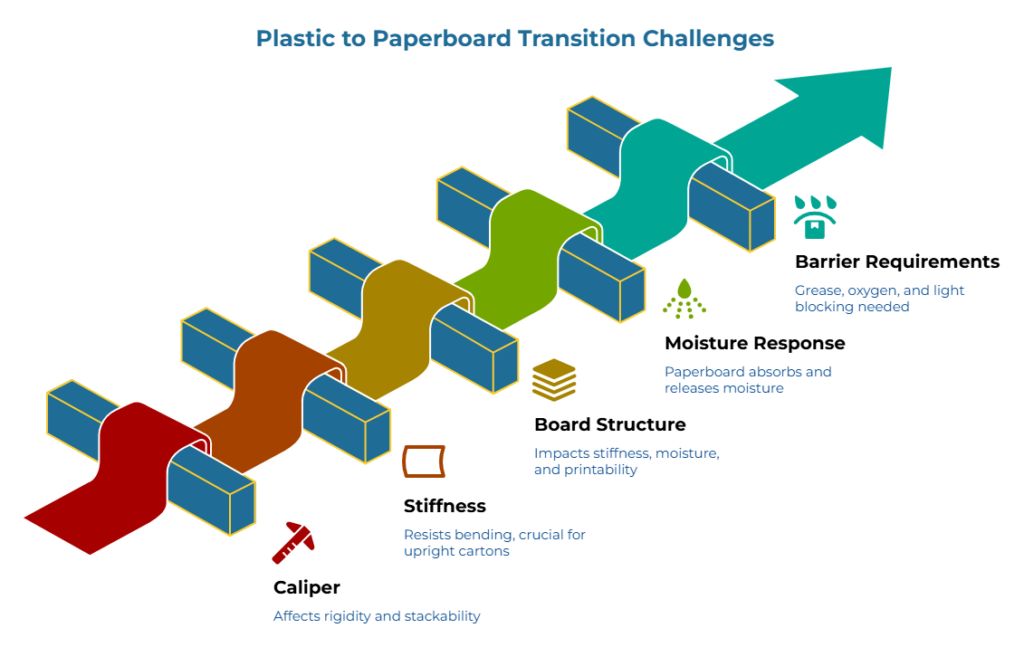
Once the baseline audit is complete, the next step is translation. Each function the plastic pack performs must be restated in paperboard language.
Caliper is the thickness of the board, typically measured in micrometres or points. Caliper affects rigidity, stackability, and how the folding carton feeds through automated equipment. A thicker board is not always better. The right caliper depends on the structural job the folding carton must do and the tolerances the filling line can accept. ISO 534 provides a standardized test method for measuring paperboard thickness and density.
Stiffness describes how the board resists bending. Stiffness is not the same as caliper. Two boards with identical thickness can have different stiffness values depending on fibre composition and board structure. Machine-direction stiffness—how the board resists bending along the grain—is especially important for folding cartons that must stand upright or move through high-speed equipment. ISO 2493-1 outlines the standard approach for measuring bending resistance.
Board structure refers to the composition of the paperboard itself. Solid bleached sulphate, coated natural kraft, and recycled paperboard each have different stiffness-to-weight ratios, moisture responses, and printability profiles. The structure must match the performance requirements, not just the sustainability narrative.
Moisture response is where many transitions fail. Paperboard absorbs and releases moisture depending on ambient humidity. A folding carton that performs well in a climate-controlled facility may warp, soften, or jam in a humid warehouse. TAPPI T 441 provides the standardized Cobb procedure for determining the quantity of water absorbed under specified conditions. For products sensitive to humidity or grease, understanding Cobb values and tolerances is essential before selecting a board.
Barrier requirements extend beyond moisture. Grease resistance, oxygen transmission, and light blocking may all be relevant depending on the product. If the plastic pack currently provides any of these barriers, the folding carton must address them through coatings, laminations, or product reformulation.
The goal of this step is a translation table: a document that maps each plastic function to a specific paperboard variable, test method, and target value.
Mini Glossary
Caliper: The thickness of the board, usually treated as a control point because small variation can affect geometry and handling.
Stiffness: The board’s resistance to bending; important for feeding, opening, and shape retention.
Cobb: A standardized measure of water absorptiveness for paper and paperboard under specified conditions.
Barrier: The material or coating system that helps manage moisture, grease, aroma, oxygen, or other exposure risks.
Tolerance: The permitted variation around a target value. In practice, this is what turns a description into a usable specification.
Where Folding-Carton Transitions Usually Fail on Existing Lines
Most transition failures do not happen because the folding carton was poorly designed. They happen because the folding carton’s behavior was never tested against the realities of the existing filling line.
Caliper variation within tolerance can still cause problems. A board grade specified at 350 micrometres with a ±5% tolerance can arrive anywhere from 332.5 micrometres to 367.5 micrometres—both technically acceptable. This underscores why board grade tolerances must be secured across suppliers before production begins. On a high-speed folding cartoner calibrated for the midpoint, that variation can cause misfires, jams, or crushed folding cartons. The machine does not care that the supplier met specification. It only knows the folding carton did not feed correctly.
Stiffness mismatch is harder to see but equally disruptive. A folding carton that bends too easily may not erect properly in the feeder. A folding carton that is too stiff may not fold cleanly at the score lines. Both scenarios create downtime that accumulates across production runs.
Moisture-induced warp appears after the folding carton has been stored. A flat folding carton that tested well in the sample room may bow or twist after a week in a non-climate-controlled warehouse. This phenomenon is why GSM accuracy fails without moisture content control—board absorbs moisture after production, softening despite meeting initial specifications. The result is feeding failures that seem random but are actually predictable once humidity is factored in.
Visual approval does not prove line compatibility. A folding carton can look perfect—correct dimensions, clean print, sharp folds—and still fail at production speed. Appearance-based approval skips the structural and behavioral testing that prevents downstream problems. For more on why visual checks fall short, consult established quality assurance guidelines for automated filling lines or review why visual quality checks fail in folding carton packaging.
Why Tolerance Normalization Must Happen Before Supplier Outreach
Vague specifications produce vague quotes. When a buyer asks for “a folding carton similar to this plastic tub,” each supplier interprets the request differently. One quotes a heavier board. Another quotes a thinner board with a coating. A third quotes the cheapest option that meets the stated dimensions.
The problem is not supplier quality. The problem is that the buyer never defined what “similar” means in measurable terms.
Tolerance normalization means writing down the acceptable range for every critical variable before issuing a request for quotation. Calipers should be stated with a target and a tolerance band, such as 350 micrometres ±3%. Stiffness should reference a test method, such as ISO 2493-1 for bending resistance, and state a minimum value. Cobb values should specify the test duration—typically Cobb120 (120 seconds) for paperboard, though 60 seconds is often used for lighter papers—and the maximum acceptable result in grams per square metre.
This work is not optional. It is the difference between comparing real options and comparing guesses.
When specifications are normalized, supplier quotes become comparable. Deviations become visible. Conversations shift from ‘can you match this?’ to ‘here is exactly what we need—can you hold these tolerances consistently?’ For guidance on this process, see how to standardize your next folding carton RFQ with board grade calibration.
Sustainability claims and structural compatibility should never be treated as the same test. The U.S. EPA frames sustainable packaging within a broader sustainable materials management context, emphasizing environmental impact and packaging construction choices. Useful as that framing is, it does not replace line-specific, product-specific, or tolerance-specific engineering decisions. A sustainability project becomes more durable when it is treated as a translation exercise with engineering discipline, not as a fast material swap led by hope or vendor shorthand.
A Practical Transition Workflow for Cross-Functional Teams
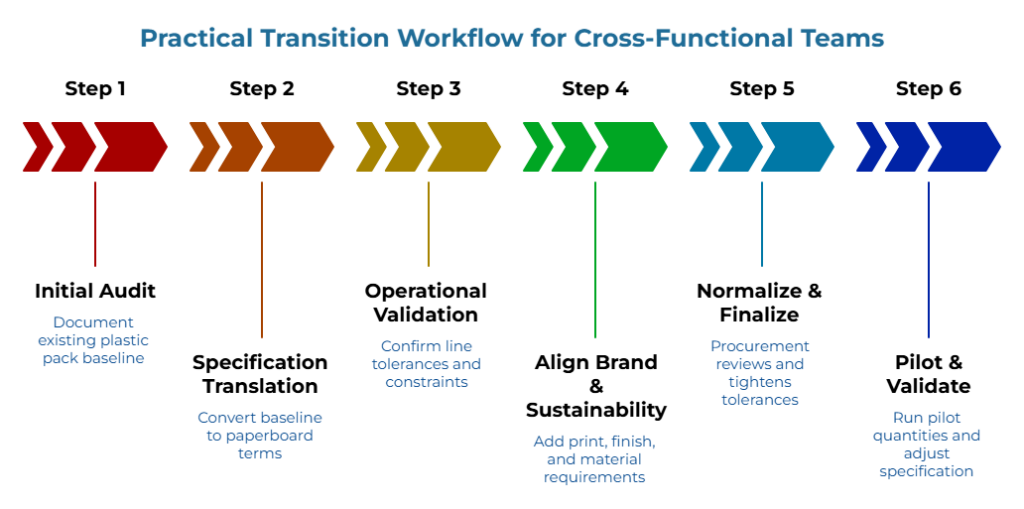
A successful transition requires coordination across packaging engineering, procurement, brand, and sustainability. The following workflow keeps all functions aligned without creating bottlenecks.
Step 1: Initial Audit: Document the existing plastic baseline. Packaging engineering documents what the plastic pack does today—structural role, barrier role, line behavior, and shelf requirements. This is the source material for everything that follows.
Step 2: Specification Translation: Convert baseline data. Engineering converts the baseline into paperboard terms: caliper, stiffness, board structure, Cobb targets, and any barrier coatings. The output is a draft specification sheet.
Step 3: Operational Validation: Confirm line tolerances. Operations or engineering confirms the tolerance windows the filling line can accept. This step often reveals constraints that were never documented, such as the maximum caliper the cartoner can handle or the humidity range of the storage area.
Step 4: Align brand and sustainability requirements. Brand confirms print and finish expectations. Sustainability confirms any certification or material-content requirements. Both inputs are added to the specification sheet.
Step 5: Normalize and finalize the specification. Procurement reviews the specification for completeness and sourcing feasibility. Tolerances are tightened or loosened based on what the supply base can realistically hold. The final document becomes the basis for all supplier outreach.
Step 6: Pilot and validate. Before full-scale production, run pilot quantities through the actual filling line under realistic conditions. Document any failures, adjust the specification, and retest until the folding carton runs cleanly at target speed. The International Safe Transit Association explains that its general simulation performance tests are designed to provide a laboratory simulation of damage-producing motions, forces, conditions, and sequences of transport environments.
This methodology progresses from a baseline audit through structural translation and specification normalization, resulting in a supplier-ready brief.
That sequence is not decorative. It is the core planning logic that separates successful transitions from operational failures.
What a Specification-Ready Transition Brief Should Include
A specification-ready brief gives suppliers everything they need to quote accurately and buyers everything they need to compare fairly. For a comprehensive approach to vetting suppliers before requesting quotes, see how to verify international food-grade folding carton packaging suppliers. The following elements should be present before any formal outreach.
Folding carton dimensions and tolerances. Length, width, depth, and acceptable variation for each.
Board requirements. Target caliper with tolerance band, minimum stiffness with test method reference, and board structure preference if applicable.
Barrier and moisture requirements. Cobb target and tolerance, plus any grease or oxygen barrier needs.
Print and finish specifications. Number of colours, coating type, any special finishes.
Filling-line constraints. Maximum and minimum caliper the equipment can handle, speed requirements, and any known sensitivities.
Certification or material requirements. FSC certification, recycled content targets, or other sustainability mandates.
Test methods. Named standards for every critical variable—ISO 534 for caliper, TAPPI T 441 for Cobb, ISO 2493-1 for stiffness—ensuring inter-laboratory correlation and measurement consistency across the supply chain.
A specification-ready brief separates three kinds of content that often get mixed together: what is verified from the current system, what is a general packaging principle that should guide translation, and what varies by line, product, or environment and therefore needs validation rather than assumption. That separation makes internal conversations cleaner and reduces the chance that one team mistakes a working hypothesis for a locked requirement.
For a detailed checklist covering these parameters, consult your organization’s internal packaging engineering standards or the folding carton baseline packaging parameter checklist.
The Real Goal: A Sustainable Transition That Still Runs Cleanly at Scale
The point of this work is not to make the transition harder. The objective is to ensure operational continuity through structural rigor.
A folding carton that runs cleanly at production speed, holds its shape in the warehouse, and presents well on the shelf is a sustainable transition. A folding carton that causes line jams, returns, or customer complaints is not—regardless of what material it is made from.
The methodology outlined here gives cross-functional teams a shared language for managing the shift. Engineering, procurement, brand, and sustainability can all work from the same specification. Suppliers can quote against real requirements instead of guessing. Problems surface in pilot runs instead of full-scale production.
Folding cartons are a viable, practical alternative to rigid plastic for many consumer product applications. The transition simply requires the same rigor applied to any other engineering change: define what must be true, measure it, and verify it before scaling.
When the time comes to explore options, folding cartons offer a starting point for product discovery, and folding carton suppliers provide a path to supplier discovery. For deeper guidance on specifications, tolerances, and supplier evaluation, browse the PaperIndex Academy.
Disclaimer:
This article is for educational purposes only
Our Editorial Process:
Our expert team uses AI tools to help organize and structure our initial drafts. Every piece is then extensively rewritten, fact-checked, and enriched with first-hand insights and experiences by expert humans on our Insights Team to ensure accuracy and clarity.
About the PaperIndex Insights Team:
The PaperIndex Insights Team is our dedicated engine for synthesizing complex topics into clear, helpful guides. While our content is thoroughly reviewed for clarity and accuracy, it is for informational purposes and should not replace professional advice.