

📌 Key Takeaways
Supplier quotes become comparable only when you lock every board specification before pricing begins.
- Lock Specifications Before Quotes: Name the exact board type, weight, and grade family so suppliers cannot fill in blanks with their own guesses.
- Tolerances Need Test Methods: A target number like “280 g/m²” means nothing without a range (±5%) and a named standard (ISO 536) to settle disputes.
- Separate Universal from Item-Specific Rules: Keep shared requirements in one section and product-specific notes in another so suppliers know which rules apply everywhere.
- Normalize Commercial Terms: Require the same price basis, delivery terms, and lead-time format from every supplier—otherwise “cheaper” might just mean “different assumptions.”
- Build Your Scorecard First: Define which fields must match, which trigger follow-up, and which make a quote unusable before responses arrive.
Comparable quotes come from controlled requests, not better suppliers.
Packaging buyers and procurement managers sourcing folding cartons will gain a ready-to-use RFQ framework here, preparing them for the detailed five-step workflow that follows.
~ ~ ~ ~ ~ ~ ~ ~ ~ ~ ~ ~ ~ ~ ~ ~ ~ ~
The quotes arrived.
Three suppliers, three prices—and three completely different interpretations of what “suitable board” means. One quoted a lighter grammage. Another used a different moisture specification. The third left the test method blank entirely.
You are staring at numbers that cannot be compared—a situation that exposes the guesswork gap that undermines predictable packaging budgets. The suppliers did not mislead you. They simply filled in the blanks you left open.
For packaging engineers, operations managers, supply chain leaders, and quality managers at growth-stage consumer brands, this problem is familiar. The issue is rarely quoted volume. It is an interpretation. When board requirements leave room for supplier judgment, every supplier judges differently. The result is not merely price variance, but latent discrepancies in material assumptions that only surfaces after you have awarded the contract—or worse, after folding cartons fail in transit.
Board grade calibration solves this problem before it starts, transforming your process so you can create flawless folding carton RFQs that eliminate supplier finger-pointing. It is the discipline of locking your material requirements completely before any supplier sees your request. This approach—sometimes called RFQ normalization or parameter locking—ensures that every supplier responds to the same technical reality. When you define the board identity, add tolerances and test methods, separate shared requirements from exceptions, normalize commercial fields, and prepare your comparison framework in advance, quotes become genuinely comparable.
The payoff is immediate: cleaner quote comparisons, faster internal review, and confidence that the lowest price is not simply the vaguest interpretation. This guide walks through the five steps to create flawless folding carton RFQs that eliminate supplier guesswork.
What Board Grade Calibration Means Before You Send an RFQ
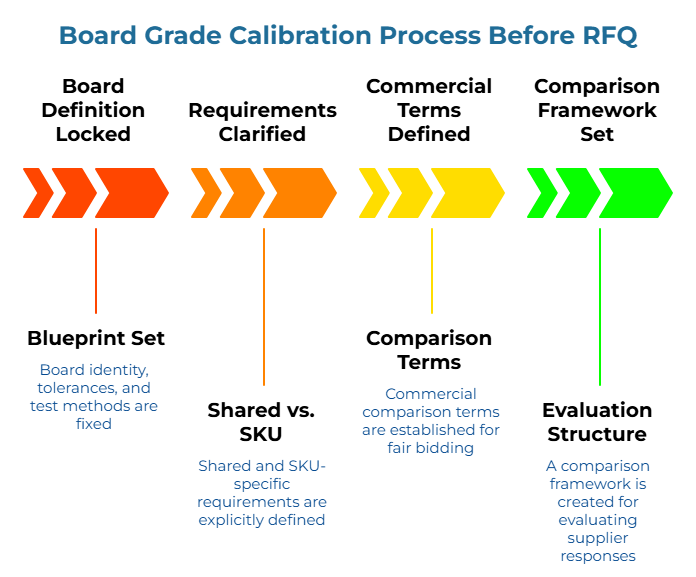
Board grade calibration is the act of locking the board definition before supplier pricing enters the conversation. Think of it as setting a blueprint to a fixed scale before asking builders to bid. If every supplier uses a different blueprint scale, the resulting figures will be mathematically incompatible despite their apparent precision.
Without calibration, each supplier interprets requirements through their own lens. One reads “strong board” as a specific grammage. Another reads it as a stiffness rating. A third assumes you want whatever grade they stock most readily. These interpretations are not wrong—they are simply different.
Calibration closes this gap by making five field groups explicit: board identity, tolerances and test methods, shared versus SKU-specific requirements, commercial comparison terms, and the comparison framework itself. When these fields are locked, suppliers cannot guess. They can only respond to what you specified. Durability becomes a technical specification baseline, not a pricing negotiation.
1. Lock the Board Identity
The first calibration step is naming exactly what you need. Suppliers cannot quote “the same thing” if the thing itself remains fuzzy.
Specify the substrate clearly. State the board type: Solid Bleached Sulfate (SBS), Coated Unbleached Kraft (CUK), or Folding Boxboard (FBB), or another grade family. Generic terms like “cartonboard” invite interpretation.
Define the grammage or basis weight. A target such as 280 g/m² sets a baseline. This value aligns with ISO 536, which specifies test methods for determining grammage in paper and board.
State the grade family or equivalent reference. If your operation has qualified a specific mill grade previously, name it. If not, describe the performance family so suppliers understand the tier you require.
| Vague | Calibrated |
| “Use a strong board suitable for shipping.” | “Quote against SBS board at 280 g/m² (±5%), tested per ISO 536.” |
The vague version forces suppliers to define “strong” themselves. The calibrated version removes that latitude entirely.
2. Add Tolerances and Test Methods
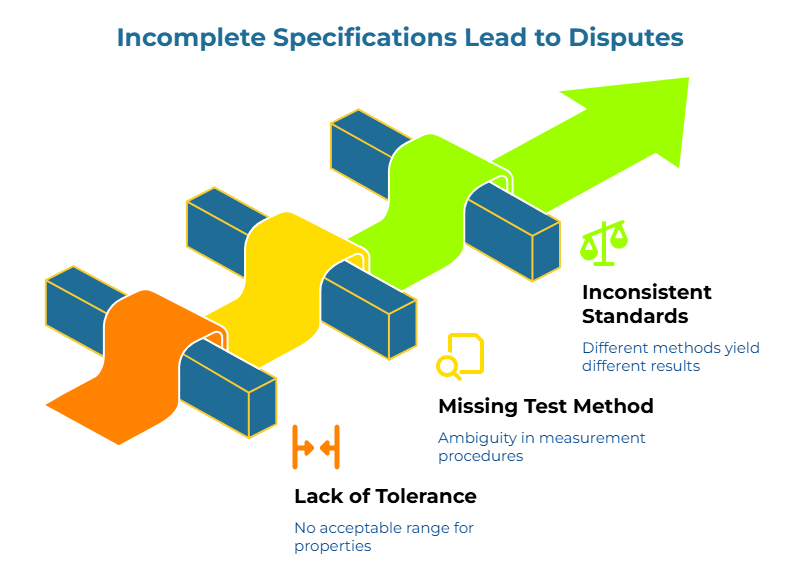
A target value alone is incomplete. A supplier can claim compliance with a 280 g/m² target while actually shipping at 265 g/m². Without a tolerance band and a named test method, you have no basis for dispute.
Pair every property with a tolerance. Stating “280 g/m² ±5%” tells suppliers the acceptable range. For deeper guidance on setting these bands, see board grade tolerances explained.
Name the test method beside the property. Reference the standard that governs measurement. For water absorptiveness (Cobb values), ISO 535 defines the procedure—a critical specification when mapping folding carton barrier requirements to your budget. For thickness and density, the most current iteration of ISO 534 applies. For bending resistance, ISO 2493-1 is the reference. The broadly adopted TAPPI T 441 standard generally provides practical Cobb-test procedures for sized paper, paperboard, and corrugated fiberboard.
Standardizing the triplet of property, tolerance, and test method ensures technical parity. A Cobb value of 30 g/m² means different things depending on whether it is a 60-second or 120-second test. Name the standard, and the ambiguity disappears.
For a detailed breakdown of Cobb specifications, review understanding Cobb values and tolerances.
3. Separate Shared Requirements from SKU-Specific Exceptions
Most RFQs cram universal rules and product-specific notes into one block of text. This invites confusion.
Shared requirements are rules every supplier must quote against: the board grade, the tolerance bands, the test methods, the moisture range. These belong in a master specification section that applies to all line items.
SKU-specific exceptions are notes that apply only to one product, one print treatment, or one pack format. These belong in a separate section, clearly labeled by SKU or product code.
When requirements blend together, suppliers make assumptions about which rules are universal and which are optional. Those assumptions diverge. The result is quotes that look comparable on the surface but are not.
This separation reduces hidden assumptions and shortens clarification cycles. Suppliers no longer have to guess which note is universal and which note applies only to a single item. For guidance on structuring these fields cleanly, see how to build quote-ready folding carton fields.
4. Normalize Commercial Comparison Fields
Technical specifications are only half of quote comparability. Commercial terms matter equally. This step is about quote hygiene, not negotiation strategy.
Price-per-unit basis. Specify whether you want pricing per thousand units, per kilogram, or per square meter. Mixed bases make comparison difficult.
Minimum order quantity and lead time. Ask suppliers to state both clearly. A lower unit price means little if the MOQ is three times your annual volume or if the lead time disrupts your production schedule—understanding how to normalize your first folding carton quote helps avoid these traps.
Delivery basis and Incoterm. State whether you need quotes on an EXW, FOB, CIF, or DDP basis. Different Incoterms shift cost and risk in ways that obscure true price differences, making it essential to understand forecasting folding carton landed costs using ‘to-door’ metrics.
Sample and proof expectations. Clarify whether you require a printed proof, a material sample, or both before awarding.
Without this hygiene, a cheaper number can reflect a different delivery basis, a different proof assumption, or a different production commitment rather than a better commercial offer.
5. Build a One-Page Comparison Sheet Before Quotes Arrive
The smartest time to define your evaluation columns is before supplier responses land—not after.
Create the columns in advance. A practical comparison sheet includes: supplier name, board identity, grade family or equivalent reference, grammage target, critical properties quoted, tolerance status (confirmed or missing), named test methods, price-per-unit, MOQ, lead time, Incoterm, proof status, and vendor verification notes.
Decide what must match exactly. Some fields should align precisely across all responses: board identity and substrate, grade family or agreed equivalent reference, critical property names, tolerance wording for those properties, named test methods, and delivery basis used for price comparison.
Decide what triggers clarification. Flag responses for follow-up when a property is named but the test method is missing, when moisture content or Cobb is mentioned without the agreed specification language, when proof timing or lead time is stated in a different format, or when an equivalent material is claimed without a clear basis for comparison.
Decide what triggers rejection. Mark a response as non-comparable until corrected when a different substrate or grade family is quoted, when a critical property has no tolerance band, when the price is built on a different delivery basis, or when the quote relies on the supplier’s standard data sheet instead of your calibrated request.
This pre-built framework speeds internal review and prevents last-minute debates about what counts—addressing the price of silence in folding carton procurement that stems from chaotic RFQ processes. It also stops a weak quote from looking strong simply because the spreadsheet is messy.
RFQ Calibration Checklist
Use this checklist before sending your next folding carton request. For an expanded version, review the baseline packaging parameter checklist.
- Lock the board identity — Substrate name, grammage target, grade family or equivalent
- Add tolerances and test methods — Each property includes a target, a ± band, and a named standard
- Separate shared requirements from SKU exceptions — Universal rules in one section, product-specific notes in another
- Normalize commercial fields — Price basis, MOQ, lead time, Incoterm, sample expectations
- Prepare the comparison sheet — Columns defined, clarification triggers set, rejection criteria clear
Common Mistakes That Reintroduce Supplier Guesswork
Even well-intentioned teams reintroduce ambiguity through small oversights. Recognizing these patterns helps maintain discipline.
Using board names without tolerances. Naming the grade is necessary but insufficient—a gap that often leads to the price of misalignment in folding cartons when tolerance failures compound across orders. Without a tolerance band, suppliers interpret “280 g/m²” as a rough target rather than a firm requirement.
Leaving test methods unnamed. A Cobb value of 30 g/m² means different things depending on whether it is a 60-second or 120-second test. Name the standard.
Mixing technical requirements with commercial notes. When product specifications and pricing terms appear in the same paragraph, suppliers skim. Separate them for clarity.
Assuming a supplier’s data sheet is enough. Supplier data sheets describe what they offer. Your RFQ describes what you require. These are not the same document. A supplier sheet can support vendor verification, but it should not replace buyer-owned specification language—a principle explored in depth in the danger of vendor-led data sheets. When you defer to supplier documentation, you lose control over the comparison basis.
What Good Looks Like After You Standardize
When board grade calibration becomes routine, the shift is immediate.
Supplier quotes arrive in a comparable format. Each response addresses the same grammage, the same tolerances, the same test methods. Price differences reflect actual cost differences—not interpretation gaps.
Internal review moves faster. Your comparison sheet already has the columns. You are checking boxes, not reconstructing requirements after the fact.
Clarification cycles shrink. Because the RFQ was explicit, suppliers have fewer questions. The back-and-forth that once stretched for weeks compresses into days.
Confidence rises. When you select a supplier, you know the selection was based on equivalent bids. Low numbers are easier to challenge when they hide underspecified material assumptions—the dynamic behind the lowest bidder myth that causes production downtime. You have more certainty that “cheap” is not simply “underspecified.”
Board grade calibration is not about adding paperwork—it is a specification bridge that aligns your requirements across suppliers and SKUs. It is about removing ambiguity so that every quote reflects the same material reality—and so that your procurement decisions stand on defensible ground.
Explore the PaperIndex Academy for more guides on folding carton specifications, supplier verification, and procurement best practices.
Disclaimer:
This article is for educational purposes only. All specifications, tolerances, and test methods referenced are illustrative examples. Consult qualified packaging engineers and verify standards (ISO, TAPPI) for your specific application. Actual requirements vary by product, region, and end-use.
Our Editorial Process:
Our expert team uses AI tools to help organize and structure our initial drafts. Every piece is then extensively rewritten, fact-checked, and enriched with first-hand insights and experiences by expert humans on our Insights Team to ensure accuracy and clarity.
About the PaperIndex Insights Team:
The PaperIndex Insights Team is our dedicated engine for synthesizing complex topics into clear, helpful guides. While our content is thoroughly reviewed for clarity and accuracy, it is for informational purposes and should not replace professional advice.