

📌 Key Takeaways
Supplier verification prevents costly sourcing failures when embedded as gates within the workflow, not bolted on afterward.
- Gate Placement Eliminates Rework: Verification checkpoints before quotes, samples, and scale-up filter unqualified suppliers early, preventing late-stage restarts and timeline slippage.
- Risk Tiers Match Verification Depth: Low-risk replenishment orders require identity and sample checks; high-visibility launches warrant full gate progression including audit decisions.
- RACI Clarity Prevents Gaps: Procurement owns documentation gates, Operations owns physical quality verification, and Brand owns print approval—explicit ownership stops “someone else checked” failures.
- FSC and PEFC Require Scope Verification: Chain-of-custody certification enables sustainability label use but requires matching certificate scope to actual site and product before RFQ finalization.
- Trial Orders Are Evaluation Events: Defining pass criteria before ordering—on-time delivery, documentation accuracy, sample consistency—transforms trials from gambles into objective assessments.
Security is the pavement that allows you to drive fast.
Procurement managers and operations leaders building paper bag sourcing programs will gain a complete gate-by-gate framework here, preparing them for the detailed workflow implementation that follows.
The RFQ deadline is tomorrow for your kraft paper bags order. Three suppliers responded, quotes are scattered across email threads, and someone asks: ‘Did anyone actually verify these companies?”
Silence.
The team scrambles, verification becomes a fire drill, and the timeline slips by two weeks.
This scenario plays out repeatedly in growth-stage procurement teams. The problem is not that verification takes too long. The problem is that verification happens too late.
Verification rarely feels slow because it requires excessive effort. It feels slow when it appears late in the sourcing cycle, when ownership is unclear, and when every order receives the same scrutiny regardless of actual risk. Procurement pushes for speed, operations demands certainty, and brand teams require consistency—often when the deadline is already tight.
When supplier verification sits outside the sourcing workflow—treated as a separate project to handle “when there’s time”—it inevitably becomes a bottleneck. Quotes arrive from suppliers who cannot provide basic documentation. Samples ship from factories that cannot scale. Trial orders go to vendors who fail the first quality gate. Each late discovery forces the team backward: re-quoting, re-sampling, re-evaluating.
This playbook presents an alternative approach. By embedding verification checkpoints directly into the sourcing process, procurement teams can filter unqualified vendors earlier, reduce late-stage rework, and move faster precisely because they have built security into the workflow rather than bolting it on afterward.
“Security is not a roadblock; it is the pavement that allows you to drive fast.”
Why Verification Slows Teams Down (And Why That Is a Design Problem)
Verification typically slows procurement cycles for structural reasons, not because teams lack diligence.
The late-stage bottleneck pattern. When verification happens after quotes are collected and a preferred supplier is identified, any failure at that point forces a restart. The team has already invested evaluation effort into a supplier who now cannot pass basic checks. Emotional commitment compounds the problem—there is pressure to “make it work” rather than restart cleanly.
The parallel-project trap. Treating verification as a separate workstream creates coordination overhead. Procurement waits for verification results. Verification waits for supplier responses. Neither team owns the handoff clearly. Deadlines slip while responsibility diffuses.
The false speed shortcut. Some teams skip verification entirely to hit deadlines, assuming they can “sort it out later.” This approach transfers risk rather than eliminating it. Problems surface as quality failures, delivery delays, compliance gaps, or brand incidents—all more expensive to fix than an upfront verification gate.
The solution is not more verification effort. The solution is better verification placement. When verification becomes a series of gates embedded at natural decision points in sourcing, it functions as a progress check rather than a project interrupt.
The Secure Sourcing Workflow: Stages and Verification Gates
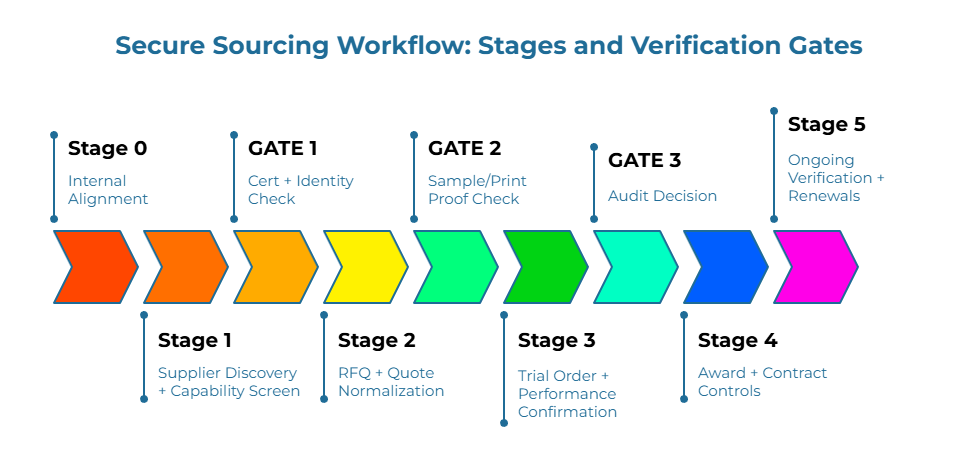
The following workflow integrates verification checkpoints into the sourcing process. Each gate serves as a quality filter: suppliers who pass move forward; suppliers who fail exit early, before consuming additional evaluation resources.
Visual Workflow Overview:
[Stage 0: Internal Alignment]
↓
[Stage 1: Supplier Discovery + Capability Screen]
→ Platform trust indicators inform initial prioritization
↓
[GATE 1: Cert + Identity Check] ← Before requesting detailed quotes
↓
[Stage 2: RFQ + Quote Normalization]
↓
[GATE 2: Sample/Print Proof Check] ← Before scaling orders
↓
[Stage 3: Trial Order + Performance Confirmation]
↓
[GATE 3: Audit Decision] ← Triggered by risk and scale
↓
[Stage 4: Award + Contract Controls]
↓
[Stage 5: Ongoing Verification + Renewals]
Stage 0: Align Internally on Requirements and Risk Tiers
Before engaging suppliers, define what “good” looks like. This prevents downstream confusion about what verification should actually check.
- Spec sheet clarity. Document the technical requirements for your packaging paper suppliers: GSM range, burst factor minimums, handle attachment method, printing specifications, size tolerances. Verification cannot assess quality if quality is undefined. For guidance on developing robust specifications, see holesale paper bags sourcing: a verification methodology for brand consistency.
- Use-case risk assessment. Not all paper bag orders carry equal risk. A replenishment order for an established SKU from a proven supplier warrants lighter verification than a new supplier relationship for branded, food-contact packaging. Define risk tiers upfront so verification depth scales appropriately.
- Branding and compliance constraints. If bags require food-grade certification, specific sustainability claims, or precise colour matching, these become verification criteria. Identify them now rather than discovering gaps at sample review.
Stage 1: Supplier Discovery and Initial Capability Screen
Cast a wide net across kraft paper suppliers and paper bag suppliers, then filter quickly based on capability signals.
- Responsiveness and evidence readiness. Suppliers who respond promptly with organized documentation signal operational maturity. Suppliers who cannot locate their own certificates or provide inconsistent information signal future friction.
- Platform trust indicators as prioritization signals. When you find suppliers on major B2B marketplace platforms, look for verification badges—such as phone verification or business registry cross-referencing. These indicate a supplier has passed that specific platform’s identity protocols, which vary significantly by marketplace and do not guarantee product quality. These indicators can help prioritize which suppliers to engage first, but they do not replace buyer-side verification. Platform verification confirms identity; buyer verification confirms capability, quality, and fit. Explore paper bag suppliers to begin supplier discovery.
Gate 1: Certificate and Identity Check
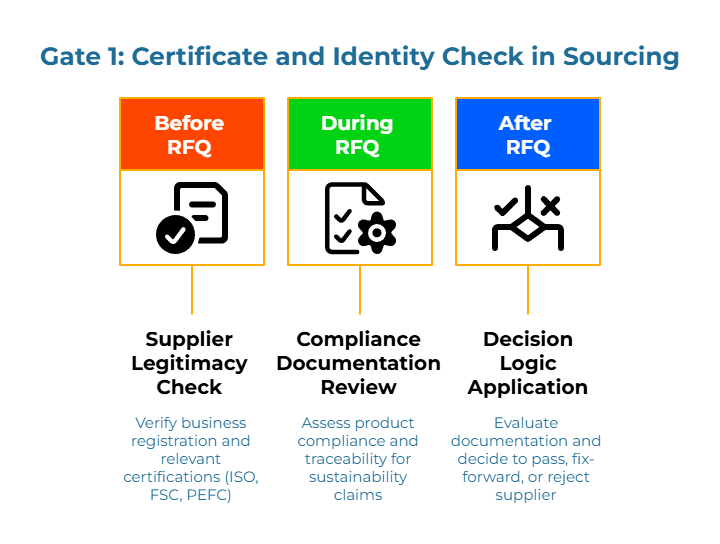
Timing: Before requesting detailed quotes or investing significant evaluation effort.
Purpose: Gate 1 confirms business legitimacy and certification validity before quote investment. This “right to quote” gate prevents wasting evaluation resources on suppliers who cannot meet fundamental requirements.
Evidence to request (illustrative):
- Business registration certificate
- Relevant quality certifications (ISO, food-contact certifications if applicable)
- Product compliance documentation for target use case
Certification scope considerations:
If sustainability claims matter to your program, understand the traceability requirements. FSC chain-of-custody certification validates the traceability required for the product, which is a prerequisite for applying the FSC label, subject to a valid trademark license agreement and approval of the specific artwork. PEFC chain-of-custody certification functions similarly, with surveillance across the certificate period. These certifications verify that certified material is tracked from forest to final product—not just that a supplier has general environmental policies.
For management system maturity, ISO 9001 and ISO 14001 serve as widely recognized references for quality and environmental management systems among kraft paper manufacturers and paper manufacturers. They indicate structured process control rather than guaranteeing specific product outcomes.
Decision logic:
- Pass: Documentation is current, consistent, and covers the required scope. Proceed to RFQ.
- Fix-forward: Minor gaps exist but appear correctable (e.g., certificate renewal in progress). Request timeline for resolution before proceeding.
- Reject: Fundamental gaps or inconsistencies. Exit the supplier from consideration.
For international suppliers and paper exporters, additional verification steps apply. See verifying international paper bags suppliers: a checklist for safe online sourcing.
Stage 2: Comparable RFQ and Quote Normalization
With Gate 1 complete, remaining suppliers have demonstrated baseline legitimacy. When you Submit RFQ requests to this filtered pool, quotes become more comparable because fundamental capability gaps have already been removed.
Structure RFQs to enable apples-to-apples comparison: same Incoterms basis, same specification reference, same delivery timeline. Verification effort upstream pays dividends here—fewer surprises emerge during quote evaluation because suppliers who could not provide documentation have already exited.
For a structured approach to quote collection, see from fragmented quotes to a sourcing program: a framework for wholesale paper bag sourcing.
Gate 2: Sample and Print Proof Check
Timing: Before committing to production-scale orders.
Purpose: Confirm the supplier can produce bags that meet specifications, not just provide documentation claiming they can.
What to evaluate:
- Physical samples against spec sheet (GSM, dimensions, handle strength, print quality)
- Print proofs for colour accuracy and brand alignment
- Construction quality under realistic handling conditions
Food-grade and packaging standards context:
In food-related applications, packaging expectations may reference recognized industry standards. BRCGS Packaging Materials serves as a global benchmark used across packaging supply chains for food safety and quality management. Exact compliance requirements vary by market and application, but understanding which standards apply to your use case helps structure Gate 2 evaluation criteria.
Decision logic:
- Pass: Samples meet specifications within acceptable tolerances. Proceed to trial order.
- Conditional pass: Minor deviations identified and correctable. Request revised samples before scaling.
- Reject: Samples fail critical specifications. Return to Stage 1 for alternative suppliers.
Pre-production sampling adds time but prevents the far greater delay of receiving a production run that fails quality standards. The cost of a sample order is trivial compared to the cost of a failed shipment.
Stage 3: Trial Order and Performance Confirmation
Treat trial orders as structured validation, not a gamble.
- Define success criteria before ordering. What does “pass” look like? On-time delivery within the agreed window? Documentation accuracy? Product consistency with approved samples? Establishing criteria upfront transforms the trial from a subjective judgment into an objective assessment.
- Document everything. Arrival condition, packaging quality, documentation completeness, any deviations from samples. This record informs the audit decision at Gate 3 and establishes baseline performance for ongoing monitoring.
Gate 3: Audit Decision
- Timing: After successful trial order, before awarding significant ongoing volume.
- Purpose: Determine whether deeper verification (remote or on-site audit) is warranted based on risk and scale.
Decision triggers:
- Order value: Higher-value contracts justify greater verification investment.
- Lifecycle stage: New supplier relationships warrant more scrutiny than established ones.
- Failure impact: Brand-critical or compliance-sensitive use cases demand higher assurance.
- Trial order performance: Issues during trial may trigger deeper investigation.
Audit framework options:
Where social compliance visibility matters—particularly for brand-exposed packaging—SMETA (Sedex Members Ethical Trade Audit) provides a commonly used methodology. SMETA (Sedex Members Ethical Trade Audit) provides a methodology that, in its 4-Pillar format, covers labor standards, health and safety, environmental assessment, and business ethics. (Note: The 2-Pillar format excludes the extended environmental and business ethics modules). The framework offers a standardized approach when on-site or third-party verification is justified by risk level.
Options:
- Proceed without audit: Low-risk, lower-value, strong trial performance.
- Remote audit: Medium-risk scenarios where documentation review and video verification provide sufficient assurance.
- On-site audit: High-risk, high-value, or scenarios with concerns from trial performance.
For detailed audit guidance, see how to vet wholesale paper bag suppliers: a remote audit checklist.
Stage 4: Award and Contract Controls
Lock quality expectations into the commercial relationship.
- Specification reference: Contract should reference the approved spec sheet and sample standard.
- Evidence renewal cadence: Define when certifications must be refreshed and consequences for lapses.
- Escalation paths: Establish CAPA (corrective and preventive action) procedures for quality deviations.
- Change control: Require notification and re-approval for material or process changes.
Stage 5: Ongoing Verification and Performance Monitoring
Verification is not a one-time event. Supplier performance can drift over time.
- Periodic documentation renewal: Certificates expire. Establish a renewal calendar and verify updated documentation.
- Performance tracking: Monitor delivery reliability, quality consistency, and responsiveness. Degradation may trigger re-verification or audit.
- Renewal qualification: Before extending contracts, confirm the supplier still meets current requirements—particularly if specifications or compliance standards have evolved.
RACI: Who Owns Each Gate
Clear ownership prevents the “everyone assumed someone else checked” failure mode.
| Stage/Gate | Procurement | Operations | Brand/Marketing |
| Stage 0: Requirements | A | C | C |
| Stage 1: Discovery | R, A | I | C |
| Gate 1: Cert Check | R, A | C | I |
| Stage 2: RFQ | R, A | C | I |
| Gate 2: Sample Check | A | R | R (print/brand) |
| Stage 3: Trial Order | R, A | R | C |
| Gate 3: Audit Decision | A | R | C |
| Stage 4: Contract | R, A | C | I |
| Stage 5: Ongoing | R, A | R | I |
R = Responsible (does the work), A = Accountable (owns the decision), C = Consulted, I = Informed
For Suppliers: Build verification readiness before buyer inquiries arrive. Prepare your evidence pack, then join free & connect with buyers to access 49,000+ active procurement professionals.
Handoff rules:
- Gate 1 to Stage 2: Procurement confirms documentation is complete and current before issuing RFQ.
- Gate 2 to Stage 3: Operations confirms samples meet physical specifications; Brand confirms print quality; both sign off before trial order.
- Gate 3 to Stage 4: Accountable party confirms audit decision is documented with rationale before contract finalization.
For a complete process framework, see designing a simple wholesale paper bag sourcing process your team can stick to.
How Deep Should Verification Go? A Risk-Tiered Approach
Verification depth should scale with failure impact. Over-verifying low-risk replenishment orders wastes resources. Under-verifying high-impact purchases creates exposure.
| Tier | Typical Use Case | Minimum Gates | Typical Depth |
| Tier 1 (Low) | Standard unprinted replenishment from proven supplier | Gate 1 + Gate 2 | Identity/cert checks; construction sample |
| Tier 2 (Medium) | Printed bags, new dimensions, or new supplier | Gate 1 + Gate 2 + Trial | Print proof discipline; trial before scaling |
| Tier 3 (High) | High-visibility launches, food-contact, sensitive use | All gates | Audit decision likely; tighter change control |
Signals that often justify moving up a tier:
- Novelty (new supplier, new product, new market)
- Complexity (custom specifications, tight tolerances)
- Visibility (brand-critical, customer-facing)
- Failure impact (regulatory, financial, reputational consequences)
- Higher order values or strategic contracts
Consensus Kit: The Internal Sell
Building internal alignment requires demonstrating why integrated verification outperforms alternatives.
Side Quest vs. Integrated Gates
| Aspect | Side Quest Approach | Integrated Gate Approach |
| Timing | Checks happen late | Checks happen before irreversible steps |
| Behavior | Exceptions and escalations | Evidence required to proceed |
| Cost of Errors | Rework and supplier churn | Early exits and cleaner shortlists |
Approach Comparison
| Approach | Speed | Control | Risk | Best Fit |
| Integrated gates (this playbook) | Moderate | High | Low | Growth-stage teams balancing speed and security |
| Price-first, minimal verification | Fast initially | Low | High | Only suitable for very low-stakes, commoditized purchases |
| Outsourced verification | Variable | Moderate | Moderate | Teams lacking internal verification expertise |
| Local-inventory shortcut | Fastest | Low | Moderate | Emergency replenishment only |
Risk-Mitigation Checklist
| Risk | Mitigation |
| Verification becomes a bottleneck | Move Gate 1 earlier in the process; pre-define reject thresholds to accelerate decisions |
| Sampling adds delay | Standardize sample criteria and approval workflows; pre-book sample evaluation windows in the project timeline |
| Audit decisions stall the project | Pre-agree audit triggers and fallback paths (e.g., limited trial run while audit proceeds) |
| Documentation collection is chaotic | Create a standard evidence request template; use a centralized repository with version control |
| Cross-functional alignment breaks down | Assign explicit RACI ownership; require sign-off at each gate before proceeding |
| Sustainability claim marketed but certificate scope does not match site or product | Verify certificate numbers, site names, and scope against FSC/PEFC sources before RFQ finalization |
| Print looks acceptable in digital proof but fails in production | Require controlled print proof sign-off and pre-production sample at Gate 2 |
| Trial order quality differs from bulk production | Add change-notification requirements and define CAPA expectations in award-stage controls |
| Reputational exposure from labor or ethics issues | Use risk-based social compliance assessment; where appropriate, use recognized audit frameworks such as SMETA |
Implementation Playbook: Embedding Gates into Tools and Routines
Make gates easier to follow than to ignore. Translate the workflow into operational practice through standardized templates and clear routines.
Vendor onboarding checklist. Create a standard checklist capturing required documentation for Gate 1. New suppliers receive this checklist with initial outreach, setting expectations before engagement deepens.
Supplier evidence preparation. Suppliers who join PaperIndex free can accelerate Gate 1 by preparing an evidence pack in advance: business registration, certificate PDFs with scope clearly marked, sample policy, quality contacts, and a change-control statement. This preparation reduces back-and-forth and demonstrates operational readiness.
Document repository structure. Establish a centralized location for supplier documentation with clear folder conventions (e.g., by supplier, then by document type). Include version control and renewal date tracking. For compliance-focused documentation, see The Sourcing & Compliance Integration Checklist: How to Buy Compliant Paper Bags.
Approval gates in workflow tools. If using procurement software or project management tools, configure approval steps that mirror the gate structure. Gate passage requires documented sign-off from the accountable party.
SLAs for verification activities. Define expected turnaround times: supplier response to documentation requests (e.g., 5 business days), internal review of samples (e.g., 3 business days), audit scheduling (e.g., within 2 weeks of trigger).
Cadence differences. New suppliers proceed through all gates. Incumbent suppliers on replenishment orders may move directly to Stage 2 or Stage 3, with verification touchpoints limited to documentation renewal and performance confirmation.
Common Failure Modes and Prevention
Verification theatre. Collecting documents without defined decision rules. Prevention: establish pass/fail criteria before requesting documentation.
Over-verification for low-risk purchases. Applying audit-level scrutiny to routine replenishment orders. Prevention: use the risk-tiered framework; match verification depth to actual risk.
Under-verification for high-impact purchases. Rushing brand-critical or regulated purchases without adequate checks. Prevention: flag high-risk use cases at Stage 0; require explicit gate completion before proceeding.
Unclear ownership. Everyone assumes someone else verified. Prevention: assign RACI explicitly; require documented sign-off at each gate.
Brand and marketing review happening too late. Print quality or brand alignment issues discovered after production orders are placed. Prevention: include Brand/Marketing as Responsible at Gate 2 for print proof approval.
Skipping Gate 1 to “get quotes quickly.” Prevention: make Gate 1 a right-to-quote rule enforced by procurement leadership.
Approving print without controlled proof sign-off. Prevention: tie approvals to revision numbers and require both digital and physical proof stages.
Treating the trial order as a formality. Prevention: define success metrics before ordering and document performance systematically.
For a deeper examination of sourcing pitfalls, see The Hidden Cost of Ad-Hoc Wholesale Paper Bag Buying.
Frequently Asked Questions
At what point in sourcing should supplier verification start?
Verification should begin at Stage 1 with initial capability screening, then formalize at Gate 1 before detailed quote requests. Starting verification after quotes are collected creates the late-stage bottleneck this playbook addresses.
What is the minimum verification before requesting quotes?
Gate 1 verification—confirming business registration, relevant certifications, and basic capability documentation—should precede detailed RFQ engagement. This prevents investing evaluation effort in suppliers who cannot meet fundamental requirements.
When is sampling enough, and when is an audit justified?
Sampling (Gate 2) is generally sufficient for lower-risk scenarios with established specifications. Audits (Gate 3) become warranted when order values are significant, failure impact is high, or trial order performance raises concerns. The decision should follow the risk-tiered framework.
Who should own verification: procurement or operations?
Ownership should be distributed according to expertise. Procurement typically owns documentation and commercial verification (Gates 1 and 3). Operations owns physical quality verification (Gate 2 sample assessment). Brand/Marketing owns print and brand alignment verification. The RACI framework clarifies these responsibilities.
How do we keep verification from slowing down reorder cycles?
For incumbent suppliers with proven track records, verification touchpoints can be lighter—focused on documentation renewal and performance confirmation rather than full gate progression. The workflow distinguishes between new supplier qualification and ongoing supplier management.
Can platform trust indicators replace buyer verification?
No. Platform-level verification (such as identity confirmation or phone verification badges) provides useful prioritization signals during supplier discovery but does not assess product quality, specification capability, or operational fit. Buyer verification gates remain essential.
What if a supplier fails a gate partway through the process?
Exit the supplier from consideration and return to the appropriate earlier stage with alternative suppliers. The value of early gates is precisely this: failures happen before significant resources are committed, making course correction less costly.
How can suppliers help speed up verification?
Suppliers can prepare an evidence pack in advance containing: business registration certificate, quality and compliance certificates with scope clearly documented, sample policy, key quality contacts, and a written change-control statement. This readiness signals operational maturity and accelerates Gate 1 progression.
Ready to connect with verified paper bag suppliers? Explore the paper bag suppliers directory to begin your supplier discovery, or Contact suppliers directly to initiate conversations.
Disclaimer: This article is for educational purposes only.
Our Editorial Process:
Our expert team uses AI tools to help organize and structure our initial drafts. Every piece is then extensively rewritten, fact-checked, and enriched with first-hand insights and experiences by expert humans on our Insights Team to ensure accuracy and clarity.
About the PaperIndex Insights Team:
The PaperIndex Insights Team is our dedicated engine for synthesizing complex topics into clear, helpful guides. While our content is thoroughly reviewed for clarity and accuracy, it is for informational purposes and should not replace professional advice.