
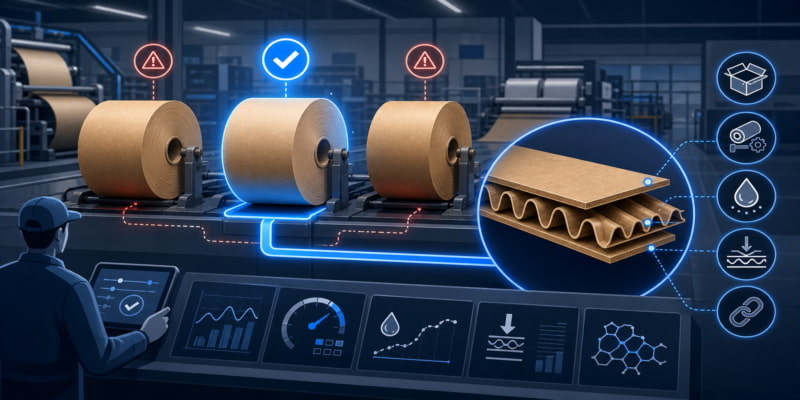
📌 Key Takeaways
Choosing kraft paper for corrugated boxes is a risk decision, not a price decision — the grade must fit the job, the machine, and the failure you can least afford.
- Start With the Box, Not the Paper: Define what the finished package must survive — weight, stacking, humidity, transit — before picking any grade.
- One Grade Rarely Fits All Jobs: Paper that works for light retail cartons can fail badly in e-commerce shipping, cold storage, or heavy industrial stacking.
- Specs Shortlist, Trials Confirm: GSM, burst factor, and Cobb values help narrow choices, but only a real machine trial proves a grade works under your actual conditions.
- Liner and Fluting Are Different Jobs: Outer liners need surface quality and printability; fluting needs consistent forming and bonding — treating them as the same input leads to board failures.
- Cheap Paper Gets Expensive Fast: A lower quote means nothing if waste climbs, machine speed drops, or customer complaints wipe out the savings.
The right grade matches the risk — not the lowest price tag.
Procurement teams, production managers, and QA leads at small and mid-sized corrugated converters will gain a structured approach to grade selection here, preparing them for the detailed sourcing framework that follows.
~ ~ ~ ~ ~ ~ ~ ~ ~ ~ ~ ~ ~ ~ ~ ~ ~ ~
Three quotes land on your desk. All say “kraft paper.” All list a GSM, a burst factor, and a price per ton. The lowest quote saves your plant roughly 6% on material cost this quarter.
However, once production begins, the 6% theoretical saving is immediately tested by operational reality. Moisture is inconsistent. The flute profile collapses under heat. Bonding complaints start before lunch, and by the afternoon shift, warp has forced a speed reduction that wipes out every Rupee, Dollar, or Euro you thought you saved.
The paper looked fine on the spec sheet. But the spec sheet did not tell you whether this paper would hold flute structure on your corrugator, bond properly at your glue station, resist humidity in your customer’s warehouse, meet the stacking requirement for a palletised load, or reduce the complaints your sales team has been fielding for the past two months.
If you source kraft paper for corrugated conversion, you have likely lived some version of that morning. Many small and mid-sized converters still begin the buying conversation with broad labels — “kraft paper,” “BF paper,” “GSM paper” — as though these terms describe a single, predictable input. They do not. The right input for a light inner carton will likely fail in heavy industrial packaging, e-commerce transit, cold storage exposure, or high-speed conversion. Selecting the right grade for each job is a discipline explored in detail in the kraft paper grade guide for SME converters.
The real problem is not that you chose bad paper. The problem is that “kraft paper” is too broad a buying category to predict what happens inside your specific board structure, on your specific corrugator, for your specific customer’s end-use conditions. Grade selection is not a commodity-price decision. It is a risk-control decision — and the risk starts well before the purchase order leaves your desk.
This sourcing framework aligns grade selection with the converted product, machine capabilities, and high-cost failure modes.
Start With the Converted Product, Not the Paper Grade
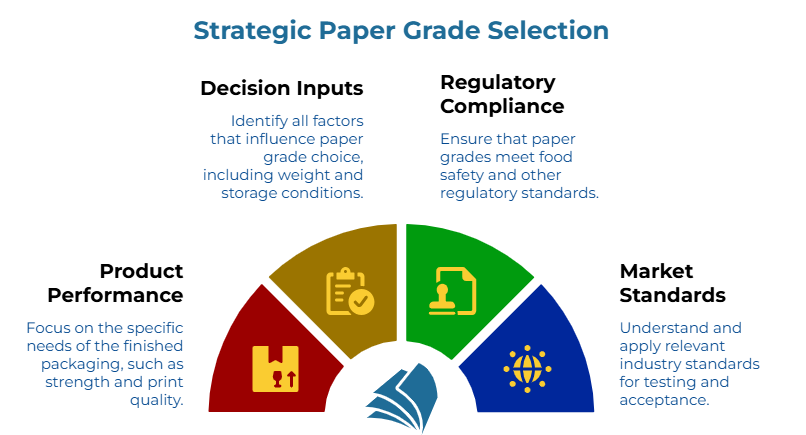
Grade selection should begin with the finished packaging job, not the paper input.
A lightweight retail shipper and a heavy produce carton may both use kraft paper as an input for corrugated boxes. Their performance priorities, however, sit at opposite ends of the spectrum. The retail shipper may need a clean print surface, sharp fold quality, and consistent appearance. The produce carton needs stacking strength, moisture resistance, and compression performance under humid storage. That is not a small difference. It changes the sourcing conversation entirely.
Before engaging any supplier, define the job the paper must support. That means mapping decision inputs that directly affect which grade will work and which will not: product weight, product fragility, box size, stacking height, storage duration, transport mode, humidity exposure, printing requirements, die-cutting or creasing complexity, and customer acceptance criteria. If the packaging involves direct or indirect food contact, regulatory documentation enters the picture early — not as an afterthought. Buyers sourcing for food-adjacent applications can evaluate food-grade kraft paper with the necessary compliance documentation already in place.
This step sounds obvious. In practice, many small and mid-sized converters skip it because they have been buying “the same kraft paper” for years. The trouble starts when a new customer, a new box size, or a new storage condition exposes a gap that the existing grade is physically incapable of bridging.
Where applicable, the terminology used for performance tests and acceptance criteria may differ across markets. Standards bodies such as ISO, ASTM, FEFCO, TAPPI, or BIS may each apply depending on the buyer’s region and customer requirements. Verifying local terminology and accepted test methods before discussing specifications with a supplier prevents misalignment down the line.
Map End-Use Risk to Paper Properties
Once the application is clear, connect it to the paper properties that matter most for that specific risk profile. The table below provides a practical starting point for that conversation. It maps common end-use applications to the risks buyers should anticipate, the kraft input concerns those risks create, the paper properties worth verifying, and the types of questions to raise with suppliers.
| End-Use Application | Typical Risk | Kraft Input Concern | Properties to Verify | Questions to Ask Supplier |
| Light consumer-goods cartons | Poor folding, poor print appearance, customer rejection for aesthetics | Paper surface or formation inconsistency affecting visual and converting quality | Surface quality, shade, formation, stiffness, tensile strength, moisture consistency | What surface quality controls are in place? What is the typical shade and formation range? Has this grade run successfully for printed light cartons? |
| E-commerce shipping boxes | Crush, puncture, rough handling, return damage | Insufficient compression or caliper for unpredictable transit conditions | Compression-related values (SCT/RCT), burst or puncture requirements, caliper, moisture, board-combination suitability | What compression and burst ranges does this grade achieve? What package-validation references or customer applications support this grade? What board combinations have worked for similar converters? |
| Heavy industrial packaging | Stacking collapse, edge failure, high board load, handling abuse | Inadequate compression strength or stiffness for sustained stacking and rough handling | SCT/RCT, ECT at board level, basis weight/grammage, stiffness, moisture, caliper, ply-bond behaviour | Verify the guaranteed SCT/RCT range and request data on lot-to-lot variance specifically for stacking applications. |
| Fresh produce or humid-storage packaging | Strength loss in humidity, board softening, glue-bond failure | Moisture sensitivity or incompatible sizing affecting bond integrity and board rigidity in humid conditions | Cobb/water absorptiveness, moisture range, wet-strength requirements where applicable, coating or sizing requirements, adhesive compatibility | What is the Cobb value range? Is the grade sized or coated for moisture resistance? What storage and humidity conditions should be controlled? |
| Food-adjacent or food-contact packaging | Compliance failure, contamination risk, documentation gaps | Lack of food-contact suitability documentation, uncontrolled recycled-fibre content, or missing migration data | Food-contact suitability declarations, recycled-fibre controls, migration and compliance documentation | Can you provide food-contact declarations for the target market? Which declarations apply to this exact end use and market? Which regulations does the documentation address — FDA, EU 1935/2004, or other? |
For e-commerce applications, package-performance validation is increasingly important. The International Safe Transit Association (ISTA) publishes test procedures that simulate drops, compression, vibration, and varied handling conditions. Pointing to ISTA procedures as a reference — rather than relying only on paper-level specs — helps buyers evaluate whether the entire packaging system, not just the paper input, meets distribution demands.
For food-adjacent or food-contact applications, compliance is not optional. In the United States, FDA food contact substance guidance applies, including provisions under 21 CFR 176.170 for paper and paperboard in contact with aqueous and fatty foods. In the European Union, food-contact materials fall under strict safety regulations governed by the European Commission’s food-contact-materials framework. FEFCO’s food-contact guidance notes that EU Regulations 1935/2004 and 2023/2006 are major laws applicable to corrugated food-contact applications. The key point for buyers: compliance documentation must be part of the sourcing conversation from the start, not a separate procurement track. A dedicated verification guide for kraft paper manufacturer certifications covers the practical steps for confirming FSC, ISO, and food-contact credentials.
Separate Liner Requirements From Fluting Requirements
Not all kraft inputs play the same role inside the board. Treating liner paper and fluting medium as interchangeable is one of the most common grade-selection mistakes — and one of the most expensive.
Kraft linerboard — especially the outer facing — carries the burden of surface quality, printability, appearance, tensile strength, burst resistance, and stiffness. It is what the customer sees and what the printing press touches. Outer liner expectations differ from inner liner expectations; an inner liner does not need the same surface finish but still must provide adequate bond strength and contribute to overall board rigidity.
Fluting medium, on the other hand, must form a consistent flute profile, bond reliably at speed, deliver crush performance under load, and maintain runnability through the corrugator. A fluting grade that forms poorly or bonds inconsistently can undermine board performance even when paired with a strong liner.
The choice between virgin and recycled fibre content is not a simple “better versus worse” question. It depends on the performance, consistency, availability, cost, and compliance documentation required for the specific application. Virgin kraft typically offers higher strength-to-weight performance, but recycled grades can serve many applications effectively when properly specified. Overclaiming that one fibre type is always superior misrepresents a decision that varies by application, supply market, and customer requirement.
When the board combination is new or the customer’s requirements are demanding, the supplier and the converter should jointly validate the combination before committing to volume orders. A testliner that performs well as an inner facing in a single-wall board may not deliver acceptable results as an outer liner in a double-wall structure intended for heavy stacking. Testing the specific combination under actual converting conditions is the only reliable way to confirm fit.
In practical terms, the question is simple: what role will this paper play inside the board structure?
Understand the Machine Process Before Approving a Grade
A grade that looks acceptable on a supplier’s data sheet can still cause operational problems if it does not match the converter’s equipment and process conditions. This section is where the article becomes especially relevant for small converters, who often lack the engineering resources to diagnose paper-related production issues quickly.
Corrugator speed, flute profile, preheating and moisture control, glue application, bonding window, slitting, scoring, die-cutting, folding, printing method, and storage conditions before conversion — each of these workflow stages interacts with the paper’s behaviour. A paper that runs cleanly at 120 metres per minute on one corrugator may warp or delaminate at 180 metres per minute on another.
Consider a practical scenario. A buyer approves a lower-cost paper based on GSM and a quoted burst factor. During production, the paper runs with inconsistent moisture, causing warp, bonding complaints, and waste. The production team flags the problem, but by then two shifts of output are compromised. The real issue was not “paper strength.” It was the mismatch between the paper’s moisture variability and the corrugator’s preheating and bonding conditions.
Now consider a second scenario. The same grade of kraft paper performs adequately for light retail cartons — consistent flute formation, acceptable print surface, no customer complaints. The converter then uses that grade for a heavy-stack transport order. Under sustained compression in a warm warehouse, the boxes crush. The paper was not defective. It was simply the wrong grade for that application’s load, storage duration, and stacking height.
The takeaway: involve production and QA before approving a new grade or supplier. The purchase decision should include runnability, waste rate, machine downtime, and complaint risk — not just price per kilogram or ton. Procurement sees the quote. Production sees the run. QA sees the complaint pattern. All three matter.
Know Which Test Values Matter — and What They Do Not Tell You Alone
Common test values are useful shortlisting tools. They are not, by themselves, purchasing decisions. Understanding what each value measures — and what it does not predict — is essential for having a meaningful conversation with suppliers.
GSM (grammage) compares mass per unit area. ISO 536:2019 specifies a method for determining grammage of paper and board, and it is the most universally quoted value. That ubiquity is exactly why it is the most over-relied-on metric. GSM does not predict compression, bonding behaviour, moisture stability, or runnability on a specific machine.
Burst strength and burst factor measure rupture resistance under pressure. They are relevant where puncture or rough handling is a concern. However, burst values do not predict stacking or compression performance — a critical distinction for transport and warehouse-stacked packaging. A high BF value does not automatically solve stacking, edge crush, moisture, or runnability problems. For a deeper comparison of when ECT matters more than burst, see ECT vs. bursting strength: how to choose the right specs.
RCT and SCT provide compression-related paper strength data. TAPPI documentation notes that SCT determines edgewise compressive strength of linerboard and fluting medium. These values are particularly useful for evaluating grades destined for applications where stacking load is the dominant risk, but they still need to be interpreted with board structure and machine conditions in mind.
Cobb value (water absorptiveness) matters wherever moisture, glue behaviour, or humidity exposure is a concern. TAPPI T 441 describes a method for determining water absorbed by paper, paperboard, and corrugated fibreboard under specified conditions. FEFCO’s corrugated testing methods also include water absorptiveness as a recognised parameter. For produce packaging or any application involving cold storage, humid warehousing, or extended transit, Cobb values should be discussed early in the supplier conversation. Practical guidance on setting Cobb-based tolerance bands is available in quality specs vs price: how basis weight, burst, and Cobb shape your kraft paper real cost.
ECT at board level relates to edgewise crush resistance of the corrugated board itself. The prevailing standard, typically ISO 3037, specifies the accepted method for this. ECT is a board-level measurement, not a paper-level one, but the paper inputs directly influence the result.
Moisture content and caliper are important for runnability, bonding, warp, and board consistency. Moisture that falls outside a paper’s optimal converting range can cause flute collapse, delamination, or dimensional instability. Understanding moisture windows and why ‘within range’ matters more than absolute values helps buyers set the right tolerance bands for their specific converting conditions. Caliper affects flute formation and overall board thickness. Buyers should verify the relevant standard or supplier test method for both values.
The critical caution: no single metric is decisive. A high-GSM paper with poor formation, inconsistent moisture, or unsuitable compression behaviour may still underperform in a given workflow. Buyers should verify the test method used, the conditioning protocol, and the reporting format before comparing values across suppliers. Different test methods, different sample conditioning, and different reporting formats can make numbers that look comparable on paper behave very differently in practice.
For a broader reference on how paper and corrugated testing standards relate to one another, the ASTM paper and packaging standards landing page and the ASTM D5639/D5639M standard for selection of corrugated fibreboard materials and box construction provide useful context. The Fibre Box Handbook from the Fibre Box Association is another practical resource for corrugated packaging design, box styles, and performance testing terminology.
Build a Grade-Fit Checklist Before the Purchase Order
A short internal checklist, completed before the purchase order goes out, prevents most grade-mismatch problems. The questions below take less time to answer than resolving one production stoppage caused by a paper that should never have been approved.
- What is the final converted product?
- What is the expected product weight and box size?
- Which failure mode carries the highest cost — crush, burst, delamination, moisture failure, poor print, rejection, or machine downtime?
- Is the paper used as outer liner, inner liner, or fluting medium?
- What board combination is planned?
- What machine conditions must the paper tolerate (speed, flute profile, glue system, preheating)?
- What test values does the customer, market, or internal QA require?
- Are food-contact, export, recycling, or retailer-specific requirements relevant?
- What supplier documentation is required (test certificates, compliance declarations, lot variation data)? For a structured approach, see build a ‘passport’ for your material: what to include in a kraft paper RFQ evidence pack.
- Has the grade been trialled on the actual machine?
- What acceptance range applies for repeat orders?
- What is the escalation process if the delivered lot deviates from the approved sample?
Twelve questions. Completing them creates a shared reference between procurement, production, QA, and the supplier — and it makes the difference between a grade that works and a grade that looks like it should work. This is where buyers reduce both overbuying and underbuying. A premium grade may be unnecessary for a low-risk inner carton. A cheaper grade may be dangerous for high-stack, humid, export, e-commerce, or heavy-duty packaging.
Questions to Ask Kraft Paper Suppliers
Suppliers expect technical questions from serious buyers. Vague requests for “standard kraft paper” invite vague responses. Specific questions create the conditions for a grade-fit conversation — and the word “standard” always needs a follow-up: define the application, the testing protocol, and the acceptable tolerance range.
- Which end-use applications is this grade commonly supplied for?
- Is it recommended for liner, fluting, or both?
- What are the typical and guaranteed ranges for GSM, burst, moisture, Cobb, SCT/RCT, and caliper?
- Which test methods are used for each value?
- Can you provide recent test certificates and lot-to-lot variation data?
- How should rolls be stored before conversion?
- What machine speed ranges and conditions have similar converters used successfully with this grade?
- Is the grade suitable for printing, die-cutting, or high-crease applications?
- Are compliance declarations available for food-contact or retailer-specific requirements, where relevant?
- What claim process applies if supplied paper falls outside agreed specifications?
For food-contact applications, buyers should avoid casual assumptions. The FDA’s food-contact-substance resources are relevant for U.S. contexts, while the European Commission’s food-contact-materials guidance and FEFCO’s food-contact guidance are useful reference points for EU corrugated packaging. Requirements can vary by jurisdiction and application, so supplier declarations should be checked against the intended market and use.
Connecting with verified kraft paper sellers and kraft papermaking mills is a practical first step toward sourcing grades that match your application. For fluting-specific sourcing, fluting paper suppliers and fluting paper makers can be evaluated separately. Similarly, kraft linerboard suppliers and kraft linerboard mills serve the liner-specific side of the sourcing conversation.
Buyers preparing a formal sourcing round can also submit an RFQ or review educational sourcing resources within industry-standard procurement platforms.
How to Compare Two Grades Without Looking Only at Price
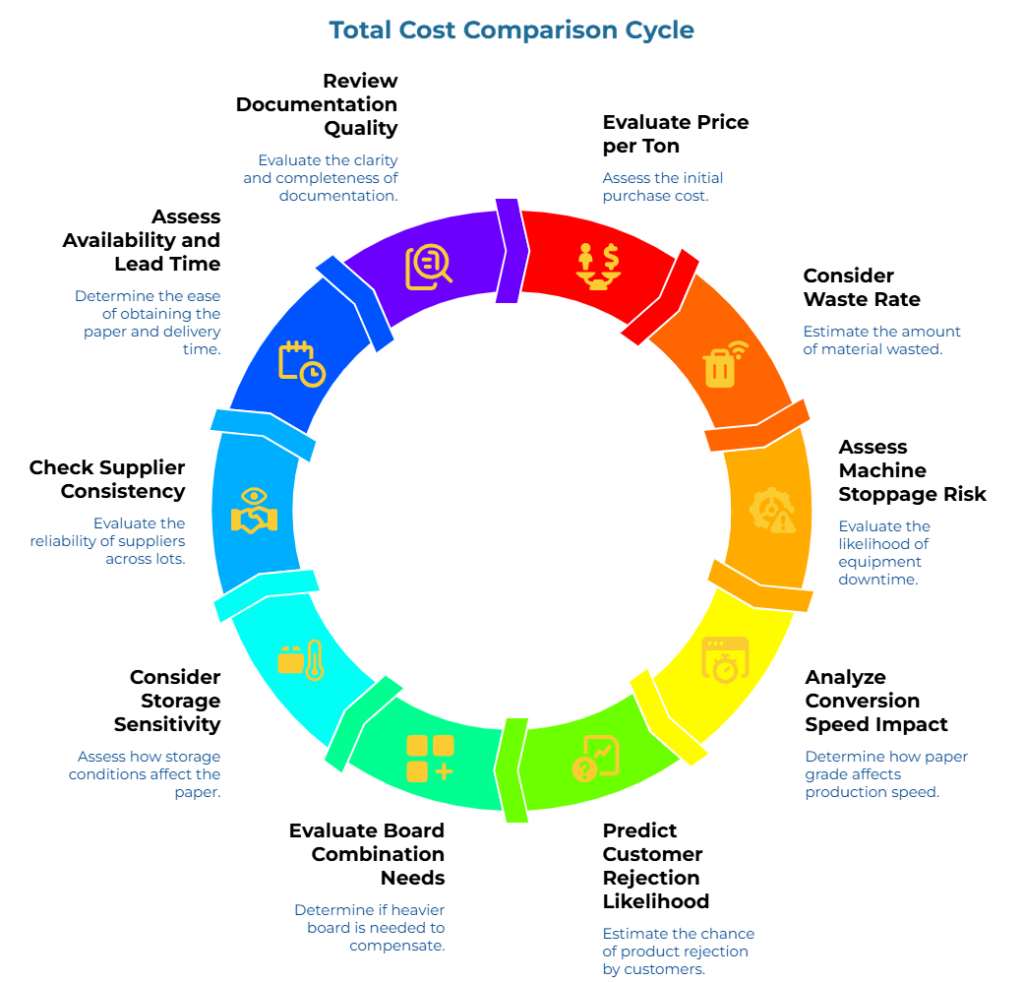
Price per ton is visible. The costs it hides are not.
When two grades sit side by side on a quote sheet, the natural instinct is to compare the unit price. But a meaningful comparison requires evaluating total cost — the cost of using each grade through the entire converting and delivery cycle, not just the cost of purchasing it.
Compare: price per ton or kilogram, expected waste rate, machine stoppage risk, conversion speed impact, customer rejection likelihood, the need for a heavier board combination to compensate for weaker paper, storage sensitivity, supplier consistency across lots, availability and lead time, and documentation quality.
A cheaper grade may work well for low-risk inner cartons. But for high-stack transport packaging, that same grade may increase crush complaints, force the corrugator to run at reduced speed, or require a heavier board combination that eliminates the paper savings entirely. The total cost of the wrong grade almost always exceeds the price premium of the right one. The same principle applies at the box level, where unit-price thinking fails when structural integrity costs surface elsewhere.
ASTM D5639/D5639M is useful here because it frames corrugated material and box-construction selection around performance requirements. That is the right mindset. Paper price matters, but failure cost decides whether the price was truly economical.
Buyers who over-spec expensive paper for low-risk applications waste money just as surely as those who under-spec for demanding ones. The goal is not to buy the most expensive grade or the cheapest one. The goal is to match the grade to the risk.
Common Mistakes When Buying Kraft Paper for Corrugated Conversion
Some mistakes appear across plants of every size. Naming them directly makes them easier to catch before they reach the production floor.
Buying by GSM alone. GSM tells you mass per unit area. It does not tell you whether the paper will bond reliably, resist moisture, hold a flute profile, or survive stacking. A buyer who selects paper based solely on GSM is making a weight decision, not a performance decision.
Treating burst factor as a universal performance guarantee. BF is useful — particularly in markets where burst factor is a common trade metric — but it measures rupture resistance, not compression, not runnability, and not bonding behaviour. A high BF does not automatically mean a high-performing corrugated board.
Using one grade across too many end-use applications. The grade that works for a light consumer carton may fail in an e-commerce transit box or a cold-storage produce package. Each application carries a different dominant risk, and the paper properties that address one risk may be irrelevant to another.
Ignoring moisture and storage conditions. Paper stored improperly before conversion — exposed to ambient humidity, stacked near loading docks, left without climate control — behaves differently from paper conditioned within its optimal moisture range. The supplier’s spec sheet assumes proper storage. If storage conditions at your plant do not match, the spec sheet’s values may not hold. (For more on this, see storage and conditioning for kraft reels and moisture windows: why ‘within range’ matters more than absolute values.)
Not separating liner and fluting requirements. Treating all kraft paper inputs as interchangeable leads to mismatched board performance. Liner and fluting serve structurally different roles. Specify each separately.
Approving paper without a machine trial. Specs help shortlist. Only a trial confirms whether the paper performs under your actual converting conditions — your speed, your glue system, your flute profile, your operator practices.
Not aligning supplier test methods with buyer or customer test methods. A burst value tested under one protocol is not directly comparable to a burst value tested under another. If the supplier tests using one standard and the customer expects another, the numbers may look similar but produce different outcomes. A practical reference for aligning test methods is available in TAPPI/ISO in plain English: which test methods to require in your kraft paper RFQ. Buyers should align test standards and acceptance criteria with both their suppliers and their customers.
Not defining acceptance tolerances in the purchase agreement. Without agreed tolerances, every delivery becomes a negotiation. Defining acceptable ranges for GSM, moisture, burst, Cobb, and other critical values before the first order ships prevents disputes and accelerates incoming inspection. A structured approach to this is covered in contract clauses that protect against off-spec kraft paper deliveries.
Underestimating food-contact or retailer documentation requirements. Compliance documentation is not a formality. A missing declaration can halt a shipment, disqualify a supplier, or expose a converter to regulatory risk. Treat it as a sourcing criterion, not a post-purchase checkbox.
Optimising paper price while increasing waste, downtime, or complaints. The 6% savings on material cost means nothing if waste rises by 4%, machine speed drops by 10%, and two customer complaints trigger requalification. This dynamic is explored in depth in spec clarity beats price: a pragmatic framework for kraft paper converting success. Total cost visibility — not purchase-price visibility — is what protects the bottom line.
Common Objections Buyers Should Challenge
Alongside the mistakes listed above, certain assumptions persist in procurement conversations that deserve direct scrutiny.
“We already bought it from GSM and BF. Why complicate it?” GSM and BF are useful starting points, but they do not fully predict runnability, bonding, compression behaviour, moisture performance, or end-use failure. A grade that hits both numbers can still fail on the corrugator or in the customer’s warehouse if the properties that matter for that specific application were never checked.
“The supplier says this is standard kraft paper.” The “standard” is not specific enough to be actionable. Ask for the intended application, role in board structure, test method, tolerance, and lot consistency. Two papers labelled “standard” by two different suppliers can behave very differently on the same machine.
“A trial slows down purchasing.” For repeat or high-risk orders, a small trial run can prevent larger losses from waste, downtime, rejected boxes, and customer complaints. The time spent on a trial is almost always less than the time spent managing a production problem caused by an untested grade.
“The customer only asked for corrugated boxes.” The converter still needs internal input specifications to meet the customer’s performance expectations consistently. A customer’s requirement for “corrugated boxes” does not eliminate the converter’s responsibility to choose inputs that deliver the necessary strength, appearance, and runnability.
A Practical Grade-Selection Framework for Small Converters
Four steps hold the process together.
Define the application. What box or board is being made, and what must it survive? A box stacked eight pallets high in a humid port warehouse faces a fundamentally different challenge than a retail shelf-ready carton shipped in a climate-controlled truck. Start with the end-use reality.
Identify the dominant failure risk. Crush, burst, moisture, bonding, print, fold, or compliance — which failure costs you the most? Not every risk carries the same weight. A food-contact compliance failure carries regulatory consequences. A print-quality failure may mean a retailer rejection. A crush failure in transit may trigger a damage claim and a lost account. Identify the failure that matters most and let that guide the paper conversation.
Match paper properties to process and risk. Choose the test values and supplier specs that address the identified risk, verified against actual machine conditions. If compression under stacking load is the dominant risk, SCT/RCT and ECT matter more than burst factor. If moisture in transit is the concern, Cobb and moisture range deserve more attention than GSM.
Validate before scaling. Run trials, inspect performance, compare delivered lots with approved samples, and document agreed acceptance ranges for repeat orders. Validation is not a one-time event. It is an ongoing practice — especially when suppliers change raw material sources, when converting conditions shift, or when a customer’s application evolves. Structured validation through supplier qualification pilot trials ensures repeatability before scaling volume.
The converter who sent back that first reel after a bad morning on the corrugator was not facing a paper-quality problem. That was a grade-fit problem — one that started with a buying question framed around price instead of performance.
Grade fit is not about purchasing the best kraft paper. It is about purchasing the right kraft paper for the job, the machine, and the risk.
Frequently Asked Questions
What is the best kraft paper grade for corrugated boxes?
There is no universal best grade. The right grade depends on the box application, liner or fluting role, board combination, machine process, storage conditions, and failure risk.
Is higher GSM always better for corrugated packaging?
No. Higher GSM adds material mass but does not automatically resolve poor bonding, moisture sensitivity, weak compression behaviour, poor formation, or unsuitable runnability.
Should buyers choose kraft paper by BF?
BF can be useful, especially in markets where burst factor is a common trade metric. However, it should not be the sole decision point. Buyers should also consider compression-related values, moisture, Cobb, caliper, runnability, and the final box application.
What is more important — paper specs or a machine trial?
Both matter. Specs help shortlist grades. A machine trial confirms whether the paper performs under actual converting conditions — the converter’s specific speed, glue system, flute profile, and operator practices.
Why does the same paper perform differently at different converters?
Machine settings, speed, glue system, storage conditions, flute profile, operator practices, and board combination all affect paper performance. Two converters running the same grade may see different results because their process environments differ.
What should buyers ask suppliers before approving a kraft paper grade?
Ask for the intended application, role in board structure, test values and test methods, lot-to-lot variation, moisture range, storage guidance, compliance documentation where relevant, and whether the supplier can support a machine trial. A structured template for these questions is available in the anatomy of a perfect kraft paper RFQ.
When is food-contact documentation needed?
When the packaging is intended for direct or relevant indirect food-contact use, buyers should verify applicable regulations and supplier declarations for the target market. In the United States, FDA food-contact-substance guidance applies. In the EU, food-contact materials regulations including EU 1935/2004 and 2023/2006 are relevant. In India, while general BIS standards such as IS 2771 apply to the physical performance of corrugated boxes, food-contact safety is specifically governed by the FSSAI (Food Safety and Standards Authority of India) Packaging Regulations, which mandate compliance with appropriate migration limits and safety standards for paper and paperboard. Requirements vary by jurisdiction, so verifying with the relevant regulatory body is essential.
How can small converters reduce grade mismatch?
Create an internal grade-fit checklist, involve production and QA before purchase, run trials for new grades, define acceptance tolerances, and track customer complaints by paper grade and supplier lot. For a step-by-step approach, see the five-step grade selection workflow using the match matrix.
Disclaimer:
This article is published for educational purposes. Readers should verify all specifications, test methods, and regulatory requirements with qualified professionals and relevant standards bodies before making sourcing decisions.
Our Editorial Process:
Our expert team uses AI tools to help organize and structure our initial drafts. Every piece is then extensively rewritten, fact-checked, and enriched with first-hand insights and experiences by expert humans on our Insights Team to ensure accuracy and clarity.
About the PaperIndex Insights Team:
The PaperIndex Insights Team is our dedicated engine for synthesizing complex topics into clear, helpful guides. While our content is thoroughly reviewed for clarity and accuracy, it is for informational purposes and should not replace professional advice.