

📌 Key Takeaways
A smarter paper bag SKU list starts with grouping bags by the job they do, not by how often they sell.
- Role Beats Volume: Cutting slow-moving bags without checking what job they cover can leave your team scrambling during a rush.
- Group by Fit, Not by Name: Bags that hold similar products the same way can often share one SKU, even if supplier labels make them sound different.
- Test Before You Cut: Run any replacement bag through a real busy period and watch for double-bagging or awkward workarounds before deleting the original.
- Tag Seasonal Bags with End Dates: Holiday or promotional bags quietly pile up on shelves for months unless someone flags them for removal when the season ends.
- Staff Spot Problems First: Counter and kitchen workers notice packing friction long before inventory reports show a gap.
Every bag on the list should have a clear job and a review date.
Small retail and food service buyers managing their own reorder lists will find a ready-to-use classification framework below, preparing them for a cleaner supplier conversation at the next review cycle.
~ ~ ~ ~ ~ ~ ~ ~ ~ ~ ~ ~ ~ ~ ~ ~ ~ ~
Most small retail and food service teams accumulate paper bag SKUs gradually. A new menu item calls for a larger bag, a holiday promotion introduces a branded variant, a supplier suggests a coated option for greasy takeaway, and a previous manager’s preferred size never leaves the reorder list. Before long, the bag shelf holds more variants than the operation needs, staff grab whichever bag is closest during a rush, and reorder planning becomes guesswork.
Paper bag SKU rationalization offers a way to reduce that clutter, but it only works when it focuses on operational fit rather than simply cutting line items. The framework below helps small teams classify, test, and document a simplified SKU mix before the next supplier catalog review or reorder cycle.
SKU Rationalization Is Not the Same as Removing Slow Movers
The most common approach to SKU reduction is pulling a usage report and deleting the lowest-volume items. That logic sounds efficient, but it misses the operational picture. A large catering bag used twice a month may still be the only SKU that safely holds a 4 kg multi-item order with handles intact. A coated bag stocked for greasy takeaway might move slowly during breakfast hours yet prevent sauce bleed-through for every evening delivery. Remove either one based on volume alone, and the team discovers the gap during a service rush.
The reverse is also true. A frequently reordered bag might be redundant if another SKU covers the same size range, load type, and use case. Keeping both adds storage pressure and ordering complexity without improving service.
This distinction matters for small teams especially, because clean usage data is often unavailable. The safer approach is to evaluate the role each SKU plays—its use case, substitutability, and service risk—not just its movement rate.
Start by Grouping Paper Bag SKUs by Use Case
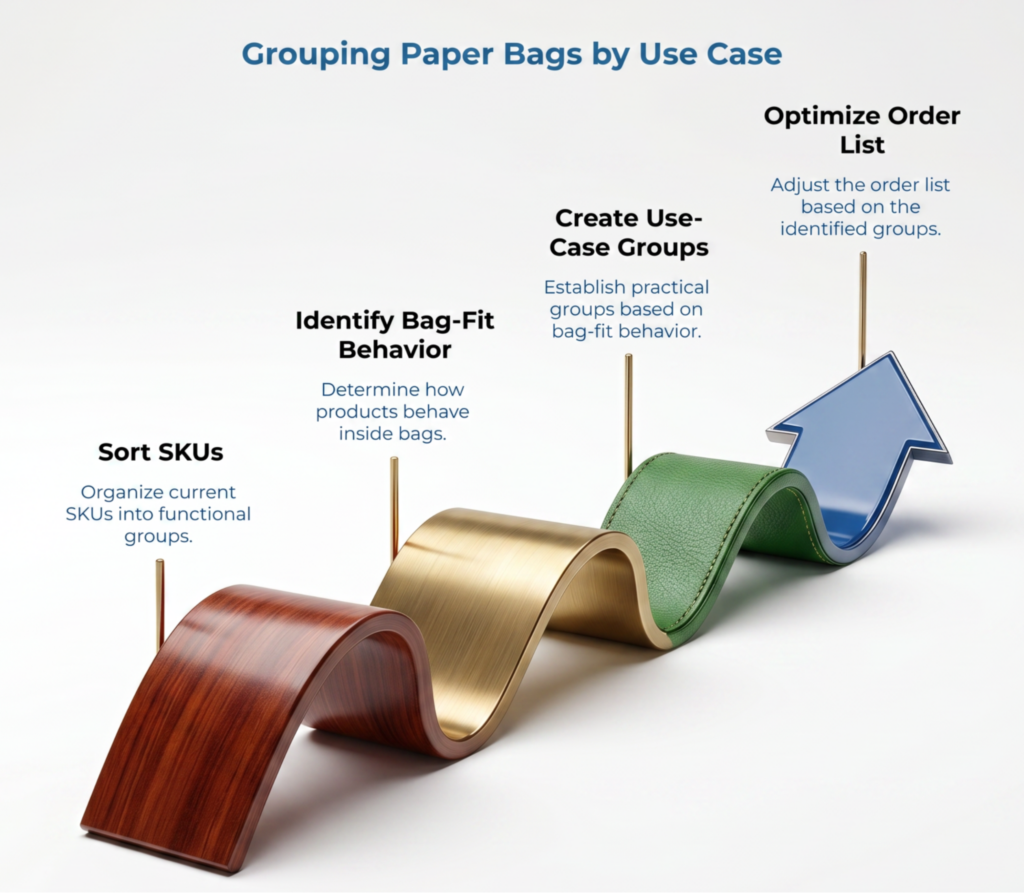
Before changing the order list, sort every current SKU into functional groups based on the job each bag actually does. Supplier catalog names and internal shorthand often obscure overlap. A bag labeled “medium kraft” and another called “lunch bag” may serve the same purpose, while two bags with similar dimensions may differ in handle type, gusset depth, or coating—differences that affect packing speed and durability through the customer handoff.
The most reliable grouping criterion is bag-fit behavior: how a product or order type actually behaves inside the bag during packing, carrying, and handoff. Products that behave similarly inside a bag can often share a SKU, even if they are different items in the sales catalog. A small accessory, a greeting card, and a packeted retail item may all belong to the same fit group if they require similar width, height, and handling. A boxed gift, a soft bundle, and a decorative product may create a different requirement if gusset depth and presentation matter more than height.
Practical use-case groups for most small retail and food service operations include:
- Everyday counter or checkout bags for single, lightweight items
- Small takeaway or single-meal bags
- Multi-item meal or grocery bags with handles
- Heavier-load bags for bulk grocery, catering, or multi-unit orders
- Printed or branded retail bags for presentation-sensitive purchases
- Seasonal, gift, or promotional bags with limited use windows
- Specialty bags requiring coating, barrier properties, or venting for hot or greasy food
Variables like size, gusset, handle type, paper grade, and coating matter only when tied to a real product and workflow need. For guidance on how these specifications interact with packing conditions, evaluate how bag size, gusset, and handle specifications affect pack-out efficiency, or review how to match paper bag specifications to basket size and handling conditions.
Use a Rationalization Matrix Before Changing the Order List
Once SKUs are grouped by use case, evaluate each one against a set of operational criteria. A compact matrix structures this review and makes the reasoning visible to staff, suppliers, or a second location manager.
| SKU / Description | Main Use Case | Frequency | Load / Fit | Workflow Dependency | Substitute? | Storage Burden | Decision |
| Small flat kraft bag | Counter checkout, pastries | Daily, high | Light items under 0.5 kg | Used at every shift | No safe substitute | Low | Keep — core daily SKU |
| Printed holiday gift bag | Seasonal retail gifting | 6 weeks per year | Medium, presentation-sensitive | Holiday window only | Unbranded bag covers function, not branding | High if stored year-round | Seasonal-only — order before season, clear after |
| Medium handled kraft bag | Takeaway meals | Daily, moderate | Single meal, 1–1.5 kg | Overlaps with lunch bag SKU | Lunch bag covers same role | Moderate | Consolidate — test lunch bag as replacement |
| Large coated catering bag | Heavy multi-item catering | Weekly, low | 3–5 kg, grease resistance needed | Only bag rated for heavy catering | No — next largest lacks coating and capacity | Low | Keep — no safe substitute for this load and barrier need |
Each row should end with a clear classification: keep, consolidate, seasonal-only, remove, or test further. “Test further” applies when staff disagree about a replacement, the substitute has not been tried under real conditions, or the SKU covers an edge case that usage data alone cannot evaluate. Minimum order quantity constraints and supplier lead times may also influence whether consolidation is practical.
Pay attention to near-duplicates during this review. Two bag sizes may differ in a supplier catalog but behave almost identically in actual store use. If they serve the same product group, require similar storage space, and create no meaningful workflow difference, one may be enough.
Check Workflow Fit Before Consolidating Sizes or Formats
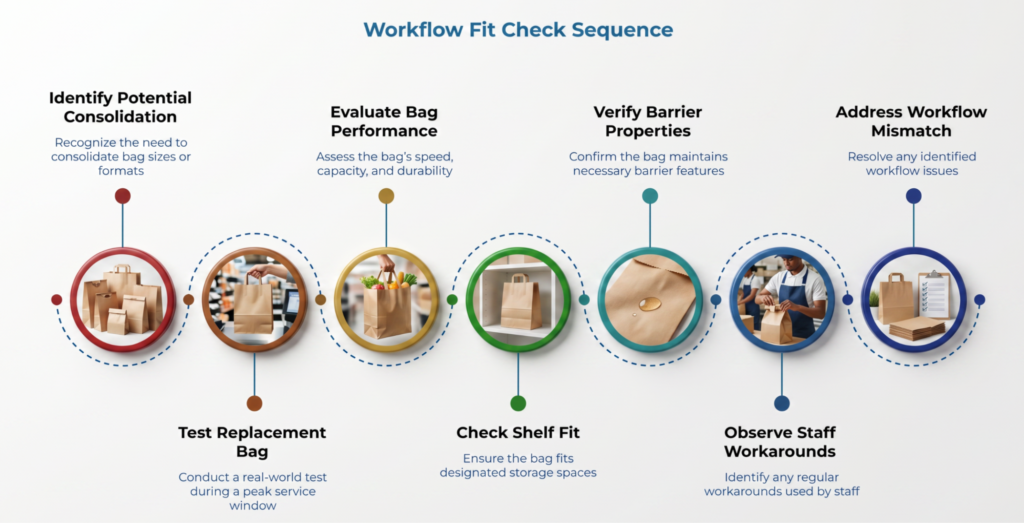
Consolidation that ignores daily workflow creates new friction. A replacement bag that is slightly too wide may not stand upright at the packing station. One without a flat base tips when staff set it on the counter. A bag with insufficient gusset depth forces double-bagging, adding time and material cost.
Before removing any SKU, test the proposed replacement during a real service window—ideally during a peak period. Confirm that the substitute bag:
- Opens, fills, and closes at the same speed as the original during peak packing
- Holds the intended product without bulging, tipping, or tearing
- Supports comfortable carry at the expected load weight
- Fits the designated shelf, bin, or dispenser at the counter or kitchen station
- Maintains any barrier properties—grease resistance, moisture tolerance—that the original required
Staff workarounds are the most reliable warning signs of a workflow mismatch. If workers regularly double-bag, switch to oversized bags, fold tops awkwardly, or avoid a particular size during busy periods, the consolidation has introduced a problem it was meant to solve. These patterns often surface before inventory data reflects the issue, which is why direct observation during a test window matters more than a spreadsheet comparison.
Separate Core, Seasonal, and Exception SKUs
Not every rationalization decision should end in permanent deletion. Seasonal retail displays, gift packaging, catering contracts, and promotional events may justify keeping a controlled SKU that would otherwise be a removal candidate. The key is to classify these bags explicitly so they do not drift back onto the everyday reorder list.
| SKU Type | Stocking Logic | Review Timing |
| Core | Used consistently in daily service across most or all shifts | Review quarterly or before a major reorder |
| Seasonal | Used for defined seasonal events, holiday promotions, or limited campaigns | Review before and after each seasonal window |
| Exception | Ordered only for specific triggers: catering contracts, special menu items, or one-time events | Require approval or a documented trigger before ordering |
| Retired | No clear current use case, or a safe substitute now covers the role | Remove from reorder templates and supplier standing orders |
Seasonal bags deserve particular attention. A printed holiday bag ordered in November can still occupy shelf space in April if no one flags it for removal. Tagging seasonal SKUs with start and end dates—and reviewing them when the window closes—prevents quiet accumulation.
How This Looks in Practice
Consider a small retailer preparing for a holiday assortment. The store carries three regular paper bag SKUs: a small flat bag, a medium handled bag, and a large gusseted bag. The seasonal range adds boxed gifts, small accessories, and bulky gift bundles.
Rather than creating a separate bag size for each seasonal product, the buyer groups items by fit behavior. Small accessories fit the existing small bag. Most boxed gifts work in the medium handled bag. Multi-item purchases can use the large gusseted bag. Only the bulky gift bundles create a repeated issue—they fit poorly in the medium bag and look loose in the large one. The buyer marks one temporary exception SKU for that product group, with a note to review usage after the season. The underlying principle is to group use cases first, deploy existing core sizes where functional, and introduce an exception SKU only when a documented workflow friction emerges.
Align the Simplified SKU List with Supplier Review
A rationalized SKU list transforms the supplier conversation. Instead of requesting quotes for “small, medium, and large paper bags,” the buyer can share specific use cases, order profiles, load expectations, seasonal volume patterns, and format requirements. That specificity reduces back-and-forth and makes it easier to compare offers on a like-for-like basis.
Before sending a request for quotation, document each SKU with enough detail for a supplier to quote accurately: bag dimensions, paper grade or weight range, handle style, gusset depth, coating or barrier requirement, local regulatory compliance requirements (such as minimum post-consumer recycled content), estimated order volume, and whether the order is continuous or seasonal. Understanding the paper bag cost drivers that shift between suppliers helps ensure that quote differences reflect real specification differences rather than inconsistent assumptions.
When bags are intended for direct food-contact use, buyers should verify relevant requirements through supplier documentation and recognized sources for the target market, such as the FDA food-contact substances page, the European Commission food-contact materials page, and local jurisdiction databases for specific chemical restrictions like PFAS bans, where applicable. For technical specification language and test methods, standards-oriented references from ISO/TC 6 and TAPPI can help frame clearer RFQ requirements. Not every buyer needs a technical standard in every RFQ—in many routine retail and food-service situations, the immediate need is clearer communication about what the bag must carry, how it will be packed, how it will be stored, and where the current mix creates friction.
Buyers evaluating new supplier options can utilize B2B procurement platforms to source paper bag suppliers and submit paper bag buying requirements.
Common Mistakes to Avoid When Reducing Paper Bag SKUs
SKU rationalization efforts fail most often when they prioritize count reduction over operational coverage:
- Removing a low-volume but high-importance SKU without first confirming that another bag handles the same load, product type, and handling path.
- Consolidating based on size alone while overlooking differences in handle type, gusset depth, coating, or paper grade that affect packing speed and product fit.
- Assuming a heavier bag automatically replaces a lighter one. A stronger bag that is too stiff to open quickly, too large for the product, or more expensive per unit may not be a functional substitute.
- Leaving seasonal SKUs on the everyday reorder list so they keep arriving and consuming shelf space long after the relevant season ends.
- Skipping staff input. Counter and kitchen staff often identify which bags cause packing friction well before inventory data reflects the issue.
- Comparing supplier quotes before finalizing the SKU mix. If the intended bag list changes after quotes arrive, the comparison becomes unreliable and may need to restart.
- Treating rationalization as a one-time cleanup rather than an ongoing review tied to seasonal planning, menu changes, and new product introductions.
Simplify the SKU Mix Without Weakening Service
Paper bag SKU rationalization should make daily work easier, not just make the stockroom tidier. The goal is a clearer bag set where every SKU has a defined role and a review schedule.
Before the next reorder cycle, document the current bag list, classify each SKU by use case, test proposed consolidations under real packing conditions, and update supplier-facing order details to reflect the mix the operation actually needs.
For related guidance on material choices that affect specification fit and supplier quotes, explore kraft, white, and recycled paper bag trade-offs.
Frequently Asked Questions
How many paper bag SKUs should a small business keep?
There is no universal number. The right count depends on product mix, order profiles, seasonal patterns, storage capacity, and whether the operation requires specialty bags with barriers, handles, or branding. A cafe with a narrow menu may manage with three or four core SKUs; a retail store with seasonal gift packaging may need more. The aim is for every active SKU to have a documented purpose.
Should slow-moving paper bag SKUs always be removed?
Not necessarily. A slow-moving bag may serve a critical use case—catering loads, heavy grocery orders, branded retail presentation, or items requiring grease resistance. Review use case, substitutability, and service risk before removing any low-volume SKU.
What is the safest way to test SKU consolidation?
Run the proposed replacement through a real service window, ideally during a busy period, before deleting the original from the reorder template. Monitor packing speed, product fit, and whether staff revert to double-bagging. If the replacement creates friction, keep the original until a better substitute is found.
Are kraft paper bag sizes standardized across suppliers?
Supplier catalogs may use similar size labels, but the actual dimensions, gusset depth, handle format, paper grade, construction, and finish can differ. Similar descriptions do not always mean the bags will perform the same way in storage, packing, or customer handoff. Confirm exact specifications before ordering, especially when switching suppliers or comparing quotes.
What should be documented before asking suppliers for quotes?
For each SKU, record bag dimensions (width, depth, height), handle type, gusset depth, paper grade or weight range, coating or barrier requirements, print specifications if applicable, estimated volume per order cycle, and whether the order is continuous or seasonal. Including the intended use case helps suppliers recommend appropriate options. Confirm minimum order quantities and lead times directly with each supplier.
Disclaimer:
This article is for general informational purposes only. It is not a substitute for advice from a qualified professional, provider, or official source relevant to your situation. Always verify important decisions with the appropriate expert, authority, or service provider.
Our Editorial Process:
Our expert team uses AI tools to help organize and structure our initial drafts. Every piece is then extensively rewritten, fact-checked, and enriched with first-hand insights and experiences by expert humans on our Insights Team to ensure accuracy and clarity.
About the PaperIndex Insights Team:
The PaperIndex Insights Team is our dedicated engine for synthesizing complex topics into clear, helpful guides. While our content is thoroughly reviewed for clarity and accuracy, it is for informational purposes and should not replace professional advice.