
📌 Key Takeaways
Retail bag transitions succeed when operations are protected before products are perfected.
- Stabilize First, Optimize Later: Calculate days of cover and assign ownership for supply continuity and training within 48 hours to prevent checkout gaps.
- Specification Matching Prevents Failures: Match paper bag GSM, handle type, and moisture resistance to your actual basket weights and product mix before committing to volume orders.
- Trial Before Scale: Test bags at your busiest checkout lane during peak periods to expose handle tears, bottom splits, and moisture failures that samples alone won’t reveal.
- Staging Eliminates Friction: Pre-open bags at bagging stations and establish clear double-bag rules to prevent the “pause and decide” moments that slow checkout lines.
- Compliance-First Messaging Reduces Complaints: Frame the transition as regulatory compliance with helpful service offers rather than environmental persuasion or excessive apology.
Operations continuity protects brand credibility when packaging changes.
Retail managers and store owners facing plastic ban deadlines will gain a phased action plan here, preparing them for the detailed implementation timeline that follows.
Switching bags is simple. Switching operations is what keeps your checkout running.
When a plastic ban deadline arrives, the real challenge isn’t finding paper bags. It’s preventing the small disruptions that cascade into customer complaints, staff confusion, and empty bag stations during peak hours. A torn handle at the register. Moisture-damaged stock discovered too late. Customers caught off guard by a sudden change.
These operational hiccups don’t just slow things down. They signal to customers that your store wasn’t prepared. In retail, packaging functions like currency at the checkout counter. When that currency runs out or fails in a customer’s hands, your professional credibility takes the hit.
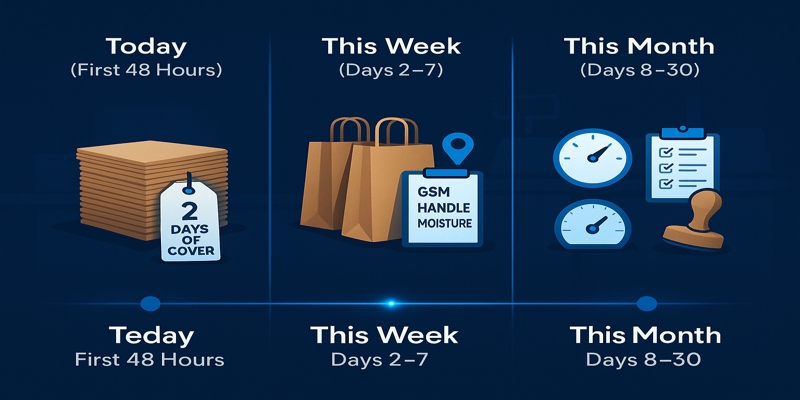
The good news: a structured transition prevents most of these problems. What follows is a practical plan organized around three timeframes: what to do today, what to tackle this week, and what to lock in this month. Regulations vary by jurisdiction, so keep your local requirements documented and verify compliance details with the relevant authorities in your area.
By the end of this guide, you’ll have a clear path from reactive scrambling to controlled confidence, with checkout continuity protected throughout.
Plastic-to-Paper Transition Timeline
This timeline provides a phased approach to manage the switch without disrupting daily operations.
Today (First 48 Hours)
- ☐ Confirm current bag inventory levels and calculate days of cover at normal volume
- ☐ Set a temporary checkout policy for staff (paper-only, limited bags per transaction if needed)
- ☐ Assign one owner for bag supply continuity and one owner for staff training
- ☐ Communicate the change to all shift supervisors before the next shift starts
- ☐ Place an emergency order if stock falls below one week of typical usage
This Week (Days 2–7)
- ☐ Define paper bag specifications based on your typical basket weight and contents
- ☐ Request samples from at least two suppliers and collect basic documentation
- ☐ Prepare a basic documentation folder (supplier docs, spec sheet, trial notes)
- ☐ Run a small trial at your busiest checkout lane and capture staff feedback
- ☐ Identify a dry, flat storage area away from loading dock moisture exposure
This Month (Days 8–30)
- ☐ Finalize supplier selection based on trial results and documentation quality
- ☐ Update receiving procedures to include condition checks on arrival
- ☐ Train all checkout staff on new bagging techniques and edge-case handling
- ☐ Establish a reorder point and buffer stock level for peak periods
- ☐ Post customer-facing signage explaining the transition
What to Do First When a Plastic Ban Hits (48 Hours)
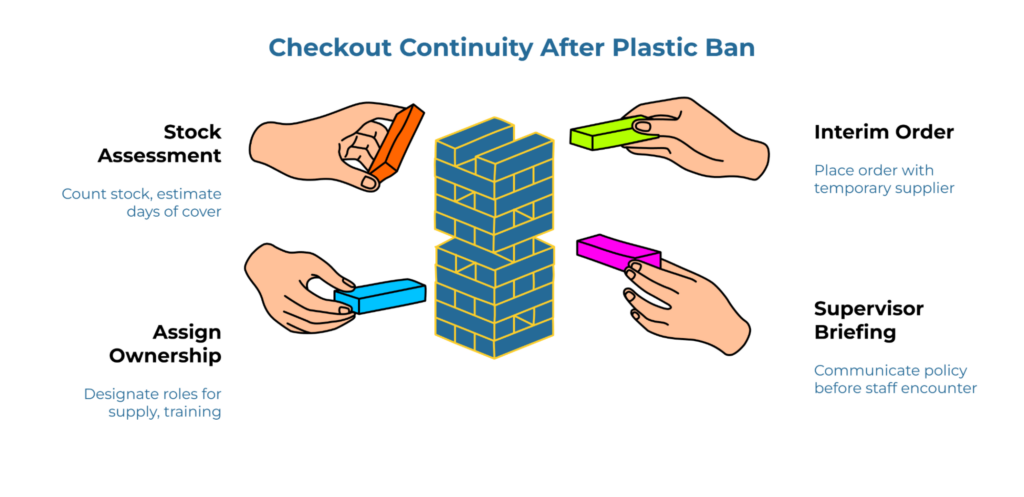
The first two days are about stabilization, not optimization. Your single priority is preventing a gap at the checkout counter.
Start by counting your existing stock and estimating days of cover at normal volume. If the answer is less than a week, place an interim order immediately, even if it means accepting a less-than-ideal supplier temporarily. Running out of bags entirely creates a far worse customer experience than using a transitional product.
Next, assign clear ownership. Designate one person responsible for bag supply continuity and another for staff training. This prevents the diffusion of responsibility that causes both tasks to slip during a busy transition period.
Then brief your shift supervisors before staff encounter the change themselves. A simple policy statement works: “We’re switching to paper bags starting today. Here’s how we’re handling it until we’re fully stocked.” This prevents the awkward moment when a cashier doesn’t know what to tell a customer asking about the change.
Operations lens: Checkout continuity comes first. Avoid “surprise moments” for staff by communicating the temporary policy before the next shift begins. Even a brief huddle prevents confusion that slows the line.
Pick the Right Paper Bag Specs for Your Store
Paper bags vary more than most retailers initially expect. Selecting the right specifications upfront prevents returns, complaints, and mid-shift bag failures.
The core variables to consider are weight capacity, handle style, and moisture resistance. Rather than chasing the cheapest option from unverified paper bag suppliers, match the bag to your actual use case.
| Typical Use Case | Bag Features to Prioritize |
| Light groceries (bread, produce, dry goods under 3 kg) | Flat paper handle, standard kraft, 70–80 GSM |
| Medium loads (canned goods, bottles, mixed basket 3–7 kg) | Twisted paper handle, reinforced bottom, 90–100 GSM |
| Heavy or wet items (meat trays, frozen goods, 7+ kg) | Reinforced twisted handle, moisture-resistant liner, 100+ GSM |
These are illustrative ranges for general retail bags. For businesses requiring heavy-duty or specialized packaging, explore kraft paper bags with reinforced construction. Actual specifications depend on your product mix, customer habits, and local supplier availability.
Procurement lens: When requesting quotes, ask for a specification sheet that includes GSM (paper weight), handle attachment method, and any moisture treatment. Also request a certificate of compliance with relevant local packaging regulations. This documentation becomes valuable if you face an inspection.
For a deeper framework on aligning sourcing decisions with compliance requirements, the sourcing and compliance integration checklist provides a structured approach.
Run a Fast, Low-Risk Paper Bag Trial Before a Full Switch
Testing paper bag performance before committing to a large order prevents costly operational issues. A simple trial takes less than a week and reveals problems that samples alone won’t expose.
What to test:
- Handle durability under realistic load (fill the bag to your typical transaction weight)
- Bottom seam strength when lifted from the counter
- Performance with moisture exposure (refrigerated items, condensation)
- Behavior with sharp corners or awkward shapes (cereal boxes, bottle necks)
Where to test: Choose your busiest checkout lane during a peak period. This creates the realistic pressure that exposes weaknesses. A bag that performs fine during a slow Tuesday afternoon may fail during Saturday rush.
How to capture results: Give checkout staff a simple notes template. For supplier evaluation beyond the trial phase, use structured verification approaches similar to those outlined in our guide on how to vet wholesale paper bag suppliers to ensure long-term supply reliability. Three questions are enough: Did any bags fail? What was in the bag when it failed? Any customer comments? Collect responses at the end of each test day and compile them in your documentation folder alongside supplier specs and sample photos. When evaluating kraft paper bag suppliers, this trial documentation becomes essential evidence for supplier comparison and selection.
If more than one or two percent of bags show problems during the trial, investigate before scaling. The failure pattern usually points to a specific cause, whether that’s overfilling, moisture, or a manufacturing inconsistency.
Business Owner lens: A short trial protects you from two risks: operational disruption from a poor product, and wasted inventory if you need to switch suppliers. The time investment is minimal compared to the cost of a failed rollout.
Update Operations So Paper Bags Don’t Slow Checkout
Paper bags behave differently than plastic throughout your operation. Adjusting receiving, storage, and checkout workflows prevents the small frictions that accumulate into delays.
Receiving: When stock arrives, check for visible damage, moisture exposure during transit, and consistency across the delivery. Crushed bags or water stains on outer packaging suggest handling problems that may have compromised the product inside. Document any issues before signing off on the delivery.
Storage: Paper bags need protection from humidity and physical pressure. When sourcing from paper suppliers, verify their packaging and storage recommendations to ensure product integrity throughout your supply chain. Store them flat in a dry area away from loading docks, exterior walls, and refrigeration units where condensation can accumulate. Avoid stacking heavy items on top of bag inventory. Crushed or moisture-damaged bags won’t open properly at checkout and create delays. Research consistently highlights that paper products are particularly vulnerable to moisture damage due to their absorbent fiber composition, with studies by the US Environmental Protection Agency (EPA) emphasizing the need for strict environmental controls to maintain product integrity during storage.
Checkout workflow: Paper bags require slightly different handling than plastic. Consider staging opened bags at the bagging area so cashiers don’t need to open each one during the transaction. Establish a double-bagging guideline for heavy items. For edge cases like broken handles or wet items, give staff a simple rule: “If in doubt, double-bag and apologize for the inconvenience.”
Operations lens: Staging pre-opened bags and establishing clear edge-case rules prevents the “pause and decide” moments that slow checkout. A three-second delay per transaction multiplies quickly during peak hours.
Communicate the Change to Customers Without Triggering Complaints
How you frame the transition shapes whether customers see it as an inconvenience or a sign of your store’s professionalism. Compliance-first messaging works better than environmental lecturing.
Signage example: “We’ve transitioned to paper bags in compliance with local packaging regulations. Thank you for your understanding as we make this change.”
This framing accomplishes three things: it explains the reason (compliance), acknowledges the change affects customers, and positions your store as responsive rather than reactive. With single-use plastic bans now implemented or planned in over 170 countries according to United Nations Environment Programme data, customers increasingly recognize packaging transitions as regulatory responses rather than discretionary choices.
Staff script for questions: “We’re now using paper bags to comply with the new packaging requirements. They’re sturdy, and we’re happy to double-bag heavier items. Let us know if you need any help.”
Avoid apologizing excessively or criticizing the regulation. Both responses invite complaints. A matter-of-fact tone signals competence.
For stores where sustainability is part of the brand identity, the transition offers an opportunity. Certification marks like FSC on your bags provide visible proof of responsible sourcing. Understanding why FSC certification matters for brand reputation can help frame this as a positive differentiator rather than a forced compliance measure.
Brand/Marketing lens: The goal is friction reduction, not persuasion. Customers don’t need to be convinced that paper is better. They need to know you’re prepared, professional, and ready to help them get their groceries home.
Lock the Change in With a Basic Reorder and Backup Plan
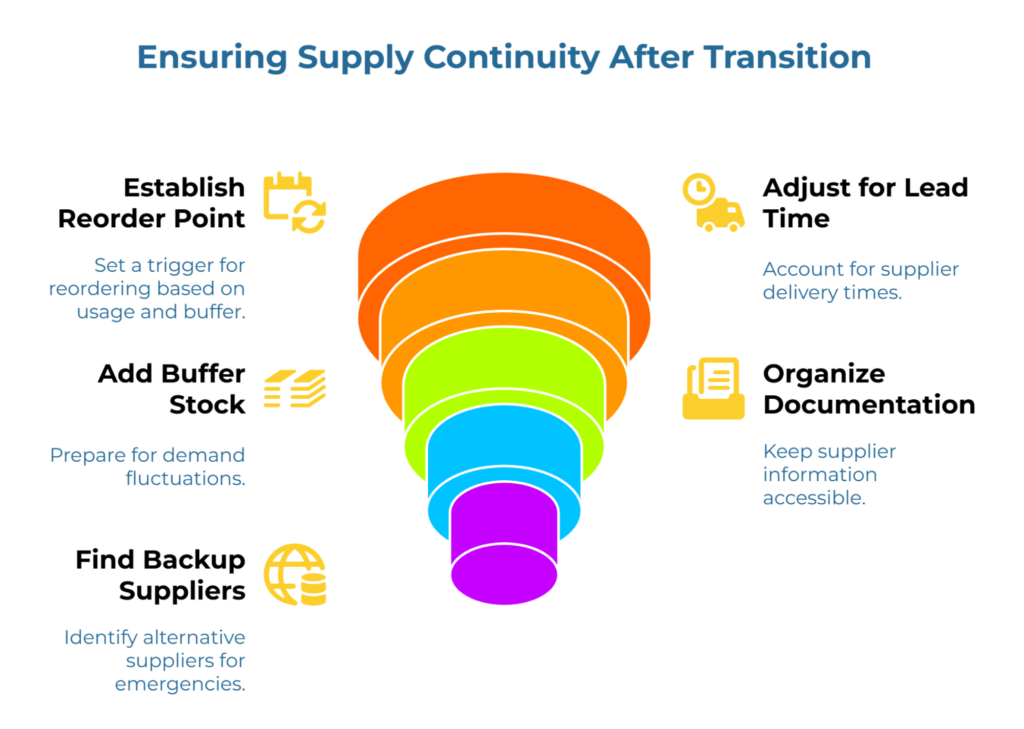
Once the initial transition is complete, the risk shifts from implementation to supply continuity. A single delivery delay shouldn’t empty your checkout counter.
Establish a reorder point based on your average weekly usage plus a buffer. A common approach: reorder when stock drops to two weeks of supply, with a target delivery that replenishes to four weeks. Adjust based on your supplier’s typical lead time and your peak season patterns. For stores with unpredictable demand variability, consider adding an extra week of cover during uncertain periods, then adjusting once consumption patterns stabilize.
For stores with significant volume variation, such as holiday rushes or promotional events, build additional buffer stock ahead of known peaks. Running short during your busiest period damages both revenue and customer perception.
Keep supplier documentation organized and accessible in your documentation folder. If you need to qualify a backup supplier quickly, having your specifications, compliance requirements, and testing criteria already documented speeds the process considerably. The sustainable packaging compliance guide offers a framework for organizing this documentation.
If you do face an unexpected shortage, find suppliers on PaperIndex’s verified marketplace, and apply the principles in how to fix a paper bag stockout crisis fast can help you respond without making decisions you’ll regret.
Quick Checklist: A Smooth Plastic-to-Paper Transition
- Confirm current inventory and calculate days of cover at normal volume
- Set a temporary checkout policy and communicate it to all supervisors
- Assign owners for supply continuity and staff training
- Place an emergency order if stock falls below one week of supply
- Define paper bag specifications based on your typical basket contents
- Request samples and documentation from at least two suppliers
- Prepare a documentation folder with supplier docs, specs, and trial notes
- Run a trial at your busiest checkout and collect staff feedback
- Identify dry, flat storage away from moisture and heavy stacking
- Update receiving procedures to check for damage and consistency
- Train checkout staff on bagging techniques and edge-case handling
- Establish a reorder point with buffer stock for peak periods
- Post customer-facing signage with compliance-first messaging
- Organize supplier documentation for inspection readiness
FAQ
How should paper bags be stored to prevent damage?
Store paper bags flat in a dry area away from exterior walls, loading docks, and refrigeration units where humidity accumulates. Avoid stacking heavy items on top of bag inventory, as compression damages the structural integrity and makes bags difficult to open at checkout. The US Environmental Protection Agency notes that paper products are particularly sensitive to moisture, making proper storage conditions essential for maintaining performance.
Are paper bags strong enough for heavy groceries?
Paper bags designed for retail use can handle substantial weight when properly specified. The key is matching the bag specification to your use case. Reinforced handles and heavier GSM paper handle loads that standard bags cannot. Request specification sheets and test under realistic conditions before committing to volume orders.
What if customers complain about the switch?
Most complaints stem from surprise or inconvenience, not the bags themselves. Clear signage, a brief explanation from staff, and an offer to double-bag heavier items resolve the majority of concerns. A matter-of-fact, helpful tone works better than excessive apology or environmental justification. With packaging regulations, including single-use plastic bans, now active in a vast majority of United Nations member states according to recent data from the United Nations Environment Programme (UNEP), most customers understand these transitions as compliance requirements.
What documentation should be kept for compliance purposes?
Maintain supplier specification sheets, certificates of compliance with relevant packaging regulations, and any sustainability certifications such as FSC in an organized documentation folder. Keep these accessible for potential inspections. Documentation that demonstrates you’ve verified your packaging meets local requirements provides confidence during regulatory reviews. The Forest Stewardship Council maintains registries that allow verification of certification claims.
How much buffer stock is appropriate?
This depends on your supplier’s lead time and your volume variability. A general starting point is maintaining two to four weeks of supply, with reorder triggered at the two-week mark. For stores with unpredictable demand patterns, consider adding an extra week of cover until consumption stabilizes. Adjust upward for peak seasons or if your supplier has longer or less predictable lead times. Research by the Organisation for Economic Co-operation and Development (OECD) on supply chain risk management strongly supports maintaining buffer inventory proportional to mitigate risks from demand variability and lead time uncertainty.
Explore more practical packaging playbooks in PaperIndex Academy, including detailed guides on supplier verification, compliance documentation, and strategic sourcing.
Disclaimer:
This guide is for general, educational purposes only and is not legal, regulatory, or professional advice. Plastic-ban requirements and enforcement vary by jurisdiction and can change; confirm current rules with local authorities and keep appropriate supplier documentation. Any timelines, test steps, or cost examples are illustrative and must be adapted to the store’s products, conditions, and supply chain. References to third-party standards or certifications are informational only and do not guarantee compliance or performance.
Technical Note: This article is optimized for Article schema markup. The FAQ section qualifies for FAQPage schema due to substantive, non-duplicative answers that add value beyond the main content.
Our Editorial Process:
Our expert team uses AI tools to help organize and structure our initial drafts. Every piece is then extensively rewritten, fact-checked, and enriched with first-hand insights and experiences by expert humans on our Insights Team to ensure accuracy and clarity.
About the PaperIndex Insights Team
The PaperIndex Insights Team is our dedicated engine for synthesizing complex topics into clear, helpful guides. While our content is thoroughly reviewed for clarity and accuracy, it is for informational purposes and should not replace professional advice.