
📌 Key Takeaways
An ISO certificate proves a supplier has organized processes—it does not prove your specific folding carton run is safe for your food product.
- Certificates Show Systems, Not Safety: ISO badges confirm how a company manages quality, not whether this batch works for your frozen pizza or bakery box.
- Quotes Without Specifications Are Guesses: When suppliers fill in blank RFQ fields with their own assumptions, you end up comparing three different products at the same price.
- Ask for Proof, Not Badges: Request test reports that match your exact food type, temperature, and contact time—not just a logo on the quote.
- Split the Verification Work: QA checks whether the folding carton fits the food; Procurement checks whether all suppliers answered the same questions.
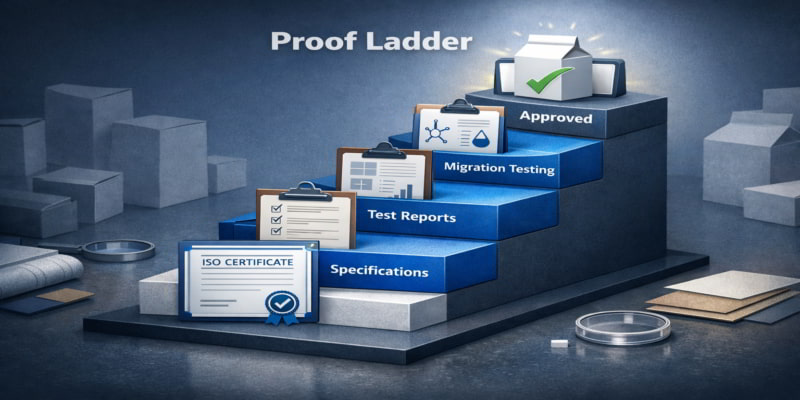
- Use Certificates as a Starting Point: ISO belongs at the bottom of your approval ladder, not the top—deeper proof comes later for serious candidates.
Proof beats paperwork—run-specific evidence protects you where badges cannot.
Procurement managers, QA specialists, and packaging engineers sourcing folding cartons for food applications will gain a clearer supplier vetting approach here, preparing them for the specification frameworks that follow.
~ ~ ~ ~ ~ ~ ~ ~ ~ ~ ~ ~ ~ ~ ~ ~ ~ ~
The supplier quote lands in your inbox. You scroll past the pricing, past the lead times, and there it is: the ISO 9001 badge, cleanly embedded in the header. A small wave of relief washes over you. The supplier is certified. The compliance box is mentally checked.
That moment of reassurance is understandable. It is also where compliance risk quietly enters your supply chain.
An ISO certificate confirms that a supplier operates a documented quality management system. It does not confirm that the folding cartons in your next shipment will meet your specific food-contact requirements—your barrier specifications, substrate suitability, coating choices, migration testing relevance, moisture barriers, or the direct food contact variables your product demands. The certificate speaks to how a supplier organizes its processes. It says nothing about whether the folding carton run currently in production is safe for your frozen dessert, bakery item, confectionery, dairy product, fresh produce, or packaged snack.
This distinction matters because international compliance disputes rarely start with obviously bad folding carton suppliers. They start with buyers who stopped verifying at the certificate layer. The hidden mechanism is simple: the certificate gets treated as product proof, so the buyer stops asking for run-specific proof.
Myth: If the Supplier Is ISO-Certified, the Folding Carton Must Be Food-Safe
This assumption feels logical. A supplier who passed an ISO audit must be producing safe packaging, right?
The reasoning is seductive because it saves time. If a third-party auditor already validated the supplier, why duplicate the effort? The certificate becomes a shortcut—a way to skip the harder work of aligning specifications before the RFQ process begins.
Many procurement and QA teams operate this way. Not out of negligence, but because the certificate looks like proof. It arrives as a PDF, carries an official seal, and references an internationally recognized standard.
Reality: ISO Certifies the Management System, Not Your Specific Folding Carton Run
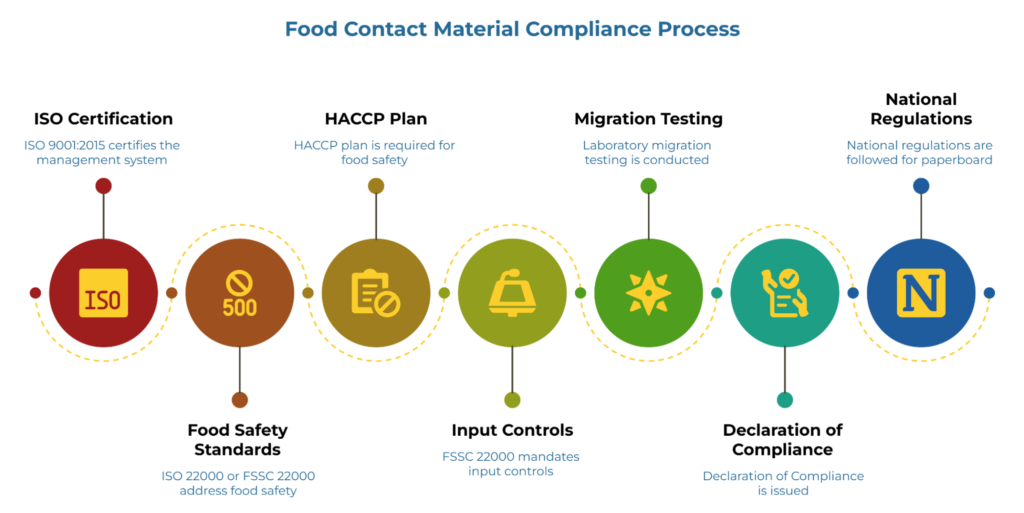
While ISO 9001:2015 certifies a general quality management system, it is increasingly supplemented in the packaging sector by ISO 22000 or the FSSC 22000 scheme. These standards specifically address food safety by requiring a Hazard Analysis and Critical Control Points (HACCP) plan. While ISO 22000 and FSSC 22000 provide a robust framework for HACCP, they primarily govern the management of food safety hazards and the hygienic environment of the converter. Furthermore, while FSSC 22000 mandates input controls, it lacks the granularity of a product-specific Certificate of Analysis (CoA). It fails to validate that the specific chemical migration profile of a finished folding carton—influenced by inks, adhesives, or recycled fibers—falls below legal thresholds for your specific food type under actual use conditions (time and temperature).
Consequently, these certifications do not supersede the legal requirement for a Declaration of Compliance (DoC) supported by laboratory migration testing (OML/SML) conducted under the appropriate simulant conditions (e.g., Tenax for dry foods or 3% acetic acid for acidic foods) as mandated by Regulation (EC) No 1935/2004. It focuses on the consistency of the process rather than the suitability of the specific substrate for your particular food product.
This is not a flaw in the standard. ISO 9001 was never designed to validate product-specific compliance. It validates organizational discipline.
The gap becomes dangerous when buyers treat system-level certification as a substitute for run-specific proof. A certified mill can still produce folding cartons that fail your moisture barrier requirements, use coatings incompatible with your migration limits, or lack the food-grade barriers your regulatory environment demands.
Food-contact regulations—such as the FDA’s 21 CFR frameworks in the United States, EU Regulation 1935/2004, and Commission Regulation (EU) No 10/2011. While this regulation specifically targets plastic materials, it is the mandatory legal framework for any plastic layer or coating used within multi-material folding cartons. Under the ‘multi-material multi-layer’ (MMML) principle, plastic layers in these structures must be composed of substances on the ‘Union List’ and the finished article must not exceed the Overall Migration Limit (OML) of 10 mg/dm², as well as specific migration limits (SML) for regulated substances (as per Art. 13 and 14 of 10/2011).
However, users must be aware that for the paperboard substrate itself, a specific harmonized EU regulation does not yet exist. Consequently, industry standard practice relies on national legislations, most notably the German BfR Recommendation XXXVI (Paper and board for food contact) and the Dutch Warenwet, to demonstrate safety under the umbrella of the Framework Regulation (EC) No 1935/2004. These regulations demand a Declaration of Compliance (DoC) that traces the material’s safety back to its chemical constituents—something an ISO 9001 certificate is not designed to provide.
If you want proof that a folding carton run meets your barrier, migration, and substrate requirements, you need documents that explicitly reference those requirements. The ISO badge is not that document. The question worth asking before any technical review begins: what evidence in this quote is tied to my exact folding carton specification, not just the supplier’s general quality system?
Myth: A Certified Supplier Quote Is Already Comparable
When three suppliers submit quotes and all three attach ISO certificates, the comparison feels straightforward. They are all certified. Now you can evaluate on price, lead time, and capacity.
This reasoning collapses the moment you realize that none of the quotes may be answering the same specification question.
Reality: Without Spec-True Proof, You Are Comparing Assumptions, Not Suppliers
Quote comparability depends on specification alignment, not certification status. If your RFQ does not define the exact barrier performance, the moisture tolerance window, the substrate composition, and the test conditions you require, suppliers will fill those gaps with their own assumptions.
One supplier interprets your RFQ as requiring a standard SBS board. Another assumes you need a moisture-resistant coating. A third quotes virgin fiber because they believe that is what food-grade means. The result is ‘phantom parity’—quotes that appear equivalent but obscure divergent material standards.
When the folding cartons arrive and one fails incoming inspection, the dispute begins. The supplier claims they met the specification as they understood it. You claim they should have known what food-safe meant. Neither side has documentation that links the quote to your actual run requirements.
The better habit starts before the RFQ leaves your desk. Define your named specification fields first. Require suppliers to respond to those fields explicitly. Then compare quotes on the basis of documented proof, not inferred capability. For guidance on structuring this process, see what proof to request at the RFQ stage for folding cartons. The honest question to ask yourself: which assumptions in this quote are documented, and which ones did the supplier infer on their own?
What Buyers Should Ask for Instead of “Are You Certified?”
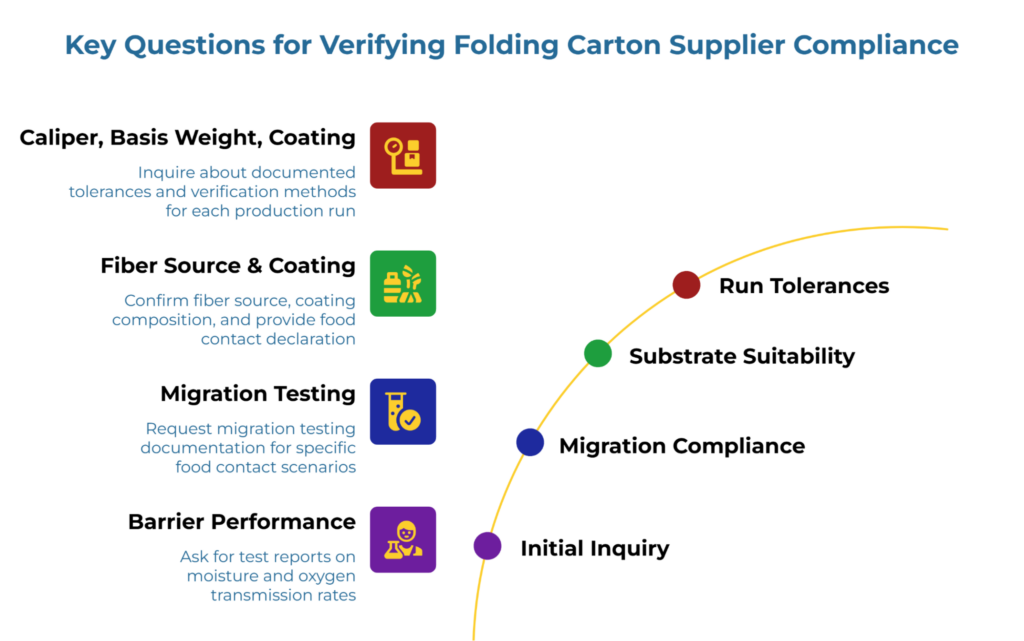
Replacing the certificate question with proof-oriented questions changes the entire supplier conversation. Instead of asking whether a supplier has a quality system, you ask whether they can demonstrate compliance with your specific requirements.
On barrier performance: “Can you provide test reports showing moisture vapor transmission rate and oxygen transmission rate for the specific board grade you are quoting?”
On migration compliance: “Do you have migration testing documentation that matches our intended food type, temperature range, and contact duration?”
On substrate suitability: “Can you confirm the fiber source and coating composition, and provide a declaration of compliance for direct food contact under FDA or EU 1935/2004?”
On run tolerances: “What are your documented tolerances for caliper, basis weight, and coating weight, and how do you verify conformance on each production run?”
Each question ties back to a named specification field. Each answer becomes auditable evidence. The goal is not bureaucratic burden—it is spec-true vetting that connects supplier claims to your actual requirements.
A practical division of labor often helps. QA or Regulatory should review proof related to food-contact suitability, migration testing, and compliance logic. Procurement should confirm that each supplier is quoting the same requirement set and that the evidence pack is complete enough for a fair comparison. That split will vary by organization, but the principle holds broadly: technical proof should not get buried inside a commercial-only review.
Yes, this approach takes more time upfront than checking a badge. That front-end discipline typically reduces confusion later because it prevents the team from comparing non-equivalent offers. Supplier pushback is predictable, but often useful—it reveals whether the supplier can support a serious verification process. And the “cheapest landed cost” mindset is exactly where food-contact risk hides, because a low price on a vaguely defined folding carton is not a controlled buy.
The Better Habit: Move from Badge-Checking to a Proof Ladder
ISO certification is not worthless. It tells you that a supplier has invested in formalizing their quality management. That investment signals organizational seriousness and provides a reasonable starting point.
But it is only a starting point. The certificate belongs at the base of your verification process, not at the top. Treating it as the finish line leaves the most important questions unanswered: Does this supplier understand my specific food-contact requirements? Can they prove they met them? Will the documentation survive an audit or a dispute?
Even food-safety-specific certification schemes reinforce this point. FSSC 22000, for example, is designed to assess and improve an organization’s food safety management system. That is useful context for evaluating supplier discipline, but it still does not replace run-specific proof for a folding carton’s exact application.
A proof ladder for folding carton suppliers sequences verification in stages. For a detailed methodology on structuring this approach, see the guide on building a proof ladder for folding carton suppliers. Early stages confirm basic eligibility—the ISO badge fits here. Later stages require progressively deeper evidence: specification alignment documents, test reports linked to your use case, declarations of compliance that name the regulations your market demands.
This approach protects you without overwhelming suppliers with unreasonable requests upfront. You ask for light evidence early and reserve the heavier documentation requirements for suppliers who advance toward approval. For an integrated protocol on connecting compliance requirements to your supplier qualification process, explore the PaperIndex Academy guide on food-safe folding carton compliance. Additional context on why certificates alone do not qualify a folding carton supplier can sharpen your internal qualification criteria.
The verification habits you build now will determine whether your compliance confidence is real—or just a badge. When you are ready to identify folding carton suppliers who can meet rigorous specification requirements, start by asking not whether they are certified, but whether they can prove they meet your exact requirements.
Disclaimer:
This article is for educational purposes only and does not constitute legal, regulatory, or compliance advice. Readers should consult qualified professionals for guidance specific to their products, markets, and regulatory requirements. Certification standards and food-contact regulations vary by jurisdiction and may change; always verify current requirements with official sources.
Our Editorial Process:
Our expert team uses AI tools to help organize and structure our initial drafts. Every piece is then extensively rewritten, fact-checked, and enriched with first-hand insights and experiences by expert humans on our Insights Team to ensure accuracy and clarity.
About the PaperIndex Insights Team:
The PaperIndex Insights Team is our dedicated engine for synthesizing complex topics into clear, helpful guides. While our content is thoroughly reviewed for clarity and accuracy, it is for informational purposes and should not replace professional advice.