

📌 Key Takeaways
Screening coated cupstock suppliers with structured questions before quotes and samples prevents costly mismatches later.
- Ask Before You Quote: Structured screening questions collect reviewable information before quotes and samples become expensive to reverse.
- Match Specs, Not Names: Two suppliers quoting the same grade name can deliver materials that perform very differently on the converting line.
- Documents Must Be Specific: Food-contact declarations should name the exact grade, coating, contact conditions, and target market to be reviewable.
- Samples Must Mirror Production: Polished presentation samples may not predict how production-quantity material actually performs during converting trials.
- Price Alone Misleads: The lowest unit price may cost more when MOQ, freight, lead time, and documentation readiness differ between suppliers.
Structured questions before quotes build shortlists on evidence, not assumptions.
Procurement teams screening coated cupstock suppliers will gain a repeatable question framework here, preparing them for the detailed qualification guide that follows.
~ ~ ~ ~ ~ ~ ~ ~ ~ ~ ~ ~ ~ ~ ~ ~ ~ ~
Coated cupstock suppliers can look remarkably similar at the quote stage. Offers arrive labeled “hot cup grade,” “cold cup grade,” “food grade,” or simply “PE coated,” and procurement teams face pressure to shortlist on price. Broad labels obscure the technical fit, documentation scope, and commercial assumptions that determine whether a supplier’s material will hold up through converting trials, QA review, and production.
Price becomes meaningful only when quotes describe comparable material, equivalent documentation readiness, and aligned commercial terms. This article provides a practical question framework for screening coated cupstock suppliers before quotes, samples, or trials — not a final supplier approval checklist, a legal compliance guide, or a ranking of coating types. Every supplier that passes initial screening will still require buyer-specific QA, production, and compliance review. The goal is to help buyers collect reviewable information before quotes, samples, trials, and internal approvals become expensive to reverse.
Ask First: What Cup Application Is This Coated Cupstock Meant to Support?
Supplier qualification should begin with the cup’s actual job. Hot and cold beverage cups create fundamentally different exposure profiles, and screening questions need to reflect those differences before quote comparison begins.
Hot cups may face sustained heat exposure, lid-fit and seam-integrity demands, extended hold time, and leakage risk. Cold cups encounter condensation, direct ice contact, prolonged moisture exposure, and longer consumer handling time. A grade described as suitable for “hot beverages” tells procurement little unless the supplier also defines the temperature range, hold time, and cup formats the material has supported.
For instance, consider a case where a supplier describes a board as suitable for hot beverages, but the buyer has not clarified hold time, lid use, sealing method, or leak-testing expectations. The gap between supplier language and actual production review requirements stays invisible until it causes delays.
Screening questions include:
- what beverage types the grade covers, whether it applies to hot drinks, cold drinks, or both,
- what temperature range and hold time the supplier associates with the material,
- what cup sizes, lid formats, and forming conditions have been supported, and
- whether there are applications the supplier does not recommend.
These questions establish whether the supplier’s use-case alignment justifies requesting a quote.
The answers should be routed to product development, QA, and production before the supplier is treated as technically comparable. A supplier’s statement of intended use is a screening input; the buyer’s own cup design, equipment, filling conditions, and trial results still determine final suitability.
When evaluating hot beverage cupstock coating questions or cold beverage cupstock moisture exposure, beverage conditions drive the screening, not the supplier’s grade name. For buyers still defining the use case, PaperIndex’s product directories for paper cups for hot beverages and cold beverages can help clarify the product category before supplier outreach.
Ask What Exactly Is Being Quoted, Not Just What the Grade Is Called

Coated cupstock comparisons become unreliable when procurement compares grade names or GSM values in isolation. Two suppliers may both quote a “280 GSM PE-coated cupstock,” yet differences in base board composition, caliper, stiffness, coating weight, coating side, and reel format can produce materials that perform differently on the converting line.
A useful supplier request is: “Please confirm the full technical specification for the quoted grade, including base board, GSM, caliper, stiffness, coating type, coating side, coating weight or barrier description, tolerances, supply format, winding, dimensions, packaging, and palletization.”
Procurement should clarify the base board grade, basis weight or GSM, caliper, stiffness, and tolerance range. Equally important: what coating type and side are specified, whether the coating is single-side or double-side, what coating weight or barrier description applies, what reel or roll format is included, and what packaging or palletization format the supplier will use. Industry standards bodies such as TAPPI publish recognized test methods for basis weight, caliper, and stiffness — asking whether the supplier references specific methods helps QA compare results on consistent terms.
The main risk is a hidden mismatch. A supplier may send one description in the commercial quote, a slightly different description in the technical data sheet, and a sample that does not clearly link to either. Before shortlisting, ask whether the quoted material, technical data sheet, sample, and commercial offer all refer to the same grade and structure.
Procurement needs defined specification fields so QA and production can compare suppliers on equivalent terms. A guide on building a cupstock RFQ that reduces ambiguous pricing and sample delays is a useful companion resource for structuring these specification requests.
Ask Whether Supplier Documents Are Reviewable for the Exact Cupstock Use
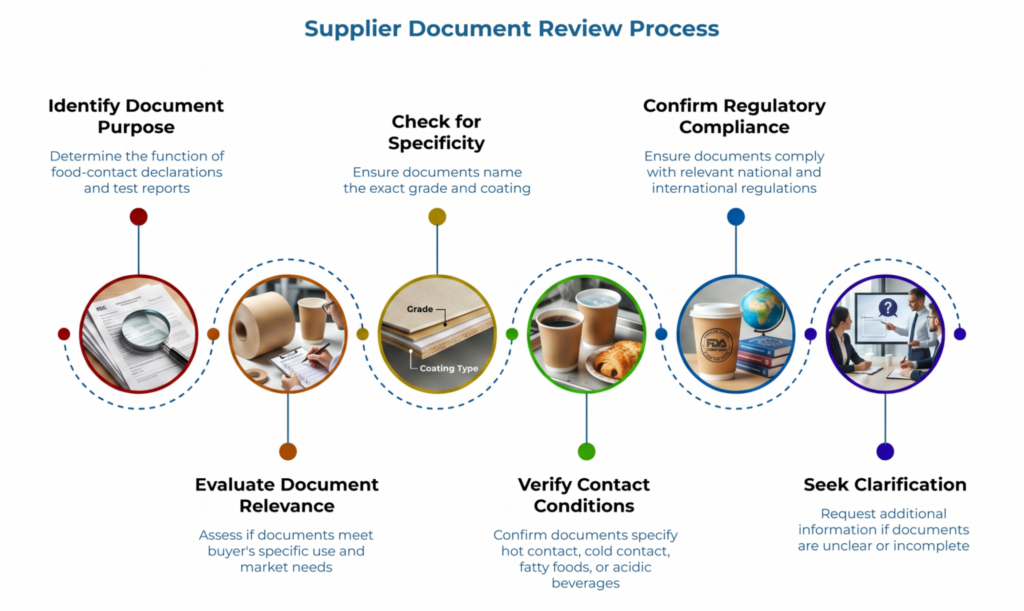
Food-contact declarations, test reports, and compliance documents serve a specific function: they give QA and regulatory teams the information needed to evaluate whether a material is reviewable for the buyer’s intended use, coating, contact conditions, and target market. Documentation readiness is not about collecting paperwork — it is about collecting documents that internal reviewers can act on.
A declaration that covers a broad product family but does not name the quoted grade and coating creates a gap. A test report referencing general food-contact conditions without specifying hot contact, cold contact, fatty foods, or acidic beverages may not address the buyer’s application. A document referencing one market’s regulatory basis — such as the U.S. FDA framework for food-contact substances (specifically 21 CFR Part 176 for paper and paperboard and 21 CFR Part 177 for polymer coatings), the European Commission’s overarching food-contact materials framework (Regulation (EC) No 1935/2004), or specific national legislation for paper — may not apply to buyers sourcing across multiple jurisdictions. The FDA provides links to food-contact-substance guidance and inventories, while European compliance for paper requires navigating both general EU framework requirements and applicable Member State rules, such as Germany’s BfR recommendations.
For instance, if a food-contact declaration covers a broad product family without naming the specific coating or target market, procurement must route it for formal regulatory review rather than treating it as automatic evidence of compliance.
Procurement should ask whether the declaration names the exact grade and coating, whether it covers the quoted structure or a broader family, what food-contact conditions it addresses — including hot contact, cold contact, fatty foods, or acidic beverages when applicable — what market or regulatory basis it references, who issued it and when, and what changes trigger updated documentation. Structuring these questions into a repeatable process, such as a cupstock food-contact documentation intake form, prevents inconsistent evidence collection. Compliance and food-contact suitability depend on product, coating, use conditions, and target market — documents should be routed to qualified internal reviewers.
Ask Whether Samples Represent Production Material and Trial Conditions
A desk sample supports initial evaluation — visual inspection, caliper measurement, curl behavior — but may not predict converting performance. Polished presentation samples produced under controlled conditions can bear little resemblance to production-quantity material.
If a supplier offers a “cold cup” grade but the buyer has not defined condensation behavior, ice exposure, or expected handling time, sample performance cannot be evaluated accurately.
Procurement should ask whether the sample comes from a normal production run or a special batch, whether it matches the quoted GSM, coating, and format, what lot or production reference identifies the sample, what quantity is available for desk review versus line trial, what trial conditions the supplier recommends, whether prior heat-seal, leak, curl, or dimensional-stability data is available, and what support is available if the trial shows sealing, curling, or leakage concerns. Buyers should define acceptance criteria before the trial. Production teams should define what quantity and format are needed for a meaningful line trial — a few sheets may support initial inspection, while a converting trial may require material supplied in the intended production format.
Where test methods, paper and board properties, or technical terminology need standardization, buyers may refer to official standards bodies such as ISO’s paper and board standards catalog or TAPPI’s standards and methods as appropriate. ISO maintains a catalog for paper and board standards, and TAPPI publishes standards, methods, and technical information papers used across the pulp, paper, and packaging sectors.
Samples create evidence for review. They do not replace production trials or guarantee future batch consistency. A cupstock sample review checklist helps teams evaluate samples systematically across procurement, quality, and production perspectives.
Ask How the Supplier Controls Consistency After the First Acceptable Sample
An initial sample that meets expectations establishes a starting point. Qualification should extend into repeatability — how the supplier controls batch-to-batch consistency, communicates changes, and supports investigation when problems arise.
Procurement should ask how batches, rolls, coating lots, and shipments are identified, what information appears on certificates of analysis, what tolerances are controlled across shipments, how the supplier notifies buyers of grade, coating, mill, or process changes, what complaint investigation information can be provided, and what retention samples or production records are kept.
Production problems rarely surface at the quote stage. They appear months later when a coating lot shifts, a raw material substitution occurs, or a tolerance drifts. For growth-stage paper cup manufacturers, a common workflow gap emerges here: procurement collects the quote, production tests the material, QA receives documents later, and nobody has a clean route for change control when the next shipment differs. Asking these questions during screening gives procurement time to assess whether the supplier’s quality system supports ongoing supply.
Routing technical questions through a structured process, such as cupstock specification questions for technical or compliance review, prevents procurement from committing before internal stakeholders have weighed in.
Ask Commercial Questions That Affect Real Procurement Risk
Supplier qualification includes practical business terms, and quote normalization matters as much as specification clarity. Growth-stage paper cup manufacturers often face commercial conditions that make quote comparison deceptively difficult. The lowest unit price may not represent the lowest total cost if MOQ, freight terms, quote validity, lead time, payment terms, or packaging format differ. A supplier with a higher quoted unit price may still be easier to evaluate if the offer is complete, documents are reviewable, samples are traceable, and logistics assumptions are clear.
Procurement should ask what MOQ applies, what lead time covers sample, trial, first order, and repeat order, what Incoterms are included, what quote validity period applies, what payment terms the supplier requests, what packaging, palletization, labeling, and shipment documentation are included, whether prices are linked to quantity, shipment schedule, or grade availability, what recourse exists if documentation, samples, or production lots do not match the quote, and what happens if the trial requires a specification adjustment. Identifying the technical contact during the quoting phase also confirms whether the supplier provides accessible ongoing engineering support.
Comparing stated terms side by side helps procurement present shortlist recommendations to finance and logistics with supporting detail, not a single price figure.
A Practical Coated Cupstock Supplier Qualification Screening Matrix
The matrix below consolidates major screening areas into a single reference. Each row maps a qualification area to a supplier question, the reason it matters, the internal reviewer responsible, and the evidence to request.
This is a screening matrix. Shortlisting based on these questions still requires buyer-specific QA, production, and compliance review before approval. Each buyer should adapt the matrix to its cup design, converting equipment, target market, internal review process, and supplier qualification procedure.
| Qualification Area | Supplier Question | Why It Matters | Internal Reviewer | Evidence to Request |
| Cup use case | What beverage types, temperature ranges, hold times, cup sizes, and lid formats is this grade intended for? | Confirms use-case alignment before quote comparison | Procurement + Product Development | Technical data sheet, use-case statement |
| Coating and board structure | What base board grade, GSM, caliper, stiffness, coating type, coating side, coating weight, and tolerance range are quoted? | Prevents comparing different materials as equivalent | QA + Production | Specification sheet |
| Food-contact documentation | Which grade, coating, food-contact conditions, and target market does the declaration cover? | Avoids collecting documents QA cannot review | Regulatory/Compliance | Declaration, test report, scope notes |
| Sample readiness | Are samples production-equivalent and traceable to the quoted specification? | Reduces sample-to-order mismatch risk | Procurement + Production | Sample lot details, trial quantity confirmation |
| Converting and trial support | What heat-seal, leak, curling, and runnability information can the supplier provide? | Screens for production risk before line time is committed | Production + QA | Trial data, recommended operating conditions |
| Traceability and change control | How are batches, coating runs, shipment lots, and specification changes identified and communicated? | Supports investigation, change control, and repeatability | QA | Lot traceability records, change-notification process |
| Commercial terms | What MOQ, lead time, Incoterms, quote validity, packaging format, and shipment assumptions are included? | Makes quotes comparable on equivalent terms | Procurement + Finance/Logistics | Commercial quotation, shipment details |
| Support and escalation | Who handles technical questions, complaints, documentation updates, and post-shipment issues? | Tests supplier communication reliability after the first order | Procurement + QA | Contact path, escalation process |
Frequently Asked Questions
Should procurement ask for price before technical documents?
Budgetary pricing can be requested early to gauge affordability. Meaningful quote comparison, however, requires aligned specifications, defined use-case conditions, documentation scope, and commercial terms. A price without these inputs is a number without context.
What should procurement ask before shortlisting coated cupstock suppliers?
Procurement should ask about the cup application, board and coating structure, specification tolerances, documentation scope, production-equivalent samples, trial support, traceability, change communication, MOQ, lead time, trade terms, and quote validity. The purpose is to collect information that QA, production, compliance, finance, and logistics teams can review before supplier approval moves forward.
Is a food-contact certificate enough to qualify a coated cupstock supplier?
A food-contact certificate is one review input among several. The document should be checked against the exact grade, coating, contact conditions, and target market by qualified internal reviewers. A certificate that does not name the quoted product or cover the buyer’s use conditions may not be reviewable for that application.
Should hot and cold cupstock suppliers be screened with the same questions?
Some questions overlap — specification clarity, traceability, and commercial terms apply regardless of beverage temperature. Exposure conditions differ, though. Hot and cold cups should be screened for their actual beverage conditions, hold time, sealing requirements, and moisture exposure.
When should procurement request samples?
Samples should be requested after the buyer has defined the intended cup use and key specification fields. For early review, a small sample may be enough to inspect basic characteristics. For production evaluation, the sample should be production-equivalent, traceable to the quoted specification, and available in a quantity and format that supports a meaningful trial.
When should production or QA join supplier screening?
Before shortlisting is finalized. Production and QA input is particularly valuable when specifications, samples, heat sealing, leak testing, or food-contact documents require technical review. Waiting until after shortlisting often creates rework when technical teams surface gaps procurement missed.
Conclusion
Coated cupstock supplier qualification is strongest when procurement asks structured, buyer-owned questions before quotes and samples create momentum. The screening areas covered here — use-case fit, specification clarity, documentation reviewability, sample traceability, quality consistency, converting support, and commercial comparability — help procurement teams compare suppliers on terms that matter to QA, production, compliance, and finance.
This establishes a practical internal workflow where procurement collects structured supplier answers. QA and regulatory teams review documentation scope. Production tests converting fit. Finance and logistics check commercial assumptions. The result is a shortlist built on clearer information, not only on the supplier that responded fastest or quoted the lowest price.
Routing responses to the right internal reviewers before shortlisting reduces late-stage surprises: documentation that cannot be assessed, samples that do not match production material, or commercial terms that distort comparison.
Disclaimer:
This article is for general educational and supplier-screening purposes only. Coated cupstock suitability, food-contact status, regulatory applicability, recyclability, compostability, and production performance depend on the exact product, coating, use conditions, cup design, target market, documentation scope, and qualified technical or compliance review. Procurement teams should route supplier claims and documents to appropriate QA, regulatory, legal, technical, or compliance professionals before approval or commercial use.
Our Editorial Process:
Our expert team uses AI tools to help organize and structure our initial drafts. Every piece is then extensively rewritten, fact-checked, and enriched with first-hand insights and experiences by expert humans on our Insights Team to ensure accuracy and clarity.
About the PaperIndex Insights Team:
The PaperIndex Insights Team is our dedicated engine for synthesizing complex topics into clear, helpful guides. While our content is thoroughly reviewed for clarity and accuracy, it is for informational purposes and should not replace professional advice.