
📌 Key Takeaways
The cheapest folding carton quote often hides durability gaps that create bigger costs downstream—plan first, then compare prices.
- Quote Gaps Signal Assumption Gaps: When supplier quotes differ by 15% or more, they’re usually bidding on different versions of the job—not offering different levels of generosity.
- Map Your Stress Points First: Before requesting quotes, document every handling node, stacking height, humidity risk, and transit condition your folding cartons will actually face.
- Cheap Costs Show Up Elsewhere: A 2% rise in transit damage can erase unit-price savings through returns, emergency freight, and customer complaints that scatter across multiple budgets.
- Lock Specifications Before Comparing Price: Define board grade, moisture range, burst strength, and test methods upfront so every supplier bids against the same baseline.
- Folding Cartons Are Route Plans, Not Commodities: Treat packaging like a protective system designed for your specific distribution network, not a generic input to negotiate down.
Planning first protects shipments; lowest price protects spreadsheets.
E-commerce procurement and operations teams managing multi-node distribution will find a practical framework here, preparing them for the specification checklists that follow.
~ ~ ~ ~ ~ ~ ~ ~ ~ ~ ~ ~ ~ ~ ~ ~ ~ ~
Two folding carton quotes sit on the desk. One is 18% cheaper than the other. The procurement team feels the pressure to capture the savings. Operations stays quiet, already calculating how many damaged shipments, customer complaints, and emergency freight runs will follow once those folding cartons hit the 3PL (third party) network.
Three months later, the pattern is familiar: crushed corners, returns spiking, finger-pointing between suppliers and logistics partners, and leadership asking why “cost savings” turned into operational chaos.
This is the lowest bidder trap. And it raises a question most teams never ask early enough: What has the cheapest quote silently removed from the durability plan?
E-commerce supply chain security—moving products through multi-node distribution without preventable failures—does not come from the lowest unit price. It comes from defining durability requirements before quotes arrive, so that every supplier bids against the same operational reality. In packaging terms, this means defining folding carton performance against the actual risks of omnichannel transit before awarding business. It is not a slogan about buying safely. It is a practical discipline: matching board, structure, conditioning, testing logic, and vendor verification to the handling conditions the folding carton will actually face.
Protecting Margins via the Lowest Quote
The belief persists because it feels logical. Packaging is often treated as a commodity input. If two suppliers offer the same product category, the cheaper option appears to protect budget discipline.
Procurement teams prioritize unit savings because they represent a measurable, upfront win for the balance sheet. Packaging costs are visible line items. Unit savings are easy to report. And when leadership asks for cost reductions, folding carton pricing offers a tangible number to improve.
The problem is that folding carton performance is not visible on the quote. A folding carton is often treated like a commodity purchase when it should be treated like a route plan. If the route is rough, the weather is variable, the handling is inconsistent, and the stack height is real, then the cheapest material choice may only be cheaper because those stresses were not fully priced into the specification. A lower price might reflect genuine efficiency. Or it might reflect thinner boards, weaker adhesives, reduced moisture treatment, or assumptions about handling conditions that do not match your actual distribution network. The quote does not distinguish between these possibilities. Only planning does.
The Correlation Between Low Quotes and Aggressive Assumptions
Wide quote gaps often begin with different assumptions, not different supplier generosity. One supplier may be pricing a board and structure that can tolerate real handling stress. Another may be pricing to a thinner or looser interpretation because the durability baseline was never locked down.
A supplier quoting significantly below competitors (sometimes by 15% or more) may have generally assumed lighter handling, shorter transit times, or single-tier stacking. If your folding cartons actually face conveyor sorting, humidity exposure, and five-high pallet stacks at a 3PL warehouse, that quote is not comparable to one built against your real conditions.
This is where the Specification-True planning approach becomes essential—an approach explored in depth in comparability before price: the spec-true mindset that reduces kraft paper RFQ chaos. Quote disputes often begin with specification misalignment—differences in assumed GSM, moisture content, or burst strength—rather than bad luck or dishonest pricing. This dynamic is explored in the failure of vague RFQs: Using specification-true folding carton blueprints to ensure global compliance. When specifications are vague, suppliers fill gaps with their own assumptions. Those assumptions may not survive your supply chain.
Why E-commerce Packaging Is Not a Standard Transit Problem
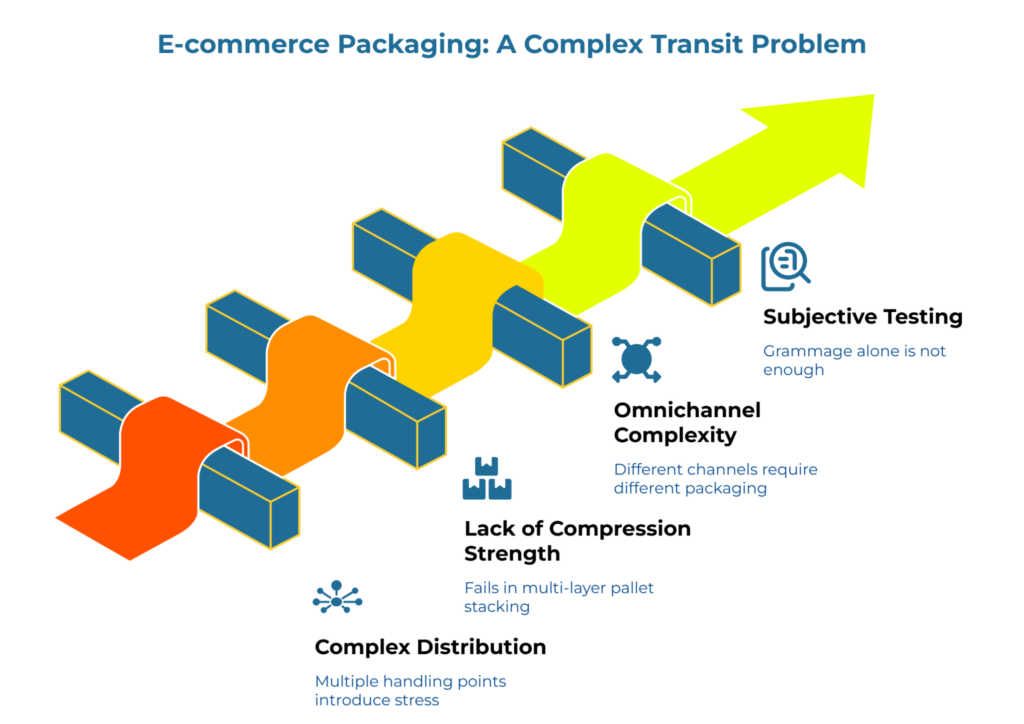
Standard packaging assumptions were developed for predictable, point-to-point shipments. E-commerce and omnichannel distribution operate differently.
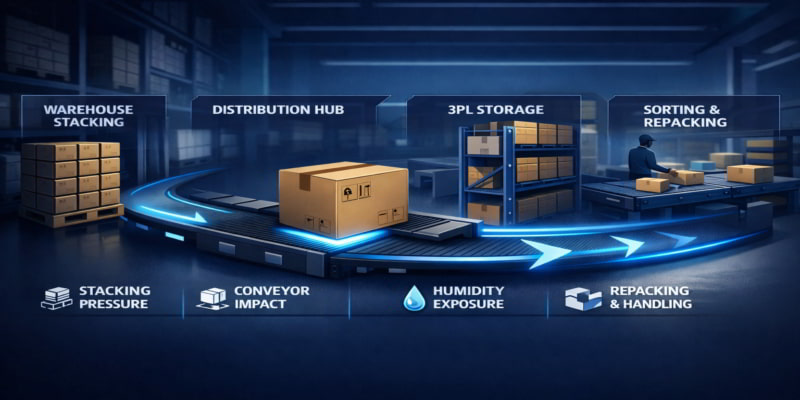
A single folding carton might pass through a manufacturer’s outbound dock, cross-dock at a regional hub, enter a 3PL warehouse for storage, be picked and repacked for a direct-to-consumer order, travel through a parcel carrier’s automated sorting system, and finally reach a customer’s doorstep. Each node introduces stacking pressure, vibration, temperature swings, and handling intensity.
Standard designs can fail in external 3PL environments because they lack structural compression strength for multi-layer pallet stacking—a failure mode examined in how to start folding carton durability planning before the next product rollout. The folding carton that survived controlled palletized shipment may collapse under a conveyor system optimized for speed, not gentleness.
Omnichannel adds another layer of complexity. The same SKU might ship pallet-to-retail one week and direct-to-consumer the next. Folding carton specifications that work for one channel may fail in another. Without mapping these stresses upfront, procurement inherits a liability that never appeared on the quote.
This is why specific testing methods matter. When buyers reference grammage… those variables must be anchored to recognized standards such as ISO 536, ISO 287, ISTA test procedures, and TAPPI T 402. Those sources do not tell a team which folding carton to buy. They do make the discussion more repeatable and less subjective.
The Hidden Cost Stack Behind a “Cheap” Folding Carton Decision
When under-specified folding cartons fail in transit, the cost does not appear on the packaging line item. It scatters across operations in ways that resist easy tracking.
Transit damage triggers direct losses: replacement product, reshipping fees, return processing labor. But secondary effects often exceed the primary cost.
Emergency freight enters when damage rates force expedited replenishment. Air freight premiums can dwarf the original folding carton savings.
Line disruption happens when fulfillment teams start improvising—double-boxing fragile SKUs, adding void fill, re-taping weak seams. Labor hours climb. Throughput slows.
Supplier disputes consume management attention. Without clear specification baselines, arguments about accountability become circular—a dynamic addressed in the guesswork gap: using folding carton transit planning to neutralize accountability disputes. Did the supplier ship a weak board, or did the 3PL stack too high? Without documented requirements, neither side can prove their case.
Customer-facing brand damage is hardest to quantify but often most consequential. A crushed box signals carelessness to the customer before they even open the product.
For a high-value SKU, a 3% increase in transit damage—at a product value of $50—represents a $1.50 loss per unit, which dwarfs an 18% savings on a $1.00 folding carton. For a framework to quantify these hidden costs, see the price of misalignment in folding cartons: quantifying the impact of tolerance failures. The folding carton did not cost less. It cost differently—in currencies the procurement dashboard was not tracking.
The Mechanics of Planning-First Durability Mapping
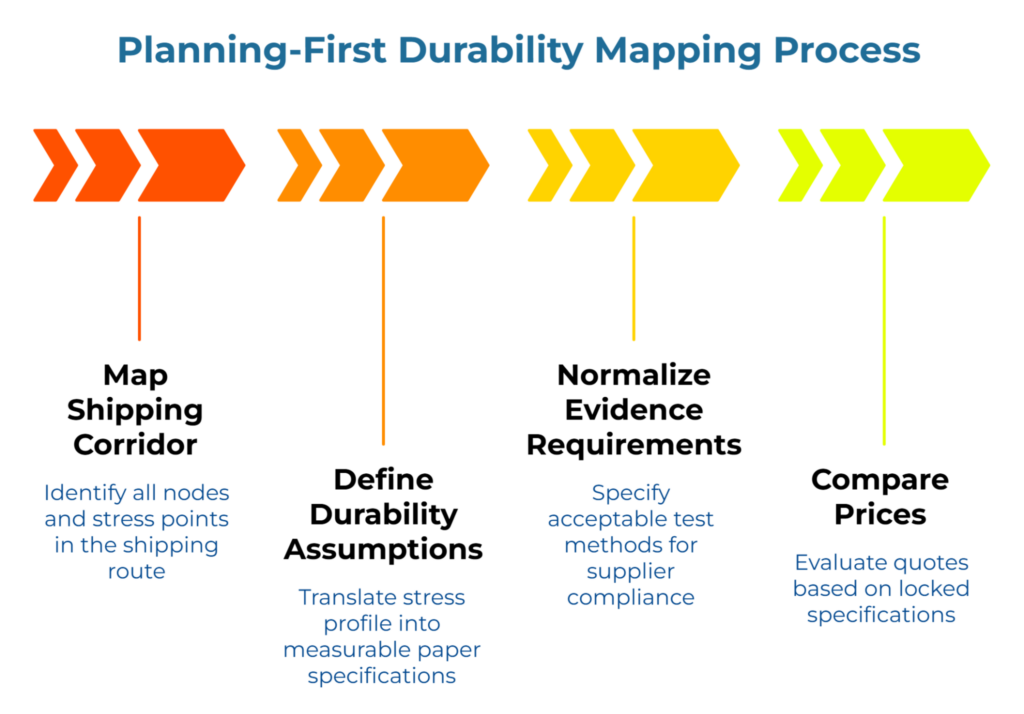
Planning-first durability mapping inverts the typical procurement sequence. Instead of gathering quotes and then evaluating specifications, teams define specifications first and let that clarity determine which quotes are genuinely comparable.
Map the shipping corridor and handling environment. Identify every node folding cartons will pass through. Document where stacking pressure peaks, where humidity exposure occurs, and where handling intensity is highest. This stress profile becomes the foundation for specification requirements.
Define structural and durability assumptions. Translate the stress profile into measurable parameters. What basis weight range does the application require? Standards like ISO 536 provide methodology for grammage measurement—see kraft paper manufacturers capability matrix: compare GSM, BF/BST, moisture control, and certifications without guesswork for practical application. What moisture content window prevents performance degradation? ISO 287 defines oven-drying methods for moisture determination. What burst strength protects against your handling conditions?
Normalize what evidence suppliers must provide. Decide upfront which test methods count as proof. ISTA test procedures offer protocols for simulating real-world transit conditions, while TAPPI T 402 establishes standard conditioning atmospheres for repeatable board testing. Suppliers should demonstrate compliance against your conditions, not just their internal standards.
Only then compare prices. With specifications locked, quotes become genuinely comparable. The supplier offering a lower unit price is now competing on the same technical baseline—not on an interpretation gap that will surface as damage claims later.
A Myth vs Reality Framework for Disparate Supplier Quotes
When quotes diverge, use this framework to identify where assumptions differ:
| Factor | What the Cheap Quote Shows | What the Cheap Quote Hides | Where the Cost Comes Back |
| Unit Price | Lower per-folding carton cost | Weaker board grade, thinner walls, or no moisture treatment | Damage rates, rework, expedited replacements |
| Transit Assumptions | “Standard shipping” | No alignment with your actual 3PL stacking or parcel sorting | Failures at handling nodes the supplier never planned for |
| Durability Requirements | “Industry standard” | Missing compression strength for multi-layer pallets | Crushed folding cartons, returns, customer complaints |
| Verification Depth | Certificate of conformance | No named test methods, no conditioning protocols | Disputes without objective evidence to resolve them |
| Hidden Operational Exposure | Not quoted | Emergency freight, line disruption, brand damage | Scattered costs across departments procurement never sees |
| Supplier Comparability | Appears comparable | Different assumptions make quotes non-equivalent | False savings that reverse once operations absorbs the gaps |
Before You Compare Prices, Verify These Inputs
Use this checklist to confirm planning inputs are captured before quote comparison begins:
- Shipping corridor complexity: Have all handling nodes from production to customer delivery been mapped?
- 3PL stacking exposure: Is maximum pallet stack height and dwell time at each warehouse documented?
- Handling intensity across nodes: Will folding cartons face conveyor sorting, manual picking, or both?
- Moisture exposure risk: Does the distribution network include unconditioned staging areas or cross-dock environments?
- Required structural consistency: Are basis weight, burst strength, and caliper tolerances defined with named test methods? See board grade tolerances explained: securing folding carton specifications across suppliers for guidance.
- Evidence expectations: Do RFQ documents specify which standards—ISO, TAPPI, ISTA—will be accepted as proof of compliance?
If those inputs are not named, the quote is still preliminary, even if it looks final.
For teams building specification baselines, the folding carton baseline packaging parameter checklist provides a structured starting point.
Strategic Security Through Technical Normalization
The cheapest folding carton quote is a signal—not of value, but of risk. For procurement teams evaluating folding carton suppliers, this distinction defines the difference between short-term savings and long-term supply chain security. It suggests that somewhere between specifications and supplier assumptions, critical planning inputs went missing.
E-commerce supply chain security does not emerge from negotiating harder on unit price. It emerges from defining durability requirements before quotes arrive, normalizing supplier evidence against actual operating conditions, and treating specification clarity as a non-negotiable foundation for any price comparison.
Achieving long-term supply chain security requires the simultaneous normalization of technical specifications and the mapping of logistics intensity; treating these as isolated procurement tasks is what creates the ‘lowest bidder’ vulnerability.
The cheapest quote may win the meeting. Planning-first discipline protects the shipment.
Resources
Continue building a planning-first procurement process with these guides:
- Create Flawless Folding Carton RFQs: Stop Supplier Finger-Pointing with Standardized Parameters — The step-by-step guide on standardizing requirements before quotes are compared.
- The Lowest Bidder Myth: Why Cheap Folding Cartons Cause Production Downtime — Extend the false-economy argument with the sibling article on operational consequences.
- The Hidden Risks of Single-Source Procurement for E-commerce Packaging — Understand how supplier concentration compounds the risks of under-specified folding cartons.
- Board Grade Tolerances Explained: Securing Folding Carton Specifications Across Suppliers — Lock tolerances so suppliers quote against the same baseline.
- How to Verify Supplier Capability (When the Price List Isn’t the Risk) — Continue into supplier verification when the real risk is not the quoted price.
Disclaimer
This article is for educational purposes only. Any discussion of costs, planning, testing, or supplier evaluation should be validated against your own specifications, operating conditions, and counterparties.
Our Editorial Process:
Our expert team uses AI tools to help organize and structure our initial drafts. Every piece is then extensively rewritten, fact-checked, and enriched with first-hand insights and experiences by expert humans on our Insights Team to ensure accuracy and clarity.
About the PaperIndex Insights Team:
The PaperIndex Insights Team is our dedicated engine for synthesizing complex topics into clear, helpful guides. While our content is thoroughly reviewed for clarity and accuracy, it is for informational purposes and should not replace professional advice.