

📌 Key Takeaways
Looking at a toilet tissue parent roll sample tells you nothing about whether it will actually run on your converting line.
- Visual Checks Miss What Matters: You cannot see GSM, bulk, or moisture levels—the hidden variables that cause line jams and web breaks.
- Lock Specifications Before Samples: Define target values with tolerances (like “18 GSM ±3%”) so every supplier quotes against the same baseline.
- Name Your Test Methods: Referencing ISO or TAPPI standards removes guesswork about how you’ll verify what you receive.
- Condition Samples Identically: Moisture differences distort every comparison, so test samples under the same conditions or the comparison means nothing.
- Compare Quotes Only After Alignment: When specifications are locked first, price differences reflect real value—not hidden assumption gaps between suppliers.
Specification clarity before supplier comparison protects your production line.
Procurement managers and converting plant managers sourcing toilet tissue parent rolls will gain a clear framework for avoiding costly runnability failures, preparing them for the detailed specification guides that follow.
~ ~ ~ ~ ~ ~ ~ ~ ~ ~ ~ ~ ~ ~ ~ ~ ~ ~
A shipment of toilet paper raw material arrives at the dock. The outer wrap looks intact. The edges appear clean. Someone signs the delivery note, confident the material will run without issue on the converting line.
Seventy-two hours later, that same line jams for the third time in a single shift. Operators point to the machinery. Quality control flags moisture readings outside the acceptable window. And the procurement manager who approved the sample based on how it looked is now explaining why a shipment that seemed fine is dragging down throughput.
This pattern repeats across toilet tissue converting operations more often than it should. Visual sample review persists because it feels practical—fast, familiar, and reassuring when uncertainty runs highest. This cognitive bias obscures the volatility of latent material variables. A visual check cannot verify the measurable variables that determine whether a toilet paper parent roll will actually run.
Why Visual Samples Feel Reassuring in Toilet Tissue Procurement
Visual inspection has a powerful psychological appeal. When a procurement manager or plant manager handles a sample, they can see the sheet formation, touch the surface, and form a gut-level impression of quality. The process takes minutes. It requires no lab equipment, no waiting for test results, no coordination across departments.
For toilet paper parent rolls destined for private-label converting, this shortcut seems especially reasonable. The product category is familiar. Samples from different suppliers often look similar. And the pressure to move quickly—securing supply, locking in quotes, meeting production schedules—rewards speed over methodical verification.
At early RFQ stages, visual checks appear practical. They offer immediate feedback. They feel like progress.
The problem is that “looks fine” is not the same as “will run fine.” Visual similarity between two toilet tissue samples does not mean specification parity. A parent roll that appears acceptable on the receiving dock may conceal GSM drift, bulk inconsistency, or moisture levels that only reveal themselves when the material hits a high-speed line running at several hundred meters per minute.
What a Visual Sample Cannot Confirm in a Toilet Tissue Parent Roll
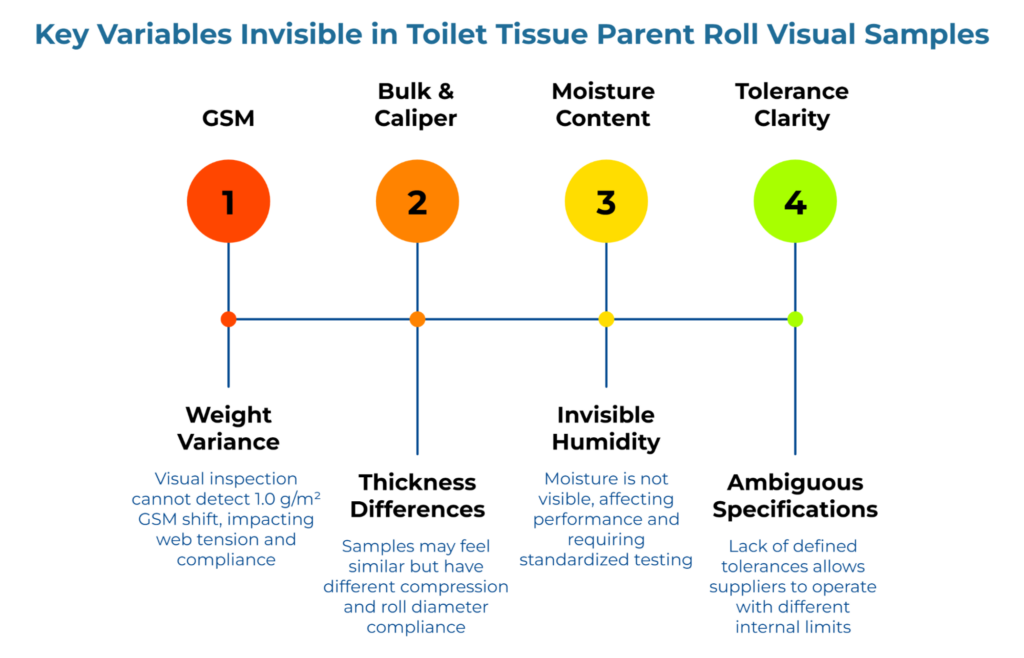
Visual samples cannot verify the measurable performance drivers that determine runnability and downstream quality. The variables that matter most for toilet paper converting are invisible to the eye.
GSM (grams per square meter) defines the weight of the sheet. Visual inspection cannot distinguish between 17.5 GSM and 18.5 GSM—but a high-speed line reacts to the 1.0 g / m2 shift. This 5.7% variance destabilizes web tension, winding consistency, and the final product’s compliance with retailer specifications for hand-feel and sheet count.
Bulk and caliper determine the sheet’s thickness relative to its weight. Two samples may appear equally soft to the touch, yet one may compress differently under embossing rolls. One may fail to meet the minimum roll diameter a retailer requires for the same sheet count. These differences do not announce themselves visually.
Moisture content is entirely invisible. A parent roll conditioned at one relative humidity behaves differently from one conditioned at another—a challenge addressed in 4 steps to normalize absorbency and moisture tolerances before evaluating toilet tissue paper parent roll suppliers. ISO 287 establishes standardized test methods for moisture determination—test methods that require gravimetric measurement, not tactile guesswork. TAPPI T 402 specifies the conditioning atmospheres necessary for comparable testing. Without this discipline, a sample’s apparent softness may simply reflect elevated moisture that will drift unpredictably during storage or transit.
Tolerance clarity is the silent variable that undermines quote comparability. Even when a supplier states a GSM target, the absence of a defined tolerance band leaves room for interpretation. Two suppliers quoting the same nominal GSM may operate against different internal limits. Visual inspection cannot reveal the gap. Only a buyer-defined specification with explicit tolerances can force alignment.
How Visual Approval Becomes an Operational Failure Later
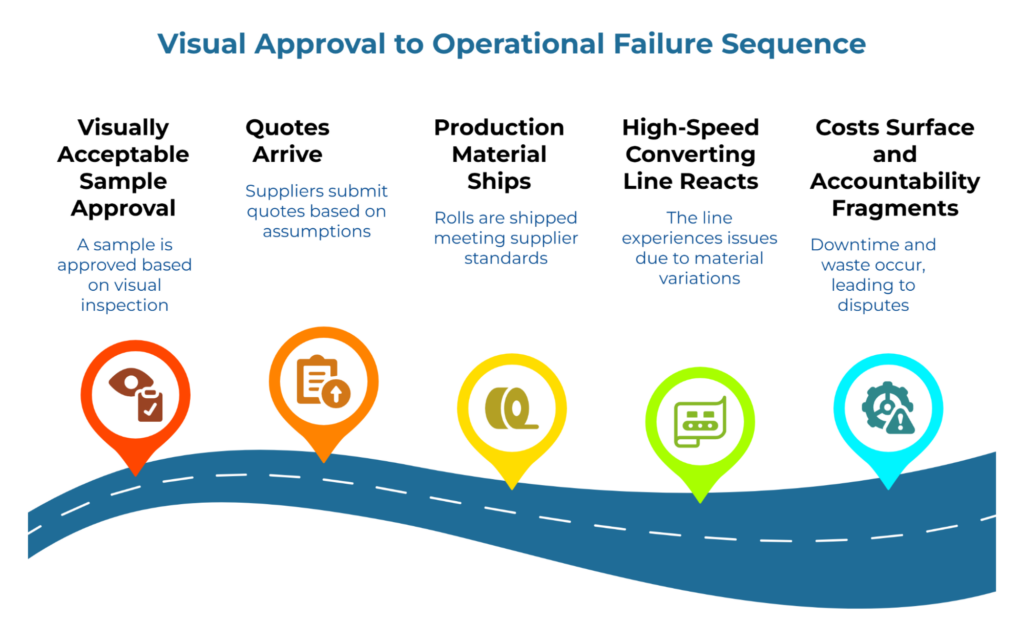
The danger is delayed. This latency period between dock receipt and the winder-stand conceals the financial impact of out-of-specification fiber.
1. A visually acceptable sample wins approval without a locked specification baseline. The buyer assumes the sample represents what production shipments will deliver. The supplier assumes the sample reflects their standard output. But their standard may differ from the buyer’s unstated operational requirements.
2. Quotes arrive. Because no measurable baseline was defined—no tolerances, no named test methods—each supplier interprets the requirement according to their own assumptions. The quotes appear comparable. They are not.
3. Production material ships. The parent rolls meet the supplier’s internal standards but drift outside the buyer’s actual operational window. Moisture absorbed during a humid transit leg goes undetected. Bulk variation falls within the supplier’s range but outside what the converting line can tolerate.
4. The high-speed converting line reacts. Tension inconsistencies cause web breaks. Bulk variation disrupts embossing registration. Moisture differences affect perforation strength. Operators troubleshoot the machinery while the actual root cause—incoming material that was never specified tightly enough—remains undiagnosed.
5. Costs surface and accountability fragments. Downtime accumulates. Rejected output goes to waste or rework. Emergency replacement orders carry premium freight. Disputes arise over whether the supplier failed to deliver or the buyer failed to specify. The answer, often, is both—but the origin was the moment visual approval substituted for specification discipline.
The Hidden Procurement Error: Comparing Appearance Instead of Specifications
The operational failure on the plant floor traces back to a procurement logic error: comparing visual samples instead of standardized specifications.
When buyers evaluate toilet paper parent rolls by appearance, they create false comparability—a problem explored further in our guide on stripping hidden variables from your next toilet tissue parent rolls (raw material) RFQ.
Two samples from different tissue paper raw material suppliers may look similar yet have been produced against different baselines, tested under different conditions, or quoted with different assumptions about moisture range, bulk tolerance, recycled fiber content, and acceptable GSM variation. Raw quotes hide these assumption gaps behind identical-looking numbers.
This false comparability distorts supplier selection. A supplier holding tighter internal controls may quote higher because they are guaranteeing a stricter standard. Once specifications are locked, buyers can find suppliers who meet those defined requirements. A supplier with looser tolerances may quote lower and win the business—only to deliver material that triggers line instability, rejected output, or retailer complaints.
The fix is not sharper visual judgment. The fix is a change in sequence. Normalization must come before price discussion. Before comparing samples, before requesting quotes, the buyer defines the measurable baseline: GSM with tolerance, bulk or caliper target, moisture window, and the test methods that will govern acceptance. TAPPI T 412 provides one such test method for moisture measurement. International standards such as ISO/IEC 17025 on metrological traceability explain why documented, traceable measurement chains matter when suppliers present test results.
Only after that shared baseline exists can quotes be compared on equal footing.
What Better Looks Like: A Specification-First Toilet Tissue Buying Habit
Shifting from visual approval to specification discipline does not require a laboratory overhaul or a months-long process redesign. It requires a change in habit—specifically, a change in the sequence of decisions.
- Name the metrics before requesting samples. Define GSM, bulk, and moisture targets as measurable values with explicit tolerances. A specification like “18 GSM ±3%, bulk ≥ 7.0 cm³/g, moisture 6.0–8.0%” gives every supplier the same target to quote against.
- Specify the test methods. Referencing ISO or TAPPI standards removes ambiguity about how compliance will be verified. It also creates traceability—a documented chain connecting the supplier’s reported values to recognized measurement protocols.
- Condition samples identically before evaluation. If samples are to be compared at all, they must be conditioned under the same atmosphere. Otherwise, moisture differences distort every other variable, and the comparison becomes meaningless.
- Compare quotes only after the baseline is locked. When every supplier quotes against the same defined specification, price differences reflect real value differences—not hidden gaps in what each party assumed. Our guide to normalizing toilet tissue parent roll quotes before RFQ chaos starts provides a detailed framework for this approach.
This is the habit shift that protects runnability: specification clarity before supplier comparison, not after problems emerge on the line.
For teams that want to go deeper without jumping into a full RFQ build, related guidance already exists. Why visual samples cause toilet tissue line jams (and what to do instead) explains the failure mechanism in detail. Understanding the toilet tissue paper specification-to-normalization checklist provides a practical tool for linking product specifications to procurement requirements.
Operational Risk Map: The Cascade from Visual Sample to Line Jam
The failure mechanism described throughout this article follows a predictable cascade. Understanding the sequence makes it easier to interrupt.
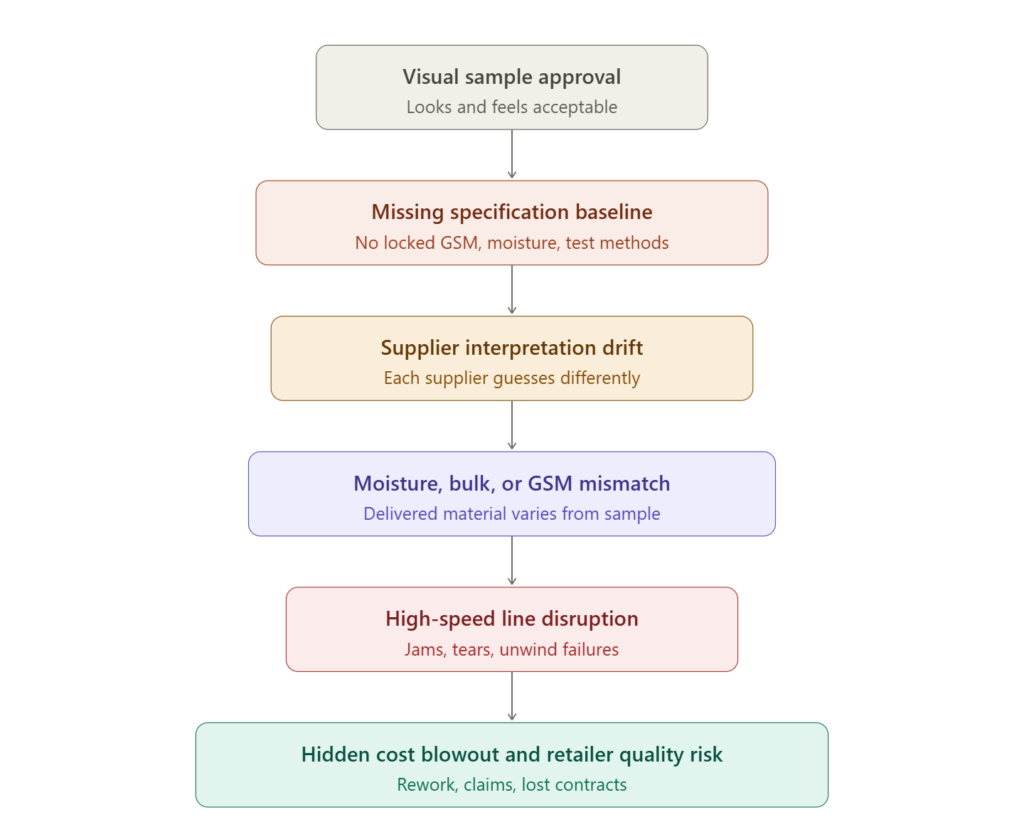
Each arrow represents a failure point that visual inspection cannot intercept. The visual sample looked acceptable. The quotes looked comparable. The machinery looked fine. But the specification was never locked, so every downstream assumption rested on an unstable foundation.
The cascade breaks only when measurable specifications replace visual assumptions at the start of the procurement process—not at the end, when the line is already jamming.
A visual sample can look acceptable and still fail a toilet paper converting line. The risk is structural, not incidental. For procurement managers, converting plant managers, and product development managers, the safest mental shift is simple: Visual approval is a comfort signal, not a procurement control. A specification-first baseline is the control.
Until the baseline is defined in measurable terms—GSM, bulk, moisture, tolerances, test methods—the sample is not a procurement control. It is a source of hidden operational exposure.
For more specification-first sourcing guidance, explore the PaperIndex Academy. When the baseline is clear, compare toilet tissue parent roll suppliers or browse toilet tissue mills on a more defensible footing.
Disclaimer:
This article is educational and methodology-first. It does not constitute professional procurement, engineering, or quality assurance advice. Readers should verify specifications with qualified experts and conduct their own testing before making sourcing decisions. Examples are illustrative only.
Our Editorial Process:
Our expert team uses AI tools to help organize and structure our initial drafts. Every piece is then extensively rewritten, fact-checked, and enriched with first-hand insights and experiences by expert humans on our Insights Team to ensure accuracy and clarity.
About the PaperIndex Insights Team:
The PaperIndex Insights Team is our dedicated engine for synthesizing complex topics into clear, helpful guides. While our content is thoroughly reviewed for clarity and accuracy, it is for informational purposes and should not replace professional advice.