
📌 Key Takeaways
Buying more kraft paper only saves money if your warehouse can keep it usable for the longer time it will sit there.
- Dwell Time Is the Real Risk: Larger orders mean material sits longer, and every extra week adds moisture, heat, and handling exposure that can ruin usability.
- Wrapping Integrity Protects Everything: Once mill packaging is torn or removed, paper absorbs moisture, collects dust, and picks up contamination far faster than sealed stock.
- Ask Specific, Not General, Questions: “Where exactly will the extra pallets sit?” works better than “Is storage okay?” because it forces observable, honest answers.
- Match Order Size to Warehouse Reality: Stable, dry storage with good stock rotation supports bulk buying; humid, crowded, or poorly rotated warehouses need smaller, more frequent deliveries.
- Your Supplier Can Help — If You Ask: Before finalizing a bigger order, request grade-specific storage guidance, maximum holding periods, and signs of damage your receiving team should watch for.
Storage conditions belong in the buying conversation, not just the warehouse conversation.
Procurement teams managing kraft paper inventory will gain a clear framework for aligning order volume with warehouse capabilities, preparing them for the detailed checklist and supplier questions that follow.
~ ~ ~ ~ ~ ~ ~ ~ ~ ~ ~ ~ ~ ~ ~ ~ ~ ~
A larger kraft paper order looks efficient on the purchase order, offering lower unit costs, fewer deliveries, and less administrative overhead. The math is clean — until you visit the warehouse eight weeks later and find rolls sitting near a loading dock, wrapping torn, edges soft to the touch.
We approved this to save money, not to write off inventory.
Procurement teams do not always control what happens after material arrives. Warehouse layout, climate exposure, handling practices, and stock movement sit outside the purchase order. But the decision to increase order volume is a procurement decision, and it carries a storage risk that belongs in the buying conversation — not just the warehouse conversation.
Before Increasing Kraft Paper Order Volume, Check How Long Inventory Will Sit in Storage
Larger orders extend inventory dwell time. That is the core tradeoff. Material that would normally cycle through the warehouse in two or three weeks may now sit for six or eight — exposed to whatever conditions the storage environment presents.
Kraft paper handles well, ships well, and converts well when stored properly. But longer dwell time increases cumulative exposure to moisture, temperature swings, dust, and physical handling. The question is not whether kraft paper can survive storage. The question is whether your specific warehouse conditions can preserve usability for the longer period your new order volume requires.
This does not mean bulk buying is wrong. Larger orders can still make sense when turnover is predictable, storage space is clean and dry, protective packaging stays intact, and stock rotation is disciplined. The risk appears when the commercial benefit depends on assumptions no one has checked.
Storage requirements vary by paper grade, packaging format, supplier recommendation, and intended end use. A sack kraft grade destined for food-contact packaging faces different sensitivity thresholds than a kraft linerboard used for corrugated boxes. Before changing order cadence, confirm what “proper storage” means for the specific product you are purchasing.
The Storage Conditions Most Likely to Affect Kraft Paper Usability
Not every warehouse risk carries the same weight. Some degrade usability quickly. Others create slow, cumulative problems that surface only when the material reaches the converting line — issues explored in detail in ‘will this kraft paper roll run? how to protect roll quality before converting.’
Humidity and Moisture Exposure
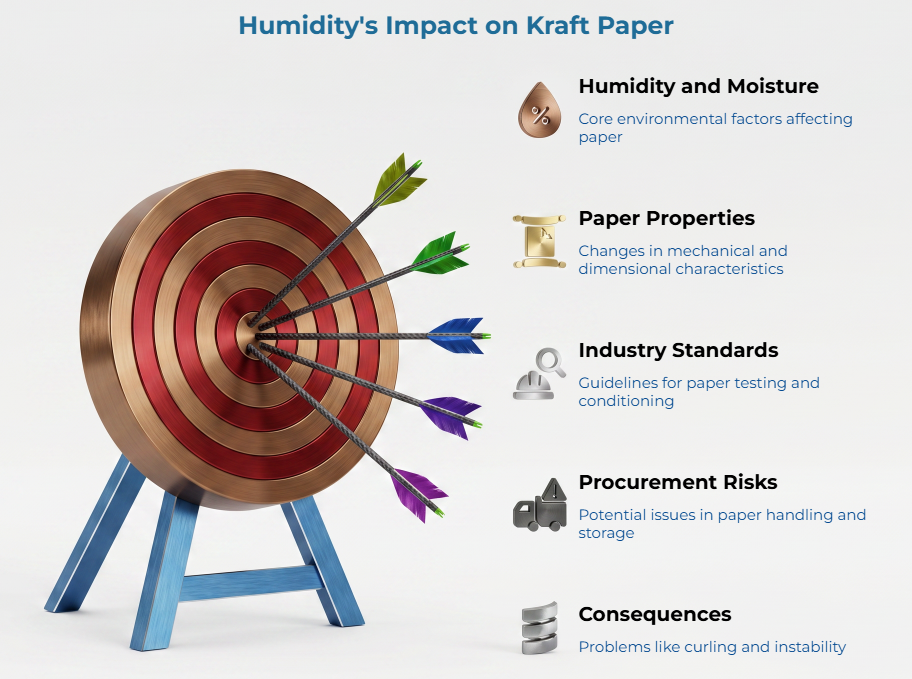
Paper is hygroscopic — it absorbs and releases moisture in response to surrounding conditions. Relative humidity refers to the percentage of moisture the air holds compared to its capacity at a given temperature, and as it shifts, so do the mechanical and dimensional properties of kraft paper. Industry standards such as TAPPI T 402 and ISO 187 define standard atmospheres for conditioning and testing paper precisely because moisture levels affect measurable performance.
For procurement, the concern is straightforward. If kraft paper sits near damp floors, close to an open dock door during rainy seasons, or on pallets that absorb ground moisture during transit — its moisture content can shift beyond what the converting process or end-use application can tolerate. Curling, dimensional instability, reduced stiffness, and surface issues can follow.
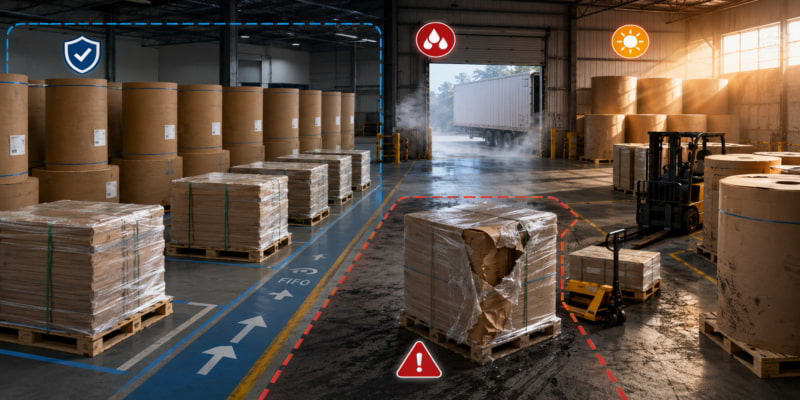
The risk increases when original packaging has been compromised. Intact wrapping buffers against short-term humidity exposure. Once wrapping is torn, cut open for inspection, or removed during partial use, the remaining material absorbs ambient moisture faster.
A common pitfall is assuming “dry warehouse” means “low humidity.” A warehouse can be dry at floor level and still have significant moisture variability near exterior walls, dock openings, or areas with poor air circulation. Direct moisture exposure — from leaks, damp pallets, or condensation — is a different risk than ambient humidity, and both deserve attention.
Temperature Fluctuation, Sunlight, and Acclimation
Stable temperatures matter more than a specific number. Large swings — common in warehouses without climate control, or near exterior doors, heating vents, or skylights — can cause condensation on or within paper rolls. That condensation introduces moisture in concentrated areas rather than uniformly, creating localized quality problems difficult to detect until the material is unwound.
Direct sunlight accelerates surface degradation. Paper preservation guidance from the Library of Congress recommends avoiding direct or intense light exposure for works on paper. While commercial kraft inventory is not archival material, the principle applies: prolonged UV and heat exposure can yellow surfaces, reduce flexibility, and create uneven aging across a roll or pallet. In a warehouse, that translates into checking skylights, windows, hot walls, radiators, and areas where afternoon sun hits wrapped stock.
Acclimation — allowing material to adjust to the temperature and humidity of the production environment before use — is the related operational concern. Kraft paper moved directly from a cool storage area to a warm production floor may need time to reach equilibrium before converting. Industry-standard paper handling guidance generally supports this point: allowing material to acclimate can help prevent moisture-related performance issues.
Dust, Pests, and Packaging Integrity
Dust accumulation on exposed kraft paper creates surface contamination that matters most when the end product is customer-facing packaging — paper bags,wrapping paper, box liners, or food-adjacent applications.
Pest activity is a warehouse-level concern that procurement should acknowledge, not manage directly. Rodents, insects, and birds can damage wrapping and contaminate material that passes visual inspection at the pallet level but fails at the sheet or roll level.
Packaging integrity ties these risks together. Intact mill wrapping protects against humidity, dust, and contamination simultaneously. Once packaging is opened or damaged — during receiving, internal moves, or partial consumption — the remaining inventory loses that protection. A realistic example: receiving opens a wrap, production uses part of the stock, and the remaining material returns to storage with loose protection. That is no longer the same risk profile as unopened inventory.
Ask whether partially used rolls or opened pallets are re-protected between uses, and whether receiving teams inspect wrapping conditions on arrival. That single question—is the wrapping intact?—connects to every other storage risk.
Pallet, Roll, and Warehouse Handling Issues Procurement Should Ask About
Storage is not just about climate. Physical handling during receiving, internal movement, and staging for production introduces damage risks that increase with order volume — more material means more handling events.
Crushed edges, torn wrapping, flat spots on rolls stored horizontally without proper support, floor contact that wicks moisture into bottom layers, and unstable stacking all affect usability. Roll handling requires appropriate equipment and trained personnel — for a detailed look at how each internal handoff introduces risk, see kraft paper parent roll handling: how to prevent damage before production starts. Established paper manufacturer guidelines typically note that improper reel storage can alter paper’s technical characteristics and that companies often need site-specific criteria, equipment, and training for reel storage and handling.
What procurement can do is ask the right questions before increasing order volume. Does the warehouse have adequate space for additional pallet positions or roll storage? Is the equipment rated for the weight and format being ordered? Are kraft paper jumbo rolls stored following the supplier’s orientation and stacking recommendations?
Do not ask the warehouse, “Is storage okay?” That question invites a general answer. Ask observable questions instead. Where will the added stock sit? Will it be near dock doors, exterior walls, vents, windows, damp floors, or pest-prone areas? Can older stock remain visible and accessible after the next delivery? Who checks torn wrapping after receiving or internal movement? How are partially used rolls, sheets, or pallets protected between uses?
Shared warehouse space deserves specific attention. Kraft paper may be stored beside returned goods, cleaning supplies, waste materials, or unrelated packaging. If space is tight, the paper may move several times before use — and each move creates another opportunity for edge damage, torn wrap, or misplaced stock.
These questions are not about second-guessing the warehouse team. They are about confirming that the storage infrastructure matches the procurement plan. For roll handling, stacking, and equipment use, follow supplier instructions and site safety procedures.
How Storage Conditions Should Influence Order Volume and Delivery Cadence
Here is where storage awareness becomes a procurement decision.
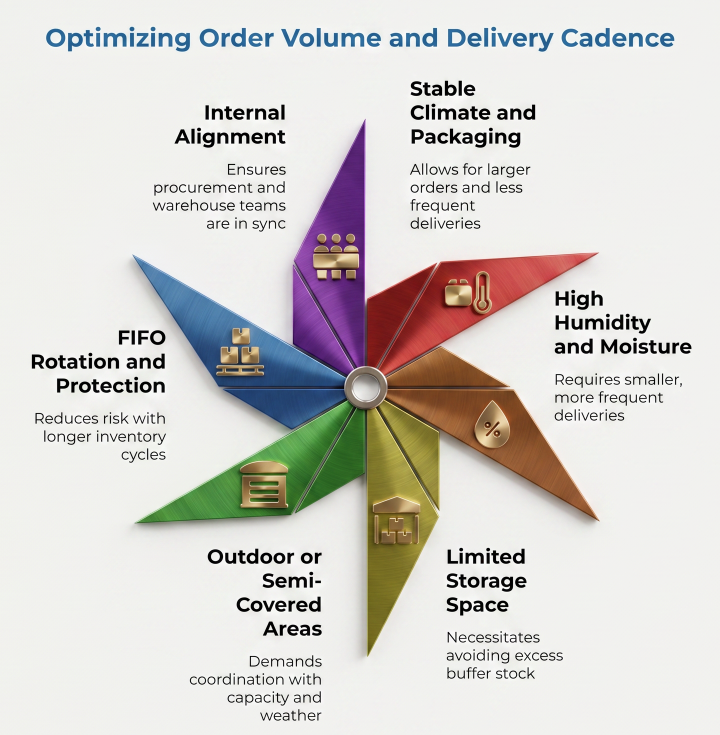
If your warehouse has stable humidity, intact packaging protection, reliable stock rotation, and enough clean, dry floor space, a larger order with less frequent deliveries may work well. The savings in unit cost and logistics coordination are real, and the storage risk is manageable.
If your warehouse runs warm in summer, sits near a coast, has limited covered storage, or routinely handles partial pallets with compromised wrapping — a smaller, more frequent delivery cadence may protect more value than the unit-cost discount from a bulk purchase.
Use these operational risk baselines to align ordering frequency with actual warehouse capabilities:
| Storage Condition | Risk Level | Procurement Response |
| High ambient humidity or seasonal moisture exposure | Higher | Consider smaller, more frequent deliveries to reduce dwell time |
| Limited clean, dry storage space | Higher | Avoid excess buffer stock beyond confirmed capacity |
| Stable climate, intact packaging, good rotation practices | Lower | Larger orders with extended delivery intervals may be feasible |
| Outdoor or semi-covered receiving and staging areas | Higher | Coordinate delivery timing with warehouse capacity and weather |
| Strong FIFO rotation and wrapping protection protocols | Lower | Longer inventory cycles carry less risk |
This is also where internal alignment matters. Procurement may be chasing fewer orders and better unit cost. Warehouse teams may be protecting limited space. Production may discover the problem only when a roll or pallet is needed and the material cannot perform. A short alignment conversation before the purchase can prevent a long dispute after the material is on site.
Stock rotation — often called FIFO, or first-in, first-out — deserves specific attention. FIFO means older inventory is consumed before newer deliveries. Without deliberate rotation, new pallets get stacked in front of older ones, and the older stock degrades silently until someone discovers it during a count or a production complaint. FIFO only works when labels are visible, locations are planned, and picking teams can access older stock without excessive re-handling.
Match order volume to realistic turnover. If your operation consumes fifteen pallets per month, ordering forty-five pallets to capture a price break only works if storage conditions can keep that third month of inventory usable — a dynamic explored further in The ‘Inventory Trap’: why buying mill direct is bankrupting small paper converters.
Kraft Paper Storage Readiness Checklist for Procurement Teams
Before approving a larger order or reducing delivery frequency, review these factors with your warehouse team.
| Storage Factor | What to Check | Why It Matters | Procurement Action |
| Humidity and moisture | Is the storage area consistently dry? Any exposure to dock doors, exterior walls, or ground moisture? | Moisture shifts affect paper performance and dimensional stability | Confirm conditions with warehouse; reduce dwell time if exposure is high |
| Temperature stability | Are there large daily or seasonal temperature swings in the storage area? | Swings cause condensation and uneven moisture distribution | Ask about climate variability; consider acclimation time before production |
| Sunlight and heat | Is inventory near skylights, windows, or direct sunlight? | UV and heat degrade surfaces and accelerate aging | Request shaded, interior storage positions for kraft paper |
| Dust and contamination | Is the area clean? Is inventory near dusty operations or open construction? | Surface contamination affects customer-facing packaging quality | Verify cleanliness standards and separation from contamination sources |
| Pests | Is there evidence of rodent or insect activity in the storage area? | Pests damage wrapping and contaminate material | Confirm pest management is active; inspect wrapping on arrival |
| Packaging integrity | Is mill wrapping inspected on receipt? Are opened or partial units re-protected? | Compromised wrapping accelerates all other risks | Require wrapping inspection at receiving; establish re-protection protocols |
| Pallet and roll handling | Does the warehouse have equipment and training for the format being ordered? | Improper handling causes edge damage, flat spots, and wrapping tears | Confirm capability before ordering heavier rolls or larger quantities |
| Stock rotation | Is FIFO rotation practiced? How is older stock identified? | Poor rotation lets inventory sit beyond practical usability | Require rotation protocols; align order volume with consumption rate |
| Inventory dwell time | How long will the new order volume sit before full consumption? | Longer dwell time increases cumulative exposure to every risk above | Compare expected dwell time against warehouse conditions before approving volume |
| Supplier storage guidance | Has the supplier provided grade-specific storage recommendations? | Requirements vary by grade and format | Request supplier documentation before setting order volume |
Questions to Ask Your Supplier Before Changing Order Volume
Your supplier should be a resource, not just an order recipient. The objection that “the supplier never mentioned special storage requirements” is common — but the conversation often has not been started from the procurement side.
Before increasing volume or extending delivery intervals, make the supplier conversation specific. A useful request might sound like this: “We are considering a larger order. Please confirm recommended storage conditions, wrapping expectations, receiving checks, and any storage-duration guidance for this grade and format.”
Ask these questions before the purchase order is finalized:
- What storage conditions do you recommend for this grade and format?
- Should rolls or pallets remain wrapped until the point of use?
- Is there a recommended maximum storage period under typical warehouse conditions?
- What signs of moisture exposure or handling damage should receiving teams look for?
- How should opened or partially used material be protected between uses?
- Do you recommend a different delivery cadence for humid climates or limited covered storage?
Most kraft paper suppliers and kraft paper producers welcome the opportunity to help buyers store material correctly — because storage damage generates returns and relationship friction that neither side wants. For more on the questions worth raising before your first shipment arrives, see before the roll arrives: packaging, delivery, and warehouse questions kraft paper jumbo roll buyers should ask.
Storage Reality Should Shape Procurement Strategy
Kraft paper storage is not only a warehouse responsibility. It is a procurement input.
You do not need to manage the warehouse. You need to account for what it can realistically protect. Ask the questions. Review the conditions. Coordinate with your supplier on grade-specific guidance and delivery cadence. If your warehouse team has always stored paper a certain way, that does not mean those conditions can support a longer dwell time under a new order volume.
Aligning incremental order volumes with verified warehouse preservation thresholds transforms procurement from a transactional unit-cost chase into a total-value optimization strategy.
For deeper guidance on protecting kraft paper parent rolls from warehouse moisture and temperature risks, improving roll storage, picking, and rotation, and preventing handling damage before production, explore the related guides on PaperIndex Academy.
Frequently Asked Questions
Does kraft paper have a fixed shelf life?
Not universally. While cellulose fibers do not inherently spoil, mechanical performance degrades under unmanaged ambient exposure. Procurement must secure a maximum holding window from the vendor based on the warehouse’s localized seasonal humidity baselines. Do not use a fixed duration unless it comes from product documentation.
Is humidity the biggest storage risk for kraft paper?
It is often one of the first risks to review because paper properties are directly affected by moisture conditions. But handling damage, compromised packaging, and poor stock rotation can be equally consequential over extended storage periods.
Should kraft paper stay wrapped until use?
In many cases, keeping protective packaging intact reduces exposure to moisture, dust, and handling damage. Follow supplier guidance for the specific format, and confirm whether your warehouse re-protects partially used rolls or pallets between uses.
Should procurement reduce order volume if storage is not climate-controlled?
Not automatically. Compare expected turnover speed, local climate conditions, packaging protection, and supplier recommendations before deciding. A warehouse without climate control in a dry region may present less risk than a climate-controlled facility with persistent dock-door exposure or poor rotation — a point reinforced in Is “Inventory Overload” the Silent killer of your working capital? In inconsistent storage environments, smaller or more frequent deliveries may be more practical than holding excess buffer stock.
What should procurement ask the warehouse before buying more kraft paper?
Ask about humidity and moisture exposure, proximity to dock doors or exterior walls, packaging inspection at receiving, stock rotation practices, pest and dust controls, available space for safe handling, and whether existing equipment is rated for the format and weight being ordered.
Disclaimer:
This content is for general educational purposes only and does not constitute professional procurement, warehousing, or supply chain advice. Storage requirements vary by kraft paper grade, format, coating, and supplier. Always refer to your supplier’s product-specific documentation and storage recommendations before making purchasing or inventory decisions. The authors assume no liability for outcomes resulting from actions taken based on this information.
Our Editorial Process:
Our expert team uses AI tools to help organize and structure our initial drafts. Every piece is then extensively rewritten, fact-checked, and enriched with first-hand insights and experiences by expert humans on our Insights Team to ensure accuracy and clarity.
About the PaperIndex Insights Team:
The PaperIndex Insights Team is our dedicated engine for synthesizing complex topics into clear, helpful guides. While our content is thoroughly reviewed for clarity and accuracy, it is for informational purposes and should not replace professional advice.