

📌 Key Takeaways
Kraft paper durability isn’t one property. It’s a set of measurable specs you should request as a complete package.
- Define Your Stress Profile First: Tell suppliers the actual loads, humidity, and handling of your packaging faces instead of just asking for “durable paper.”
- Request the Full Spec Package: Get tensile strength, tear resistance, burst strength, moisture data, tolerances, and test methods — not just weight (GSM).
- Match Test Methods Before Comparing: Two suppliers reporting the same property using different test standards can’t be compared side by side.
- Tolerances Turn Claims Into Commitments: A strength number without a minimum-maximum range is a marketing target, not a reliable promise.
- Specs Alone Don’t Prove Performance: Lab-tested values are a starting point — sample trials under your real storage and production conditions finish the evaluation.
Documented specs don’t guarantee results, but they make every sourcing decision defensible.
Procurement managers and packaging buyers evaluating kraft paper suppliers will sharpen their RFQs and shortlisting process here, preparing them for the detailed specification guide that follows.
~ ~ ~ ~ ~ ~ ~ ~ ~ ~ ~ ~ ~ ~ ~ ~ ~ ~
“Strong.” “Heavy-duty.” “Durable.”
Those three words appear on supplier brochures, email quotes, and trade-show handouts with impressive consistency. A procurement manager scanning data sheets from four different kraft paper suppliers can see some variation of “high strength” on every single one — and still have no structured way to compare them. The claims sound confident. The documentation behind them, though, is often thin.
You’ve likely been in that position: preparing an RFQ or an internal material recommendation, knowing that the packaging application demands real durability, but lacking the documented supplier details to evaluate one sheet against another. The word “durable” shows up everywhere, yet it doesn’t point to a single measurable property. It doesn’t tell you whether the paper resists tearing, withstands bursting pressure, or holds up in a humid warehouse. Durability isn’t one thing — it’s a collection of properties, and each one answers a different question about performance under stress.
With a structured specification request and the right supplier questions, you can move past vague marketing language and into evidence-based shortlisting — the kind that holds up when internal stakeholders ask why you chose one supplier over another.
Start With the Use Case, Not the Word “Durable”
Before requesting a single data sheet, define the stresses your packaging application will actually impose on the paper.
A kraft paper used as protective wrapping inside a carton faces different forces than one converted into a multiwall sack carrying 25 kilograms of powder. Void-fill paper needs flexibility and recovery. Liner paper needs stacking compression resistance —a requirement explored further in our guide, ‘how to match kraft paper grades to corrugated end use, process, and failure risk.’ Paper headed for cold-chain storage or ocean freight containers faces moisture risks that affect kraft paper shelf life in storage — risks that dry, climate-controlled distribution doesn’t present. Paper used in bag conversion may need to handle pulling, folding, creasing, printing, gluing, and machine tension — not just a single type of load. Protective packaging applications can add puncture risk and abrasion during transport. The converting process itself, along with roll condition and storage before use, adds mechanical stresses no supplier data sheet captures.
If you approach suppliers asking only for “durable kraft paper,” you’ll receive answers shaped by whatever the supplier wants to sell. If you approach them with a defined stress profile — load weight, transit distance, storage humidity, converting method, handling intensity — you give them something specific to respond to. That specificity separates a productive supplier conversation from a vague one.
Define the application stresses first. Then evaluate whether the supplier’s documented specifications actually address those stresses. The PaperIndex guide on ‘specifying the right kraft paper grade from end use to RFQ’ walks through that same principle in more detail.
Supplier Specification Details to Request for Kraft Paper Durability
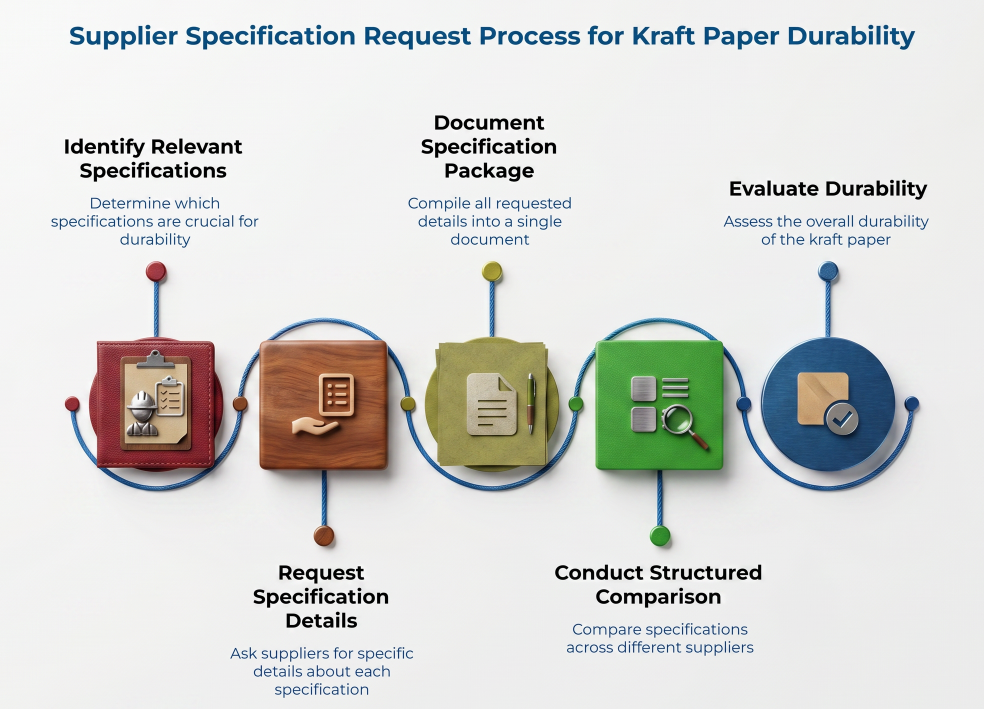
The following checklist covers the specification details most relevant to durability evaluation. Not every detail applies to every application — but requesting them as a documented package gives you the raw material for a structured comparison.
| Specification Detail | Why It Matters | What to Ask the Supplier | What Not to Assume |
| Grammage (GSM) / basis weight | Baseline density reference for comparison. | “Nominal GSM and tolerance band?” | Higher GSM automatically means stronger paper. |
| Thickness (caliper) | Influences stiffness and cushioning; relevant to converting equipment fit. | “Measured caliper in micrometers and test conditions?” | Thicker paper is inherently more durable. |
| Tensile strength | Force to pull paper apart; critical for wrapping tension and stretching. | “Values for both machine and cross direction? Test method used?” | A single tensile number tells the full story. Direction matters significantly. |
| Tear resistance | Force to continue a tear once started; relevant where nicks or edge damage occur. | “Tear values available, and are they direction-specific?” | High tensile strength guarantees high tear resistance. Different failure modes. |
| Burst strength | Pressure before rupture under perpendicular force; relevant for sacks and heavy wrapping. | “Burst value and which test method?” | Burst strength alone proves durability. It measures one stress type. |
| Moisture content / water absorption | Critical when storage, transit, or end-use involves humidity exposure. | “Cobb values, moisture content, or both? Test conditions?” | Lab moisture specs reflect uncontrolled warehouse performance. |
| Fiber composition | Virgin, recycled, or blended fiber can influence strength characteristics. | “Can you confirm fiber composition for this grade?” | Virgin fiber is always superior. Relevance depends on application demands. |
| Tolerances | Define acceptable variation around each nominal value; affect production consistency. | “Minimum, maximum, and tolerance ranges for each spec?” | A nominal value without a tolerance band represents a commitment. |
| Test method and conditions | Different methods can produce different results for the same property. | “Which recognized test method for each reported property?” | Values are comparable across suppliers when test methods don’t match. |
Request these details as documented specifications. A verbal assurance or a marketing summary isn’t a specification — it’s a starting point for a longer conversation.
How to Read These Specs Without Over-Interpreting Them
Receiving a detailed data sheet is the first step. Reading it accurately is the second — and it’s where many procurement teams trip up. Compare like for like. If two suppliers report tensile strength, confirm that both used the same recognized test method and the same testing conditions before drawing comparisons — a principle covered in depth in the spec-true mindset that reduces kraft paper RFQ chaos. Values generated under different methods may look similar but aren’t equivalent. This is one of the most common sources of false confidence in supplier comparison.
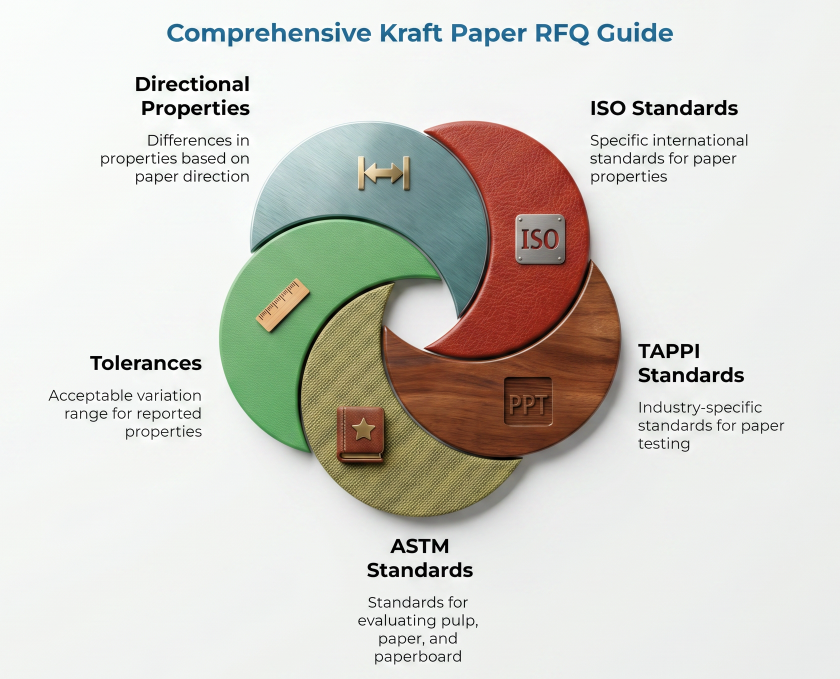
When buyers want to reference specific standards in an RFQ, the relevant ones include ISO 536 for grammage, ISO 1924-2 for tensile properties, ISO 1974 for Elmendorf tearing resistance, ISO 2758 for bursting strength of paper, and ISO 2759 for bursting strength of board. For a broader reference on which TAPPI and ISO test methods to require in your kraft paper RFQ, we’ve published a ready-to-copy table covering 12 methods with acceptance clauses. ASTM also publishes standards for evaluating physical, mechanical, and chemical properties of pulp, paper, and paperboard. If your purchasing team prefers not to cite specific standards, simpler RFQ language works too: “State the test method used for each reported property.”
Ask for tolerances, not just nominal values. A supplier reporting a burst strength of 350 kPa is telling you the target. Without a tolerance band, you don’t know how much delivery-to-delivery variation to expect. The 12 measurable parameters buyers must specify in a kraft paper RFQ covers how to define these fields with units and tolerances. Tolerances turn a marketing target into a measurable commitment.
Clarify whether directional properties are separated. Tensile strength and tear resistance can differ substantially between machine direction and cross direction. If a supplier reports only one value, ask which direction it represents — and whether the other is available, particularly when the paper will be pulled, folded, slit, wound, or converted at speed.
Here’s an illustrative example. Imagine comparing two kraft paper parent rolls from different suppliers — both at 90 GSM. Supplier A provides tensile values in both directions, tear resistance, burst strength, Cobb values, tolerance bands, and test method references. Supplier B provides GSM and a generic “high strength” label. Both papers might perform well, but only Supplier A has given you documented evidence to evaluate that possibility.
That single comparison illustrates the core principle: specs don’t guarantee performance, but they make your evaluation defensible. For deeper reading on this kind of comparison, our article, ‘comparing kraft paper parent roll offers beyond grade names’ is useful when quotes look similar but specifications differ.
RFQ Questions Procurement Teams Can Use
Converting the specification checklist into RFQ language — following the structure outlined in the anatomy of a perfect kraft paper RFQ — improves the consistency and comparability of supplier responses. These questions can be adapted to your application context.
As a hypothetical example, consider a procurement team preparing an RFQ for kraft paper used in protective packaging for heavy industrial components — an application involving repeated forklift handling, compression stacking, and three weeks of warehouse storage before shipment. That stress profile immediately suggests tensile strength, tear resistance, burst strength, and moisture behavior all matter, and the RFQ questions should reflect those priorities rather than defaulting to GSM and price.
With that application context in mind, the following questions sharpen any kraft paper RFQ:
- “Which recognized test method was used for each reported strength property?”
- “What are the minimum, maximum, and tolerance ranges for each specification value?”
- “Can you provide recent test reports or certificates of analysis?”
- “Are tensile and tear resistance values reported separately for machine direction and cross direction?”
- “Can you provide samples for application-specific testing?”
- “What storage or moisture conditions affect the reported performance values?”
- “Which properties should our packaging, quality, or production team validate before approval?”
These questions aren’t adversarial. They’re the foundation of a clear buyer-supplier relationship built on documented evidence.
Budget pressure can complicate this process. A lower-cost quote may still be the right choice, but only after the missing variables are visible — as explored in ‘when a cheaper kraft paper becomes more expensive in production.’ If one supplier includes test methods, tolerances, samples, and documentation while another provides only a grade name and price, the lower unit price may not represent the lower procurement risk.
For buyer teams still building their supplier-question workflow, what to ask a kraft paper supplier when grade descriptions are too vague offers a practical companion to this RFQ approach.
Common Mistakes When Comparing Kraft Paper Durability
Several recurring errors weaken procurement evaluations. Recognizing them saves time and reduces material-mismatch risk.
Treating GSM as a complete durability indicator. GSM tells you how much fiber is in a square meter, not how that fiber performs under tension, tearing, or bursting. For the full set of criteria that matter, see ‘beyond GSM: parent roll buying criteria that prevent breaks, waste, and downtime.’ A lighter paper with stronger fiber bonding can outperform a heavier one with weaker bonding. GSM is necessary context, not a sufficient verdict.
Comparing supplier data sheets without verifying test methods. Two burst strength values measured under different recognized standards aren’t interchangeable. Without method alignment, your comparison spreadsheet mixes units of meaning, not just units of measurement. This is worth getting right — it’s the single most common source of misleading supplier comparisons.
Ignoring moisture and storage conditions. Consider a hypothetical scenario: a procurement team selects kraft paper based on strong tensile and burst values, but the paper spends three weeks in a coastal warehouse with no climate control before converting. The paper’s measurable properties at converting time look nothing like the values in the lab report. Storage context matters proportionally to the moisture risk in your supply chain.
Accepting vague strength claims at face value. “High strength” and “heavy-duty” are descriptions, not specifications. If a supplier uses these terms without documented test values, request the data behind the language.
Treating sustainability credentials as durability proof. Environmental certifications, such as FSC or PEFC compliance, may be important procurement requirements — but they should be requested and evaluated separately using registry verification. Without approved documentation tied to the specific claim and use case, they should not stand in for evidence of handling, converting, or transit performance.
Not involving technical stakeholders for critical applications. Procurement teams excel at supplier management and commercial evaluation. For applications where packaging failure creates significant cost or brand risk, bringing a packaging engineer into the specification review strengthens the evaluation. Operations, quality, and warehouse staff often know failure modes — edge damage, fold cracking, tension breaks, moisture exposure — that don’t appear in a price sheet. You don’t need to become a testing lab — you need to know when to bring the testing lab into the conversation.
When Specs Are Not Enough: Samples, Testing, and Stakeholder Review
Specifications are procurement tools. They support shortlisting, comparison, and supplier qualification. They don’t eliminate the need for validation in applications where failure matters.
Consider a sourcing manager evaluating three shortlisted suppliers for corrugated liner board. All three data sheets look comparable. But only a production trial on the buyer’s own corrugating line — using their adhesives, at their line speeds, in their storage conditions — reveals which paper runs without breaks, delaminates under humidity, or creates waste at the slitter. That trial produces information no data sheet can.
A paper sample can look acceptable at a desk but behave differently after warehouse staging in a humid area. The roll may still match the quoted description, yet handling, moisture exposure, or storage conditions may affect how it runs at converting time. Receiving, storage, and conversion checks should support — not replace — the supplier specification review.
For critical packaging applications, request samples and conduct application-specific testing. Involve operations, quality, and packaging engineering stakeholders when failure risk justifies it — especially when there isn’t time for full lab validation before the shortlisting deadline.
Document the assumptions behind your final decision. Record which values were compared, which tolerances were accepted, which fields were missing, which samples were reviewed, and which teams approved the choice. That record protects the decision if a material underperforms later, allowing you to trace the gap to a specific specification or condition.
Specifications get you to a shortlist. Testing and stakeholder review get you to a decision. PaperIndex’s guide on kraft paper sample trials before full-order commitment is relevant when the supplier sheet looks acceptable but production approval still needs evidence.
Turn Specifications Into Better Supplier Conversations
The procurement value of kraft paper specifications isn’t in the numbers alone. It’s in what those numbers enable: structured comparison, sharper questions, clearer RFQs, and supplier conversations grounded in verifiable test data and defined tolerances.
Request specifications as a complete package — strength properties, tolerances, test methods, and condition-specific data where relevant. Use the checklist from this article to prepare your next supplier questionnaire or RFQ. Where the application demands it, follow the data sheet with a sample request and a production trial — because that’s where the evaluation you started with documented specs turns into a decision you can defend.
If supplier discovery is the next step, buyers can review relevant kraft paper parent roll suppliers or submit requirements through PaperIndex’s RFQ submission page while keeping the same evidence-first discipline.
Frequently Asked Questions
Is GSM enough to evaluate kraft paper durability?
No. GSM indicates material weight per unit area — useful as a reference but not a strength measure. Durability evaluation should also account for tensile strength, tear resistance, burst strength, and the test methods behind each value. Application context — load, handling, and storage conditions — further shapes what “durable enough” means for your use case.
Which kraft paper strength test is the most important?
That depends on your application. Tensile strength matters where the paper faces pulling or stretching forces. Tear resistance matters where edge damage or punctures are likely. Burst strength matters where internal pressure pushes outward against the surface. Ask suppliers for the properties that align with your specific stress profile rather than relying on any single metric.
Should buyers compare virgin and recycled kraft paper for durability?
Fiber composition can be compared where the supplier provides documented details, but virgin or recycled content should not be treated as a universal durability ranking. Application fit, measured properties, tolerances, and sample performance matter more than a broad fiber label.
Should buyers ask suppliers for test reports?
Yes, particularly when durability is a critical requirement. Recent test reports or certificates of analysis show that the supplier actively monitors production quality and gives you documented values you can compare across suppliers using consistent criteria.
Do specifications guarantee packaging performance?
No. Specifications reflect laboratory-measured properties under controlled conditions. Packaging performance depends on additional variables: converting process, package design, handling intensity, storage environment, and real-world use. Specifications help you evaluate and shortlist. Application testing and supplier validation help you confirm.
Disclaimer:
This article is for informational purposes only and does not constitute professional engineering, testing, or procurement advice. Specification details, test methods, and evaluation approaches discussed are general guidance, not guarantees of material performance. Buyers should verify all supplier data independently and consult qualified technical professionals before making sourcing decisions. Actual paper performance depends on application-specific conditions that may differ from laboratory-tested values.
Our Editorial Process:
Our expert team uses AI tools to help organize and structure our initial drafts. Every piece is then extensively rewritten, fact-checked, and enriched with first-hand insights and experiences by expert humans on our Insights Team to ensure accuracy and clarity.
About the PaperIndex Insights Team:
The PaperIndex Insights Team is our dedicated engine for synthesizing complex topics into clear, helpful guides. While our content is thoroughly reviewed for clarity and accuracy, it is for informational purposes and should not replace professional advice.