
📌 Key Takeaways
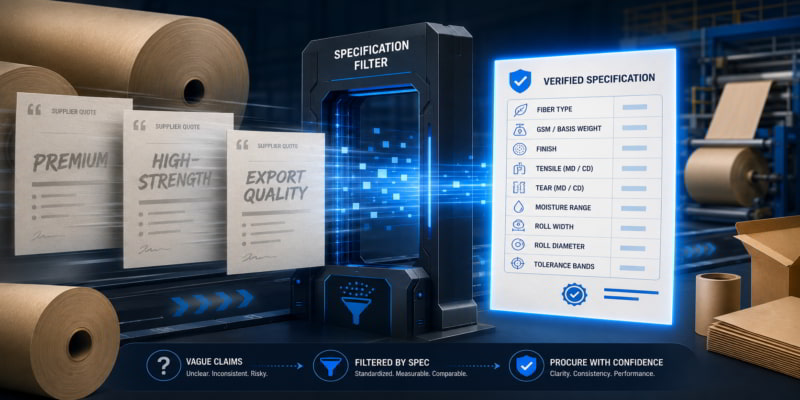
Kraft paper grade names like “premium” or “high-strength” mean different things at different mils. Always ask for measurable specs behind the label.
- Grade Names Are Not Specs: Ask suppliers to define grades using fiber type, finish, strength values, and moisture range instead of marketing labels.
- Know What’s Guaranteed: Find out which quoted values are contractual promises and which are just typical averages — claim rights depend on this.
- Match Paper to Process: A grade that looks right on a data sheet can still fail on the converting line if no one checked application fit.
- Samples Can Mislead: Confirm whether samples come from current production and whether bulk shipments will match within agreed tolerances.
- Compare Answers, Not Just Prices: Score each supplier’s clarity on specs, tolerances, roll details, and documentation — the cheapest quote often hides the highest total cost.
The supplier who answers clearly up front is the one least likely to surprise you on the production floor.
Procurement managers and packaging engineers evaluating kraft paper suppliers will gain a structured questioning framework here, preparing them for the detailed guide that follows.
~ ~ ~ ~ ~ ~ ~ ~ ~ ~ ~ ~ ~ ~ ~ ~ ~ ~
Grade names promise more than they prove.
Three kraft paper quotes land in the inbox on the same morning. Each one describes the product as “high-strength natural kraft,” and each one quotes a different price. The GSM figures look close enough. The lead times work. So why does the cheapest roll jam the converting line by the third splice, while the pricier one runs clean for 14 shifts straight? Often, the answer is that a cheaper kraft paper becomes more expensive in production once waste, downtime, and rejects are factored in.
The answer almost always hides behind language that sounds precise but is not. Terms like “premium,” “export quality,” “food grade,” or “virgin kraft” appear on kraft paper supplier data sheets worldwide, yet they describe very different papers depending on the mill, the region, and the production run. A procurement buyer comparing quotes on price alone may not see the gap. A packaging engineer evaluating runnability will feel it on the converting floor, after the purchase order has shipped.
The goal is not to interrogate every supplier, but to ensure that buyers, engineers, and suppliers are describing the same material, tolerances, and proof requirements before money changes hands. The depth of questioning should scale with order value, application risk, and whether the supplier is new or proven. For a broader RFQ structure that pairs technical specs with commercial terms, see the spec-driven kraft paper RFQ template. Applied consistently across every RFQ, these questions become a filter that separates well-defined offers from poorly defined ones.
Start by Asking What the Grade Description Actually Means
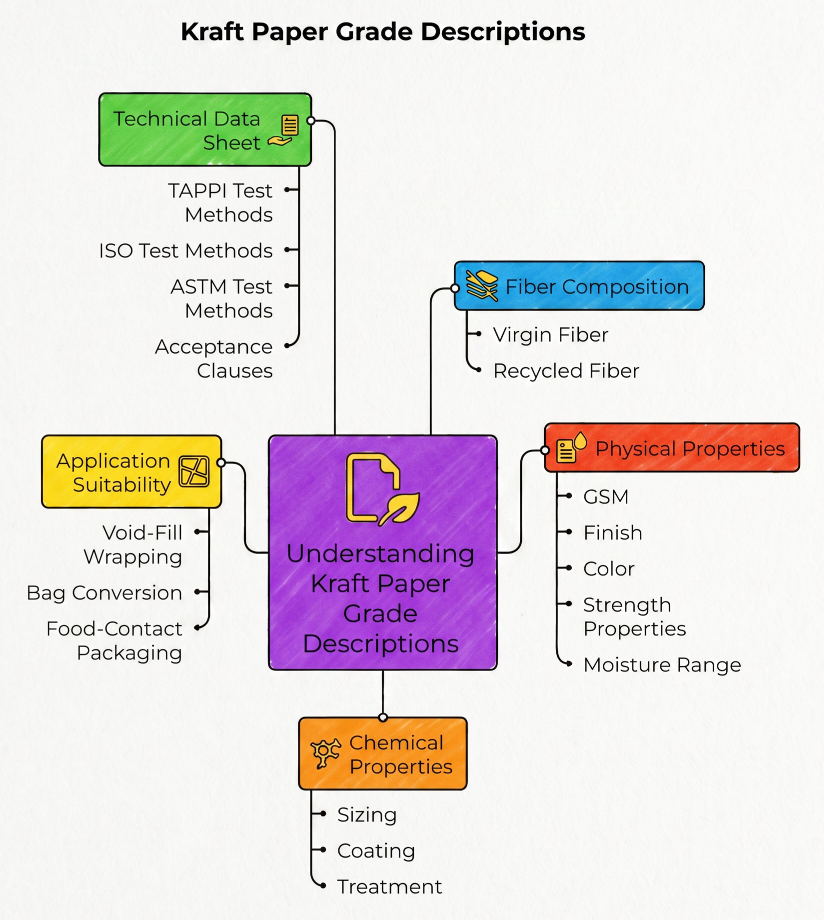
The first question should force vague grade language into measurable terms.
Ask the supplier to define the kraft grade in terms of fiber composition — virgin, recycled, mixed fiber, bleached, or unbleached — along with GSM or basis weight, finish (MG, MF, ribbed, calendered), color, strength properties, moisture range, and any sizing, coating, or treatment applied. Ask which applications the grade is designed for, and equally important, which applications it should not be used for.
Not every order requires every test value. The required level of detail depends on the end use. A buyer sourcing parent rolls for simple void-fill wrapping needs less specification depth than one sourcing for high-speed bag conversion or food-contact-adjacent packaging. The point is to move the conversation from a marketing label to a measurable description — a discipline explored in depth in the kraft paper property–application match matrix, which maps specific properties to specific end uses. If a supplier says “high strength,” ask which property is being referenced — tensile, tear, burst, and stiffness are not interchangeable.
Request the technical data sheet (TDS) for the exact grade being quoted. If no TDS exists, that gap is worth noting. Standard test methods — TAPPI T 494 for tensile properties, TAPPI T 414 for tear resistance, TAPPI T 410 for grammage, and TAPPI T 441 for Cobb water absorptiveness — provide a shared vocabulary. For a plain-language guide to which test methods to require in your kraft paper RFQ, including acceptance clauses, see the TAPPI/ISO reference. For global sourcing, specific International Organization for Standardization test methods (such as ISO 1924-2 or ISO 1924-3), alongside ASTM D828 for tensile properties, typically serve as equivalent references.
A “high-strength kraft” sold for shopping bags may not be the same material a converter needs for wrapping, lamination, void fill, or corrugation-facing use. The grade name starts the conversation. It should never end.
Ask Which Specifications Are Guaranteed, Typical, or Only Indicative
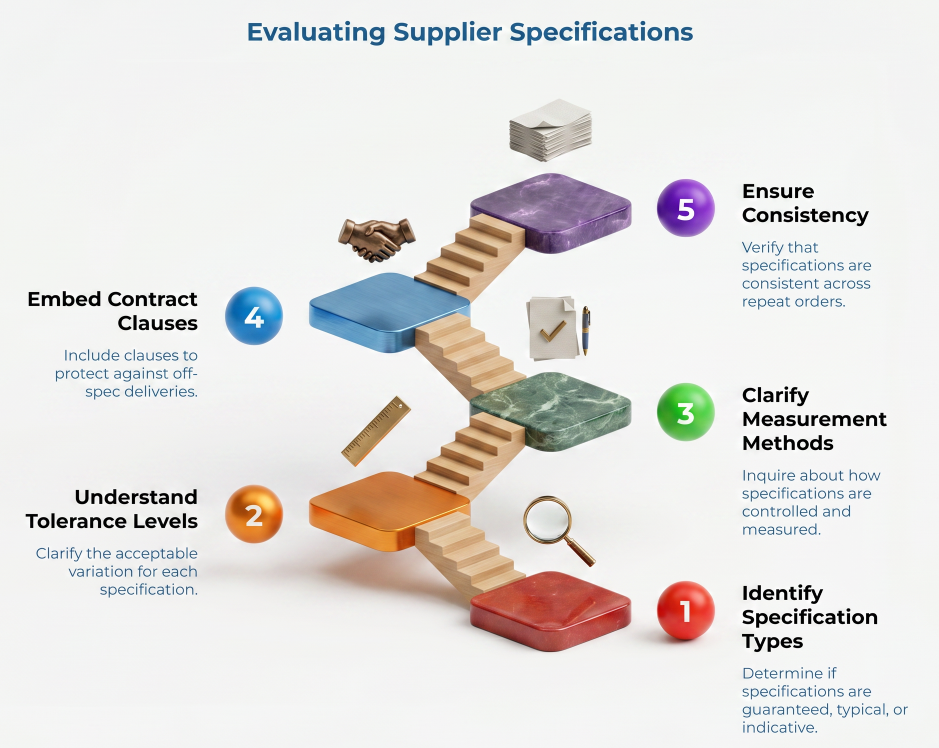
A supplier’s quoted values do not all carry the same level of commitment. Some are guaranteed on every shipment. Others are typical averages drawn from production history. Some may be internal production targets that the mill aims for but does not formally promise. And a few may be one-time sample results that have never been verified across repeat runs.
This distinction changes everything about how a buyer evaluates a quote. A supplier quoting 80 GSM with a ± 3% guaranteed tolerance is making a contractual commitment. A supplier quoting the same 80 GSM as a “typical” value is offering a description, not a promise. When rolls arrive at 76 or 85 GSM, claim rights depend on what was agreed — not what was assumed. Embedding contract clauses that protect against off-spec kraft paper deliveries before the purchase order ships is the mechanism that converts tolerance agreements into enforceable remedies.
Inquire specifically about the guaranteed versus typical values for the shipment. Which are typical averages? What tolerance range applies to GSM, width, moisture, roll diameter, and strength values? Are those tolerances stated per roll, per lot, or per production run? A lot average may not protect the buyer if individual rolls disrupt converting. And what happens if delivered rolls fall outside the agreed tolerance?
Beyond the numbers themselves, ask how specifications are controlled, measured, and handled when there is a deviation. A supplier who can explain the quality control process behind the data sheet — not just the data sheet itself — is demonstrating a level of operational maturity that directly affects consistency across repeat orders. For a structured way to evaluate that maturity, see the kraft paper producers capability matrix. A single lot test report does not prove that consistency.
Ask About Application Fit, Not Just Paper Grade
The right supplier should understand the buyer’s converting process and end-use stress conditions, not just the paper’s lab properties.
Procurement may evaluate a kraft paper quote on price and lead time. Engineering evaluates whether the roll will run at the required machine speed, handle folding and creasing without cracking, and maintain performance through storage and shipping. The supplier questions in this section serve both teams by testing whether the paper fits the application, not just the spec sheet.
Ask: what end uses is this grade designed for? Has it been used in similar applications? What converting processes has it run through successfully? Are there known issues with printing, gluing, coating, folding, creasing, slitting, or high-speed converting? What storage or humidity conditions affect performance? For food-contact-adjacent packaging or moisture-exposed shipping, ask whether the grade’s sizing or Cobb values have been validated and what documentation supports that claim.
If a buyer needs kraft paper for bag conversion, questions about tensile strength, tear resistance, folding behavior, printability, and glue compatibility matter far more than a generic grade label — a selection process detailed in how to choose the right brown paper grade for bag manufacturing. A supplier who can discuss application-specific risks and converting behavior is fundamentally different from one who can only confirm GSM and price.
Ask for Parent Roll Details That Affect Production
Paper quality and roll quality are not the same thing. A sheet that passes every lab specification can still cause downtime if the parent roll is poorly wound, damaged in transit, or inconsistent from one roll to the next. This section is the operational core of any kraft paper supplier evaluation.
Ask about roll widths, diameters, and core sizes available — and the tolerances on each. Ask the maximum number of joints or splices permitted per roll and how joints are marked. Ask about winding conditions: tightness, telescoping risk, edge quality, and roll hardness. For export shipments, ask how rolls are wrapped and protected, how roll IDs, lot numbers, and production dates are labeled, and what the claim process covers for transit damage or hidden defects discovered during converting.
Claim handling deserves direct attention. Ask what happens if rolls arrive with transit damage, hidden defects, unclear labels, or off-spec conditions. A practical answer should identify the inspection window, the evidence required, roll ID traceability, and the remedy process. Establishing a standard receiving protocol at the dock allows for immediate verification of these supplier commitments.
A buyer once accepted a competitive quote only to discover that excessive splices, inconsistent winding tension, and edge damage were generating waste that erased the apparent price advantage. A jumbo roll quality checklist covering roll condition, winding, splices, and edges helps prevent exactly this scenario. The gap between invoice price and actual production cost revealed the true value of the higher-quality roll. Roll-level details are where usable yield — and real cost — are determined.
Ask How Samples Relate to the Actual Shipment
Samples are useful only when the buyer knows where they came from and what they represent. A sample cut from a specially selected roll, stored under ideal conditions, and presented at its best tells very little about what the bulk shipment will look like.
Ask the supplier: is this sample from current production, stock lots, or a specially prepared sample run? The distinction matters — a stock lot sample may represent surplus or off-grade production that does not reflect current manufacturing capability. Ask about the sample size, the source lot, and whether a test report accompanies the sample showing GSM, moisture, and strength values. Confirm whether the sample comes from the same grade, machine, mill, and furnish as the quoted product. Ask whether the first shipment will match the sample within agreed tolerances, and whether a small trial order is possible before committing to recurring volume.
Color, feel, and stiffness can be useful initial indicators, but they do not replace documented specifications tied to a production run. A sample that performs well in a converting trial means little if the bulk shipment varies in shade, moisture, or winding quality. A proper supplier trial with baseline data and acceptance criteria is worth more than any sample sheet.
Ask What Documentation and Traceability the Supplier Can Provide
For global sourcing, documentation helps buyers verify claims, manage compliance expectations, and resolve disputes when shipments do not match what was agreed.
The depth of documentation required depends on the buyer’s market, customer requirements, application, and regulatory exposure. Not every buyer needs FSC or PEFC chain-of-custody documentation, food-contact certifications, or country-specific compliance records. But every buyer benefits from asking what the supplier can provide — and what documents ship with the order by default.
Key questions: can the supplier provide a TDS for the exact grade? Can they provide recent lot-level test reports? What certificates are available, and do they apply to this specific product, facility, and order — not just the company in general? For sustainability requirements, can chain-of-custody claims be shown on transaction documents? What traceability exists from production lot to delivered roll?
A certificate on a supplier’s website is not the same as a verified certificate that covers the specific grade, facility, and transaction being purchased. A step-by-step verification guide for FSC, ISO, and food-contact certifications shows how to confirm scope, status, and entity in under 40 minutes. Claims like “export quality,” “premium,” or “eco-friendly” should be backed by relevant documentation, test data, or order-specific evidence.
Turn the Answers Into a Simple Supplier Comparison
Asking the right questions is half the work. The other half is comparing answers consistently across every supplier under evaluation.
A straightforward comparison does not require a complex procurement framework. Score each supplier across seven categories using a simple rating — clear, partially clear, or unclear — for specification clarity, application fit, tolerance transparency, sample reliability, roll and packing details, documentation and claim support, and repeat-order consistency.
The pattern that emerges is often revealing. Supplier A may offer the lowest price but remain vague on tolerances, sample origin, and roll details. Supplier B may quote slightly higher but provides clear specifications, lot-level testing, defined claim terms, and documented roll construction standards. A price-per-ton comparison is weak if the two suppliers are not quoting equivalent material, tolerances, and roll conditions — a principle explored fully in comparability before price: the spec-true mindset that reduces kraft paper RFQ chaos. The buyer who compares answers — not just prices — will understand why Supplier B often represents lower total risk. For deeper specification development after the comparison, see defining and enforcing brown paper technical specs.
Conclusion
Vague grade descriptions are not automatically a red flag. Many reliable suppliers use broad grade names because internal nomenclature does not translate neatly into buyer specification language. What matters is whether the supplier can explain the paper in terms of measurable specifications, application fit, tolerances, representative samples, roll construction, and documentation when asked.
The depth of questioning should match the risk. Low-stakes, one-time orders require a streamlined review, whereas new partnerships or high-volume, sensitive conversions demand rigorous scrutiny. Good suppliers rarely object to precise questions — clarity up front reduces disputes later.
Before comparing price on the next kraft paper jumbo rolls RFQ, build a short supplier-question checklist and apply the same questions to every quote. The suppliers who answer clearly are worth shortlisting. The suppliers who cannot are telling you something important about what the first shipment will look like.
Frequently Asked Questions
What is the first question to ask a kraft paper supplier?
Request a technical breakdown including fiber composition, specific finishing (MG/MF), and guaranteed tolerance ranges for moisture and strength. This prevents vague grade descriptions from becoming the basis of a purchase decision.
Is GSM enough to compare kraft paper suppliers?
No. GSM describes weight per unit area, but it does not fully describe performance. Buyers should also compare strength properties (tensile, tear, burst), moisture, Cobb water absorptiveness where relevant, roll quality, tolerances, sample reliability, and application fit.
Should I ask for a sample before buying kraft paper parent rolls?
Yes, but the sample should be tied to documented specifications. Ask whether it comes from current production, whether it represents the quoted product, and whether the bulk shipment will match the sample within agreed tolerances.
What documents should a kraft paper supplier provide?
Depending on the application and market, buyers may request a technical data sheet, lot-level test report, certificate of analysis, production or roll traceability, packing details, and any relevant sustainability or chain-of-custody documentation.
How can I compare kraft paper suppliers beyond price?
Standardize your evaluation by scoring clarity on tolerances and claim protocols; this highlights operational risks that a price-per-ton figure conceals. A simple “clear / partially clear / unclear” scorecard across these categories highlights risk faster than a spreadsheet of prices alone.
Disclaimer:
This article is published for educational purposes only. All buying and selling decisions, negotiations, and due diligence are the sole responsibility of the parties involved. Readers should verify all supplier claims, test data, and certifications independently or with qualified professionals before making procurement commitments.
Our Editorial Process:
Our expert team uses AI tools to help organize and structure our initial drafts. Every piece is then extensively rewritten, fact-checked, and enriched with first-hand insights and experiences by expert humans on our Insights Team to ensure accuracy and clarity.
About the PaperIndex Insights Team:
The PaperIndex Insights Team is our dedicated engine for synthesizing complex topics into clear, helpful guides. While our content is thoroughly reviewed for clarity and accuracy, it is for informational purposes and should not replace professional advice.