

📌 Key Takeaways
Appropriate paper bag specifications match documented use-case stressors, not maximum strength assumptions or minimum cost targets.
- Under-Spec Fails Loudly: Torn bases, broken handles, and moisture damage trigger re-deliveries, refunds, and slower fulfillment throughput.
- Over-Spec Fails Quietly: Unnecessary material, narrower supplier pools, and higher MOQs erode margins without reducing actual delivery failures.
- Define Bag Families: Translating stressors into Light/Dry, Medium/Mixed, Heavy/Point-load, and Moisture-exposed families enables comparable supplier quotes.
- Pilot Before Scaling: Pre-production samples and real-condition testing reveal specification gaps before field failures accumulate downstream costs.
- Lock Quote-Critical Fields: Freezing dimensions, ply ranges, handle types, and QA standards eliminates post-award disputes and stabilizes lead times.
Specification clarity transforms supplier selection from guesswork into evidence-based comparison.
E-commerce operations managers and packaging procurement teams will gain a defensible framework for matching specs to real delivery conditions, preparing them for the detailed consequence analysis that follows.
A paper bag specification is a promise that the bag will survive the delivery journey without creating avoidable cost or friction. Under-spec means the bag cannot reliably handle real loads, handling, or moisture exposure. Over-spec means paying for features and tolerances that do not materially reduce failures in the actual use case.

Two teams can order what looks like the same paper bag and walk away with opposite outcomes. One sees bags tearing during delivery. The other watches per-bag costs creep up quarter after quarter with no explanation. The difference almost always traces back to specification choices—and how well those choices matched the real conditions the bags had to survive.
Under-specifying means selecting bag characteristics (weight, ply, handle attachment, coatings) that fall short of the physical demands of storage, handling, and delivery. Over-specifying means building in more strength, heavier materials, or premium features than the use case actually requires.
Under-spec fails loudly—tears, broken handles, complaints, and rework.
Over-spec fails quietly—higher landed cost, tighter supply constraints, and more SKU complexity.
Neither extreme is a quality decision—it is a trade-off between visible failure risk and quiet cost accumulation. The goal is not maximum strength; it is appropriate strength for each use case, documented well enough to quote repeatedly and measure over time.
The Real Cost of Getting Paper Bag Specs Slightly Wrong
Requirement volatility is common in e-commerce; while the spec remains static, the stressors—ambient humidity, multi-node handling, and peak-season ‘velocity’—vary wildly. A single route might expose bags to rain, heat, stacking in a delivery vehicle, multiple hand-offs, and a final drop at a doorstep or mail room. Point loads from bottles, corners, or heavy items stress handles and bases. Seasonal surges compress handling time and increase the chance of rough treatment.
When teams lack a clear framework for translating these stressors into specification choices, decisions get driven by fear (over-spec after a complaint) or cost pressure (under-spec to hit a per-unit target). Neither approach is strategic. A more defensible path ties spec decisions to documented stressors—weight, moisture exposure, handling intensity, transit distance, and expected return or refund rates—rather than to subjective preference or arbitrary budget caps.
Paper bags are often discussed as a unit-price item, but the larger impact shows up in operations and customer experience. Under-spec creates exceptions—repacking, double-bagging, slower pack-out. Over-spec creates overhead—higher material cost, narrower supplier options, more inventory risk. A more defensible baseline is total landed cost, not unit price alone. For a neutral framework that helps normalize supplier comparisons, see how to calculate landed cost for paper bags.
Over-Spec vs Under-Spec — The Consequence Table
The table below summarizes the business impact of getting paper bag specifications wrong in either direction. Use it as a discussion tool when procurement, operations, and brand stakeholders need to align on trade-offs.
| Spec Dimension | Under-Spec Consequence | Over-Spec Consequence | How to Correct |
| Unit & Landed Cost | Lower per-bag price hides downstream costs: replacements, re-deliveries, refunds. | Higher material and freight costs erode margin without visible failure. | **Calculate Total Landed Cost (TLC) including failure costs; compare on a to-door basis. |
| Failure / Rework Risk | Base tears, handle pull-out, seam splits, moisture softening create visible field failures. | Risk is low, but internal rework may increase (slower picking, stiffer bags, storage issues). | Match spec to use-case stressors; pilot test before volume commitment. |
| Customer Experience | Failed bags damage brand perception; complaints spike; return rates increase. | Customers rarely notice overbuilt bags—cost absorbed by the business, not the customer. | Define acceptable failure rate; monitor complaints by SKU or route. |
| Operational Speed | Failures slow fulfillment; workers handle bags more carefully, reducing throughput. | Oversized or overly stiff bags slow packing; heavier packs increase carrier surcharges. | Observe packing lines; time bag handling; flag consistent slowdowns. |
| Sustainability Risk | Low risk, but failed bags become waste without fulfilling their purpose. | Excess material undermines waste-reduction claims; complicates certification scope. | Document spec choices against use-case needs; avoid unverifiable claims. |
| Supplier Quoting | Vague specs invite wide quote variance; post-award disputes increase. | Over-engineered specs shrink the supplier pool; quotes cluster at premium prices. | Lock quote-critical fields; standardize into bag families suppliers can price clearly. |
**Calculate Total Landed Cost (TLC) using:
TLC = Pu + Lc + (Fr × [Pu+ Sr + Ca])
where:
Pu is unit price,
Lc is Logistics Cost per unit,
Fr is Failure Rate (expressed as a decimal, e.g., 0.05),
Sr is Reshipping Cost, and
Ca is Administrative Overhead per error.
Root Cause Analysis: While manufacturing variances occur, systemic performance issues are frequently traced to failures to align material properties (GSM/Burst Strength) with environmental stressors.
When Bags Are Under-Specified (The Visible Failure Mode)
Under-specification shows up as failures customers and operations teams can see: torn bases, handles that pull away from the bag body, seam splits under stress, and moisture softening that causes bags to sag or collapse. The structural weak points tend to cluster at predictable locations—the base-to-wall seam, the handle attachment zone, fold lines on printed or laminated surfaces, and anywhere the paper is perforated or scored.
The business consequences extend beyond the bag itself. Field failures trigger immediate EBITDA erosion: the cost of a single replacement shipment (product + shipping + labor) can nullify the margin of multiple successful orders (often estimated between 5–15 depending on specific unit economics). Fulfillment workers, aware that some bags fail, may start handling all bags more cautiously, slowing throughput.
Under-spec shows up where the bag sees real handling: loaded fast, carried one-handed, swung during walking, exposed to humidity or rain, then lifted again at handoff. Instead of upgrading everything, tie the failure to the lever that governs it. Key spec elements include dimensions and gusseting (fit and shifting), ply or GSM range (baseline strength), handle type and attachment (carry stresses), reinforcements for point loads, and coatings or liners only when the moisture profile truly requires them. A diagnostic approach distinguishes between specification mismatch and production variance, eliminating guesswork in structural reinforcement. For a deeper diagnostic approach, see diagnosing why paper bags tear during delivery.
A meal-delivery operation in a city with variable weather finds that bags work in dry conditions but fail during rain or humidity. The base softens, the bag sags, and condensation from hot food accelerates the breakdown. The failure mode is not the supplier’s fault—it is a mismatch between the paper’s moisture resistance and the delivery environment. Operations adds double-bagging during peaks, improving outcomes but increasing packing time and material use. The underlying issue is a moisture and heat stressor that was not embedded in the original spec assumptions.
Signals a Bag Is Under-Spec for the Use Case
- Rising complaint rate tied to a specific SKU or route
- Failures concentrated in a specific handling step (hand-off, stairs, rain exposure)
- Failures cluster around a structural point (handle attachment, base seam, fold line)
For systematic approaches to identifying and addressing these specification gaps, see our guide on wholesale paper bags sourcing verification.
When Bags Are Over-Specified (The Quiet P&L Leak)
Over-specification rarely causes visible failures—its costs hide in the profit-and-loss statement. Teams often over-spec after a bad experience with bag failures, reasoning that more is safer. The result is unnecessary material usage: extra ply, higher GSM paper, premium handle systems, coatings or laminations that add cost without matching actual exposure conditions, and heavy print coverage that complicates production and increases setup time.
The landed-cost effects compound. Heavier bags push shipments closer to carrier weight thresholds. Bulkier packaging takes more warehouse space. Higher MOQ commitments lock up working capital. On the fulfillment floor, stiffer bags may slow packing, and oversized bags may not fit standard workflows.
Over-spec is often a caution response after a failure incident. The risk is paying for strength everywhere and accidentally tightening supply. Specialized builds reduce the number of suppliers who can quote consistently and can increase MOQs, lead times, and SKU complexity. Over-spec commonly appears as universal upgrades—reinforced handles, higher ply or GSM, coatings—when only a subset of shipments faces the stressor, plus tolerance tightening that increases rejects without improving delivery outcomes.
An e-commerce apparel company ships lightweight garments in paper bags. After a few customer complaints about torn bags—which were isolated incidents, not systemic failures—procurement upgraded the entire bag spec to a heavier, multi-ply option with reinforced handles. The complaints stop, but per-order packaging cost rises across thousands of shipments, many of which contained items weighing well under the bag’s new capacity. Fewer suppliers can meet the full spec at volume, and MOQs increase. Inventory balancing becomes harder across sizes, substitutions reappear during stock-outs, and landed cost rises with little customer-visible benefit.
Signals a Bag Is Over-Spec
- Specs are driven by worst-case scenarios that rarely occur
- One bag SKU is forced to cover every product category and every route
- Teams cannot explain which use-case assumption required the strongest spec
How to Find the Appropriate Spec (Without Over-Engineering)
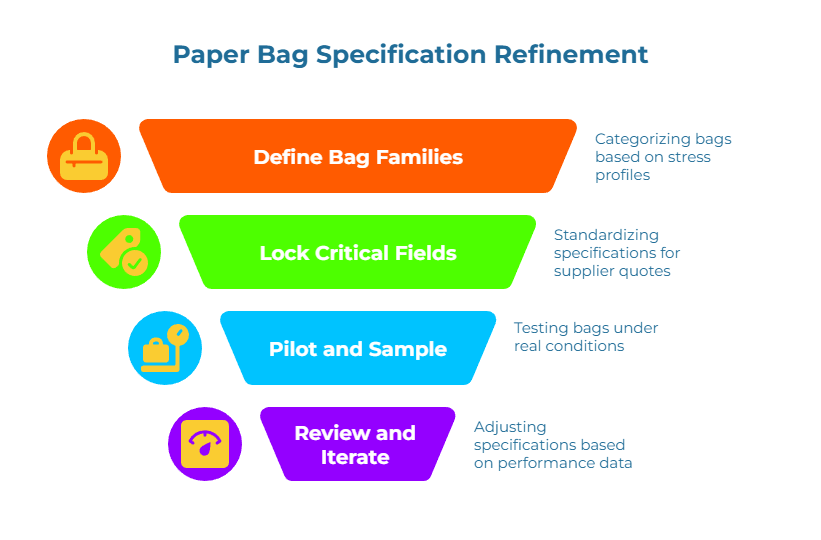
Finding the right spec is a discipline, not a guess. The process starts by naming the use-case stressors the bag must survive, translating those into a small number of bag families, locking the quote-critical fields, piloting before volume commitment, and then reviewing real-world performance to tune assumptions over time.
Name the use-case stressors. Write the stress profile in plain language: weight range, point loads (bottles, jars, corners), moisture exposure, handling steps from warehouse to delivery, transit distance, stacking, and expected return or refund rates. These are the facts the spec must address—typical and maximum loads, point-load risk, handling intensity, moisture exposure, and what unacceptable failure means in the customer journey.
Translate into bag families. Instead of trying to design one bag for every scenario, define a small set of families—for example: Light/Dry/Short-haul, Medium/Mixed, Heavy/Point-load, and Moisture-exposed. Each family has its own spec sheet.
Lock quote-critical fields. For each family, freeze the fields so suppliers price the same target. Document dimensions and gusset format, ply or GSM range with tolerances, handle type and attachment method, reinforcements, print coverage and finish, coatings or liners only when required, and key QA checks (burst, seam strength, moisture resistance if relevant). Suppliers can then quote apples-to-apples.
Pilot and sample. Before committing to volume, request pre-production samples. Run a small pilot order under real conditions. Basic acceptance checks—visual inspection, simple drop tests, moisture exposure if relevant—reveal gaps before they become field failures. Align acceptance criteria so quality is measurable and disputes are less likely. ISO 2859-1 provides a common reference for attribute-based sampling logic: ISO 2859-1 sampling procedures for inspection by attributes. Paper testing can vary with atmosphere and conditioning; ISO 187 provides the reference framework: ISO 187 standard atmosphere for conditioning and testing paper.
Review and iterate. Capture failure patterns and cost data. If failures cluster at a specific point, strengthen that element—not the entire bag. If no failures occur across thousands of orders, consider whether the spec can be trimmed without increasing risk. For ongoing quality monitoring, implement a verification methodology for brand consistency.
Because spec-related failures often occur at the transfer of risk, cross-reference your specs with Incoterms® 2020 (e.g., DAP vs. DPU) to determine the exact point where environmental exposure becomes the buyer’s liability. A practical trust control for verification programs is understanding how accredited test results are recognized across borders. ILAC’s overview of the mutual recognition arrangement and signatories is a useful reference: ILAC MRA and signatories.
A grocery delivery service notices handle pull-out failures on orders containing bottled beverages. Rather than upgrading all bags, they create a separate Heavy/Point-load family with reinforced handle attachment and a gusseted base. Orders without point loads continue to use a lighter, less expensive bag family. The solution addresses the actual stressor without inflating costs across the entire operation. This approach of matching bag specifications to use cases demonstrates the value of segmentation.
Why This Matters for Wholesale Paper Bag Sourcing
When specifications are clear and tied to real use-case stressors, supplier comparisons become straightforward. Quotes arrive in comparable formats. Disputes about what was promised drop. Lead times stabilize because suppliers can plan production without late-stage revisions. Wholesale paper bag sourcing becomes defensible when the same inputs—specs and terms—produce comparable outputs: quotes and performance. Under-spec drives churn and recurring disputes because the use case was never specified clearly. Over-spec narrows the supplier pool and increases dependency risk through MOQ and lead-time pressure.
For a detailed breakdown of how requirements shape supplier selection, see from specs to sourcing: how requirements drive supplier selection.
Conversely, mis-specification creates friction. Vague specs invite wide quote variance. Post-award disputes multiply. Emergency orders become common as teams scramble to fix field failures with rush shipments. Over time, supplier relationships erode because neither side can rely on stable, repeatable specs. Total landed cost rises—not because prices are high, but because hidden costs (re-deliveries, rework, freight exceptions) accumulate.
Appropriate Strength Beats Maximum Strength
Under-spec creates visible failures. Over-spec creates silent waste. Neither is a quality decision—both are trade-offs that can be managed once teams stop treating spec choices as intuition or politics and start treating them as documented, measurable decisions.
The right spec is the one that matches real stressors—weight, moisture, handling, transit, returns—and is documented well enough to quote, repeat, and improve over time. Spec reviews should be framed not as buy stronger or cut costs, but as optimizing the balance between cost, reliability, and brand promise. Appropriate strength is the balanced position. Define the stress profile, freeze quote-critical fields, pilot, and use measurable acceptance criteria. The result is a predictable program that scales without constant renegotiation.
Ready to compare options? Browse paper bag suppliers on PaperIndex to start building your shortlist.
Disclaimer:
This article is provided for general educational purposes.
Our Editorial Process:
Our expert team uses AI tools to help organize and structure our initial drafts. Every piece is then extensively rewritten, fact-checked, and enriched with first-hand insights and experiences by expert humans on our Insights Team to ensure accuracy and clarity.
About the PaperIndex Insights Team:
The PaperIndex Insights Team is our dedicated engine for synthesizing complex topics into clear, helpful guides. While our content is thoroughly reviewed for clarity and accuracy, it is for informational purposes and should not replace professional advice.