

📌 Key Takeaways
A polished sample and low quote don’t prove a supplier can deliver consistent toilet tissue parent rolls—only structured, multi-layer verification does.
- Cheap Quotes Hide Costly Risks: An attractive price often reflects mismatched specifications, weaker materials, or a supplier who can’t sustain quality across shipments.
- Five Checks Beat One Good Sample: Digital signals, live calls, manual data review, government registry matching, and document checks work together to catch hidden problems.
- Registry Records Prove Legal Reality: Confirming a supplier’s name, status, and address against official government databases protects contracts and audit trails.
- Verification and Quality Go Together: Suppliers who pass rigorous checks usually have the systems to deliver stable GSM, moisture, and bulk—batch after batch.
- Make the Process Mandatory: Applying all five verification layers to every new supplier prevents shortcuts that cause line stoppages and private-label failures.
Verified suppliers = stable converting lines and defensible contracts.
Procurement managers and QA leads qualifying overseas toilet tissue parent roll vendors will gain a ready-to-use screening framework here, preparing them for the detailed verification blueprint that follows.
~ ~ ~ ~ ~ ~ ~ ~ ~ ~ ~ ~ ~ ~ ~ ~ ~ ~
The specification sheet says 18.5 GSM. The mill’s test report says it is compliant. The supplier’s website looks professional, the sales representative responds within hours, and the FOB quote undercuts the current vendor by 8%. None of these facts answer the question that actually matters: is this prospective vendor operationally real, legally traceable, and safe to trust with a private-label contract?
A good visual sample and a cheap quote are not enough to qualify an overseas toilet tissue parent roll supplier. This misconception persists because the signals it relies on—sample appearance, price competitiveness, communication responsiveness—do not correlate with a supplier’s ability to deliver consistent parent rolls across multiple shipments. The gap between “appears legitimate” and “verified to enterprise standards” represents the primary point of failure in private-label supply chains.
For toilet tissue converters managing high-speed lines and retailer commitments, advanced risk mitigation does not begin with samples or price comparisons. It begins with a multi-layer verification blueprint—a rigorous process designed to authenticate the operational legitimacy and technical capability of overseas toilet tissue parent roll manufacturers before they are trusted with critical supply. This article presents that blueprint as a governance-ready framework that procurement leaders can adapt into internal policy, connecting each verification layer to the operational realities of toilet tissue converting and private-label supply continuity.
The Necessity of Granular Verification Standards
The traditional supplier qualification model—collect a sample, review a specification sheet, negotiate a price—was designed for stable, localized supply chains where buyers and sellers operated within shared legal jurisdictions and reputational networks. Cross-border toilet tissue parent roll procurement operates under fundamentally different conditions.
Production environments at toilet tissue converting plants cannot absorb downtime. When cost pressure rises, teams may rush supplier qualification to meet sourcing deadlines. A common false fix is switching suppliers based on the lowest FOB quote, while ignoring root causes in verification and technical alignment. This pattern repeats because surface-level checks filter out only the most obvious non-starters—they cannot detect the deeper legitimacy and capability gaps that cause port-arrival failures, batch rejections, and private-label contract breaches.
Toilet tissue converters sourcing internationally face three core pain points that basic directory checks cannot address. First, visual samples and incomplete technical verification create port-arrival and line-side failures that halt converting schedules. Second, global supplier quotes become impossible to compare when specifications, Incoterms® 2020, and quality proof are misaligned across vendors. Third, unverified overseas suppliers threaten private-label contract continuity—and the secondary reputational risks associated with supplier-induced downtime.
The verification standard for cross-border toilet tissue parent roll suppliers must therefore operate at a depth that matches the operational exposure. The goal is not simply to find suppliers; it is to guarantee near-zero-defect tolerance for private-label toilet tissue supply and to build a defensible process that withstands scrutiny from QA, operations, and leadership.
The 5-Layer Verification Blueprint for Cross-Border Toilet Tissue Suppliers
Structured verification works because it forces systematic coverage of risk dimensions that ad-hoc qualification misses. The following five-layer blueprint sequences checks from automated early filters through manual, deep-dive validation, ensuring that procurement resources concentrate on high-capacity manufacturers who have already cleared foundational legitimacy tests.
This approach reflects the principle of risk-based due diligence established in frameworks like the OECD Due Diligence Guidance for Responsible Business Conduct — applying verification intensity proportional to supply chain risk.
The Digital Signal Layer
The first verification layer uses digital signals to flag abnormal supplier patterns before human review begins. Technology-based checks examine whether the supplier’s online presence—IP address patterns, website registration data, commercial digital footprint—aligns with the profile of a legitimate toilet tissue manufacturing or trading operation.
Inconsistencies at this layer warrant immediate scrutiny. A supplier claiming manufacturing capacity in one country while operating digital infrastructure from an unrelated jurisdiction raises questions. Listing patterns that suggest bulk profile creation rather than organic business development suggest potential misrepresentation. Within this specific procurement category, these signals also identify specification inconsistencies—suppliers listing GSM ranges, moisture tolerances, or reel dimensions that don’t align with standard converting requirements.
While isolated signals do not confirm fraud, they filter the supplier pool efficiently. The value lies in catching abnormal patterns early, before procurement invests evaluation time in suppliers whose digital footprint doesn’t support their stated identity.
Communication Authentication
Phone verification tests whether the supplier maintains functional business communication infrastructure. A live confirmation call—reaching an actual representative who can discuss the company’s toilet tissue parent roll production or supply capabilities—establishes that the listed contact information connects to a real operation.
This layer catches suppliers who list disconnected numbers, route calls to unrelated parties, or operate without staff who can speak to product specifications. Some verification systems use a “Phone Verified” designation to indicate that this check has been completed, providing an early trust signal before deeper qualification begins.
For toilet tissue converters, the phone verification call can also serve as a technical screening opportunity. Does the representative understand GSM tolerances? Can they discuss moisture testing methods and reel packaging standards? A supplier who cannot address basic toilet tissue parent roll specifications during initial contact may lack the technical depth to support a converting operation.
The operational value of phone verification lies in what it actually tests—responsiveness, consistency, and basic commercial reality—not in the symbolic reassurance of a verification badge. Treating any single check as a proxy for broader credibility inverts the purpose of systematic screening. Phone verification should precede deeper qualification steps, but it earns its place by reducing the chance that procurement advances a supplier file built on weak contact integrity, not by conferring trust prematurely.
Structural Data Validation
Automated checks and phone verification establish baseline legitimacy, but supplier qualification for toilet tissue parent rolls requires manual review of company data for consistency and completeness. This layer examines whether the supplier’s stated capabilities, documentation, and operational profile form a coherent picture.
Manual review for toilet tissue suppliers should assess several dimensions. Does the company’s stated production capacity align with facility descriptions and equipment lists? Do specification sheets for toilet tissue parent rolls include complete technical parameters — GSM, moisture content, bulk, tensile strength, absorbency—with named test methods such as ISO 287 standards for moisture lot determination? Does the supplier’s export history, where verifiable, suggest consistent shipment activity?
Inconsistencies uncovered during manual review may not disqualify a supplier outright, but they create documentation gaps requiring resolution before approval. A toilet tissue supplier whose specification sheets lack moisture tolerance bands or fail to reference recognized test methods may simply have incomplete documentation—or may lack the quality control systems that meaningful tolerances require. Manual review surfaces these gaps for procurement to address before trial orders begin.
Statutory Registry Verification
Registry cross-referencing represents the most defensible verification layer for cross-border toilet tissue parent roll suppliers. This step confirms that the supplier’s legal identity—company name, registration number, registered address, and authorized representatives—matches official government business records in the supplier’s jurisdiction.
The distinction between “appears real” and “registry-confirmed real” matters operationally. A toilet tissue supplier whose listed company name doesn’t match registry records, whose registration status shows inactive or suspended, or whose registered address conflicts with stated business locations presents verification failures that basic checks miss entirely. These failures create legal and operational risks: contracts with misidentified entities may be unenforceable, and suppliers operating outside formal registration may lack the stability to honor multi-shipment commitments.
For toilet tissue converters with private-label exposure, registry cross-referencing provides documentation that procurement decisions followed due diligence standards. If a supplier later fails to deliver or delivers non-conforming parent rolls, verified registry documentation demonstrates that qualification followed a defensible process—critical protection when facing executive scrutiny after a supply disruption.
Document Authentication Standards
The final verification layer examines supplier-provided documentation for authenticity and completeness. This may include company registration certificates, export licenses, quality management certifications, and—where verification protocols require it—personal identification for authorized company representatives.
For toilet tissue raw material suppliers, document review should specifically verify quality-relevant certifications. ISO 9001 certification for quality management systems, where claimed, should be verifiable against issuing body records. Production certifications for specific toilet tissue grades should align with facility capabilities established during earlier verification layers.
Document review also catches misrepresentation patterns. Certificates with inconsistent formatting, expired validity dates, or issuing bodies that don’t appear in accreditation databases warrant escalation. For converters whose private-label contracts require supplier quality documentation, these verification failures directly impact contract compliance and audit readiness.
Where a Toilet Tissue Supplier Can Still Look ‘Good’ While Remaining High Risk
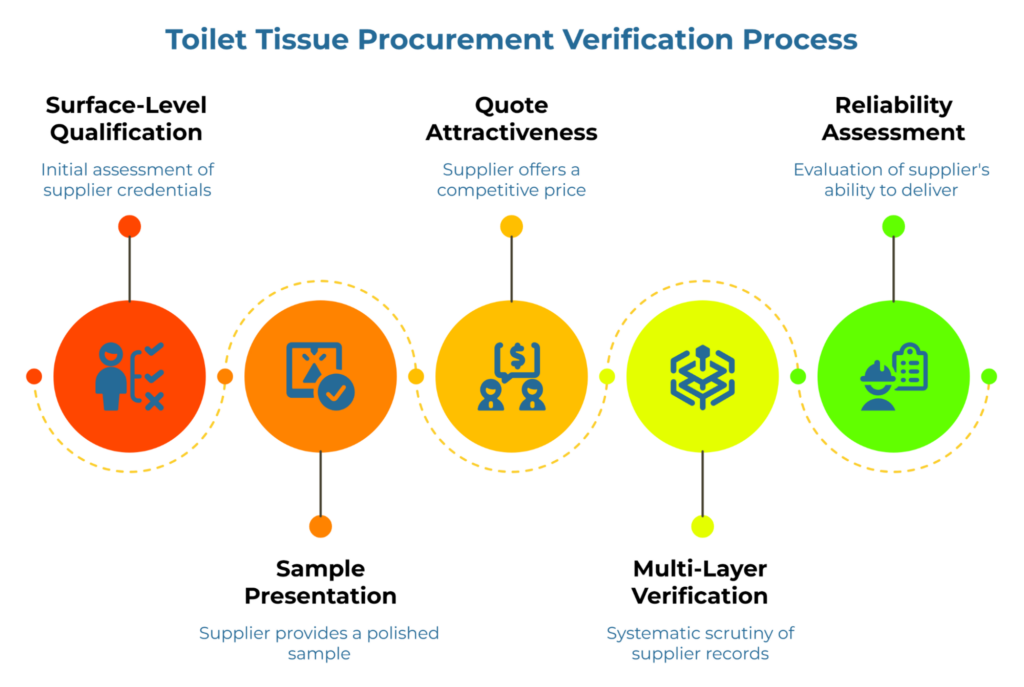
Surface-level qualification creates false confidence because the signals it measures don’t predict a supplier’s ability to deliver consistent toilet tissue parent rolls across multiple shipments. Understanding where false positives occur helps procurement teams recognize verification gaps before they become operational failures.
A toilet tissue supplier can present a polished sample representing ideal production conditions rather than typical output. The sample may originate from a different facility than future shipments. GSM, bulk, and moisture values may reflect cherry-picked rolls rather than production-run averages. Visual inspection—and even basic lab testing of a single sample—cannot predict batch-to-batch variation from a supplier lacking robust process control. The risks of visual samples in toilet tissue procurement are well-documented: rolls that look acceptable can still cause line jams when moisture, bulk, or GSM varies beyond converting-line tolerances.
Quote attractiveness creates similar blind spots. An FOB price undercutting alternatives may reflect different specification assumptions, lower-grade raw materials, or a supplier willing to quote aggressively to secure an initial order without operational capacity for sustained fulfillment. When specifications, Incoterms, and quality proof differ between quotes, price comparisons become misleading—the lowest number may represent the highest risk.
Think of multi-layer verification as a mine detector sweeping the ground before each step forward. The surface may look clear—the supplier’s website appears professional, the sample arrived on time, the quote fits the budget—but hidden beneath that clean presentation may sit verification failures that only systematic scrutiny reveals. A supplier whose government registry records show a different company name than their marketing materials, or whose specification sheets lack the moisture-content test methods that toilet tissue converting requires, represents exactly this kind of concealed risk.
The operational lesson is direct: supplier attractiveness and supplier reliability are separate questions. Multi-layer verification answers the reliability question before procurement commits resources to negotiation and trial orders.
How Verification Supports Moisture, GSM, and Runnability Control
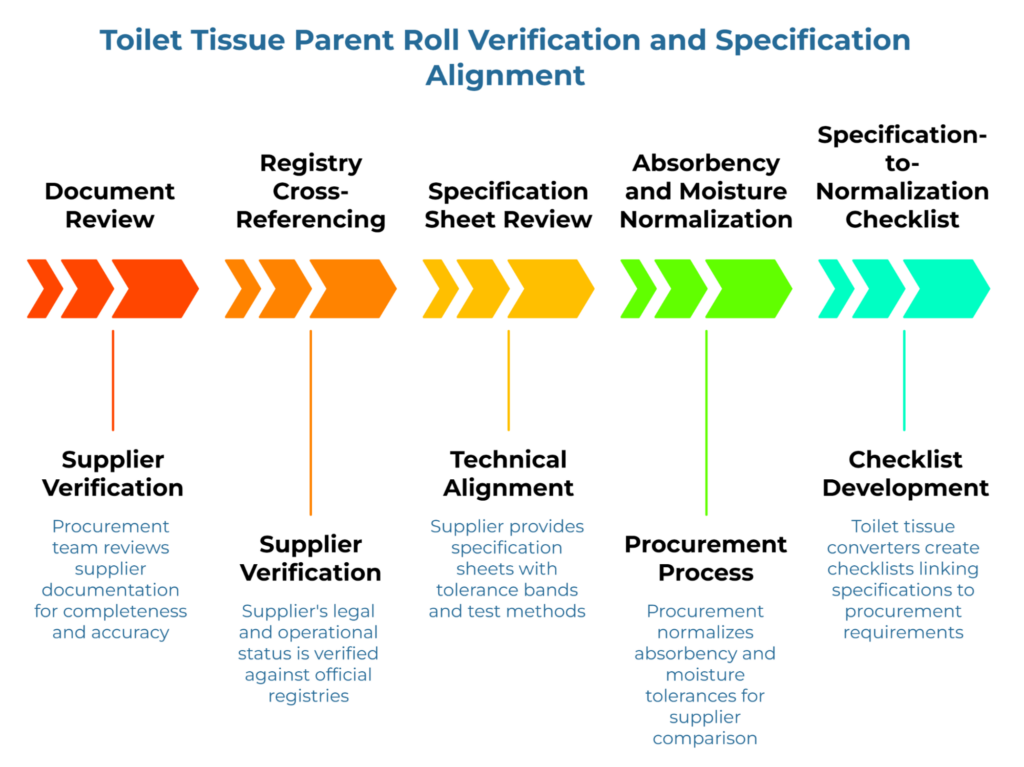
Supplier verification and technical specification alignment are not separate concerns—they reinforce each other. A legally verified supplier with complete documentation typically maintains the quality systems that produce consistent toilet tissue parent rolls. A supplier whose verification fails at document review or registry cross-referencing often lacks the operational discipline that stable GSM, moisture, and bulk values require.
Toilet tissue converting lines depend on parent rolls meeting tight specification windows. GSM variation beyond stated tolerances affects finished product weight and sheet count. Moisture content outside acceptable bands—whether too high or too low—creates runnability problems that visual inspection cannot predict: web breaks, tension inconsistencies, embossing failures. Bulk variation affects finished-roll diameter and converting-line calibration. These technical parameters determine whether a parent roll runs smoothly at production speed or causes the line stoppages that disrupt schedules and erode margins.
Suppliers who pass multi-layer verification typically provide specification sheets including tolerance bands for these parameters, reference specific test methods (ISO 287 for moisture content, ISO 536 for grammage), and can discuss testing frequency and process controls. This documentation depth correlates with the operational systems that actually produce consistent toilet tissue parent rolls.
The connection works in reverse as well. When procurement applies absorbency and moisture tolerance normalization before comparing suppliers, the process naturally filters toward vendors whose verification credentials support their technical claims. A supplier cannot provide meaningful moisture tolerances without the testing infrastructure that verification surfaces.
For toilet tissue converters building specification-to-normalization checklists, multi-layer verification provides the supplier-side foundation. Normalized specifications create value only when sourced from suppliers whose legitimacy and operational depth can sustain stated quality commitments across shipments.
Audit Framework Implementation: Before the Next Overseas Supplier Is Cleared
A strong verification framework should end as a tool, not just an idea. Translating the five-layer verification blueprint into an internal approval scorecard creates a governance-ready instrument for qualifying cross-border bulk tissue vendors. The scorecard format ensures consistent evaluation criteria across all vendor assessments, documents verification decisions for audit purposes, and creates escalation triggers when suppliers fail specific layers.
A practical scorecard for toilet tissue supplier verification—designed to be printable and directly usable by procurement and QA teams—should address each layer with clear pass/fail or scored criteria:
Technology Signal Assessment
- Digital presence consistency: Does the supplier’s stated location align with IP infrastructure and website registration?
- Listing behavior: Does the pattern suggest legitimate business activity or bulk profile creation?
- Specification plausibility: Are claimed GSM ranges, moisture tolerances, and reel dimensions consistent with toilet tissue parent roll standards?
Assessment Benchmarks: The digital footprint and technical claims must present a coherent, plausible operational profile.
Live Communication Verification
- Phone confirmation: Did contact reach a representative at the stated business location?
- Technical competence: Could the representative discuss toilet tissue parent roll specifications, including GSM ranges, moisture tolerances, and standard reel dimensions?
- Response documentation: Is the verification call logged with date, contact name, and summary?
Verification Benchmarks: Direct contact must confirm technical competency and commercial legitimacy.
Company Data Consistency Review
- Capability alignment: Do stated production capabilities match facility documentation and equipment descriptions?
- Specification completeness: Do specification sheets include complete technical parameters with named test methods?
- Export history credibility: Does available shipment history suggest consistent activity to verifiable buyers?
Hold if: The file contains naming inconsistencies, thin records, or unexplained documentation gaps.
Government Registry Validation
- Legal identity match: Does the company name match official government business records exactly?
- Registration status: Is the registration active and in good standing?
- Address consistency: Do registered addresses align with stated business and facility locations?
Remediation Protocols: The supplier appears commercially plausible but legal identity cannot be cross-referenced cleanly.
Document Authenticity Assessment
- Certification verification: Are claimed certifications (ISO 9001, production certifications) verifiable against issuing body records?
- Document validity: Do registration certificates show current validity dates and consistent formatting?
- Quality documentation alignment: Does quality documentation support claimed production capabilities?
Do not clear if: The supplier cannot provide verifiable documentation that supports a serious business relationship.
Escalation Triggers
- Does the file contain any warning signs that should stop approval until leadership, QA, or cross-functional review is involved?
- Examples: unresolved legal-identity questions, incomplete proof, weak technical clarity, or commercial urgency pushing the file past control gates.
Each section should include clear escalation protocols. A supplier who fails registry cross-referencing should not proceed to trial orders regardless of sample quality or quote competitiveness. A supplier with incomplete specification documentation requires gap resolution before approval advances. Documented escalation triggers protect procurement from pressure to approve toilet tissue suppliers who present well but fail verification fundamentals.
The scorecard also creates audit trail documentation. For converters whose private-label relationships require supplier qualification evidence, a completed verification scorecard demonstrates that approval followed a systematic, defensible process—precisely the documentation needed when QA, operations, or leadership reviews sourcing decisions.
Strategic Mandate: Universal Application of Verification Standards
The verification blueprint delivers value only when applied consistently. A policy that permits shortcut qualification for “urgent” sourcing needs or “trusted referrals” reintroduces exactly the risks the blueprint eliminates.
Future-proofing cross-border toilet tissue parent roll procurement means establishing multi-layer verification as a mandatory standard—applied to every new overseas supplier before approval, regardless of referral source, quote urgency, or sample impressiveness. The rule should be simple: no toilet tissue parent roll supplier earns approved-vendor status without completing all five verification layers.
This policy stance protects against several common failure patterns. Suppliers referred by existing contacts may carry reputational assumptions that don’t survive registry cross-referencing. Urgent sourcing requirements create pressure to compress qualification timelines, but the converting-line failures caused by inadequately verified suppliers cost more time than thorough verification requires. Sample-first qualification inverts the correct sequence, investing evaluation effort in suppliers whose basic legitimacy remains untested.
The deeper benefit is supply chain sovereignty. Converting schedules stabilize when the approved supplier base consists entirely of toilet tissue parent roll vendors who have passed rigorous, multi-layer verification. Each shipment from a verified supplier carries lower risk of the specification drift, documentation gaps, and supply interruptions that unverified suppliers introduce. Private-label contracts become defensible because the qualification process behind each supplier can withstand scrutiny.
Mandatory verification also positions toilet tissue converters for evolving supply chain due diligence expectations. Retailer requirements for supplier documentation, sustainability certifications, and chain-of-custody verification continue to intensify. Converters who have already built systematic verification into procurement processes adapt to new requirements more readily than those still operating on ad-hoc qualification.
The future intent is clear: implement mandatory multi-layer vetting rules for all future toilet tissue parent roll sourcing, treating verification not as a one-time check but as an ongoing governance standard that protects operational continuity and contractual survival.
Look for toilet tissue parent roll suppliers only after the verification standard, documentation rules, and technical-alignment gates have been defined internally.
For toilet tissue converters ready to build verification-first sourcing processes, the PaperIndex Academy provides additional methodology guides covering specification normalization, moisture-tolerance alignment, and cross-border trade-term standardization. Those prepared to apply verification standards to active supplier evaluation can explore the directory of toilet tissue parent roll suppliers as a starting point for qualified-supplier discovery.
Disclaimer:
This article is for general educational purposes only.
Our Editorial Process:
Our expert team uses AI tools to help organize and structure our initial drafts. Every piece is then extensively rewritten, fact-checked, and enriched with first-hand insights and experiences by expert humans on our Insights Team to ensure accuracy and clarity.
About the PaperIndex Insights Team:
The PaperIndex Insights Team is our dedicated engine for synthesizing complex topics into clear, helpful guides. While our content is thoroughly reviewed for clarity and accuracy, it is for informational purposes and should not replace professional advice.