
📌 Key Takeaways
Kraft paper packaging holds up only when the grade matches the job, the storage, and the handling, not just the price.
- Application Drives the Spec: Start with what the packaging must do i.e, carry, wrap, protect, print and then find a grade that fits, not the other way around.
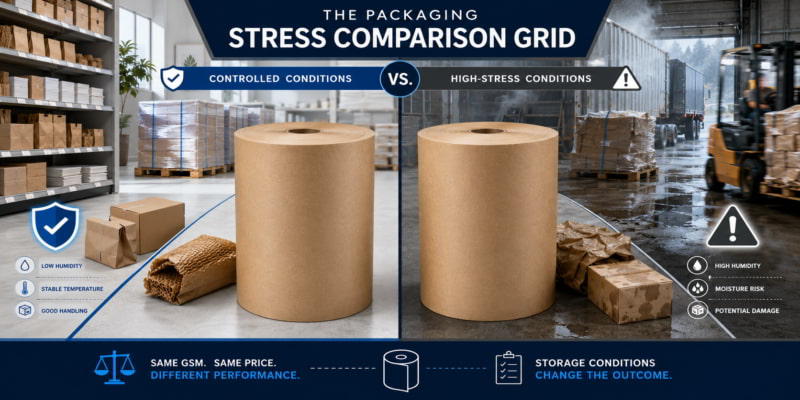
- GSM Alone Misleads: Two papers at the same weight can perform very differently under humidity, compression, or rough handling because GSM measures mass, not strength.
- Storage Conditions Change Everything: Paper absorbs moisture from its surroundings, so a grade that works in a dry warehouse may weaken after weeks in a humid port or shipping container.
- Food-Contact Compliance Isn’t Automatic: Looking like food-safe paper doesn’t make it food-safe — buyers need supplier documents proving the grade meets the rules for their specific market.
- Supplier Documentation Closes the Gap: Requesting test data, certificates, and trial samples before ordering prevents specification mismatches that only show up after a full production run ships.
Match the paper to the job first, then compare prices — not the other way around.
Procurement teams and packaging buyers sourcing kraft paper for specific applications will sharpen their supplier conversations here, preparing them for the detailed grade-selection framework that follows.
~ ~ ~ ~ ~ ~ ~ ~ ~ ~ ~ ~ ~ ~ ~ ~ ~ ~
Same GSM. Similar price. Two kraft paper rolls sitting side by side in a supplier’s warehouse, looking nearly identical on the quote sheet. One is headed for retail bags that spend a few weeks on a shop shelf. The other will wrap industrial components stored in a humid port warehouse for six months before shipping overseas.
Will the cheaper option actually hold up?
That uncertainty — the gap between what a spec sheet promises and what a packaging application demands — is where procurement mistakes compound. Under-specify, and the packaging fails in storage. Over-specify, and the budget absorbs unnecessary cost while operations and warehousing teams deal with material that doesn’t match the job.
Kraft paper grade, packaging use, and shelf-life expectations are three variables that should be evaluated together before comparing quotes. Grade and intended use can influence shelf-life decisions because packaging performance depends on the match between paper properties and the product’s handling, storage, and protection requirements. The framework below connects them to drive more precise supplier inquiries, though it does not replace formal material testing.
Start With the Application, Not the Paper Grade
Most procurement conversations begin with grade names, GSM figures, or pricing. That sequence is backwards. The packaging application — what the paper must actually do — should drive the specification.
Consider the range of jobs kraft paper performs: carrying weight in retail bags, wrapping products against dust and abrasion, cushioning goods during transit, lining packages, separating layers, or providing a printable surface for branding. Each job places different demands on tear resistance, stiffness, moisture tolerance, and surface quality. Shelf-life planning should reflect those demands rather than treating durability as a fixed number attached to a grade name.
This is also where incomplete specifications create conflict. Procurement may be asked to reduce cost, quality may ask for tighter controls, and operations may want a paper that runs cleanly on existing equipment. None of those priorities is wrong. The problem starts when the RFQ does not say which priority matters most for the application. The buyer sees the quote. The production team sees runnability. The warehouse sees storage damage. The customer sees the final package. Leading with the application forces alignment across those perspectives before the purchase order is released.
When procurement teams lead with the application, they frame supplier conversations around fit instead of price alone. A kraft paper grade that runs well for dry retail bags may underperform when wrapping moisture-sensitive components in a coastal warehouse. The application tells you what to specify. The grade tells you whether a particular paper can deliver it.
What “Shelf Life” Means for Kraft Paper Packaging
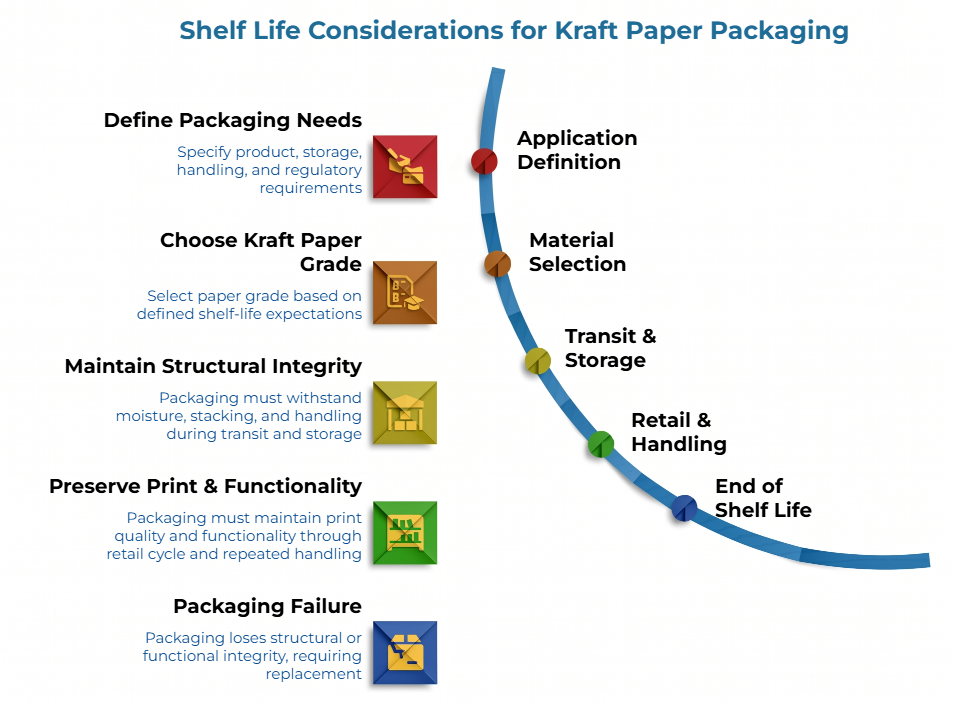
Shelf-life expectation, in a packaging context, refers to the period during which the packaging material itself must remain structurally and functionally sound for its intended use — not the expiration date of the product inside.
This distinction matters more than most buyers expect. While product viability governs internal expiration, packaging storage endurance dictates physical containment. If an un-coated sheet undergoes moisture-induced fiber relaxation during transit, the structural envelope collapses regardless of internal product stability.
Packaging may need to maintain shape under stacking weight, resist moisture vapour, hold print quality through a retail cycle, or survive repeated handling across a supply chain. A barrier requirement — any need to slow or reduce exposure to moisture, grease, oil, dust, odour, or other conditions that could affect the product or the package — should be defined from the application, not assumed from a grade name alone.
Defining shelf-life expectations means specifying what the packaging must withstand — duration, environmental exposure, handling intensity, and regulatory requirements — before selecting a grade. The sharper question is not “How long does this kraft paper last?” but rather: “For this product, storage route, handling process, and packaging role, what grade and documentation should support the specification?” That framing keeps the discussion practical and avoids unsupported promises about exact shelf-life duration.
How Kraft Paper Grade Can Influence Packaging Performance
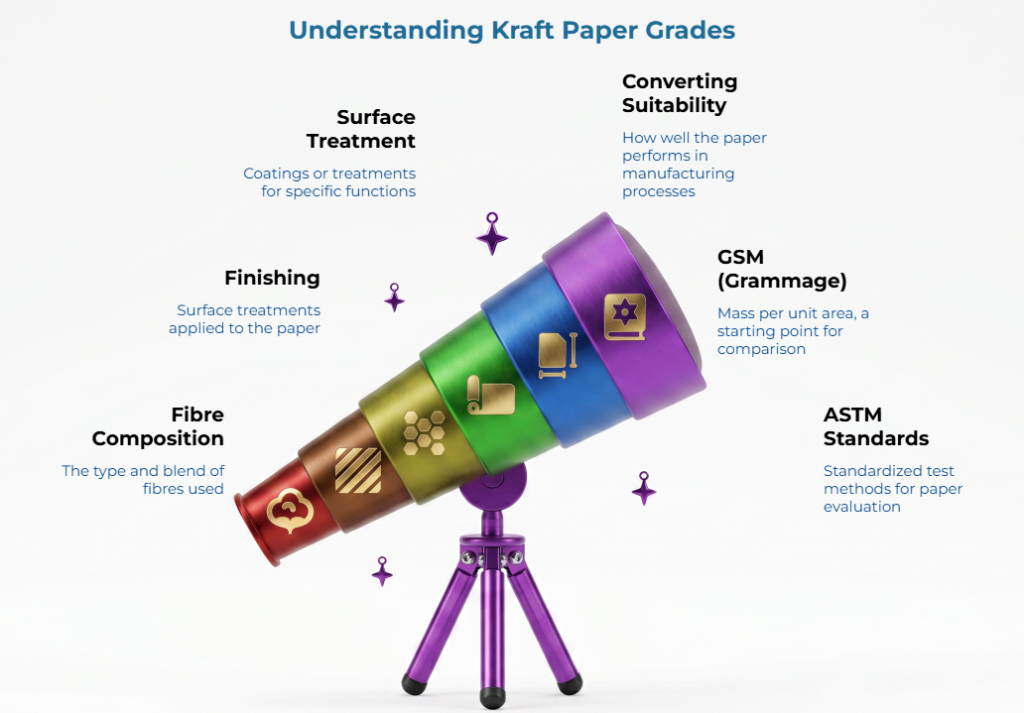
A grade is not a single property. It reflects a cluster of material characteristics — fibre composition, finishing, surface treatment, and converting suitability — that collectively shape how paper performs under real packaging conditions. Understanding what “grade” means in practice is essential for comparing kraft paper parent roll offers beyond the quote sheet.
GSM (grams per square metre) measures mass per unit area, formally referred to as grammage (ISO 536). It is a useful starting point, but two papers at the same GSM from different grade families can behave very differently under compression, humidity, or abrasion. GSM says nothing about burst strength, tear resistance, or moisture response over time. ASTM International provides standardised test methods for evaluating physical, mechanical, and chemical properties of paper and paperboard used in packaging, which is why specification work should go beyond labels and price lines. Relying on GSM alone is one of the most common procurement oversimplifications — a point explored in more detail in this guide to parent roll buying criteria beyond GSM.
Virgin kraft paper tends to offer longer fibre length, which may contribute to higher tensile and tear resistance. Recycled kraft paper can be a practical choice for less demanding applications, though its strength profile may differ — a distinction explored further in this guide to choosing between virgin and recycled kraft paper for paper bag durability. While coated grades may provide improved moisture or grease resistance depending on the coating type, uncoated grades may offer better breathability, printability, or converting flexibility. These are broad categories, not shortcuts — the choice depends on the specific exposure conditions of the application, not on a blanket assumption that one type is always superior.
Moisture deserves particular attention. TAPPI’s moisture-content test method (TAPPI T 412) notes that moisture content can affect a paper’s printability, dimensional stability, shrinkage behaviour, and physical strength. For packaging shipped across climate zones, understanding how a specific grade responds to moisture exposure is a practical specification concern — not only a warehouse housekeeping issue.
Match Grade to Intended Use: Common Packaging Scenarios
The table below connects common packaging applications to the procurement considerations they create. These are illustrative examples, not product-specific recommendations. Actual suitability depends on the grade, supplier documentation, and testing.
| Packaging Use | What the Buyer Should Consider | Supplier Question to Ask |
| Dry product wrapping | Product weight, tear resistance, storage duration, handling frequency | Which grade and GSM fit this product weight and expected storage route? |
| Retail carry bags | Load-bearing strength, printability, surface finish, handle attachment | What performance data supports this grade for the expected carry loads and bag format? |
| Food-adjacent packaging | Food-contact regulatory status, grease or moisture exposure, coatings, inks, jurisdiction | What documentation supports the intended food-contact type and region? |
| Industrial wrapping | Abrasion resistance, puncture tolerance, pallet movement, transport stress | What test data supports this grade for the expected handling and transit conditions? |
| E-commerce void fill or wrapping | Compression resistance, courier handling, humidity during transit, packing speed | Is this grade suitable for the temperature and humidity conditions of the expected shipping route? |
Internal sourcing pages can help buyers identify relevant supply categories before contacting suppliers. Industry sourcing marketplaces such as PaperIndex currently list categories for kraft paper jumbo rolls, kraft paper producers, and food-grade kraft paper suppliers. These marketplaces support supplier discovery, not technical verification.
For food-adjacent or food-contact uses, suitability should not be assumed based on grade name or appearance. In the United States, the FDA regulates food-contact substances including paper and paperboard. As of May 2026, specific requirements for paper and paperboard components appear in 21 CFR Part 176, which must be met in conjunction with the general provisions and Good Manufacturing Practice (GMP) requirements outlined in 21 CFR Part 174. Buyers should verify food-contact requirements with the supplier and the relevant regulatory authority. Further reading is available in this guide to why generic bag paper may not be FDA compliant, and buyers sourcing for food-contact applications can explore food-grade kraft paper suppliers as a starting point for supplier discovery.
The Shelf-Life Factors Procurement Teams Should Clarify Before Buying
Rather than evaluating kraft paper in isolation, procurement teams should build specifications around the factors that define real-world performance. The decisions made here affect not just the purchasing team but also packaging, warehousing, logistics, and quality control downstream.
Product sensitivity. What is being packaged? A moisture-sensitive electronic component demands different protection than a stack of printed brochures. If the product can stain, soften, scuff, leak, or pick up contamination, the paper discussion should include barrier needs and handling exposure — particularly for food-adjacent uses, where understanding the difference between food grade and food safe determines whether the specification will hold up under inspection. The product’s vulnerability sets the baseline for what the packaging must do.
Storage environment. Temperature swings and humidity can affect paper properties over time. Paper stored in a clean, controlled warehouse faces different risk than paper staged near loading doors, damp floors, open pallets, or high-humidity zones. Storage after conversion matters too — a finished package may sit in a warehouse, shipping container, retail back room, or distribution centre before it reaches the final user. Communicating expected conditions to suppliers ensures the recommended grade accounts for real environmental exposure — not just laboratory performance. For more detail, see this guide to protecting kraft paper rolls from warehouse moisture risks.
Handling and transport. How many times will the packaged product be moved, stacked, and unloaded? Tear resistance, burst strength, and structural rigidity matter more for products passing through multiple handling stages. A wrap may look fine on a packing bench and fail after pallet movement, compression, vibration, strapping, or courier sorting. Procurement decisions made without consulting the logistics team can result in specifications that fail in the field — a pattern detailed in this guide to how to translate packaging failure risks into kraft paper durability requirements.
Exposure to moisture, oil, grease, or dust. Whenever the packaging will face direct liquid contact, high-humidity storage, oily product surfaces, or food-adjacent exposure, barrier properties become a specification priority. Not all kraft paper grades resist these elements equally, and the right barrier depends on the specific exposure type.
Regulatory or food-contact requirements. For packaging used in food, pharmaceutical, or other regulated contexts, compliance verification is not optional. ISO Technical Committee 6 supports international standardisation for paper, board, and pulps — including terminology, sampling procedures, test methods, and product specifications. Specifying test methods by name in supplier requests can help normalise the language across quotes.
Supplier testing and documentation. Requesting test data, certificates of analysis, and sample material is standard practice for performance-sensitive applications. Clear supplier documentation reduces the risk of specification mismatches that only surface after a full production run. A practical way to compare quotes is to put each supplier’s offer into the same columns: grade description, GSM, tolerance, relevant strength data, coating or treatment, moisture information if provided, intended application, sample availability, and compliance documents where applicable. If one column is blank for one supplier and detailed for another, the quotes are not yet comparable — and the gap may be the hidden difference that explains the price.
Procurement Checklist: Questions to Ask Before Finalising Kraft Paper Grade
When sharing these questions with a supplier, include as much application context as possible — suppliers recommend more suitable grades when they understand the packaging job, not just the desired price point. This checklist works as a buying filter: it helps procurement teams decide when a quote is ready for price comparison and when the supplier still needs to clarify application fit.
- What product will be packaged, and how sensitive is it to environmental or physical damage?
- What must the paper do — wrap, carry, line, separate, cushion, print, fold, or protect?
- How long must the packaging remain structurally and functionally sound?
- What are the expected storage conditions, including temperature range and humidity levels?
- Will the paper be exposed to moisture, grease, oil, dust, abrasion, puncture risk, or compression?
- What strength, print, folding, sealing, or converting requirements matter for the application?
- What physical stresses will the packaging face during handling, stacking, and transport?
- Is this a food-contact or regulatory-sensitive application? If so, which jurisdiction applies?
- Will the paper be printed, laminated, coated, or converted into a finished packaging product?
- What grade, GSM, tolerance range, and test data can the supplier provide for the intended application?
- Are samples or trial runs available before committing to a full order?
- What documentation — certificates of analysis, compliance statements, test reports — will accompany the order?
Common Mistakes That Lead to Poor Paper Fit
Buying only by price. The lowest-cost option may underperform in demanding applications. A packaging failure — damaged goods, customer complaints, repackaging labour — can cost far more than the price difference between grades. The real economics of when a cheaper kraft paper becomes more expensive surface at the converting line through machine downtime, or in the supply chain via elevated product spoilage rates.
Treating GSM as the only performance indicator. Grammage does not correlate linearly with mechanical endurance; premium thin virgin liners frequently exhibit superior burst indexes and puncture thresholds compared to heavy-gauge recycled alternatives. For a structured approach to evaluating specifications that go beyond GSM, see our parent roll buying criteria guide.
Assuming coating solves the problem. Coating choice depends on exposure, product type, converting process, printing needs, and compliance requirements. The wrong coating conversation creates as much confusion as no coating conversation. In some applications, a coating that addresses one exposure type may introduce converting or compliance complications that the original specification did not anticipate.
Ignoring storage humidity. Paper is hygroscopic — it absorbs and releases moisture depending on its environment. A grade that performs well in a dry warehouse may soften or lose strength in high-humidity conditions over weeks of storage.
Assuming all kraft paper is suitable for food use. Food-contact suitability depends on material composition, surface treatments, coatings, and the regulations of the target market. Verify compliance rather than assume it.
Skipping supplier documentation or sample testing. Accepting a grade without reviewing test data introduces risk. A paper sample that looks right on a desk may behave differently under stacking weight or after weeks in a humid warehouse. Trial runs under realistic conditions reveal gaps that specification sheets cannot.
When to Involve a Supplier or Testing Partner
Supplier input is especially valuable when the packaging application involves moisture exposure, food contact, export markets, heavy loads, extended storage, demanding print work, or high-speed conversion. These are the scenarios where grade selection has the greatest impact — and where assumptions carry the most risk.
Standardised test methods from ASTM International and TAPPI provide objective benchmarks, and many kraft paper manufacturers can supply test data for their grade offerings upon request. Before finalising an order, share your product type, packaging application, storage conditions, and expected shelf-life requirements with your supplier so they can recommend a suitable grade and documentation. For a structured way to frame that conversation, see our guide to the anatomy of a perfect kraft paper RFQ.
Kraft Paper Selection Starts With the Job, Not the Price Sheet
Even when two materials appear identical on a commercial bid, their molecular and structural performance diverges starkly once subjected to dynamic supply chain stresses. Grade, GSM, finish, and treatment all matter — but they matter in relation to what the packaging must do and how long it must do it.
Procurement teams that clarify the product, the environment, and the handling demands before comparing grades avoid the compounding cost of a specification mismatch. Supplier documentation, test data, and trial runs turn kraft paper procurement from a commodity purchase into a specification decision that holds up across the supply chain.
Application first. Grade second. Price last.
Frequently Asked Questions
Does kraft paper grade affect shelf life?
Grades can influence how well packaging performs over time, but shelf-life outcomes depend on multiple factors: the product being packaged, the storage environment, handling intensity, and the specific properties of the chosen grade. There is no universal shelf-life number for a given grade.
Is higher GSM always better for packaging shelf life?
Not necessarily. GSM measures paper weight, not overall durability. Tensile energy absorption (TEA) and cross-direction tear properties, rather than mass per unit area, dictate long-term integrity under load. Selecting a sheet based purely on thickness ignores foundational polymer and fibre-length dynamics.
Can kraft paper be used for food packaging?
Kraft paper may be used in some food packaging contexts, but food-contact suitability is not automatic. It depends on composition, coatings or treatments, and the regulations of the target market. In the United States, the FDA regulates food-contact packaging substances under 21 CFR Part 176. Verify compliance with qualified suppliers and the applicable regulatory authority.
What should procurement teams ask a supplier before ordering kraft paper for packaging?
Start with the application: what product, what storage conditions, what handling demands, and what regulatory requirements apply. Then ask the supplier to recommend a grade with supporting test data, certificates of analysis, and samples for trial runs. The procurement checklist earlier in this article provides a structured starting point, and you can submit an RFQ to receive quotes once your specification is ready.
What should a supplier receive before quoting?
Share the product type, intended use, expected storage period, handling route, exposure risks, printing or converting needs, compliance requirements, and minimum documentation expectations. Suppliers recommend more suitable grades when they understand the packaging job, not just the desired price point.
Disclaimer:
This article is for educational purposes only. Packaging suitability depends on the product, intended use, storage conditions, and applicable regulations. Confirm technical and compliance requirements with qualified suppliers, testing partners, or regulatory advisors before finalising specifications.
Our Editorial Process:
Our expert team uses AI tools to help organize and structure our initial drafts. Every piece is then extensively rewritten, fact-checked, and enriched with first-hand insights and experiences by expert humans on our Insights Team to ensure accuracy and clarity.
About the PaperIndex Insights Team:
The PaperIndex Insights Team is our dedicated engine for synthesizing complex topics into clear, helpful guides. While our content is thoroughly reviewed for clarity and accuracy, it is for informational purposes and should not replace professional advice.