

📌 Key Takeaways
Choosing between kraft paper rolls and sheets depends on what your warehouse can actually store, move, and protect — not just the unit price.
- Format Shapes Handling Risk: Rolls need special equipment, vertical storage, and trained staff, while sheets need stacking discipline and moisture control — each format creates different warehouse problems.
- Storage Conditions Beat Format Choice: A roll in a dry, stable warehouse outlasts sheets left near a humid loading dock — environment matters more than whether you buy rolls or sheets.
- Ask Suppliers for Specifics: General storage advice isn’t enough — request written, grade-specific guidance on temperature, humidity, wrapping, and shelf-life windows before you order.
- Match Format to Your Workflow: Rolls suit continuous, high-volume production lines; sheets suit manual packing and smaller batches — pick the one your operation actually runs.
- Align Procurement with Warehouse Reality: The best purchase decision fails if your warehouse team can’t store, move, or protect the format — loop them in before the order ships.
The right format is the one your team can handle without creating waste.
Packaging procurement managers and warehouse teams sourcing kraft paper will gain a practical framework for format decisions here, preparing them for the detailed comparison and buyer checklist that follows.
~ ~ ~ ~ ~ ~ ~ ~ ~ ~ ~ ~ ~ ~ ~ ~ ~ ~
Format choice shapes your warehouse.
The outer wrap on a kraft paper roll is torn at the edge. Two pallets over, a stack of sheets sits uncovered near the loading dock, corners curling where humidity crept in overnight. Both orders looked identical on the spec sheet — same grade, same weight, same supplier. But what if the format you chose creates problems your warehouse team has to solve long after the purchase order clears?
Comparing kraft paper rolls and sheets may seem straightforward, but it isn’t. Rolls and sheets differ in how they’re stored, moved, protected from moisture, and kept usable over time. The procurement manager signs the order, but warehouse staff live with the handling consequences every day — and when those two teams aren’t aligned on what “manageable” means, the mismatch shows up as damaged inventory, emergency reorders, and wasted time.
With the right questions answered before ordering, you can match the format to your warehouse conditions, your team’s handling capacity, and your real turnover rate — then defend that choice with operational reasoning, not just unit price.
Does Kraft Paper Format Affect Shelf Life?
Format alone doesn’t determine how long kraft paper stays usable. But it does influence how the paper is exposed to its environment and how vulnerable it is to damage that shortens usable life.
Shelf life — the period during which paper retains its intended properties for the target application — depends on the paper’s grade, protective wrapping, storage conditions (temperature, humidity, dust, sunlight), handling frequency, and whether any coating or treatment changes the paper’s sensitivity to moisture. “Usability over time” is the more useful working term here: paper may still exist in storage, yet no longer suit clean wrapping, smooth feeding, flat presentation, folding, printing, or customer-facing packaging. A roll stored in a climate-stable area with its original mill packaging intact faces very different risks than one leaned against a dock wall with torn wrapping. A shrink-wrapped sheet bundle on racking behaves differently from loose reams on the floor near a humid loading bay.
Industry standards like TAPPI T 402 define general conditioning and testing atmospheres for paper and board products — but TAPPI T 402 is a testing reference, not a blanket storage promise for a buyer’s warehouse. It should not be treated as product-specific shelf-life guidance. Manufacturer guidance from sources like Domtar reinforces the importance of stable temperature and humidity in storage areas, but neither replaces a supplier’s recommendations for a specific grade. Treat supplier documentation as the source of truth: if a supplier provides storage conditions, use windows, wrapping instructions, or handling limits for a specific grade, those instructions should govern the purchase, receiving checklist, and warehouse SOP.
How Rolls Change Storage and Handling Requirements
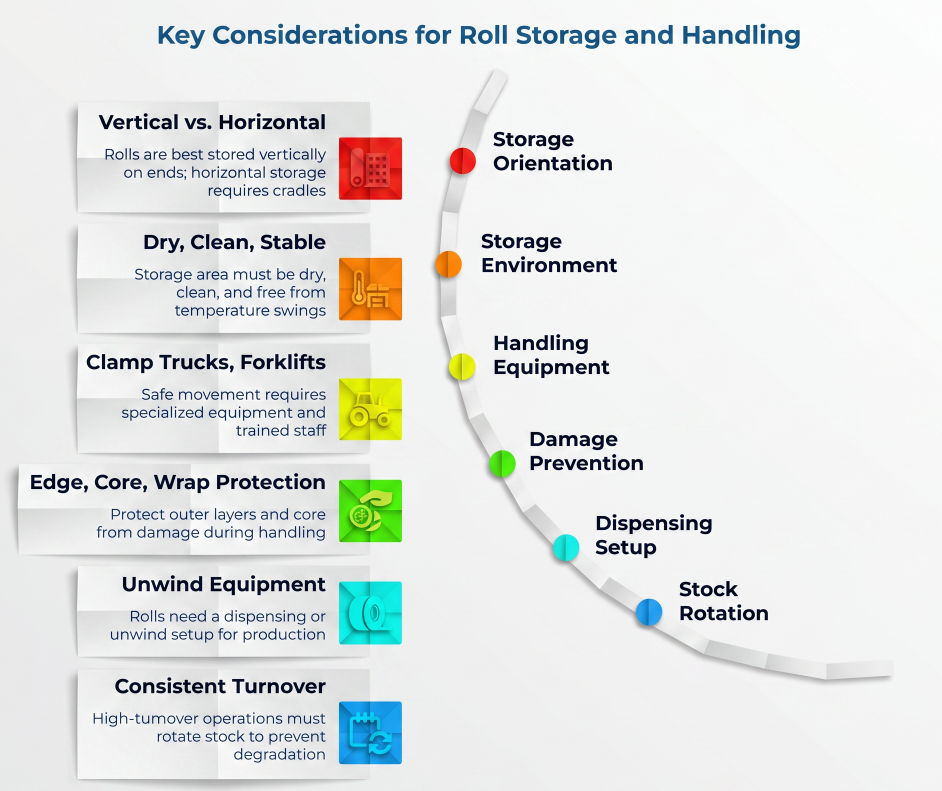
Rolls suit operations with continuous or high-volume usage patterns, where a single roll feeds a converting, wrapping, or dispensing line for an extended run. That efficiency comes with storage and handling requirements that shouldn’t be taken for granted.
Storage orientation matters. Rolls stored horizontally on their sides risk developing flat spots and out-of-roundness under their own weight. Rolls are generally best stored vertically on their ends on a clean, level surface; if horizontal storage is unavoidable, they require proper cradles or racking to protect the roll and prevent shifting. Either way, you need floor space or racking capacity to accommodate the roll diameter without crowding, and the storage area needs to be dry, clean, and free from temperature swings that cause condensation on the paper surface.
Moving rolls safely typically requires handling equipment — clamp trucks, roll cradles, or forklifts with roll-specific attachments. Without the right equipment or trained staff, every relocation risks edge damage, core crush, and wrap tears — damage types covered in detail in our guide to kraft paper parent roll handling. The outer layers are especially vulnerable; once protective wrapping is breached, those layers absorb moisture, collect dust, and may become unusable. A roll with a crushed edge, dented side, or damaged core may still contain usable paper, but it can create dispensing or conversion problems downstream — if your operation uses shafts, stands, cutters, or unwind equipment, roll condition matters before use. Rolls also need a dispensing or unwind setup to feed into packaging equipment — a requirement easy to overlook during procurement.
Consider a high-turnover packaging operation where kraft paper feeds a corrugator or bag-making machine continuously. Rolls can be efficient here because the format matches the production flow. But that efficiency holds only if the warehouse can store rolls properly, move them without damage, and rotate stock consistently. A common pitfall is buying rolls because volume looks large, while ignoring whether the warehouse can move them consistently. Assuming rolls are the default choice for bulk operations ignores the necessary infrastructure.
How Sheets Change Storage and Handling Requirements
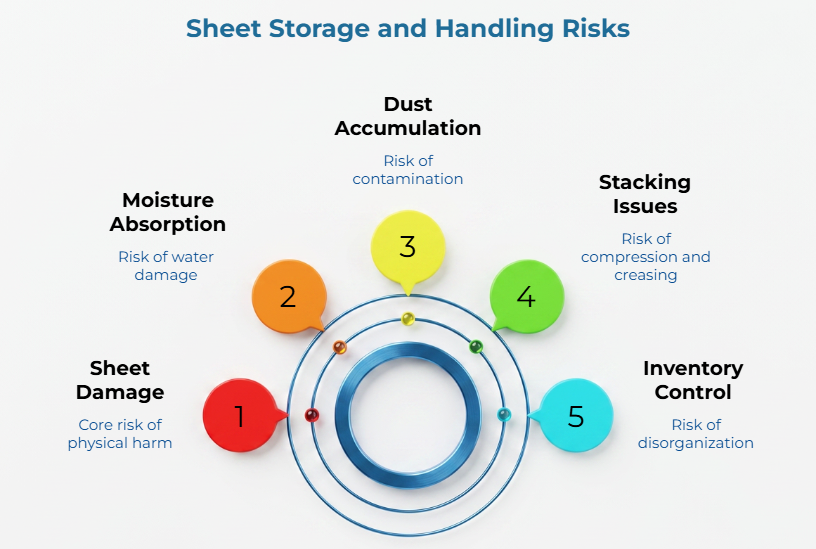
Sheets offer a different set of advantages — and a different set of risks. Pre-cut sheets can simplify manual packing workflows, smaller-batch operations, and applications where cutting or dispensing equipment isn’t practical. They’re easier to pick individually and don’t require specialized lifting equipment for smaller quantities.
But “easier to handle” doesn’t mean “easier to protect.” Sheets are vulnerable to edge damage, corner bending, curling, moisture absorption, and dust accumulation when they aren’t stored flat, stacked properly, and kept covered. General paper-handling guidelines often note that cut paper edges are especially sensitive to moisture when wrapping is compromised or paper is left open, frequently citing relative humidity targets around 50% (aligning with testing baselines like ISO 187) for controlled environments — though practical warehouse storage often allows a broader range, and this should not be treated as a kraft-paper-specific guarantee. A pallet of kraft sheets left near a loading dock, where temperature shifts and humidity spikes are common, can develop wavy edges and stiffness changes that make the sheets difficult to feed, fold, or print on later. Even short storage periods create exposure risk when the environment isn’t controlled; storage doesn’t have to be long-term to cause problems.
Stacking height and weight distribution matter too. Sheets at the bottom of an overloaded pallet can compress, crease, or bond together under pressure, creating waste before the paper reaches the packing station. Open packs, mixed sheet sizes, and partial pallets also create inventory-control issues that require clear labelling and rotation discipline.
Picture a small-batch manual packing station where an operator pulls kraft sheets from a nearby pallet. No dispenser needed, no unwind stand required. But if that pallet sits in a staging area with inconsistent climate control, sheets at the bundle edges can rapidly absorb enough moisture to become noticeably limp. The operator starts discarding them one by one — avoidable waste that traces back to storage conditions, not format choice.
Rolls vs. Sheets: Practical Comparison for Packaging Buyers
Unit price alone doesn’t capture the operational cost of choosing the wrong format. And fast inventory turnover does not eliminate handling risk — a roll can be damaged during receiving even if it will be consumed within four days, and a sheet pack can absorb moisture at exposed edges even with fast use. The comparison that follows maps key factors by format, but it should be used as a buying tool matched to your specific operation, not as a universal ranking.
| Factor | Rolls | Sheets | Buyer Question |
| Storage space | Require vertical or horizontal racking; larger footprint per unit | Stack on standard pallets; modular footprint | Can the warehouse store this format without improvising? |
| Handling equipment | Clamp trucks, roll cradles, or adapted forklifts typically needed | Standard pallet jacks and manual handling sufficient for smaller quantities | What equipment moves the material from receiving to use? |
| Damage exposure | Outer layers, edges, and wrapping vulnerable during moves | Edges, corners, and top/bottom sheets vulnerable to stacking, moisture, and dust | What damage signs would make the material unsuitable? |
| Inventory turnover | Better suited to higher-volume, faster-turnover operations | Suited to smaller-batch or variable-frequency usage | How quickly will the opened material be consumed? |
| Application workflow | Feeds continuous converting, wrapping, or dispensing lines | Supports manual, pre-cut, or short-run packaging tasks | Does the line need continuous feed or ready-to-use pieces? |
| Inspection | Check wrap integrity, edge condition, core fit, outer-layer quality | Check edge curl, moisture damage, stacking compression, and bundle integrity. | What should be photographed and recorded? |
| Reorder planning | Larger minimum orders typical; longer lead times possible | Smaller order increments possible; easier to adjust quantity | Does the order quantity match actual weekly use? |
Buyer Checklist: Questions to Ask Before Ordering
Before finalising a format decision, work through these questions with your supplier and your warehouse team.
Storage environment:
- What storage conditions does the supplier recommend for this specific product (temperature range, humidity, light exposure)?
- Is your storage area climate-controlled, or does it experience seasonal or day-night fluctuations?
- Should the material be kept away from dock doors, direct sunlight, vents, floor moisture, or chemical storage areas?
Shelf life and usability:
- Does the supplier provide a stated shelf-life window or a recommended use-by period?
- What conditions does that guidance assume — and do your warehouse conditions match?
Protection and wrapping:
- Should the paper remain in its original wrapping until the point of use?
- What happens to usability if the wrapping is damaged, or if the roll or sheet pack is exposed to humidity?
- How should partial rolls or opened sheet packs be protected between jobs?
Handling equipment and workflow:
- What equipment is needed to move, stage, and dispense this format safely?
- Does the format match your packaging line’s intake method (continuous feed vs. pre-cut)?
- Can your team manage this format at planned order volumes, and are staff trained on format-specific handling?
- What handling method could damage edges, cores, wrappers, cartons, or sheet corners?
Inspection and damage detection:
- What visual or physical signs indicate usability loss (moisture uptake, edge curl, discoloration, stiffness change)? For a structured approach, see our guide to verifying kraft paper quality upon arrival.
- If the paper is coated, treated, or food-grade, does it require different storage or inspection procedures?
Inventory turnover and order quantity:
- What order quantity matches expected consumption within the supplier’s recommended use window?
- Will inventory turn fast enough to avoid extended storage — and if not, what additional protection is needed?
- How will older stock be identified and used before newer deliveries?
Supplier documentation:
- Has the supplier provided written storage and handling guidance for this specific product?
- Are coated or treated grades subject to different storage instructions?
- Which lot, roll, pallet, or batch details should be recorded for traceability?
If your supplier’s answers are vague or generic, that’s worth paying attention to before committing to a large order. Inventory turnover — the rate at which stock is consumed and replaced — directly affects how long any format sits exposed to handling and environmental risk. For related guidance, our article covers what to ask when kraft paper grade descriptions are too vague.
This checklist should become part of the RFQ, purchase order notes, receiving inspection, and warehouse handling instructions — not a one-time exercise that stays in procurement’s inbox.
When Rolls May Be the Better Fit
Rolls tend to work well when the operation has consistent, higher-volume demand that justifies the storage space, handling infrastructure, and dispensing setup they require. If your packaging line pulls paper continuously from a roll stand or unwind station, and your warehouse has the racking, equipment, and trained staff to move rolls safely, the format aligns with your workflow.
Operations with predictable turnover — where rolls are consumed within a reasonable window and rotated regularly — get the most from this format. Format compatibility — the alignment between a paper format and the storage, handling, and production systems it passes through — breaks down when any link in that chain is missing. Staff should know how rolls are unloaded, where they are staged, what equipment is approved, how damaged wrapping is reported, and how partially used rolls are protected. For operations evaluating roll quality at receiving, a practical checklist for kraft paper parent roll handling can help prevent damage before production starts.
Choose rolls when your operation is ready for roll handling, not merely when purchase volume is high.
When Sheets May Be the Better Fit
Sheets tend to work well for smaller-batch operations, manual packing stations, or workflows where pre-cut pieces reduce cutting time and equipment dependency. If your team handles paper by hand, uses different sizes across short runs, or lacks space for roll storage, sheets reduce handling complexity without requiring dispensing infrastructure.
The tradeoff is that sheets require proper stacking, bundle protection, and climate-aware storage. Partial packs should be covered. Corners should not overhang pallets. Open packs should be labelled clearly, especially when multiple sizes or grades are stored together. If your constraint is limited warehouse space or variable order volumes, sheets offer more flexibility in order increments and storage footprint. Even when turnover is fast, sheets stored near dock doors or in uncontrolled staging areas can deteriorate faster than expected.
Choose sheets when ready-to-use pieces matter more than roll-fed continuity.
Choose the Format Your Operation Can Protect and Use Consistently
The better format is the one your warehouse can store safely, your team can handle without damage, and your operation can consume before storage conditions erode usability.
Before placing the order, ask your kraft paper suppliers for format-specific storage and handling guidance. Compare that guidance against what your warehouse actually delivers — not what the floor plan says, but what the loading dock and the staging area look like on a Tuesday afternoon. Review available kraft paper parent rolls, or send a clear kraft paper RFQ that includes storage, handling, packaging, and documentation requirements. If you need supplier responses against your own specifications, PaperIndex lets buyers submit RFQs and receive quotes.
Frequently Asked Questions
Do kraft paper rolls last longer than sheets?
Not necessarily. Shelf life depends on the paper’s grade, supplier storage guidance, wrapping protection, and actual warehouse conditions. Rolls and sheets create different exposure points, but format doesn’t override storage conditions or product specification. Confirm shelf-life expectations with your supplier’s technical data sheet and treat any stated shelf-life period as product-specific.
Should kraft paper stay wrapped until use?
In most paper-storage contexts, keeping the original protective wrapping intact until the point of use helps limit moisture absorption and surface damage. Domtar advises storing paper in original packaging until needed. Given the variability in coatings and treatments, the manufacturer’s specific handling technical data sheet (TDS) supersedes general best practices.
Are sheets always easier to handle than rolls?
Sheets can be easier for manual picking and short-run workflows, but they still require proper stacking, edge protection, dust coverage, and climate-stable storage. Rolls may be easier for continuous dispensing or roll-fed processes. The easier format is the one your staff can move, protect, open, and use correctly — handling ease depends on volume, storage setup, and whether staff are trained to manage either format without introducing damage.
What should procurement teams ask before ordering kraft paper?
At minimum, ask about recommended storage conditions, shelf-life windows, wrapping requirements, handling equipment needs, inspection signs for usability loss, and order quantity matched to realistic turnover. These questions apply whether you’re ordering kraft paper parent rolls or sheets.
Disclaimer:
The information in this article is provided for educational and informational purposes only. It does not constitute professional, technical, or product-specific advice. Storage conditions, shelf-life guidance, and handling requirements vary by product grade, coating, treatment, and supplier specification. Buyers should confirm all format-specific storage, handling, and shelf-life details directly with their supplier or manufacturer’s product documentation before making procurement decisions.
Our Editorial Process:
Our expert team uses AI tools to help organize and structure our initial drafts. Every piece is then extensively rewritten, fact-checked, and enriched with first-hand insights and experiences by expert humans on our Insights Team to ensure accuracy and clarity.
About the PaperIndex Insights Team:
The PaperIndex Insights Team is our dedicated engine for synthesizing complex topics into clear, helpful guides. While our content is thoroughly reviewed for clarity and accuracy, it is for informational purposes and should not replace professional advice.