
📌 Key Takeaways
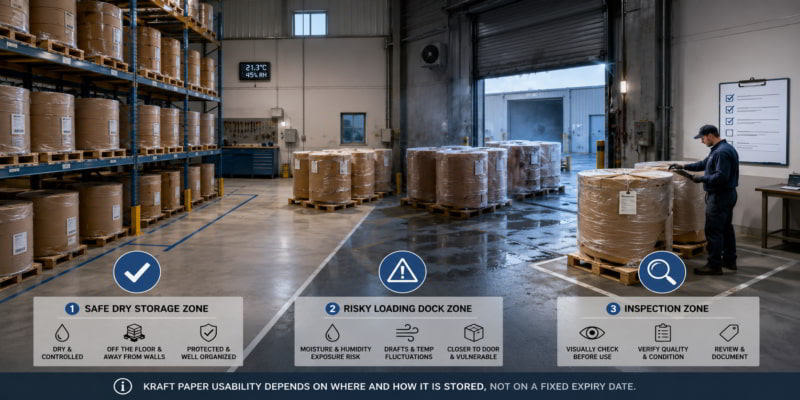
Safe kraft paper storage depends on your warehouse conditions and supplier guidance — not a universal expiry date.
- Storage Decides Shelf Life: The same roll can last over a year in a dry warehouse or fail within weeks near a humid loading dock.
- Get Supplier Proof First: Ask for a technical data sheet, storage instructions, and shelf-life statement before placing a bulk order.
- Match Orders to Reality: Base your order size on actual monthly usage and warehouse conditions — bulk savings disappear when rolls go bad.
- Rotate Stock Religiously: Label every pallet by arrival date and use a first-in, first-out system so older rolls do not get buried and forgotten.
- Inspect Before Converting: Check older rolls for waviness, mould, brittleness, or moisture marks before sending them to production.
Buy what you can store well, rotate what you receive, and inspect what you doubt.
Procurement teams and warehouse managers buying kraft paper in bulk will gain a practical checklist and supplier questions here, preparing them for the detailed overview that follows.
~ ~ ~ ~ ~ ~ ~ ~ ~ ~ ~ ~ ~ ~ ~ ~ ~ ~
Bulk orders arrive on pallets.
The shrink wrap is tight, the invoice matches, and the rolls disappear into the warehouse. Six months later, an operator peels back protective wrapping on a roll near the loading dock—and finds edges that are soft, wavy, and pulling apart. We paid for this?
You are not just looking for a shelf-life number. You are trying to avoid buying more kraft paper than your warehouse and turnover can support, then discovering the material has lost packaging performance when production needs it most.
Know the right question to ask: How long will this specific paper remain suitable for your application, under your actual storage conditions, based on what the supplier has documented.
Below is a checklist, a set of supplier questions, and a practical method for sizing orders with confidence.
Kraft Paper Shelf Life Depends on Storage and Supplier Guidance
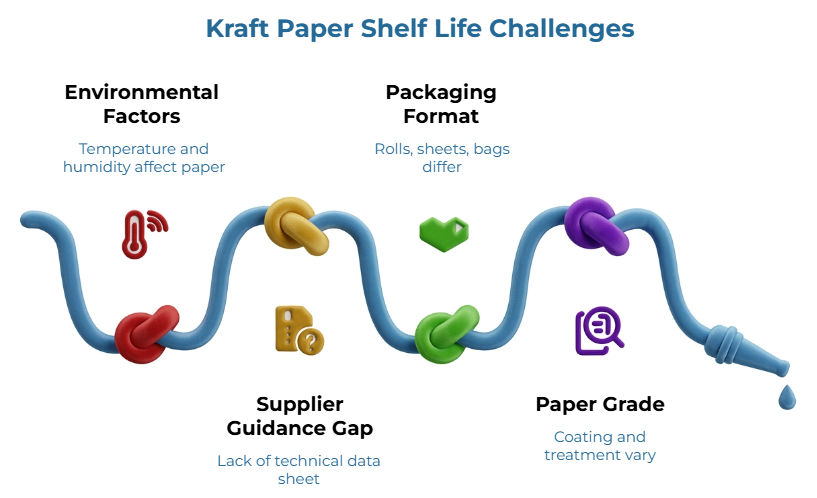
There is no expiry date stamped on kraft paper the way there is on perishable goods. Usability in storage varies by grade, coating or treatment, basis weight, packaging format—rolls, sheets, bags, coated stock—and the conditions inside your warehouse.
For procurement teams, two terms are worth separating. “Shelf life” means the supplier-stated period during which the paper is expected to remain suitable when stored as instructed. “Usability” means the paper still performs for your intended packaging task—whether that is wrapping, void fill, bag conversion, printing, sheet cutting, or ecommerce packing. A roll that remains usable for rough industrial wrapping may not be acceptable for printed retail packaging. That gap between shelf life and usability is where procurement risk lives.
A roll of uncoated sack kraft in a dry, climate-stable facility may remain usable well beyond twelve months. The same roll in a humid receiving bay near an open dock door could develop problems within weeks. ISO 187 defines standard atmospheres for conditioning and testing paper, board, and pulps precisely because paper properties shift with temperature and humidity. TAPPI T 402 reinforces the same point. These standards confirm that environmental exposure directly affects physical characteristics—which is why storage planning belongs inside the purchasing decision.
The safest procurement planning approach combines supplier guidance with good storage and FIFO rotation. Your supplier’s technical data sheet—a document covering a product’s physical properties, tolerances, and test methods—is the most reliable source of shelf-life information for your specific grade. A certificate of analysis, when provided, records lot-specific quality or test information. Neither document should be treated as a universal guarantee, but both are more reliable than a generic answer. If that documentation does not exist, treat that gap as a signal worth investigating before you scale up volume.
Why Kraft Paper Usability Changes in Storage
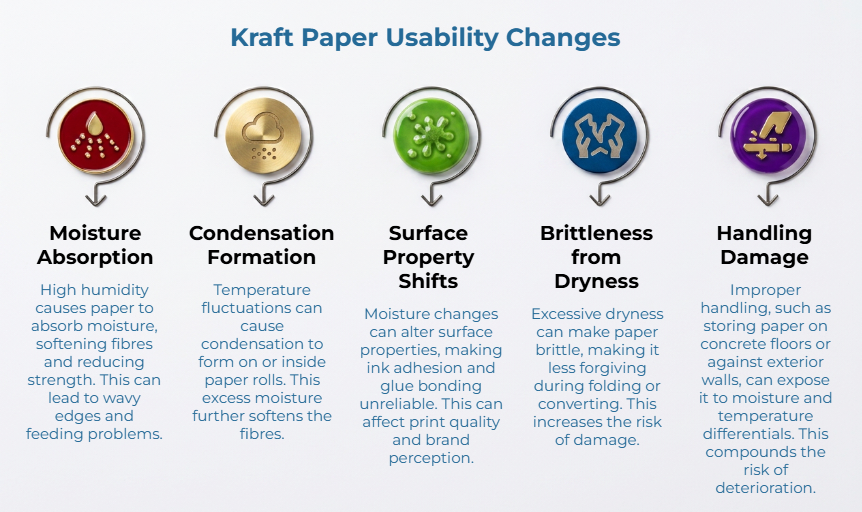
Paper is hygroscopic—it absorbs and releases moisture in response to surrounding air. When relative humidity climbs, the paper’s moisture content (the amount of water held within the fibres) rises. When temperatures swing, condensation can form on or inside rolls that were dry at delivery.
Excess moisture softens fibres, reducing tensile and burst strength. Rolls develop wavy edges or tight centres that cause feeding problems on converting equipment. Sheets may curl, cockle, or stick together. Surface properties can shift enough that ink adhesion or glue bonding becomes unreliable. Even appearance changes—yellowing, spotting, mould—can disqualify paper for customer-facing packaging.
Dryness creates its own problems. Paper that loses too much moisture may become brittle and less forgiving during folding or converting. The risk is not limited to wet environments—paper stored in excessively dry or fluctuating conditions can cycle through absorption and release enough times to degrade mechanical properties that were sound at delivery.
Handling damage compounds the risk. Paper on a concrete floor wicks moisture from below. Pallets against exterior walls face temperature differentials. For a systematic approach to identifying and mitigating these risks, a warehouse moisture and temperature risk assessment can prevent rolls that arrive within specification from failing at converting. Wrapping torn during receiving lets ambient air reach the paper far sooner than the supplier intended. A roll with a dented edge, crushed core, or exposed outer layers may create production trouble even if the paper itself has not deteriorated chemically. Domtar’s paper handling guidance recommends managing humidity in storage areas specifically because uncontrolled conditions degrade usability—even when the paper leaves the mill within specification.
A simple distinction helps here: procurement buys the material, but operations preserves it. If those two teams do not coordinate on storage conditions and handling expectations, the purchase order can look successful while the material quietly becomes harder to use.
Storage Factors Procurement Should Check Before Buying in Bulk
Before increasing your order quantity, walk the warehouse with your operations team. What you observe will tell you more about your safe inventory window than any generic estimate.
Is the storage area dry, clean, and protected from leaks and condensation? Are rolls stored off the floor on pallets or racks, away from exterior walls, dock doors, and direct sunlight? Is the temperature reasonably stable? Is original wrapping kept intact until production? Are pallets labelled by arrival date? Is there a FIFO (first-in, first-out) process, or do newer deliveries get stacked in front of older ones?
If kraft paper is dry, that does not automatically mean it is fine—paper that was dry at delivery can absorb moisture over weeks if the environment is unstable. And if more than two answers are uncertain, that uncertainty should limit how much inventory you carry.
For a closer operational view of picking, rotation, and production readiness, consulting specialized warehouse storage protocols for kraft paper parent rolls provides the necessary operational context.
Kraft Paper Bulk-Buying Shelf-Life Checklist
- Supplier-stated shelf life or recommended use-by period obtained and documented.
- Storage and handling instructions available for the specific grade and format.
- Storage area reviewed for moisture, temperature stability, cleanliness, and sunlight protection.
- Warehouse humidity and temperature monitored, even with an inexpensive data logger.
- Rolls or sheets stored away from floors, leaks, dock doors, and condensation risk.
- Original protective wrapping stays intact until production needs the material.
- Incoming stock labelled by arrival date, batch, lot number, supplier, grade, and status.
- FIFO rotation assigned to a specific warehouse or production role and communicated to staff.
- Monthly usage rate estimated from actual consumption and compared against proposed order volume.
- Inspection trigger defined for older stock before release to production.
- Older stock physically inspected before use beyond supplier-recommended storage duration.
- Questionable material has a clear escalation route to the supplier or quality team.
- Supplier contacted for guidance on material showing visible changes.
How Shelf Life Should Shape Purchasing Cadence and Inventory Volume
Ordering kraft paper balances unit economics, lead times, and storage reality. Bigger orders often bring better pricing per tonne. Buying ahead can also buffer against supply delays—a legitimate motivation for teams managing seasonal demand or long lead times. But those savings hold only if the paper stays usable as long as you plan to store it.
Start with your consumption rate. If your line uses roughly eight tonnes per month and your supplier’s lead time is three weeks, you do not need a six-month buffer in a warehouse that is not climate-controlled. A rolling two-to-three-month supply, ordered on a predictable purchasing cadence, absorbs lead-time variability without exposing material to unnecessarily long storage windows.
For operations running multiple grades, separate fast-moving materials from slow movers. The uncoated kraft you consume monthly is a different inventory problem than the specialty coated stock used one quarter per year. Slow-moving stock needs more caution because storage duration has more time to expose weak controls.
Imagine a small converter placing a bulk order to lock in pricing before an anticipated increase. The rolls fill a bay near the loading dock—convenient but not climate-controlled. Three months later, several rolls show moisture marks and wavy edges. Replacing them wipes out the unit-price savings. Smaller, more frequent orders to a stable area would have cost less overall.
FIFO is the simplest tool here. Label every pallet with an arrival date and organise storage so older inventory is physically accessible—not buried behind newer deliveries. Without that discipline, old stock often sits undiscovered until the moment production urgently needs it.
This is also where the buyer, warehouse team, and approver need different information from the same purchase decision. Procurement needs supplier guidance and pricing logic. Warehouse and production teams need storage instructions, labelling standards, and release criteria. The business owner or operations lead needs confidence that the order will not create waste, rework, or avoidable disruption. If procurement focuses on unit price while operations absorb the storage risk, the real cost of a bulk order never surfaces in the procurement report. Quantifying these hidden operational variables within a Total Cost of Ownership (TCO) model — one that accounts for how a cheaper kraft paper roll becomes more expensive in production — ensures volume discounts are not ultimately erased by localized warehouse degradation.
Signs Stored Kraft Paper May Need Inspection Before Use
Not every sign of ageing means paper is unusable. But each observation below warrants a closer look before material goes to production.
- Moisture marks or water stains suggest exposure to liquid water or sustained humidity.
- Mould or musty odour indicates prolonged moisture exposure.
- Warping, curling, or waviness—particularly at roll edges—results from uneven moisture absorption.
- Brittleness or easy tearing may mean excessive drying or too many humidity cycles.
- Yellowing or discolouration beyond normal shade range may reflect oxidation or heat exposure.
- Surface contamination (dust, oil, chemical residue) can interfere with printing or adhesive bonding.
- Crushed edges or roll deformation typically result from improper stacking.
- Damaged or loose wrapping means exposure to ambient conditions longer than the supplier intended.
The severity depends on the application. A roll with minor edge waviness might work for void fill but fail on a high-speed bag line. Surface appearance can be deceptive; a roll may seem dry externally while masking deep internal degradation from historical humidity cycling or structural handling defects. Usability should be evaluated against the actual packaging job. A practical roll quality check before converting can prevent a more expensive problem on the production floor.
When quality concerns justify testing, ISO 287 specifies an oven-drying method for determining the moisture content of a lot of paper and board. Most SMB buyers will not test every roll, but the standard is useful when moisture is central to a quality dispute or high-volume release decision.
What to Ask Suppliers Before Placing a Large Order
The shelf-life conversation belongs before the purchase order, not after a warehouse discovery. Do you really need supplier documentation for paper? Yes—without it, every assumption about storage duration is unverified.
| Question | Why it matters | Document to request |
| Recommended shelf life under specified storage conditions? | Sets your maximum inventory window | Technical data sheet or product specification |
| Storage temperature and humidity range assumed? | Compare against your actual warehouse | Storage and handling instructions |
| How should rolls or sheets be stored and stacked? | Prevents handling damage that shortens usability | Handling guide |
| Batch or lot traceability available? | Enables targeted investigation for quality issues and supports FIFO | Certificate of analysis (batch-specific test results) |
| How is paper protected during transit and shipment? | Wrapping damaged in transit shortens usability before stock reaches you | Shipping and packaging specification |
| Guidance for partially used or opened stock? | Prevents assumptions about re-wrapping | Supplier technical support |
| Return or replacement policy for damaged material? | Clarifies your recourse | Supplier terms or contract |
| Grade-specific or coating-specific storage caveats? | Different grades may store differently | Grade-specific storage guidance |
| What should be checked before using older stock? | Defines inspection expectations before production release | Supplier technical support |
| Moisture-content testing method recommended? | Supports objective checks when concerns arise | Reference to ISO 287 or equivalent |
Not every supplier will provide every document. That gap is useful information—it tells you how much risk you absorb as the buyer. If supplier grade descriptions are ambiguous, establishing a standardized technical questionnaire will help clarify specifications before comparing vendor quotes. For deeper guidance on evaluating kraft paper suppliers before placing orders, a structured qualification process reduces uncertainty significantly.
When to Be More Cautious: Coatings, Printing, Food Packaging, and Long Storage
Coated, treated, laminated, or printed kraft paper may have different storage characteristics than standard uncoated stock. Coatings can degrade or lose barrier performance under conditions that would not affect the base paper—ask the supplier about coating stability specifically. Inks and varnishes can react to humidity, heat, or light over time, causing adhesion loss or colour shift.
Recycled-content kraft paper may behave differently from virgin fibre grades under the same conditions. If you stock both, do not assume identical storage behaviour.
Food-contact kraft paper carries the highest caution level. Storage conditions may affect regulatory compliance, and any shelf-life claim for food-contact use should be backed by verified supplier documentation. Food-contact suitability should never be assumed from appearance alone—a brown kraft shade, a clean surface, or a sustainability claim does not establish compliance. Relevant declarations, product documentation, and applicable regulatory review should come from qualified sources. Shelf life is not only an issue for food packaging—but food-contact applications raise the stakes because compliance depends on storage conditions in ways that non-food grades do not face.
Sustainability documentation is also separate from shelf life. FSC Chain of Custody certification can support responsible sourcing and traceability claims, but it does not prove that a kraft paper lot will remain usable for a particular storage duration.
For any grade stored beyond six months, inspection and rotation disciplines become essential rather than optional.
Practical Takeaway for Procurement Teams
The strongest kraft paper buying plan does not start with a universal shelf-life number. It starts with controlled uncertainty.
You may begin with, “How long can this kraft paper be stored?” The better question is sharper: “Can this specific paper—stored in this specific warehouse—remain suitable for this specific packaging use until we need it?” That question gives procurement, warehouse, production, and management a shared decision point. It turns shelf life from a vague worry into a practical buying control.
Review your warehouse conditions. Estimate your usage rate. Set up FIFO rotation and arrival-date labelling. Ask your supplier for a shelf-life statement, storage instructions, and a technical data sheet. Inspect older stock before releasing it to production. Buy what you can store. Rotate what you receive. Inspect what you doubt. Ask suppliers for proof before volume turns into risk.
Before placing a bulk order, use the checklist above and ask your supplier for product-specific guidance. If you are sourcing kraft paper jumbo rolls or evaluating how warehouse moisture risks affect roll quality before converting, the preparation is worth it. Buyers who are still shortlisting sources can also review kraft paper suppliers on PaperIndex.
Shelf life is not a number to look up. It is a procurement planning discipline to build.
Frequently Asked Questions
Does kraft paper expire?
Unlike food or chemical products, kraft paper lacks a hard expiration date. It can lose usability over time if stored in poor conditions—excess humidity, temperature swings, or damaged wrapping. Practical shelf life depends on grade, storage environment, and supplier guidance.
Can kraft paper be used after the supplier’s recommended shelf life?
It may still be usable if stored well. Inspect for signs of deterioration—moisture damage, warping, brittleness, odour, or surface changes—before committing material to production. Consult the supplier or your quality team when in doubt.
Can damaged or aged kraft paper still be used?
That depends on the application and the nature of the damage. Minor edge waviness might be acceptable for void fill but not for a high-speed bag line. Visible mould, significant moisture absorption, or structural deformation are stronger reasons to set material aside. The supplier or quality team should make the final call.
Is shelf life only a food-packaging issue?
No. Food packaging needs extra caution, but storage risk can also affect wrapping paper, ecommerce void fill, paper bags, printed packaging, and converting grades. Any kraft paper application where usability depends on physical properties—strength, flatness, surface behaviour—is affected by how the material was stored.
Should procurement buy kraft paper in bulk?
Bulk buying works when usage rate, storage conditions, and supplier guidance all support a longer inventory window. If your warehouse lacks climate control or turnover is slow, smaller and more frequent orders may reduce waste and quality risk.
Disclaimer:
This article is for general educational and procurement planning purposes. It does not constitute product-specific technical advice, food-contact compliance guidance, or supplier warranty terms. Consult your supplier’s documentation and qualified professionals for guidance specific to your materials and use case.
Our Editorial Process:
Our expert team uses AI tools to help organize and structure our initial drafts. Every piece is then extensively rewritten, fact-checked, and enriched with first-hand insights and experiences by expert humans on our Insights Team to ensure accuracy and clarity.
About the PaperIndex Insights Team:
The PaperIndex Insights Team is our dedicated engine for synthesizing complex topics into clear, helpful guides. While our content is thoroughly reviewed for clarity and accuracy, it is for informational purposes and should not replace professional advice.