
📌 Key Takeaways
Bulk kraft paper orders only pay off when your storage, usage rate, and supplier guidance all line up.
- Match Orders to Real Usage Speed: Order only what your team can store well and use up before the paper loses its quality—not just what looks cheapest per unit.
- Storage Conditions Drive Usability: Paper absorbs moisture from the air, so humidity swings, dust, and rough handling can ruin rolls long before you open them.
- Ask Suppliers for Written Proof: Suppliers who give you documented storage guidance and shelf-life details are far more reliable than those offering only verbal promises.
- Check Stock Before It Hits the Line: Warping, brittleness, staining, or dust on stored paper can cause costly production stops if nobody inspects it first.
- Use Five Planning Variables Together: Usage rate, storage quality, supplier guidance, how sensitive the end use is, and stock rotation should all shape your order size.
Buy only what you can store, rotate, and use with confidence—not what looks efficient on a spreadsheet.
Procurement teams planning bulk kraft paper purchases will gain a clearer supplier conversation framework here, preparing them for the detailed overview that follows.
~ ~ ~ ~ ~ ~ ~ ~ ~ ~ ~ ~ ~ ~ ~ ~ ~ ~
A bulk order can look efficient on paper. The purchase plan is approved, the receiving team has cleared a storage bay, and the packing line expects steady material availability. Then the question appears before the next buying cycle is even settled: will the kraft paper remain usable until the team actually needs it?
That is the real shelf-life question. You are not only asking how long kraft paper can sit in storage. You are asking whether the order quantity, warehouse conditions, supplier guidance, and stock rotation process all support the way your team will use the material. Because performance variables differ significantly across specific grades and treatments, procurement teams must rely on targeted technical datasheets rather than arbitrary timelines.
This guide treats kraft paper shelf life as a procurement planning variable. It covers the factors that affect usability over time, the way shelf-life uncertainty should shape order sizing and stock rotation, and a checklist of questions to raise with suppliers before committing to a larger order.
Kraft Paper Shelf Life Is a Procurement Planning Question, Not Just a Storage Question
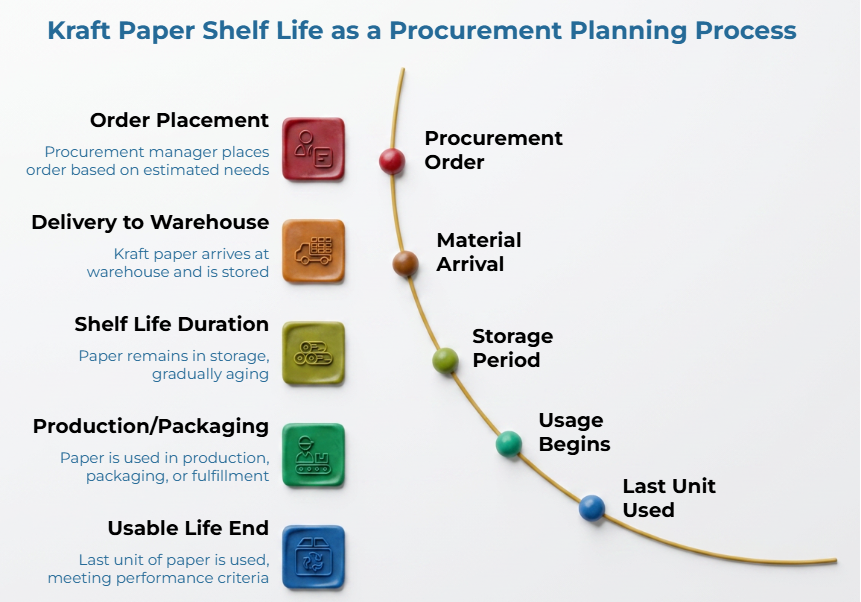
Shelf life means the period during which kraft paper remains suitable for its intended packaging application under the buyer’s actual storage conditions. Usable life is the practical version of that idea: the period in which the material still performs acceptably for your packaging, converting, wrapping, printing, or fulfillment process.
For procurement teams, “usable” should be defined by the job the paper must do. A roll used for basic void fill may be judged differently from kraft paper used in customer-facing packaging, where appearance, surface consistency, and handling feel matter more. The procurement manager may place the order, but warehouse, production, packaging, and fulfillment teams will live with the result.
That distinction matters for anyone balancing cost, storage, and quality across departments. Procurement wants economical order quantities; operations wants material that performs on the line; warehouse teams need manageable storage; finance may question working capital tied up in aging inventory; and customer-facing teams care about packaging appearance. A single shelf-life number rarely satisfies all of those stakeholders.
The better question is: “Will this material still perform as expected by the time we use the last unit, given our storage conditions and consumption rate?” Framed this way, shelf life becomes a planning exercise—one that connects order quantity, storage reality, and supplier accountability.
What Can Affect Kraft Paper Usability Over Time?
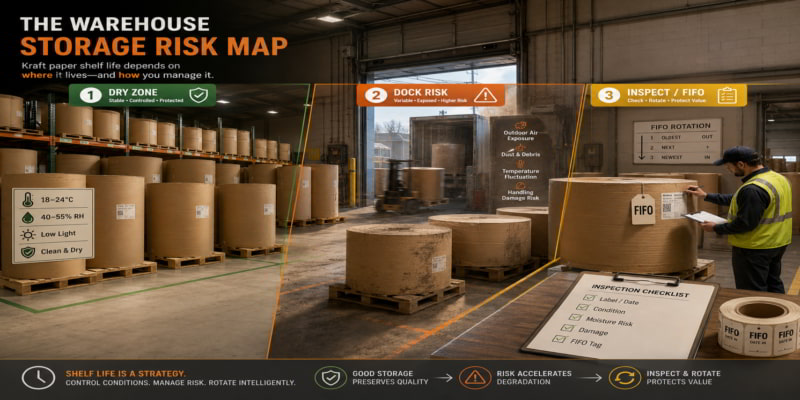
Several environmental and handling factors influence whether stored kraft paper stays suitable for use. Storage conditions—the physical environment and handling practices under which material is kept before use—include the storage area itself, exposure risk, wrapping condition, stacking method, and the amount of movement the material receives before production. Paper is hygroscopic: it absorbs and releases moisture depending on surrounding conditions. Elevated humidity can cause waviness, curl, or reduced stiffness, while excessive dryness can make sheets brittle and prone to cracking during folding or scoring.
Standard industrial warehousing practices suggest keeping raw packaging stock away from extreme temperature spikes and maintaining a stable relative humidity environment (ideally 40–60%) to preserve tensile strength and edge alignment. For a practical guide to warehouse-level moisture risk controls, see our guide, how to protect kraft paper parent rolls from warehouse moisture and temperature risks. That guidance is not a kraft-paper shelf-life guarantee, but it supports a useful procurement principle: handling and storage should not be treated as afterthoughts.
Dust, dirt, pests, and airborne contaminants pose a different kind of risk, especially when original wrapping is removed or compromised. For customer-facing packaging applications where surface appearance matters, contamination may render material unsuitable without additional cleaning or waste.
Physical handling also plays a role. Rolls stacked too high, sheets under heavy loads, or material moved repeatedly by forklift can develop compression marks, edge damage, or deformation that affects runnability. For guidance on preventing these issues during internal handling, see how to prevent kraft paper parent roll damage before production starts. Direct sunlight, while less common indoors, can cause discoloration over time.
Consider a hypothetical example: two pallets of the same uncoated kraft arrive on the same day. One is stored in a clean, dry area with wrapping intact. The other ends up near a loading dock, exposed to humidity swings and dust. Months later, the first pallet may convert without issue; the second may curl, tear, or jam. Same product, different outcome. This is a general planning example, not a guarantee—the supplier’s storage guidance for the exact product should remain the controlling reference.
Not all kraft paper grades respond identically. Coated grades, treated papers, and papers designed for specific end uses may have different sensitivities. Paper grade, coating, GSM, roll or sheet format, and application may all affect what should be checked. This is why supplier-specific storage guidance matters more than general rules of thumb. Buyers comparing kraft paper parent rolls should ask how the roll should be wrapped, moved, staged, and released for use. For a deeper look at how grade differences affect converting, see our guide, why kraft paper curls, cracks, or wrinkles during conversion.
How Shelf Life Changes Bulk Buying Decisions
When procurement teams evaluate bulk kraft paper orders, shelf-life awareness should inform several planning decisions. Bulk buying can reduce ordering friction only when usage rate and storage reality support the larger order. It should not be treated as automatically safer, cheaper, or simpler.
Start by estimating usage cadence—how quickly your operation consumes material during normal production or packing activity—against the proposed order quantity. If monthly demand is unclear, the order size is already carrying uncertainty. Hypothetical example: a growing e-commerce operation expects steady monthly usage but is also launching new product lines that could shift demand. Ordering a twelve-month supply only makes sense if the storage environment can preserve usability over that window and the demand forecast is reliable. When consumption rates are uncertain, shorter coverage windows with more frequent orders reduce the risk of aging inventory.
Storage capacity and conditions matter just as much as demand. The buyer who places the order may not be the person who handles the material—the operations, logistics, and floor fulfillment personnel must handle the immediate physical constraints. That gap makes it important to confirm that storage conditions match supplier recommendations before scaling order size.
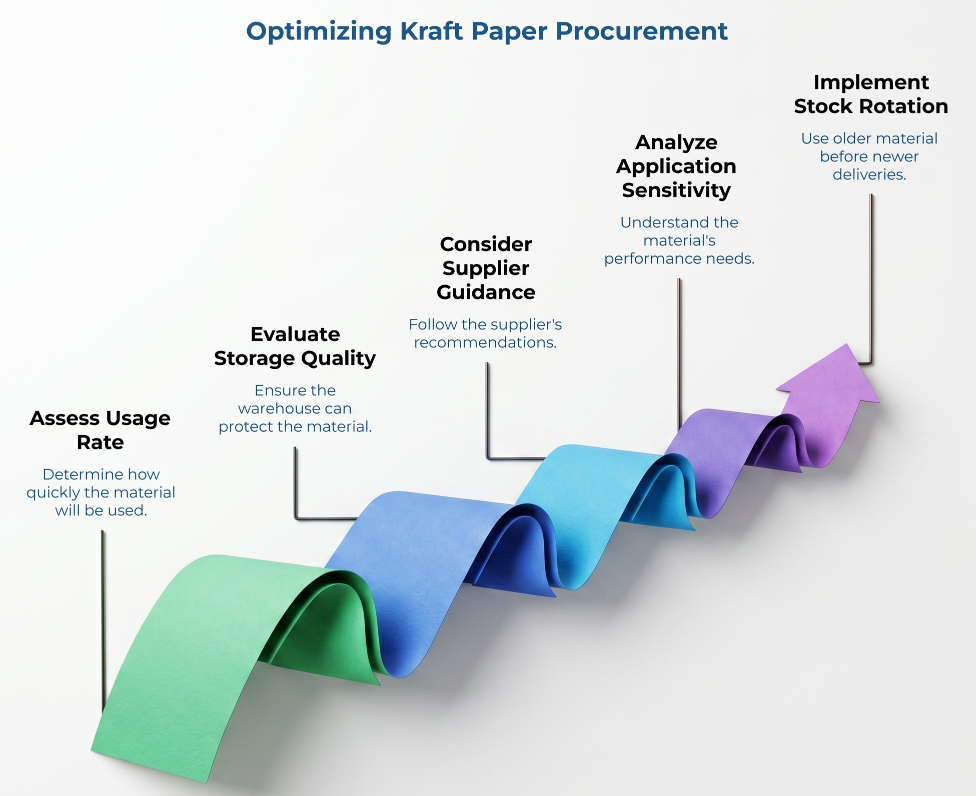
A useful planning framework brings five variables together:
- Usage rate: how fast the material is likely to move.
- Storage quality: how well the warehouse can protect it.
- Supplier guidance: what the supplier documents or explains.
- Application sensitivity: how much performance or appearance matters.
- Stock rotation: how reliably older material is identified and used before newer deliveries.
Implementing a strict First-In, First-Out (FIFO) stock rotation system typically minimizes the risk of aging inventory, ensuring stock is consumed before long-term storage can degrade its structural integrity.
When all five variables are favorable, larger orders carry less risk. When one or more are uncertain, smaller or more frequent orders are prudent. For related guidance on total cost thinking, see ‘when a cheaper kraft paper becomes more expensive in production.’
Signs Stored Kraft Paper May Need Review Before Use
Even with good storage practices, teams benefit from knowing what to look for before releasing stored material into production. A common and costly friction point: quality issues that go unnoticed until production starts, when downtime and rework costs are highest. Unused stock is not automatically ready stock.
The following indicators should trigger review—not automatic rejection—especially for quality-sensitive applications.
| Sign to review | What it may mean for procurement planning |
| Moisture marks, staining, water spots, or a damp feel | Storage conditions may need review before future bulk orders. |
| Warping, curling, dimensional changes, deformation, or crushed edges | Handling, stacking, or roll protection may be affecting usability. |
| Brittleness, unexpected tearing, or changed handling feel | Older stock may need closer comparison with known-good material. |
| Surface discoloration beyond what is typical for the grade | Customer-facing packaging or printing may need additional checks. |
| Dust, debris, odor, pest activity, or contamination from compromised wrapping | Storage location or wrapping conditions may be inadequate. |
| Poor feeding, inconsistent scoring, ink adhesion problems, folding issues, or unexpected breakage | The stock may need supplier review before wider use. |
The Technical Association of the Pulp and Paper Industry (TAPPI) notes that temperature and humidity fluctuations directly affect the physical properties and runnability of paper-based materials. While TAPPI guidelines often focus on precise testing environments, it supports the practical need for controlled storage and careful movement.
When converting problems appear, reviewing storage duration and conditions is a sensible diagnostic step before attributing the issue to the paper grade. For a structured troubleshooting approach, see a troubleshooting guide for kraft paper jumbo roll buyers. For deeper internal preparation around storage workflow, a related guide on kraft paper raw material storage can help teams think beyond receiving and focus on picking, rotation, and production readiness.
Supplier Shelf-Life Questions to Ask Before Buying in Bulk
Shelf-life uncertainty shrinks when procurement teams ask the right questions before requesting a formal quotation. Supplier documentation—written guidance, product notes, specification details, or handling instructions that support the supplier’s verbal claims—does not need to be complicated for every order. It does need to be clear enough for procurement, warehouse, and operations teams to act on.
Use the checklist below before the quote request when possible. Hypothetical scenario: before sending an RFQ for a six-month kraft paper supply, a procurement manager emails this checklist to two prospective suppliers. One responds with a technical data sheet, documented storage guidance, and clear answers. The other offers only verbal reassurance. That contrast alone sharpens the evaluation—without needing to compare a single price.
| Question to ask | Why it matters | What to request |
| What shelf-life or storage-duration guidance applies to this kraft paper product? | Establishes whether the supplier offers a documented usability window. Avoids a generic answer. | Written shelf-life statement or technical data sheet reference. |
| Does guidance differ by roll, sheet, coating, GSM, grade, or application? | Prevents treating all kraft paper as interchangeable in storage planning. | Product-specific storage notes or specification sheet. |
| What storage conditions do you recommend? | Helps the buyer verify whether internal warehouse conditions meet expectations. | Documented storage and handling guide. |
| Should original wrapping remain intact during storage? | Wrapping protects against dust, moisture, pests, and contamination. | Handling instructions included with shipment documentation. |
| What signs of deterioration should our warehouse team watch for? | Enables early detection before material enters production. | Inspection reference or quality advisory. |
| What documentation can you provide before purchase? | Supports informed procurement decisions and internal approval processes. | Technical data sheet, safety data sheet, or product specification sheet. |
| Are there application-specific limitations after extended storage? | Some end uses are more sensitive to aging than others. Links shelf life to the actual packaging job. | Application suitability notes or end-use guidance. |
| How should older stock be rotated relative to new deliveries? | Supports first-in, first-out inventory discipline. Reduces buried or forgotten inventory. | Lot identification, batch marking information, or rotation recommendations. |
| What recourse exists if material deteriorates before expected use? | Clarifies accountability—shelf-life guidance is not the same as a warranty. Clarifies escalation before dispute. | Written returns, claims, or quality-dispute process. |
| Can you help align order quantity with our expected usage cadence? | Reduces the risk of overbuying beyond the realistic consumption window. Tests whether the supplier understands the buying context. | Collaborative order-planning support or recommended order cycles. |
Addressing these variables systematically establishes contract-driven accountability before capital allocation. A small set of questions can prevent larger confusion later.
Suppliers who answer clearly and provide supporting documentation are better positioned to support longer-term inventory needs. When comparing responses, documented guidance with defined storage parameters is more useful than vague assurances. If grade names or descriptions are vague, review guidance on what to ask a kraft paper seller before comparing offers. For broader guidance on evaluating supplier evidence, see how to verify supplier capability.
A Simple Procurement Rule: Buy for Your Real Usage Window
Buy the quantity your team can store, rotate, inspect, and consume with confidence.
That rule keeps bulk buying practical. There is no universal formula for the “right” order size, but a practical principle applies: order quantities should reflect the period over which material can be stored properly and consumed confidently. Buying based only on unit price—without factoring in storage capacity, usage rate, and stock rotation—is one of the most common procurement planning mistakes in packaging operations.
| Condition | What it means | Procurement implication |
| Stable usage and controlled storage | Material is likely to move through stock predictably. | Larger orders may be reasonable if supplier guidance supports them. |
| Volatile demand, new product launches, or seasonal uncertainty | Consumption rate is uncertain; inventory may age. | Shorter coverage windows or staged orders reduce exposure. |
| Crowded warehouse, weak labeling, or uncontrolled environment | Older stock may be hard to find and rotate. Storage conditions may not preserve usability. | Fix visibility before increasing order size. Smaller, more frequent orders are safer. |
| Sensitive application or customer-facing packaging | Appearance and performance matter more. | Ask for clearer supplier guidance before approval. |
| Supplier offers vague or no shelf-life guidance | Risk cannot be sized without documented information. | Request documentation before committing to volume. |
A buyer who understands this tradeoff is better equipped to defend the procurement plan internally—whether the recommendation is to order more or to order less.
Shelf-life guidance should not be confused with warranty, return policy, or claim acceptance. Ask about those separately. A supplier’s storage guidance may explain how to protect usability, but it may not define what happens commercially if material is damaged, aged, or mishandled.
FAQs About Kraft Paper Shelf Life and Bulk Buying
Does kraft paper expire?
While standard untreated kraft paper generally does not carry an expiration date the way perishable goods do, specialized grades—such as Volatile Corrosion Inhibitor (VCI) treated kraft or medical-grade sterilization papers—often have strict, manufacturer-defined shelf-life limits, typically ranging from one to five years. Its usability can still change over time depending on storage conditions, paper grade, coating, and intended application. Rather than looking for a fixed shelf-life number, ask suppliers for storage-duration guidance specific to the product.
How should kraft paper be stored before use?
Follow the supplier’s guidance for the exact kraft paper product you are purchasing. As a general principle, protect the material from conditions that can affect cleanliness, shape, handling, wrapping integrity, or packaging performance. The main review areas are moisture or humidity exposure, dust, dirt, pests, odors, sunlight or heat (where relevant), compression, and rough handling.
Is it always better to buy kraft paper in bulk?
Not necessarily. Bulk buying makes sense when usage is predictable, storage is adequate, and the supplier provides clear shelf-life guidance. It carries more risk when demand is uncertain, storage is poor, or the team lacks visibility into how long inventory has been sitting. The decision should weigh the purchasing advantage against the risk of holding material beyond its reliable usability window.
Will suppliers actually give clear answers to these questions?
Some will; some will not. That contrast is itself useful information. Suppliers who provide written storage guidance, technical data sheets, and clear shelf-life parameters demonstrate documentation discipline that generally correlates with product reliability. For a deeper framework on evaluating supplier evidence quality, see why verifiable evidence should replace supplier promises in kraft paper procurement. A vague response is not necessarily disqualifying, but it should factor into the sourcing decision.
What should a supplier explain before a large order?
Ask about shelf-life guidance, storage requirements, documentation, grade or application differences, deterioration signs, stock rotation, and what happens if material arrives damaged or appears deteriorated before use. Suppliers who can answer these questions with written support are better positioned for longer-term procurement relationships.
Turn Shelf-Life Uncertainty Into Better Supplier Conversations
Managing kraft paper longevity directly modulates acquisition cycles, facility floor space allocation, vendor leverage, and overall line velocity.
The practical next step is simple. Review your storage conditions, estimate your usage cadence, decide how older stock will be rotated, and ask suppliers for documented guidance before placing a larger order. Use this checklist before your next supplier conversation, especially if you are planning a larger kraft paper order.
When you are ready to compare supplier responses, you can review kraft paper suppliers or submit your buying requirements with clearer questions already in hand. To explore kraft paper product listings, visit PaperIndex.
Shelf-life expectations can vary by kraft paper grade, coating, storage conditions, supplier guidance, and intended application. The information in this guide is educational and does not replace product-specific documentation from your supplier.
Disclaimer:
This content is for educational and informational purposes only. It does not constitute professional procurement, warehousing, or packaging advice. Shelf-life expectations vary by kraft paper grade, coating, storage conditions, and application. Always consult your supplier’s product-specific technical documentation before making purchasing or storage decisions. The authors assume no liability for decisions made based on this information.
Our Editorial Process:
Our expert team uses AI tools to help organize and structure our initial drafts. Every piece is then extensively rewritten, fact-checked, and enriched with first-hand insights and experiences by expert humans on our Insights Team to ensure accuracy and clarity.
About the PaperIndex Insights Team:
The PaperIndex Insights Team is our dedicated engine for synthesizing complex topics into clear, helpful guides. While our content is thoroughly reviewed for clarity and accuracy, it is for informational purposes and should not replace professional advice.