
📌 Key Takeaways
The right paper bag finish matches the job the bag actually does—not just how it looks in a sample photo.
- Looks Alone Can Mislead: A glossy or matte sample may photograph well but scuff, crack, or fail once bags are stacked, shipped, and handled by real customers.
- “Coated” Doesn’t Mean Protected: Two suppliers can both quote a “coated” bag while offering completely different treatments—always ask what the coating does, not just what it’s called.
- Food Bags Need Inside-Out Thinking: For food-service bags, the surface facing the food matters more than the printed outside, and grease, steam, and moisture each create different problems that need different solutions.
- Simpler Specs Save Money and Headaches: Adding barriers or premium finishes to bags that carry dry goods for a short walk creates extra cost and paperwork with no real benefit.
- Document Before You Commit: Ask suppliers to prove what the finish does—with test reports tied to the exact bag, not generic product-family paperwork—before approving volume orders.
Specify the failure you’re actually preventing, not the finish that looks best in a catalog.
Procurement teams and packaging buyers sourcing retail or food-service paper bags will sharpen their supplier questions here, preparing them for the detailed trade-off guide that follows.
~ ~ ~ ~ ~ ~ ~ ~ ~ ~ ~ ~ ~ ~ ~ ~ ~ ~
Most buyers start evaluating paper bags by looking at them. A gloss finish catches the eye in a supplier catalog, a matte surface feels more refined, and an uncoated kraft bag suggests simplicity. That visual starting point is reasonable—but it is incomplete.
A coating or finish also affects ink performance, handling durability, grease and moisture resistance, and the documentation needed to support claims about food contact, sustainability, or recyclability. A finish that looks right on a sample can still fail under the conditions the bag will actually face. This article works through those practical trade-offs so that the specification behind the finish matches the demands of the use case.
Coating vs. Finish: Define the Terms Before Comparing Quotes
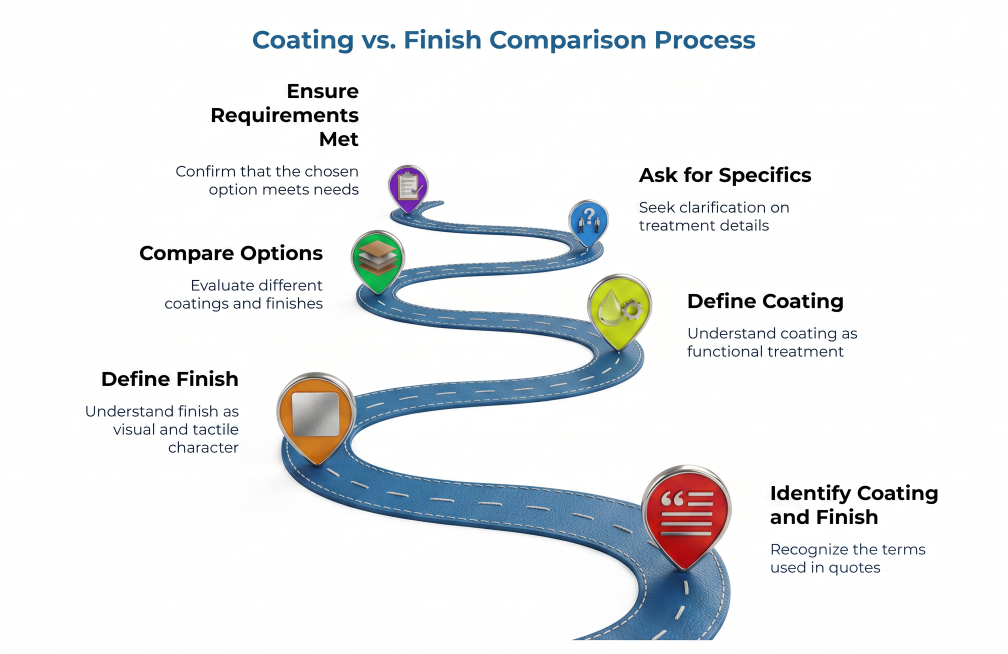
Suppliers use “coating” and “finish” loosely, and the two terms sometimes appear interchangeably on spec sheets. Before comparing options, it helps to draw a working distinction.
The visual and tactile character of a bag—whether gloss, matte, soft-touch, or uncoated—defines its finish and shapes customer perception.
A coating typically refers to a functional treatment applied to the paper substrate. Coatings may provide a barrier against grease, oil, or moisture, or they may improve print adhesion, surface smoothness, or scuff resistance. Some coatings serve both a visual and a functional role, but many do not.
This distinction matters because a glossy bag may have no grease-resistant properties, and a bag described as “coated” may carry a treatment that improves print quality without offering moisture protection. Two suppliers may both quote a “matte coated paper bag” while offering different constructions, different claim scopes, and different documentation levels. A clear RFQ should ask what is actually being applied, which side of the paper is affected, and whether the purpose is visual, tactile, protective, food-service-related, or claim-related. When a supplier quote says “coated” or “finished” without clarifying what the treatment does, ask for specifics before assuming it meets your requirements.
For buyers reviewing broad product options, a category page for paper bags can be useful as an early discovery step. The specification still needs to define the finish, coating, print, and handling assumptions before supplier quotes can be compared fairly.
Retail Display Trade-Offs: Appearance, Print, Feel, and Handling
For retail-facing bags—whether used in a boutique, specialty store, or branded grocery checkout—the finish is part of the brand presentation. But choosing a finish for shelf appeal alone can create problems downstream.
Print contrast and color consistency. A coated surface generally produces sharper ink contrast and more predictable color across print runs. Uncoated surfaces absorb ink differently, which can produce a softer look or less uniform reproduction. Where brand color accuracy matters—particularly across seasonal reorders or multi-location rollouts—verify whether the finish supports the ink system in use and whether consistency holds across production batches.
Scuffing and surface durability. A finish that photographs well on a single sample may scuff or dull once bags are stacked, bundled, shipped, and shelved. This is particularly relevant for kraft bags with heavy print coverage, where surface damage is more visible. Ask suppliers what scuff or rub behavior to expect under real storage and transit conditions.
Hand feel and fold behavior. Coatings change how a bag feels and how it folds. A gloss coating may feel slick; a matte or soft-touch surface may feel more refined but show fingerprints or handling marks. Coatings can also stiffen fold lines or affect how gussets open during hand-packing. These are details that samples reveal better than catalogs.
Batch-to-batch appearance. Multi-store rollouts and repeat orders depend on visual consistency. Ask suppliers how tightly they control finish appearance across production runs, and whether consistency depends on raw material sources or coating application methods. The trade-offs between kraft, white, and recycled paper bags also affect what level of surface consistency is achievable.
A practical retail specification should bring marketing and operations into the same conversation. Brand teams may prioritize color, gloss, and tactile impression. Operations teams may prioritize pack-out speed, stackability, storage behavior, and customer handling. Procurement needs a quote that keeps those assumptions consistent across suppliers.
For example, a boutique retailer might prefer a matte finish for a softer visual identity. That finish may be appropriate, but the buyer should still request samples handled in realistic storage and carry conditions—especially around dark printed panels and fold lines. The useful question is not whether matte looks premium. The useful question is whether the finish supports the brand requirement without creating avoidable scuffing, documentation, or production-consistency issues.
Food-Service Handling Trade-Offs: Grease, Steam, Moisture, and Contact Conditions
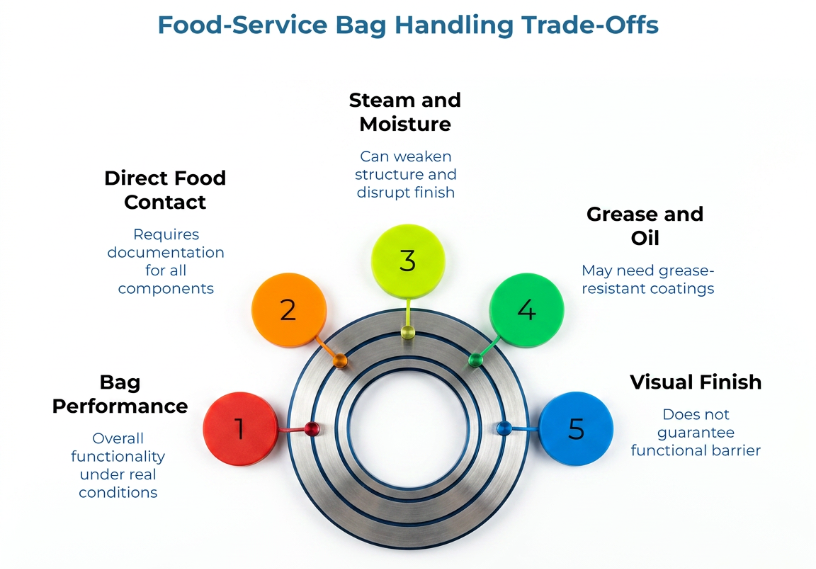
Food-service applications shift the evaluation from “How does this bag look?” to “How does it perform when it holds food under real conditions?”
Visual finish vs. functional barrier. A bag may have a branded exterior while having no barrier on the food-contact side. For bags used with bakery goods, sandwiches, fried items, or hot meals, the relevant surface is the one facing the food—not the one the customer sees. Do not assume that a visually finished bag provides a functional barrier unless the supplier confirms it.
Grease and oil exposure. Bags carrying greasy or oily food may require a grease-resistant coating or liner. A coating that performs adequately with dry pastries may fail with a hot, oil-rich sandwich held for 20 minutes. Because traditional grease-proofing agents often relied on per- and polyfluoroalkyl substances (PFAS)—which are now subject to a U.S. FDA-coordinated market phase-out, strict bans under various state laws, and EU regulations—buyers must ask suppliers to document not only the grease-resistance scope and test basis, but also explicit evidence of PFAS compliance.
Steam, condensation, and moisture. Hot food generates steam. If the bag traps moisture against the paper, it can weaken the structure, soften the surface, or disrupt the printed finish. Depending on food type, hold time, and whether the bag is sealed or open, moisture-resistant coatings or venting may be relevant. A closure method, liner, venting approach, or inner wrap may sometimes matter as much as the outer finish. The guide on paper bag venting and moisture management covers this interaction further.
Grease, steam, and moisture are not the same problem. Grease exposure may require one type of documentation. Steam and condensation may create a different handling issue. Defining the specific exposure before requesting quotes helps avoid conflating these distinct failure modes.
Direct vs. indirect food contact. Whether food touches the bag directly or sits inside a liner, tray, or wrapper changes the documentation requirements significantly. Direct-contact applications may require evidence covering the coating, ink, adhesive, and every other component—not just the paper substrate. Ask the supplier to document whether coverage extends to the full finished bag. The guide on food-service paper bag materials addresses what to check for contact surfaces, liners, and coatings.
Where food-contact claims are involved, the U.S. FDA, the European Food Safety Authority (EFSA), and the European Commission’s food contact materials page publishes guidance that can help buyers understand what documentation to expect. These links should not be treated as a substitute for supplier documentation or professional review.
The Coating-and-Finish Trade-Off Matrix
The matrix below organizes common finish directions by the reason buyers choose them, the handling question each raises, the supplier documentation to request, and the over-specification risk. It is a starting point for structuring supplier conversations—not a substitute for sample testing and document review.
| Finish / Coating Direction | Why Buyers Choose It | Practical Handling Question | Documentation to Request | Over-Specification Risk |
| Uncoated kraft or white paper | Cost efficiency, natural look, perceived sustainability | Does the bag actually need barrier or scuff protection for its intended use? | Basis weight, fiber source, any sustainability claim evidence | Adding a coating when uncoated paper would be sufficient |
| Matte finish | Premium tactile feel, subdued brand appearance | Does the matte surface hold up to stacking, bundling, and customer handling? | Scuff and rub behavior under expected handling conditions | Choosing matte for aesthetics when handling durability matters more |
| Gloss or high-sheen finish | Visual impact, color pop, shelf presence | Does the gloss resist fingerprints, scuffing, and cracking at fold lines? | Ink compatibility, fold-crack behavior, coating type | Specifying gloss for a bag that will be handled roughly or briefly |
| Grease-resistant treatment | Food-service handling of oily or greasy items | What grease types, hold times, and temperatures does the treatment cover? | Test method, grease-resistance scope, food-contact documentation | Requiring grease resistance for dry goods or non-food retail use |
| Moisture-resistant or barrier coating | Exposure to steam, condensation, or wet conditions | Does the barrier match the specific moisture source and expected hold time? | Barrier scope, test basis, effect on recyclability or end-of-life claims | Adding moisture barriers for short-carry, dry-use bags |
| Printed or ink-heavy finish area | Brand presentation, product information, regulatory labeling | Does the ink system perform on the chosen substrate and finish? | Ink rub resistance, adhesion to coated surface, food-contact status of ink | Heavy ink coverage on surfaces that are not customer-facing |
What Buyers Should Ask Suppliers to Document
Supplier catalogs and sample kits show what a finish looks like. They rarely document what it does under real operating conditions. Before approving a coated or finished bag for volume production, request clear answers to these questions:
- What exactly is the finish or coating? Ask for the coating type, material, and application method—not just a marketing name.
- Which side of the bag is coated or finished? Outside-only, inside-only, or both? This affects presentation, barrier function, and documentation scope.
- Does the coating contact food directly or indirectly? If the bag serves food, clarify whether the coated surface faces the food and whether documentation covers that specific contact condition.
- What inks, adhesives, liners, or handles are part of the finished bag? A food-contact or sustainability claim for the paper substrate may not extend to the ink, adhesive, handle, or liner.
- What test reports or declarations support food-contact, recyclability, compostability, or performance claims? Ask for the test method, scope, date, and SKU-level applicability.
- Are documents tied to the specific SKU, production site, material source, and batch? Generic documentation that covers an entire product family may not apply to the exact bag being ordered.
For grease-resistance claims, suppliers may refer to recognized methods such as TAPPI’s T 559 grease resistance test for paper and paperboard. ASTM International publishes additional test methods for paper coating properties and ink rub that serve as useful reference points. Do not convert a test reference into a universal performance promise—ask whether the result applies to the finished bag or only to one material input.
For recyclability claims, ask whether the claim is tied to the exact material combination and the destination market’s recovery system. ISO 18604, packaging and environment material recycling standard, is an example of a reference buyers may use to understand why recyclability claims need a defined basis.
For chain-of-custody claims, verify certificate status and scope through sources such as the FSC Public Certificate Search or PEFC Find Certified, if those schemes are cited. For compostability claims, check the relevant certification scheme and product scope where applicable, such as BPI Certified Compostable for markets where that certification is used.
The goal is not to create friction with suppliers but to ensure that procurement, QA, and operations work from the same documented evidence before volume commitments.
Do Not Approve a Finish Based Only on a Sample Photo
A sample photo can help screen visual direction. It cannot answer the specification questions that matter in purchasing, QA, operations, or sustainability review.
Before approving the finish direction, confirm what finish or coating is actually being used, which side of the bag is coated or finished, what handling condition it is meant to solve, and what documentation supports any associated claim.
This is especially important for multi-store or multi-outlet rollouts. A finish that looks acceptable in one sample may still create questions around batch consistency, print variation, handling marks, or claim documentation once volume production begins.
When a Simpler Finish May Be the Better Specification
Not every paper bag needs a coating or a premium finish. Over-specifying—selecting a barrier-coated or multi-treatment bag when a simpler option would meet the need—adds cost and documentation complexity without proportional benefit.
A retail bag carrying dry goods for a short walk may not require grease resistance, a moisture barrier, or a scuff-resistant coating. An internal fulfillment bag that never reaches the customer may not need any visual treatment at all.
The right question is not “Which finish is best?” but “What failure or documentation gap does the finish need to solve?” If the answer is better brand presentation, define the visual standard. If the answer is scuffing, request handling evidence. If the answer is grease exposure, define the exposure and request claim documentation. If the answer is sustainability, clarify the exact claim and the proof needed before using it externally. If there is no clear answer, a simpler specification is likely the better choice.
Practical Buyer Checklist Before Sending the RFQ
Use the checklist below to align procurement, packaging, operations, and QA before contacting suppliers.
- Define the primary use case: retail display, food service, internal packaging, or a combination.
- Identify the exposure profile: dry, greasy, moist, hot, high-touch, long hold time, or minimal handling.
- Clarify contact conditions: direct food contact, indirect contact, wrapped food, or no food contact.
- Define print and brand requirements: color accuracy, ink coverage area, scuff tolerance, and batch-to-batch consistency expectations.
- Identify any claims—food-contact suitability, recyclability, compostability, grease resistance, PFAS-related, or sustainability—that will require documented evidence.
- Ask all suppliers to quote against the same finish, coating, ink, and documentation assumptions so that comparisons are normalized.
- Request physical samples tested under real handling conditions, and review supporting documents before granting volume approval.
Frequently Asked Questions
Are coated paper bags always better than uncoated paper bags?
No. Coatings can help with specific presentation or handling goals, but they also affect cost, documentation requirements, and end-of-life claims. Whether a coated bag is the right choice depends on the use case and the claims that need to be supported. For many applications, an uncoated bag is the simpler and more practical specification.
Can a paper bag finish prove food safety?
A finish description alone does not establish food-contact suitability. Food-contact status depends on the full bag assembly—coating, ink, adhesive, liner, and substrate—and on the contact conditions, food type, temperature, and hold time. Ask suppliers for documentation covering the exact material combination and intended use.
Are coated paper bags recyclable?
That depends on the coating type, local recycling infrastructure, and the evidence behind the claim. Some coatings may be compatible with certain recovery systems; others may not. Avoid broad recyclability claims without current documentation specifying the coating and the relevant recovery system.
What should buyers ask before approving a printed paper bag finish?
Ask about ink compatibility with the substrate and coating, rub and scuff performance under expected handling conditions, which side of the bag is coated, whether the ink is relevant to food-contact documentation, whether batch-to-batch appearance consistency is controlled, and what documents support any sustainability or compliance claims.
Conclusion
Finish choices work best when they connect appearance, handling requirements, exposure conditions, and documented proof. Defaulting to the most visually appealing option—without confirming how it performs and what evidence supports any claims—creates risk that surfaces later in operations, compliance, or customer complaints.
Buyers who get the most reliable outcomes define their use case, identify which claims need documentation, and ask suppliers to demonstrate what the finish actually does before committing to volume.
Compare paper bag supplier options after you define your coating and finish requirements. When those requirements are clear, you can submit an RFQ with the specificity suppliers need to quote accurately.
Disclaimer:
This article is for general informational purposes only and does not constitute compliance, safety, technical, or professional advice. Requirements, risks, and best practices may vary by context, jurisdiction, product, supplier, coating, and intended use. Confirm important decisions with the appropriate qualified professional, authority, supplier documentation, or technical expert.
Our Editorial Process:
Our expert team uses AI tools to help organize and structure our initial drafts. Every piece is then extensively rewritten, fact-checked, and enriched with first-hand insights and experiences by expert humans on our Insights Team to ensure accuracy and clarity.
About the PaperIndex Insights Team:
The PaperIndex Insights Team is our dedicated engine for synthesizing complex topics into clear, helpful guides. While our content is thoroughly reviewed for clarity and accuracy, it is for informational purposes and should not replace professional advice.