

📌 Key Takeaways
Coating specs locked down before a trial turns surprises into diagnosable problems instead of expensive guesses.
- Document Every Variable First: A complete spec matrix — coating type, board properties, seal settings, storage history — gives teams a baseline to trace what actually went wrong.
- GSM Alone Misleads: Two boards with the same weight can perform very differently because thickness, stiffness, and moisture affect forming and sealing independently.
- Blame Is Usually Premature: Most trial failures have multiple possible causes, so a “hold and investigate” decision beats snap pass/fail calls that miss the real variable.
- Lock Acceptance Rules Early: Pass, hold, retest, and reject criteria agreed before the trial starts keep post-trial reviews objective instead of reactive.
- Ask Suppliers the Right Questions: Confirm coating side, coat weight range, tolerances, test methods, storage guidance, and whether the sample matches actual production material.
Spec discipline before the trial protects every hour of machine time spent during it.
Procurement managers, QA leads, and production teams at growth-stage cup converters will gain a practical pre-trial framework here, preparing them for the detailed specification walkthrough that follows.
~ ~ ~ ~ ~ ~ ~ ~ ~ ~ ~ ~ ~ ~ ~ ~ ~ ~
A coated cupstock sample can look flawless at a desk review — correct weight, smooth surface, clean edges — and still cause side-seam leaks, bottom-seal weakness, rim cracks, poor feeding, print scuffing, or blank blocking on the converting line. The gap between a promising sample and a meaningful trial rarely traces to “bad material.” More often, specification details were never confirmed, never shared across teams, or never documented clearly enough to interpret what went wrong.
For growth-stage paper cup manufacturers with limited trial budgets, unclear results carry real consequences: wasted machine time, delayed orders, and disagreement about whether the material or the setup caused the problem.
Why Coating Specifications Matter Before a Cupstock Converting Trial
A converting trial can fail for reasons entirely unrelated to the coating. Board structure, moisture pickup during storage, print surface chemistry, machine settings, and trial setup can all contribute. When specification fields are incomplete or inconsistent across procurement, QA, and production, the team has no reliable way to isolate which variable caused the issue.
The purpose of pre-trial specification work is not to guarantee success — it is to define enough variables so that unexpected outcomes can be diagnosed rather than guessed at. For SMB converters without the budget to repeat avoidable trials, that diagnostic clarity is worth the upfront effort.
The Pre-Trial Cupstock Coating Specification Matrix
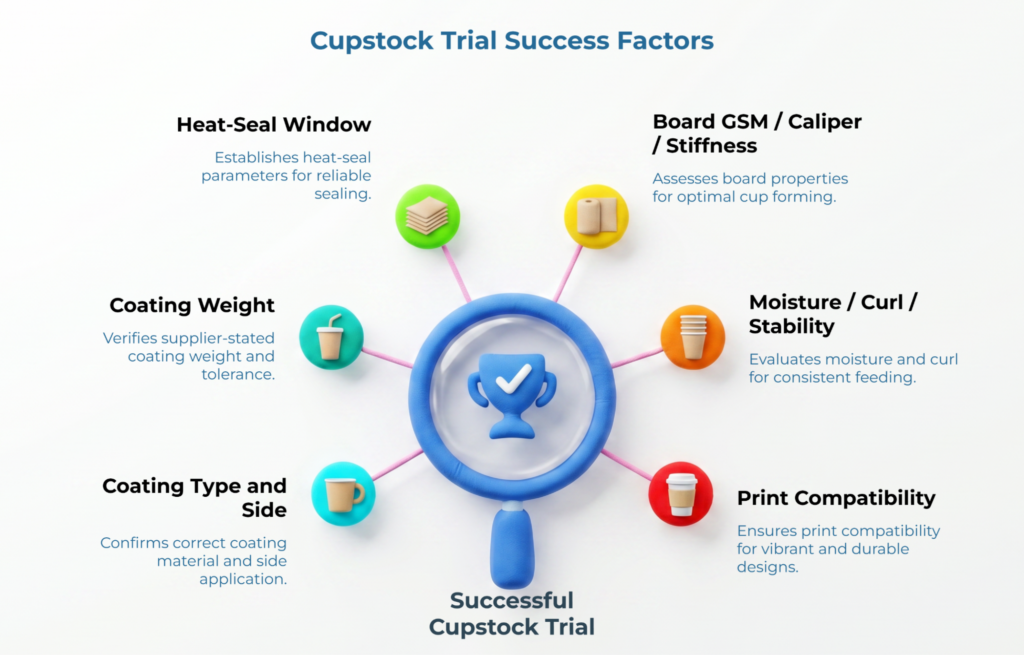
The following matrix details the fundamental specification metrics that govern line runnability. It is a documentation discipline tool, not a universal pass/fail checklist. Each converter should adapt it to the specific machine, cup format, beverage application, and supplier documentation available.
| Specification Area | What to Confirm | Why It Matters in Trial | Who Should Review |
| Coating type and side | Coating material (PE, PLA, aqueous, other barrier), which side is coated, which side contacts the product, which side is printed or sealed | Prevents wrong-side or wrong-method assumptions during sealing and forming | Supplier + QA + Production |
| Coating weight / range | Supplier-stated coat weight or range and tolerance | Affects sealing strength, barrier performance, board stiffness contribution, and print surface behavior | QA + Supplier |
| Heat-seal window | Temperature, pressure, and dwell time assumptions if supplier provides them | Helps production interpret side-seam or bottom-seal failures as specification gaps rather than machine faults | Production + Supplier |
| Board GSM / caliper / stiffness | Basis weight, thickness, bending resistance values, tolerances, and test method references where available | Affects cup forming, rim curl, rigidity, stackability, and machine feed reliability | QA + Production |
| Moisture / curl / stability | Conditioning history, storage conditions, observed curl direction and severity | Affects sheet feeding, blank registration, forming consistency, and trial repeatability | QA + Warehouse |
| Print compatibility | Print method, ink system, surface energy or treatment details if relevant | Helps avoid ink adhesion, scuffing, or drying surprises that may not originate with the coating | Printing + QA |
| Trial acceptance criteria | Defined pass, hold, retest, and reject rules agreed before the trial starts | Makes the outcome actionable across procurement, QA, production, and the supplier | Cross-functional team |
Every blank cell in this matrix represents a potential source of ambiguity when the trial is reviewed.
The matrix should not be filled with universal numeric thresholds unless those values come from the converter’s own specification, supplier technical data sheet, approved lab report, or verified test-method reference. A useful matrix creates comparability across samples and suppliers; it does not guarantee runnability on any specific line.
Coating Details That Can Change Sealing and Forming Results
Coating type is the starting point, but not the full picture. PE, PLA, aqueous, and other barrier coatings each respond differently to heat and pressure, and each interacts differently with the base board. Knowing the coating material without the coating side, target coat weight, and assumed sealing method leaves too many variables undefined when problems appear on the line.
The coating deserves more attention than many supplier data sheets give it. The print side, product-contact side, side-seam area, and bottom-seal area may not be interchangeable — a board coated on the product-contact side for barrier purposes may behave differently in side-seam sealing than one coated on both sides. If the technical data sheet (TDS) does not specify which side faces the seal bar versus the print surface, the converter cannot separate a coating-placement issue from a temperature or dwell-time issue.
Coat weight or coat-weight range, where the supplier provides it, influences sealing window, barrier integrity, and printability. A narrow tolerance suggests tighter process control; a wide range may introduce roll-to-roll variability during the trial. Surface continuity matters too — pinholes, scuffing, blocking between stacked sheets, or delamination at the coating-board interface can produce defects that mimic forming or sealing failures but originate in the coating layer.
The point is not to rank coating types — it is to document enough detail so unexpected results trace to a specific variable. For related discussion, see cupstock specification mistakes that can create converting, sealing, or waste issues.
Board Properties That Can Make Similar Coatings Behave Differently
Two cupstock samples with identical GSM and the same coating type can perform quite differently on a converting line. GSM measures mass per unit area but says nothing about thickness, stiffness, or dimensional stability — properties that directly affect forming, rim quality, feeding, and finished-cup rigidity.
A board with adequate GSM but low stiffness may form well at reduced speed yet produce inconsistent rims at production pace. A board that differs significantly from the converter’s current baseline may also require machine adjustment before its coating behavior can be judged fairly. Specifying caliper and bending resistance with tolerances and test method references — such as ISO 536 for grammage, ISO 534 for thickness, or ISO 2493-2 for bending resistance — makes values comparable across suppliers and trial batches.
Moisture content, curl, and dimensional stability add another layer. A board that has absorbed moisture during storage may curl or distort, producing trial results that reflect storage history rather than material capability. Conditioning samples to a controlled atmosphere before trial — a principle covered by ISO 187 — helps separate storage effects from board properties. For deeper coverage, see how cupstock moisture, curl, and dimensional stability affect production planning.
Surface smoothness, treatment, and coating holdout can also affect print adhesion and coating anchorage, particularly when the ink system differs from what the supplier assumed. Poor ink adhesion, mottling, scuffing, or drying issues may involve any combination of the ink system, print method, surface energy, coating, or post-print handling. Where tolerances and named test methods are available, QA should request them — but current standard versions and method suitability should be verified before specification lock-in or supplier approval.
Trial Conditions That Should Be Documented With The Material Specifications
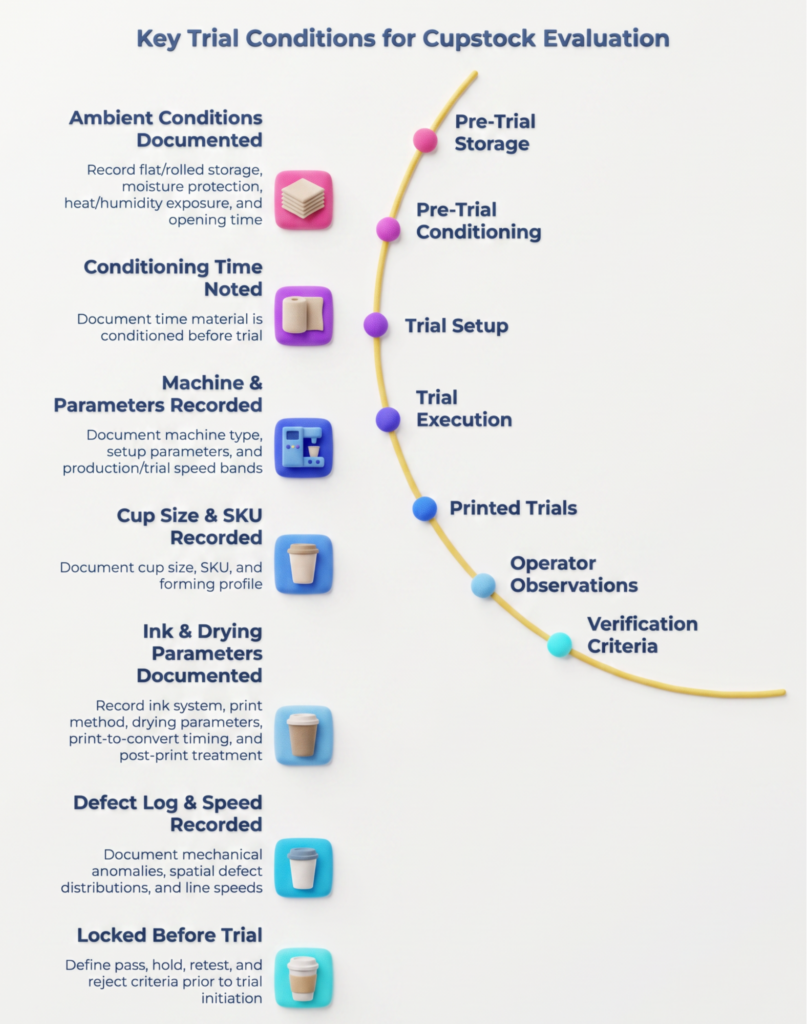
Material specifications alone do not make a trial interpretable. The conditions under which the material was stored and the trial is run determine whether results can be repeated, compared, or used to support a supplier decision.
Machine type, setup parameters, and production speed or trial-speed bands belong in the trial record alongside the cupstock specifications. A trial on a different machine or at a substantially different speed than the intended production run may yield non-transferable results. Cup size, SKU, and forming profile matter as well: the same board can perform acceptably in one format and poorly in another because of differences in draw depth, rim diameter, or seam geometry.
Ambient storage conditions and conditioning time before the trial also deserve documentation. Warehouse teams should note whether the material was stored flat or rolled, protected from moisture, staged near heat or humidity sources, or opened long before the trial. Blanks stored in a humid warehouse for weeks then run without conditioning generate results reflecting storage exposure, not the board.
When printed trials are included, record the ink system, print method, drying parameters, print-to-convert timing, and any post-print treatment or handling conditions. Print-related defects during a coating trial are easily misattributed to the coating when the actual variable is ink compatibility or drying. Operator observations and a structured defect log—documenting mechanical anomalies, spatial defect distributions on the cup body, and line speeds—complete the trial record. Verification criteria must be locked prior to trial initiation. Pass, hold, retest, and reject decisions should not be created under pressure after defects appear. A structured cupstock sample review checklist prevents the review from becoming a subjective desk-sample approval.
How To Interpret Trial Surprises Without Overreacting
Most trial surprises have more than one plausible cause. The instinct to blame the material or the machine is understandable, but premature conclusions risk rejecting a viable grade or repeating a trial without addressing the real variable.
| Trial Surprise | Do Not Assume | Review These Specification Areas |
| Side-seam leaks | Coating is defective | Coating side, coating weight, sealing window, pressure, dwell, machine settings |
| Curl before forming | Board is unusable | Moisture, storage, conditioning, grain direction, dimensional stability |
| Poor print adhesion | Ink is wrong | Coating surface, surface treatment, ink system, drying, handling |
| Rim cracking | Board is too light | Caliper, stiffness, moisture, forming profile, cup design |
| Blocking or blank sticking | Storage ruined the material | Coating formulation, storage temperature, humidity, pallet condition, stacking pressure, elapsed storage time |
A “hold and investigate” decision is nearly always more productive than an immediate pass or fail. When the specification matrix was completed beforehand, the team has a documented reference for each variable. Without it, results become harder to act on because there is no baseline for comparison. This approach keeps the discussion technical and traceable, and helps suppliers respond with useful clarification instead of defending against a vague failure report.
Compiling granular data profiles for marginal runs yields higher operational value than an undocumented clean run; seasonal humidity shifts and roll-to-roll variances will inevitably alter line dynamics. Verification must isolate local sample anomalies from macro production readiness.
What to Ask Suppliers Before Scheduling The Next Cupstock Trial
Supplier documentation is the first input to the specification matrix. Requesting the right details beforehand avoids discovering gaps on the converting line.
At a minimum, confirm the grade name, coating type, coating side, coating weight or range, board GSM, caliper, stiffness, tolerances for each property, applicable test methods, and the current TDS for the grade being trialed. If the application involves food contact, clarify the scope of food-contact documentation for the specific grade, coating, and intended market. A general “food grade” label is often insufficient; documentation must demonstrate compliance with the specific regulatory frameworks governing the target market, such as FDA 21 CFR part 176.170 in the U.S. or the EU Framework Regulation (EC) No 1935/2004, which require testing based on exact use conditions like temperature and food type.
Storage and handling guidance — recommended temperature, humidity range, maximum storage duration, stacking notes — helps the converter control pre-trial conditions. If the trial includes printed cups, request printing guidance covering assumed ink systems, surface treatment requirements, and any post-print handling recommendations.
One question often overlooked: whether the trial sample is production-equivalent material or a lab-produced batch. If sample conditions differ from commercial production, the trial may not predict scale-up performance. Ask the supplier what changes between sample and commercial output would trigger a re-trial. For help structuring these requests, see how to translate paper cup performance requirements into supplier-ready cupstock specifications.
Conclusion: Make The Trial Easier to Interpret Before The Line Starts
Good specification discipline does not remove all trial risk. What it does is make outcomes easier to interpret because coating, board, print, storage, machine setup, and acceptance criteria are visible before production time is spent.
The strongest pre-trial review is cross-functional: procurement gathers supplier information, QA checks documentation and measurable fields, production tests under defined conditions, and the supplier clarifies grade-specific assumptions. Use the trial-readiness matrix to align these teams before scheduling the next machine trial. Once specification fields are defined, compare cupstock suppliers on documented fit rather than surface-level sample impressions.
Frequently Asked Questions
Is GSM enough to compare cupstock samples before a trial?
GSM describes mass per unit area but does not capture caliper, stiffness, coating weight, moisture content, or dimensional stability. Two samples with identical GSM can produce different forming, sealing, feeding, and rim results because these properties vary independently.
Which coating detail matters most for sealing?
No single coating detail controls sealing performance in isolation. Coating type, coating side, coat weight, coating continuity, the heat-seal window (temperature, pressure, dwell time), sealing method, and the machine’s sealing setup all interact. Isolating one variable without documenting the others makes it difficult to diagnose or repeat sealing outcomes.
Should a cupstock sample be approved after a desk review?
Desk review can screen for obvious issues — surface defects, dimensional errors, missing documentation — but cannot predict converting behavior under forming, sealing, and printing conditions. Production-like trials under documented conditions are generally necessary before approving a grade for scale-up.
What should be documented after a converting trial?
Record material specifications confirmed before the trial, supplier batch or sample identification, machine type and setup, production speed, ambient conditions, defect types and locations, acceptance decision (pass, hold, retest, reject), retest conditions if applicable, and follow-up questions for the supplier or internal teams.
Disclaimer:
This article is for general informational purposes only and does not constitute technical, compliance, safety, or professional advice. Cupstock specifications, coating behavior, food-contact requirements, and converting performance can vary by grade, supplier, machine setup, storage conditions, use case, and target market. Confirm important decisions with your supplier, QA team, production team, test laboratory, or other qualified professional.
Our Editorial Process:
Our expert team uses AI tools to help organize and structure our initial drafts. Every piece is then extensively rewritten, fact-checked, and enriched with first-hand insights and experiences by expert humans on our Insights Team to ensure accuracy and clarity.
About the PaperIndex Insights Team:
The PaperIndex Insights Team is our dedicated engine for synthesizing complex topics into clear, helpful guides. While our content is thoroughly reviewed for clarity and accuracy, it is for informational purposes and should not replace professional advice.