

📌 Key Takeaways
Most cupstock problems start not with bad material but with incomplete specifications that leave suppliers guessing what production actually needs.
- Specifications Beat Supplier Blame: When cups leak or jam, the real cause is often a vague specification — not a bad shipment — because suppliers quote from their standard sheet when buyers skip key details.
- GSM Alone Is Not Enough: Paper weight does not predict how a sheet will form, seal, or run on a machine — caliper, stiffness, and moisture matter just as much.
- Coating Details Prevent Seal Failures: Writing “PE-coated” without stating which side, what weight, and what sealing conditions are expected leaves too many variables open for production.
- Roll and Delivery Specifications Cut Hidden Waste: Wrong roll sizes, undocumented splices, and poor edge quality create scrap before a single cup is formed — and these details rarely make it into the RFQ.
- Test Samples Under Real Conditions: A sheet that looks right on a desk may fail at production speed, so trial criteria — cup size, line speed, sealing settings, and pass/fail definitions — should be agreed before testing begins.
Clearer specifications before the RFQ prevent more waste than better suppliers after it.
Procurement, production, and QA teams sourcing cupstock will gain a practical alignment framework here, guiding them into the specification-gap checklist and cross-functional review process that follows.
~ ~ ~ ~ ~ ~ ~ ~ ~ ~ ~ ~ ~ ~ ~ ~ ~ ~
When a paper cup leaks at the seal or jams on the forming line, the default assumption is often that the supplier shipped substandard material. That assumption is worth questioning. Cupstock problems frequently originate not in the material itself but in the specification that was used to order it.
A quote can look perfectly acceptable — the GSM matches, the price is competitive, the coating label says “PE-coated” — and still describe a material that creates friction during converting, sealing, or start-up trials. The gap between what procurement specifies and what production actually needs is where avoidable waste, runnability failures, trimming losses, and supplier disputes begin.
Often, procurement receives incomplete input from production or QA. Production teams may describe problems in machine language that do not translate into supplier-ready specification fields. And suppliers, without clear buyer-owned requirements, quote from their standard product sheet. Everyone works from different assumptions — and no one discovers the mismatch until material is on the floor. The cause may turn out to be the material, the machine setup, storage conditions, unclear acceptance criteria, or poor handoff between teams. Treating the supplier as the default explanation delays the real diagnosis.
The Core Mistake: Treating Cupstock as a Commodity Line Item
Procurement teams often compare cupstock on three fields: GSM, price, and a general coating description. These are reasonable starting points, but they describe the product on paper — not how it will behave during cup forming, side seam sealing, or bottom sealing on a specific converting line.
A supplier-ready cupstock specification should reflect the cup design, forming equipment, sealing method, storage environment, and acceptance criteria that production and QA depend on. When those fields are missing, two quotes that look comparable may describe materials with very different converting behavior. The practical question every buyer should ask before comparing quotes is whether all suppliers are quoting against the same material requirement, the same production assumptions, and the same approval conditions.
This is not a supplier failure. It is a specification alignment problem — and it can be addressed before the first RFQ goes out.
Specification Gaps and Operational Risks
The matrix below maps common specification gaps to the risks they can create. It is designed as a pre-RFQ alignment tool for procurement, production, and QA teams.
| Specification Gap | What Can Go Wrong | Who Should Confirm It | What to Ask Before RFQ |
| Coating side or type not clearly stated | Forming or sealing may target the wrong surface; coating behavior may not match the sealing method | Production, QA, and supplier | Which side is coated? What coating type does the cup design and sealing process require? How will it be documented? |
| GSM or basis weight listed without tolerance | Delivered material may fall outside the range production needs; quotes become difficult to compare on equal terms | Procurement, QA, and supplier | What GSM range and tolerance does the forming line require for supplier comparison and incoming checks? |
| Caliper or stiffness not defined | Cups may lack structural rigidity, forming and nesting may vary, rim behavior or handling may differ — even when GSM looks similar | Production engineer or packaging technologist | What caliper and stiffness range does the target cup design need? |
| Moisture and conditioning assumptions missing | Material may gain or lose moisture in storage or transit, changing runnability and seal quality by the time it reaches the machine | QA, warehouse, and supplier | What moisture range is acceptable at the point of use? What storage and conditioning assumptions should be shared before approval? |
| Roll width, diameter, core size, or winding direction unclear | Rolls may not fit the converting line, increasing waste from reslitting, rewinding, setup delays, or incorrect feed orientation | Production and warehouse | What roll geometry and winding specifications does the machine require? |
| Edge quality, splice, or roll damage criteria missing | Edge defects or undocumented splices can cause web breaks, forming failures, start-up waste, trimming waste, or unplanned downtime | QA, production, and receiving teams | What are the acceptance limits for edge condition, splice frequency, roll packaging, and wrapping? |
| Sealability expectations not tied to cup line trial conditions | Material may pass a benchtop test but fail under actual production speed, temperature, and pressure | Production, QA, and supplier | What sealing conditions will the trial use, and what defines a passing result? |
| Food-contact or coating documentation not matched to the target market | Documentation may not satisfy requirements for the intended end-use market or application | Regulatory, compliance team, QA, and supplier | What food-contact documentation does the target market require? Has the supplier confirmed availability? |
| Sample approval not linked to production-equivalent trial | Approved samples may not reflect performance at bulk production scale | Procurement, production, and QA | Will samples be tested at production speed, on the target cup size, under realistic conditions? What trial conditions and decision gate are required before bulk approval? |
Specifying Paper Properties Without Converting Behavior
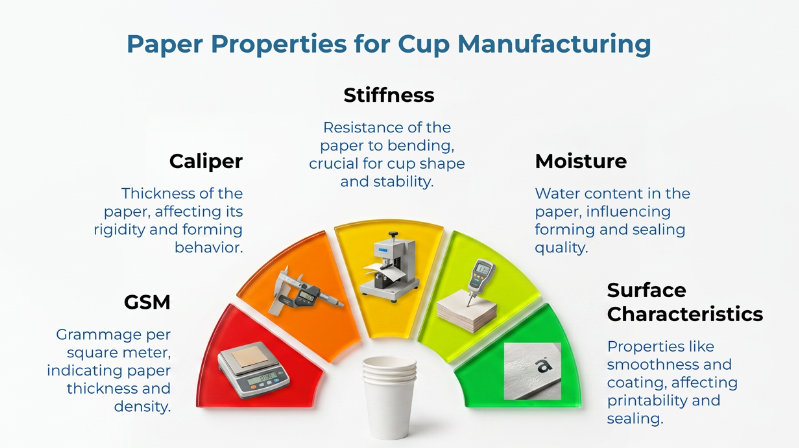
GSM tells a buyer how much the paper weighs per square meter. It does not explain how that paper will form into a cup, hold its shape under load, or run through a high-speed machine without jamming.
Caliper, stiffness, and moisture each interact with forming behavior, cup rigidity, and runnability. A sheet at the correct GSM but with stiffness below what the forming die expects may produce cups that collapse during stacking or nest unevenly. A sheet with moisture above the target range may behave differently during forming or create inconsistent seal quality. Two boards with similar GSM may still behave differently if caliper, stiffness, moisture, or surface characteristics vary. These properties depend on the cup design, the forming equipment, and the end-use application — a higher or lower value is not automatically better.
This matters because production teams often describe problems in machine-language: poor forming, unstable feed, curl, seal inconsistency, edge damage, or unexpected waste at start-up. Procurement then has to translate those symptoms into supplier-ready specification fields. If the original RFQ only captured GSM and basis weight, that translation becomes harder — and production and QA lose the reference points they need for incoming inspection.
A stronger approach is to identify which paper properties are fixed requirements, which are acceptable within defined tolerances, and which need supplier confirmation. For teams that rely on standardized test methods, organizations such as ISO 536 (grammage determination) and TAPPI (for pulp and paper industry methods) publish the relevant procedures. Any specific test method referenced in a specification should be agreed upon and verified before the RFQ, not discovered during a dispute over conflicting results.
Leaving Coating and Sealing Assumptions Too Vague
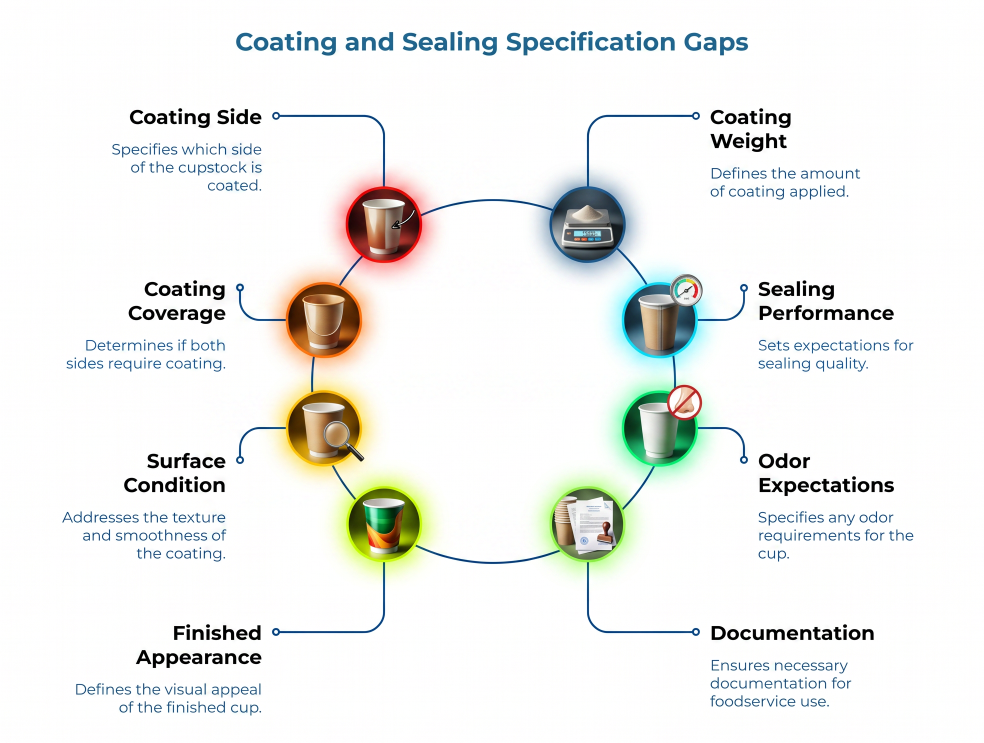
Coating is where many cupstock specification gaps become visible — and where they tend to do the most damage. A specification that says “PE-coated” without further detail leaves critical questions open: which side is coated, what coating weight is expected, whether both sides require coating, and what sealing performance the coating must deliver during side seam and bottom sealing.
Seal quality depends on the interaction between coating type, coating uniformity, surface condition, and the line-specific sealing conditions — the temperature, pressure, and dwell time used on the actual cup machine. A material that seals reliably under one set of conditions may leak under another. Without documented sealing expectations in the specification, there is no shared standard for evaluating trial results and no clear basis for resolving disagreements if cups fail.
Coating details can also affect more than sealing. Depending on the application, buyers may need to consider surface condition, odor expectations, finished-cup appearance, and documentation for the intended foodservice use. These are not all the same requirement, and a specification that groups them under a single “coated cupstock” label risks leaving each one underspecified.
Foodservice packaging adds regulatory complexity. Different markets may require different food-contact certifications, declarations, or test evidence, and requirements can vary by coating type and application. If the specification does not identify the target market’s documentation needs, procurement may approve a supplier whose compliance paperwork does not match the end-use requirement. For formal verification of food-contact compliance, buyers must ensure material adherence to specific jurisdictional statutes, such as the codified FDA 21 CFR requirements in the U.S. or Framework Regulation (EC) No 1935/2004 in the EU. Assessing these specific regulatory pathways necessitates consultation with qualified legal or regulatory counsel.
If bottom components are sourced separately, procurement may also need to clarify whether the requirement involves cupstock rolls, bottom rolls, or another format.
Confirming coating details, sealing expectations, and documentation requirements with production, QA, and regulatory stakeholders before the RFQ can prevent these gaps from surfacing late.
Ignoring Roll and Delivery Details That Affect Waste
Waste does not always begin at the cup machine. It can start at the loading dock. Cupstock delivered in the wrong roll width, diameter, or core size may require reslitting or rewinding before it can run. Rolls with undocumented splices can cause unexpected line stops. Poor edge quality from inadequate wrapping or rough handling may force operators to strip outer layers before production even begins.
A specification that covers paper properties and coating but omits roll geometry, winding direction, splice limits, edge quality criteria, and packaging requirements leaves these waste sources unmanaged. Production teams typically know exactly what the machine needs — but those details may never reach the procurement document unless they are explicitly requested.
This is especially important when incoming inspection lacks lot, roll, or tolerance references. Without those references, teams may struggle to separate supplier variation from warehouse handling, storage exposure, machine adjustment, or approval-process gaps.
Batch traceability and labeling requirements also belong in the specification. A useful receiving process records the condition of each roll before production — wrapping condition, visible edge damage, roll identification, batch reference, storage status, and document match against the buyer-owned specification. For teams working to formalize this step, building a specification-first receiving log can connect delivery documentation to production-ready acceptance criteria.
The goal is not to reject more material. The goal is to reduce uncertainty before a problem reaches the converting line.
Approving Samples Without Production-Equivalent Acceptance Criteria
A sample sheet that looks and feels right during a desk-side review is not the same as a material that performs at production speed, on the target cup size, under realistic sealing conditions. Sample approval without production-equivalent trial criteria is one of the most common paths to unexpected problems at scale.
Before a trial begins, production and QA should agree on what “pass” means: which cup sizes will be formed, at what line speed, under what sealing settings, with what defect tolerances, and over what run length. Without documented criteria, a trial becomes subjective — and if the material fails at volume, there is no reference point for diagnosing whether the issue was the material, the machine setup, or storage conditions.
The trial should also clarify what is being approved. A team may be approving a supplier, a grade, a coating structure, a roll format, a document set, or a specific production condition. If this scope is unclear, sample approval can become too broad. Later, when a bulk shipment behaves differently, the team may not know whether the issue came from material variation, storage, machine setup, or an approval process that was too informal.
Storage matters more than many teams realize. If samples sit in an unconditioned warehouse for weeks before testing, results may reflect moisture changes rather than material quality.
How Procurement, Production, and QA Can Close the Specification Gap
Most cupstock specification gaps are not caused by a lack of knowledge. They are caused by a lack of structured handoff between the teams that each own a different piece of the specification puzzle.
Procurement owns the commercial relationship and the RFQ document. Production owns the machine requirements, forming constraints, and sealing conditions. QA owns the acceptance criteria, test methods, and documentation standards. When each team contributes its inputs to a shared specification before the RFQ goes out, quotes become easier to compare, trials produce more useful data, and incoming inspection becomes a practical quality gate rather than an afterthought.
A practical starting point is a single cross-functional alignment meeting with three outputs: a buyer-owned specification sheet that captures production and QA requirements alongside commercial terms, a supplier question set that addresses any fields the internal team could not resolve on its own, and a set of incoming inspection criteria that tie delivered material back to the agreed specification and trial pass/fail definitions.
Teams looking to strengthen this process further may benefit from learning how to catch specification gaps before an order is placed or how to standardize paper supplier quotes for more consistent comparison.
Supplier-Ready Specification Checklist
Before comparing cupstock quotes, confirm that the following fields are defined and agreed upon internally:
- Coating side, coating type, coating weight expectations, and documentation requirements
- GSM or basis weight with acceptable tolerance range
- Caliper, stiffness, and surface properties relevant to the target cup design
- Moisture range at point of use and storage or conditioning requirements
- Roll width, diameter, core size, winding direction, splice expectations, and edge-quality criteria
- Roll packaging standards and wrapping condition requirements
- Sealability trial conditions, including speed, cup size, sealing parameters, and pass/fail definitions
- Food-contact, coating, odor, and target-market documentation matched to the intended application
- Sample approval criteria linked to production-equivalent trial conditions, including who observes the trial and what counts as pass or hold
- Incoming inspection fields, lot traceability, batch labeling requirements, and receiving notes
- Supplier question set for any field that cannot be confirmed from the quote alone
Do not compare cupstock quotes until these fields are defined across procurement, production, and QA.
Use the checklist above to align teams before supplier outreach. When specification fields are ready, compare cupstock suppliers or submit an RFQ to receive supplier quotes.
Frequently Asked Questions
What cupstock details should be clarified before an RFQ?
At minimum, consider clarifying coating side and type, GSM with tolerance, caliper and stiffness requirements, moisture expectations, roll geometry and winding direction, splice and edge quality criteria, storage assumptions, sealing trial conditions, food-contact documentation requirements, and sample approval criteria. Exact values should be confirmed through production, QA, supplier documentation, and relevant technical review. The more of these fields that are defined before supplier outreach, the more comparable the resulting quotes become.
Can sealing problems come from specification gaps rather than supplier quality?
Yes. Sealing issues can result from vague coating descriptions, undefined trial conditions, mismatched expectations about coating uniformity or surface condition, machine settings, storage conditions that affect seal integrity, or sample approval gaps. Before attributing a sealing problem to supplier quality, it may be worth reviewing whether the specification clearly described the sealing method, conditions, and acceptance criteria the supplier was expected to meet.
What should buyers verify before approving a new cupstock supplier?
Verify that the supplier’s material has been tested under production-equivalent conditions — not just evaluated by appearance or lab results. Confirm that incoming inspection criteria, acceptable tolerances, required documentation, roll format, coating details, trial pass/fail definitions, and escalation process are documented and agreed upon. Aligning internal specification parameters with standardized procurement benchmarks reduces critical ordering variances.
Moving Forward with Clearer Specifications
Better cupstock sourcing does not start with more supplier quotes. It starts with clearer specification inputs — inputs that reflect what production, QA, and procurement each need from the material before the first RFQ goes out.
The specification mistakes described here are common, but they are also preventable. A short cross-functional review of the fields in the matrix and checklist above—before the next supplier conversation—prevents operational friction during conversion, sealing, and material tracking, establishing a unified internal technical standard.
Disclaimer:
This article is for general informational purposes only and does not constitute technical, compliance, safety, or professional advice. Cupstock specifications, test methods, food-contact requirements, and converting conditions may vary by product, supplier, equipment, application, and target market. Confirm important decisions with qualified production, quality, supplier, regulatory, or technical experts.
Our Editorial Process:
Our expert team uses AI tools to help organize and structure our initial drafts. Every piece is then extensively rewritten, fact-checked, and enriched with first-hand insights and experiences by expert humans on our Insights Team to ensure accuracy and clarity.
About the PaperIndex Insights Team:
The PaperIndex Insights Team is our dedicated engine for synthesizing complex topics into clear, helpful guides. While our content is thoroughly reviewed for clarity and accuracy, it is for informational purposes and should not replace professional advice.