

📌 Key Takeaways
FOB and CIF define who pays for ocean freight and insurance, but risk transfers at the same point—when goods load at the origin port.
- Control vs. Convenience Trade-Off: FOB gives buyers freight visibility and carrier choice; CIF simplifies coordination but bundles costs into the supplier’s price.
- Risk Transfers Identically: Under both terms, risk shifts when goods are on board at the port of loading—the difference lies in who arranges the journey.
- CIF Doesn’t Mean Delivered: Sellers cover ocean freight to the destination port, but import clearance, terminal handling, and inland transport typically remain buyer responsibilities.
- Name the Exact Port: Writing “FOB Shanghai, Incoterms® 2020” prevents disputes; vague terms like “FOB China” invite confusion across quotes, purchase orders, and shipping documents.
- Match Terms to Capability: First-time importers benefit from CIF’s reduced coordination; repeat buyers with forwarder relationships gain transparency and cost control through FOB.
Clear Incoterms = fewer surprises between order and delivery.
Procurement managers importing paper bags internationally will gain immediate clarity on responsibility boundaries, preparing them for the landed-cost normalization methods and supplier selection frameworks that follow.
FOB vs CIF is a responsibility boundary. When that boundary is vague, imports pick up delays, surprise charges, and “who is handling this?” disputes.
Wholesale paper bag sourcing is the strategic process of identifying, vetting, and contracting manufacturers for high-volume paper bag procurement, ensuring cost-efficiency and specification adherence. It’s like curating an art collection; you aren’t just buying “paintings,” you are verifying provenance (suppliers) and quality (specs) to ensure long-term value. Imagine the confidence of knowing exactly where your packaging comes from, with a direct line to the manufacturer that cuts out markup and confusion. You need to move beyond spot-buying and establish a structured sourcing strategy with verified partners.
For procurement managers importing paper bags internationally, the FOB vs CIF decision isn’t really about which term is “cheaper.” It’s about control, cost visibility, and knowing exactly where your responsibility begins and ends. Get this wrong, and you’re left scrambling to figure out who pays for destination charges while your operations team watches inventory dwindle.
FOB vs CIF in Plain English (for Paper Bag Imports)
Incoterms are standardized trade terms defined by the International Chamber of Commerce (ICC) to establish obligations for tasks, costs, and risks between buyers and sellers in international transactions.[1] They clarify who handles what—but they don’t cover everything. Payment terms, dispute resolution, and ownership transfer still need separate contract language.[2]
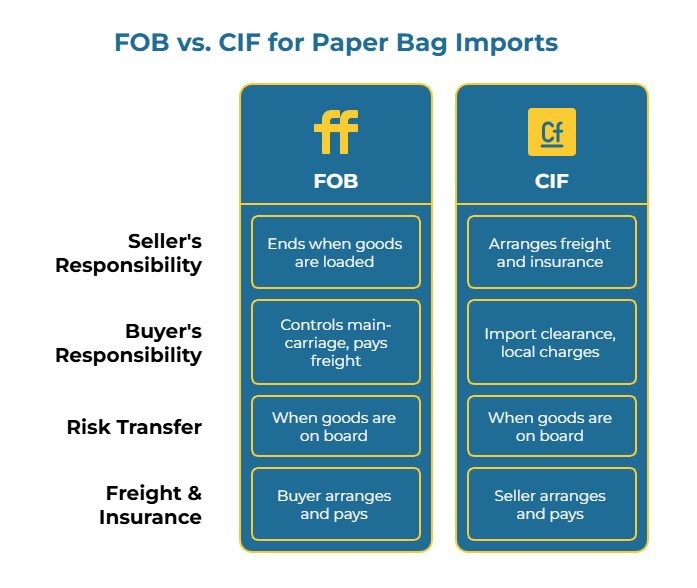
Under both FOB and CIF, risk typically shifts when the goods are placed on board the vessel (FOB) or delivered to the carrier (FCA/CPT/CIP).[1] The key difference lies in who arranges and pays for the ocean freight and insurance.
FOB (Free on Board) means the seller’s responsibility ends once goods are loaded onto the vessel at a named port of shipment. From that moment, the buyer controls main-carriage booking, pays ocean freight, and arranges insurance.
CIF (Cost, Insurance & Freight) means the seller arranges and pays for ocean freight and cargo insurance to a named destination port. Note: Risk transfers to the buyer as soon as the goods are on board at the origin port, even though the seller pays for the freight. The buyer takes over for import clearance and any destination or local charges.
Both terms require a specific named port written into the contract. “FOB Shanghai, Incoterms® 2020” tells everyone exactly where obligations shift. Skip the port name, and you’re inviting disputes.[1]
FOB vs CIF: Quick Comparison Table
| Dimension | FOB (Free on Board) | CIF (Cost, Insurance & Freight) |
| Named place required | Port of loading | Port of destination |
| Who books ocean freight | Buyer (or buyer’s forwarder) | Seller |
| Who pays ocean freight | Buyer | Seller (built into price) |
| Insurance | Buyer arranges (voluntary for self-protection) | Seller provides to destination port |
| Risk transfers | When goods are on board at port of loading[1] | When goods are on board at port of loading[1] |
| Control & visibility | Higher | Lower (depends on seller transparency) |
| “Surprise charges” risk | Lower (if forwarder quote is complete) | Higher (if destination/local charges not clarified) |
| Best fit | Repeat importers / logistics-ready SMEs | Emerging importers / tactical procurement teams |
For paper bag buyers specifically, the choice often comes down to this: Do you have the established carrier relationships to manage freight booking yourself? If yes, FOB typically delivers better cost visibility. If you’re still building that capability, CIF can reduce initial complexity—provided you clarify what’s included upfront.
Pros and Cons for Paper Bag Buyers: FOB
FOB puts the buyer in the driver’s seat for ocean freight. This means direct relationships with freight forwarders, clearer line-item visibility into shipping costs, and the ability to negotiate rates independently of your paper bag supplier.
Advantages:
- You see exactly what freight costs, separate from product price—enabling true supplier quote comparison across different Incoterms
- You choose the forwarder and shipping line, avoiding markup
- You control transit timing and routing decisions
- Easier to compare quotes across suppliers when product prices exclude freight
Responsibilities to plan for:
- You need a reliable freight forwarder or customs broker relationship, plus the capability to manage import documentation and customs clearance processes
- You arrange and pay for cargo insurance
- You handle booking confirmations, bill of lading instructions, and document flow
- Any delays after loading become your problem to solve
FOB works well when you’re importing paper bags regularly and have established logistics partnerships. The upfront coordination pays off in transparency and negotiating leverage over time.
Pros and Cons for Paper Bag Buyers: CIF
CIF shifts the freight and insurance burden to the seller, which can simplify a buyer’s first few international orders. The seller handles ocean booking and provides insurance coverage to the destination port.
Advantages:
- Less coordination required on your end for initial imports
- Seller manages carrier relationships and booking
- Insurance to destination port is included (though coverage level varies)
- Useful when internal logistics bandwidth is limited
Risks to manage:
- Freight cost is bundled into the price, reducing transparency
- Destination and local charges (terminal handling, DTHC, port fees) are excluded (buyer’s responsibility) unless specifically covered by the freight contract
- Insurance coverage is typically Institute Cargo Clauses (C) (minimum cover), which covers major casualties (fire, sinking) but excludes theft, shortage, breakage, and weather damage including moisture-related losses during shipping
- You have less control over carrier selection, transit routing, and potential ‘kickback’ fees hidden in destination local charges
The most common CIF surprise? Assuming “seller arranges freight to destination” means “seller pays for everything until goods reach your warehouse.” It doesn’t. Import clearance, destination terminal handling, and inland transport typically remain buyer responsibilities unless explicitly negotiated otherwise.[3]
How to Choose: A Decision Matrix for SMEs

The right Incoterm depends on your logistics capability today—not where you hope to be in two years.
| Buyer Scenario | Recommended Term | Why | Specify in RFQ/PO | Risk if Skipped |
| First import; no forwarder relationship | CIF | Reduces coordination burden while you learn | Named destination port; confirm what destination charges are excluded; request insurance certificate copy | Hidden local charges; inadequate insurance coverage |
| First import; forwarder available but inexperienced team | CIF or FOB | Either works; CIF if team needs simplicity, FOB if forwarder can guide | If CIF: clarify local charge responsibility. If FOB: confirm forwarder handles customs brokerage | Document handoff confusion; missed customs deadlines |
| Repeat imports; stable forwarder + customs broker | FOB | Maximizes cost visibility and control | Named port of loading; BL instructions; required export documents list | Losing negotiating leverage by bundling freight |
| High-cadence program (monthly+ orders) | FOB | Volume justifies direct carrier relationships; best visibility | Named port; standing forwarder instructions; document checklist per shipment | Overpaying on freight built into CIF pricing |
The transition from CIF to FOB often happens naturally as import volume grows and internal teams gain experience. Starting with CIF isn’t a failure—it’s a reasonable choice when logistics bandwidth is genuinely limited.
Common Pitfalls (and How to Prevent Them)
Named port missing or inconsistent. The quote says “FOB China,” the PO says “FOB Ningbo,” and the bill of lading references Shanghai. Ensure the exact port name matches across every document before shipment.
Assuming CIF covers everything until arrival. CIF gets goods to the destination port—not your warehouse. Import duties, terminal handling fees, and inland transport are typically buyer costs. Ask the seller to list exactly what is and isn’t included, in writing.
Insurance mismatch. CIF requires the seller to provide insurance, but the minimum coverage (Institute Cargo Clauses C) excludes risks like theft and water damage.[4] Request the insurance certificate upfront and confirm coverage level meets your needs. If it doesn’t, arrange supplemental coverage.
Destination charges ambiguity. Terminal handling charges, documentation fees, and demurrage can add up quickly—components often missed when calculating the true landed cost for paper bags. Get a destination charges estimate from your customs broker before the shipment arrives.
Documentation handoffs unclear. Who sends the commercial invoice? When does the bill of lading get released? Specify document responsibilities and timing in your purchase order to prevent goods sitting at port while paperwork catches up.
How to Write It into Your RFQ/PO
Clear contract language prevents most Incoterms disputes. Use these templates as a starting point—not legal advice—and adapt based on your specific transaction requirements.
FOB Template:
Incoterms® 2020: FOB [Named Port of Loading]. Seller responsible for export clearance and loading on vessel. Buyer arranges ocean freight, insurance, and import clearance. Required docs: commercial invoice, packing list, [BL/sea waybill instructions], certificate(s) if applicable.
CIF Template:
Incoterms® 2020: CIF [Named Port of Destination]. Seller arranges ocean freight and cargo insurance to named destination port. Buyer responsible for import clearance and destination/local charges unless explicitly included. Required docs: commercial invoice, packing list, insurance certificate, [BL/sea waybill instructions].
Always specify the Incoterms version year (currently Incoterms® 2020) to avoid confusion with older rule sets.[1] And remember: Incoterms define delivery responsibilities, not payment terms or dispute resolution—those need separate contract clauses.[2]
Future Pathway: From Incoterms Choice to Resilient Sourcing
Getting FOB vs CIF right is one piece of a larger sourcing strategy. Once you’ve standardized your Incoterms approach, the next step is normalizing quotes to a true landed-cost basis so you can compare suppliers accurately. Learn more in our guide on how to calculate landed cost for paper bags.
Building a resilient paper bag supply chain means moving beyond one-off transactions toward verified supplier relationships, clear specifications, and repeatable processes. Whether you choose FOB or CIF, the goal remains the same: control, visibility, and fewer surprises between order and delivery.
Resources
- Comparing Quotes Across Incoterms: A Practical Normalization Method for True To-Door Decisions
- Incoterms for Paper Supply: The Six Clauses That Change Your Delivered Price More Than You Think
- Navigating Global Logistics: Duty and Freight Factors in Sourcing Paper Bags
Ready to connect with verified paper bag suppliers worldwide? Submit your buying requirements to receive quotes directly from suppliers, or explore Paper Bag Suppliers in our directory.
Disclaimer: This article provides general information about Incoterms® and international shipments. It is not legal advice. For transaction-specific decisions, consult a qualified freight forwarder, customs broker, or legal counsel.
[1]: Incoterms® 2020 overview (Incoterms® 2020 overview (International Chamber of Commerce)
[2]: Know Your Incoterms (U.S. International Trade Administration)
[3]: Incoterms glossary (EU Access2Markets)
[4]: Incoterms® rules 2020 insurance introduction (Munich Re)
Our Editorial Process:
Our expert team uses AI tools to help organize and structure our initial drafts. Every piece is then extensively rewritten, fact-checked, and enriched with first-hand insights and experiences by expert humans on our Insights Team to ensure accuracy and clarity.
About the PaperIndex Insights Team:
The PaperIndex Insights Team is our dedicated engine for synthesizing complex topics into clear, helpful guides. While our content is thoroughly reviewed for clarity and accuracy, it is for informational purposes and should not replace professional advice.