

📌 Key Takeaways
Switching coated cupstock safely means testing seals, curl, and leaks against your current board’s documented performance — not just comparing spec sheets.
- Document Your Baseline First: Without recorded data on how your current board runs, you cannot tell whether a new board’s issues are real or routine.
- Same Coating Label Does Not Mean Same Results: Two boards with matching PE descriptions can differ in coating weight, fiber makeup, and stiffness — gaps that show up during forming and sealing.
- Test Seals Across the Run, Not Just the Best Cups: Pulling samples from different points in a trial reveals whether the new board stays stable after initial setup, not just at its best moment.
- Curl Can Appear After Arrival: A flat sheet may warp hours later on the production floor or in a humid warehouse, so checking curl over time matters more than checking it once at receiving.
- Use a Pass, Hold, or Reject Gate With Shared Criteria: Cross-functional sign-off — procurement, QA, production, and compliance — prevents one department from approving a board another department cannot run reliably.
Structured trials against a known-good baseline turn cupstock changes from guesswork into defensible decisions.
Procurement managers, QA leads, and converting teams evaluating alternative cupstock suppliers will gain a clear validation sequence here, preparing them for the detailed overview that follows.
~ ~ ~ ~ ~ ~ ~ ~ ~ ~ ~ ~ ~ ~ ~ ~ ~ ~
A coated cupstock change can look simple on paper: similar GSM, similar coating description, and an acceptable cupstock supplier quote. On a paper cup line, however, the real question is whether the new board seals, forms, stores, prints, and holds liquid consistently enough for the intended cup program. Two boards carrying the same PE coating label may differ in coating weight, distribution, base fiber composition, or stiffness — differences that surface during converting, forming, and filling, often after time and material have already been committed.
Before approving a new coated paperboard, teams should validate three production-critical areas: heat-seal behavior, curling and dimensional stability, and finished-cup leakage. The goal is not to reject new materials but to approve them with documented evidence that procurement, QA, and production can all reference. For a broader overview refer to the article, What to verify before switching cupstock grades.
Start with the Current Cupstock Baseline
No changeover check is meaningful without a documented reference point. Before running any trial on a candidate material, teams should record the converting behavior of the current known-good cupstock under normal production conditions.
Key baseline data points include board grade, GSM, caliper, stiffness, coating type and coating side, and coating weight where available. Machine settings matter equally: the sealing temperature, pressure, dwell time, and line speed that currently produce acceptable cups should be recorded alongside the cup sizes and SKUs running without recurring quality issues. If internal tracking captures scrap rates, sealing observations, or forming notes, those records add useful context for comparison.
This baseline becomes the standard against which every trial result is measured. Without it, teams cannot determine whether an issue with the new board reflects a genuine material gap or a variation that also exists in the current stock.
That baseline also clarifies the level of certainty behind each decision. Supplier technical data is useful, but it is not the same as incoming material checks. Incoming material checks are useful, but they are not the same as production-line trials. Production-line trials are useful, but they are not the same as finished-cup leak checks. Cross-functional approval records tie these layers together.
Heat-Seal Checks Before Approval
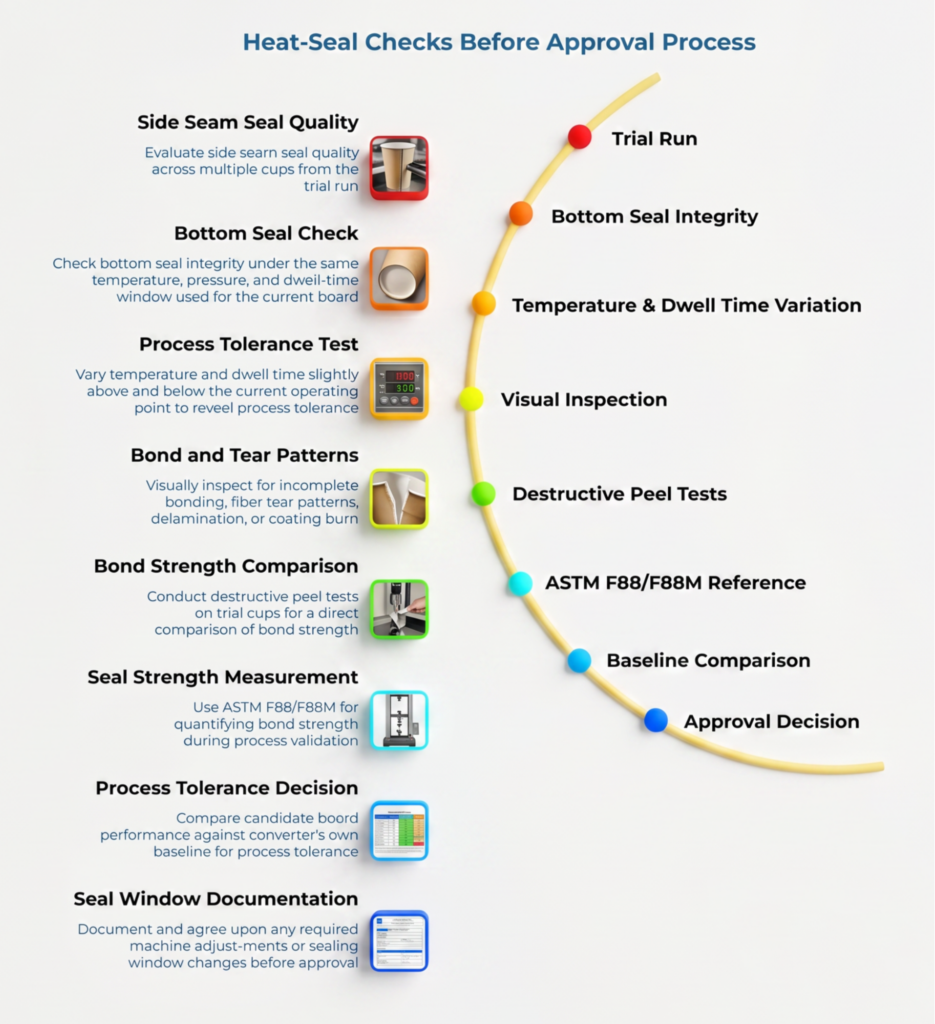
Heat-seal behavior is typically the first area where a coated cupstock change reveals unexpected differences. Variations in coating weight, distribution, base fiber construction, or calendering profile can shift the sealing window — the range of temperature, pressure, and dwell time that produces an acceptable bond — even when two boards share the same coating-type label.
Production-like trial checks should evaluate side seam seal quality across multiple cups from the trial run, not only the best samples. Bottom seal integrity should be checked under the same temperature, pressure, and dwell-time window used for the current board. A narrower sealing window on the candidate material may still be workable, but it can require machine adjustments that affect throughput or consistency. Short trials can be distorted by machine tuning, limited material, or operator variability, so pulling samples from different points in the run helps show whether the board remains stable after the first setup changes.
Varying temperature and dwell time slightly above and below the current operating point helps reveal whether the candidate board tolerates normal production drift or demands tighter process control. Visual inspection should look for incomplete bonding, fiber tear patterns that differ from the baseline, delamination at peel, or coating burn at higher temperatures. Destructive peel tests on trial cups provide a more direct comparison of bond strength.
Seal-strength measurement methods such as those described in ASTM F88/F88M may offer a useful reference for quantifying bond strength during process validation. ASTM F88/F88M is explicitly designed for flat, flexible barrier materials; therefore, sample preparation requires flattening cut sections of the curved seam, which can introduce artificial mechanical peel stresses.
The central principle is comparison against the converter’s own baseline — not against an assumed universal threshold. The decision record should show whether the candidate board ran within normal process tolerance, required reasonable machine adjustment, or needed unusually narrow control. This distinction matters because a material that can be made to work during a careful trial may still be risky if routine production cannot hold the same conditions. If the new board needs a different sealing window, that should be documented and agreed upon before approval, not discovered during a full production run. Many converting and sealing problems trace back to cupstock specification mistakes rather than equipment errors.
Curling and Dimensional Stability Checks
Curl — a board’s tendency to bend or warp due to moisture imbalance between its layers — can emerge at any point between material receipt and finished-cup dispatch. Its root cause is not always supplier quality alone. Board moisture content interacts with plant humidity, storage conditions, and staging time, so a sheet that arrives flat may curl after hours on the production floor or in a poorly controlled warehouse.
Trial checks should compare incoming conditions against post-conditioning behavior. Measuring curl on arrival and again after exposure to the plant environment for a duration that reflects normal staging time reveals moisture sensitivity that a desk review would miss. Running blanks through the feeder at production speed tests whether curl-induced misfeeds, double-picks, or registration errors occur with the candidate board under the same settings that work for the current material.
Rim forming and body wrap consistency deserve attention as well. Curls that develop unevenly across the sheet or roll can produce inconsistent rim profiles or body-wrap tension, affecting both finished-cup appearance and sealing geometry. If the converting process includes a printing or varnishing step, the additional moisture or heat introduced during those operations may change the board’s curl profile differently than it does for the baseline material.
The storage environment matters as much as incoming board quality. A candidate material that performs well in a climate-controlled trial room may curl differently in a production warehouse with seasonal humidity variation. Water absorptiveness testing methods such as those described in ISO 535 (Cobb method) or TAPPI T 441 can provide data on a board’s moisture interaction, though Cobb values alone do not predict cup-level curl or leakage. For a deeper look at cupstock moisture, curl, and dimensional stability, the linked resource explores how these factors connect to production planning.
A hold decision may be appropriate when curl appears but the cause is not clear. The next step may be supplier clarification, revised storage handling, a longer conditioning period, or a repeat trial from another lot.
Leak Checks on Formed Cups
Leak performance should be tested on formed cups under conditions that reflect intended end use — not only on board samples or under laboratory-ideal conditions. A finished-cup leak check is the most representative test of whether the candidate board will perform in the field.
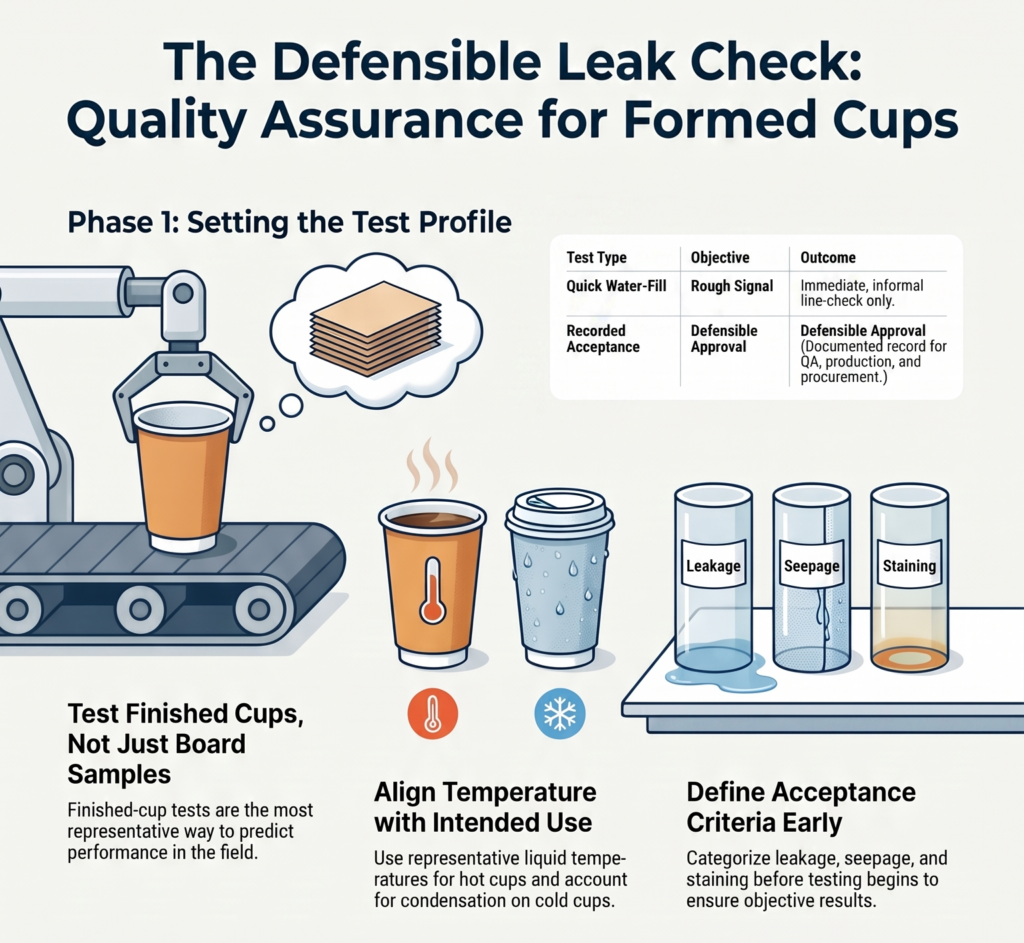
If the cup program includes hot beverages, leak checks should use liquid at a temperature representative of actual fill conditions. Cold-beverage programs may require checks that account for condensation and prolonged hold time. Paper cups for hot beverages and paper cups for cold beverages represent separate performance profiles that can require distinct validation criteria.
Bottom seal and side seam joints are the two most common leak paths. QA should define what counts as leakage, seepage, staining, side seam weakness, bottom failure, or deformation before testing begins — not after results arrive. Visual inspection should be supplemented by holding filled cups for a duration defined by the buyer’s acceptance criteria and checking for seepage, staining, or softening at seam edges. A single cup or a handful from one portion of a trial run may not capture the variation a full production batch would reveal, so teams should define a sample size and testing cadence that reflects their acceptable risk level.
There is a meaningful difference between a quick water-fill check on the line and a recorded acceptance test with defined hold conditions, sample counts, and pass criteria. The former offers a rough signal. The latter supports a defensible approval decision and creates a record that QA, production, and procurement can reference later.

Hold times, liquid temperatures, sample sizes, and pass/fail leakage limits should be defined by the buyer’s QA protocol and the intended cup application. These values vary by cup design, coating, end use, and customer requirement.
Food-contact documentation should be checked separately when cups are intended for food or beverage use.
Print, Storage, and Dispatch Considerations
Coated cupstock validation does not end at forming and sealing.
Printing and surface treatment can interact with coating chemistry in ways that differ from the baseline material. Ink adhesion, drying behavior, and scuff resistance should be compared to the known-good board under the same print conditions. Surface defects or ink transfer failures that appear only with the new material may indicate a coating surface energy or porosity difference. A board that performs within parameters during structural trials may still exhibit curling, scuffing, registration shifts, or surface marking following print conversion. These interactions must be documented during the initial verification phase to avoid late-stage sourcing disruptions.
Post-forming storage introduces its own risks. Cups stacked and packed for warehouse staging may experience compression, moisture migration, or curl progression that short trial runs do not reveal. If the facility stores finished cups for days or weeks before dispatch, trial cups should be subjected to similar hold conditions and re-inspected.
Dispatch handling — palletizing, wrapping, transport vibration — can amplify minor forming or curl differences into visible defects at the customer’s receiving dock.
Build a Pass / Hold / Reject Decision Gate
A structured decision gate prevents cupstock approvals from depending on informal consensus or a single department’s judgment.
Proceed means the candidate material performs comparably to the baseline across sealing, forming, curl, leakage, and downstream checks. Differences are documented, understood, and within the buyer’s acceptance criteria. Machine adjustments, if needed, are feasible and recorded.
Hold means one or more checks require clarification — a supplier data gap, a machine adjustment that needs re-trial, or insufficient sample size to draw a reliable conclusion. Approval pauses until the open item is resolved. A hold is not a rejection. Hold decisions are especially useful when trial material is limited or when one issue appears before the root cause is clear.
Reject means the candidate material shows recurring critical failures — persistent seal defects, unacceptable curl under normal plant conditions, or leakage beyond the buyer’s defined limit — that cannot be resolved through reasonable machine adjustment or supplier clarification.
Procurement, QA, production, and product development should each review the areas relevant to their role. Compliance or regulatory stakeholders should review food-contact documentation where relevant. Shared, documented criteria reduce the risk of procurement approving a material that production cannot run reliably, or production rejecting a board based on a single unrepresentative short trial. A cupstock sample review checklist can support this cross-functional handoff before a grade transitions to final qualification.
Coated Cupstock Changeover Validation Matrix
Use this validation matrix before approving a coated cupstock change.
| Validation Area | What to Check | Who Should Review | What to Compare Against | Decision Output | Documentation Needed |
| Current baseline | Grade, coating side, GSM, caliper, stiffness, current settings, known-good SKUs | Procurement, QA, production | Existing approved cupstock | Initiate Trial / Suspend Sourcing | Current spec, supplier data, line settings, known issues |
| Heat-seal behavior | Side seam bond, bottom seal, sealing window, peel strength | Production, QA | Baseline seal results and machine settings | Proceed / Hold / Reject | Trial run records, seal test results, machine setting log |
| Curl and dimensional stability | Incoming curl, post-conditioning curl, blank feeding, rim forming | Production, QA, warehouse | Baseline curl measurements and feeding performance | Proceed / Hold / Reject | Conditioning logs, feeding trial notes, curl measurements |
| Leak performance | Bottom seal, side seam, hold-time results under intended use conditions | QA, product development | Buyer-defined acceptance criteria and baseline leak results | Proceed / Hold / Reject | Leak test records, sample count, hold conditions, pass/fail outcome |
| Print and surface behavior | Ink adhesion, scuff resistance, drying behavior | Production, print/prepress | Baseline print results on current board | Proceed / Hold / Reject | Print trial samples, surface test notes |
| Storage and dispatch | Post-storage curl, compression, moisture migration | Warehouse, QA | Baseline cup condition after equivalent storage period | Proceed / Hold / Reject | Storage condition log, re-inspection notes |
| Supplier documentation | TDS, coating specs, food-contact declarations | Procurement, compliance | Current supplier documentation set | Validated / Deficient | Document checklist, gap summary |
Conclusion
A coated cupstock change is a production decision, not a specification substitution. Documenting results against a known-good baseline — across heat sealing, curl, leakage, print, and storage — helps teams run cleaner trials, ask better supplier questions, and build approval records that procurement, QA, and production can all stand behind.
Adopting this structured tiering ensures that approvals rest on verifiable, line-tested performance rather than static documentation. After validation criteria are clear, buyers can compare alternatives with a stronger technical brief.
Frequently Asked Questions
Can coated cupstock with the same GSM still behave differently on the cup line?
Yes. Caliper, stiffness, coating weight, coating distribution, base fiber composition, and moisture behavior can all vary between boards that share the same nominal GSM. These differences may not appear during a desk review but can affect sealing, feeding, forming, and finished-cup performance under production conditions.
Should procurement approve a new coated cupstock based on supplier documents alone?
Supplier technical data sheets and declarations of conformity describe the material as manufactured — not as it behaves on a specific converting line, under specific plant conditions, for a specific cup program. Production-like trial checks and cross-functional QA review remain necessary before approval.
What is the most important leak check before switching cupstock?
The finished-cup check under intended use conditions — using liquid at the relevant temperature, for a hold time defined by the buyer’s acceptance criteria — is the most representative test. Board-level water tests or brief spot checks on the line do not replace a documented acceptance check on formed cups.
Who should sign off on a coated cupstock change?
Procurement, QA, and production should each review the validation areas relevant to their role. Product development should confirm the material meets the intended cup program requirements. Where food or beverage contact is involved, compliance should verify that documentation covers the target market and end use.
Disclaimer:
This article is for general informational purposes only and does not constitute compliance, safety, technical, or professional advice. Requirements, risks, and best practices may vary by context, jurisdiction, system, provider, or use case. Confirm important decisions with the appropriate qualified professional, authority, supplier, testing lab, or technical expert.
Our Editorial Process:
Our expert team uses AI tools to help organize and structure our initial drafts. Every piece is then extensively rewritten, fact-checked, and enriched with first-hand insights and experiences by expert humans on our Insights Team to ensure accuracy and clarity.
About the PaperIndex Insights Team:
The PaperIndex Insights Team is our dedicated engine for synthesizing complex topics into clear, helpful guides. While our content is thoroughly reviewed for clarity and accuracy, it is for informational purposes and should not replace professional advice.