
📌 Key Takeaways
Switching paper suppliers protects your margins only when you replace guesswork with clear specs, comparable quotes, and verified capability.
- Specs Before Shopping: Match your paper requirements to what your menu actually demands—heat, grease, and hold time—before asking for any quotes.
- Over-Buying Hurts Quietly: When requirements stay vague, buyers default to the strongest (and most expensive) option, paying for protection they never use.
- Under-Spec Creates Hidden Costs: Cheap paper that fails on the line forces staff to double-wrap, burning through inventory and slowing service during peak hours.
- Normalize Every Quote: Suppliers quoting different delivery terms (FOB, CIF, EXW) are not comparable until you convert each to the same door-to-door cost.
- Verify Before Volume Moves: Test whether suppliers can hold specs repeatedly and ship on time before committing real orders—not after problems appear.
Clear specs turn a risky supplier switch into a controlled transition.
Operations managers and procurement leads sourcing food packaging paper will find a ready-to-use framework here, preparing them for the step-by-step checklist that follows.
~ ~ ~ ~ ~ ~ ~ ~ ~ ~ ~ ~ ~ ~ ~ ~ ~ ~
A packaging failure cost you a weekend.
Grease bleeding through wrappers, customer complaints stacking up, your team scrambling to find a quick fix. Now you’re ready to switch suppliers—but the quotes sitting in your inbox raise more questions than answers. Three options, three price points, and no clarity on which one actually solves the problem without wrecking your margins.
The fracture occurs not during negotiation, but within the analytical void between recognizing a failure and defining the technical remedy.
A supplier transition—a controlled change of paper supplier without changing what your packaging must do—becomes a margin protection strategy only when uncertainty gets replaced with specifications, comparability, and verification. This is not a price-shopping exercise. It is a method for preventing over-spec, failure waste, and hidden operating costs while you move to compliant food-grade packaging.
This transition framework protects margins by aligning technical specifications with actual menu stresses. For foundational concepts on GSM, coatings, and pulp types, see the beginner’s guide to food packaging paper specifications.
The Hidden Mechanism: Over-Engineering Becomes the Default Response to Uncertainty
When requirements stay undefined, buyers default to safety. That safety typically looks like ordering the highest available specification—thicker paper, heavier coatings, broader claims. More material than the menu may actually need.
The logic feels prudent in the moment. It often becomes expensive later.
Switching suppliers without a transition framework often leads to buying over-engineered, expensive materials.
A supplier transition goes off course when the new paper is chosen to reduce anxiety rather than to match real operating stress. The result is a spec built around fear instead of use. Too heavy. Too broad. Too costly.
The opposite failure carries equal cost. Under-specifying means the new paper cannot handle actual heat, grease, or hold-time demands. The result shows up as double-wrapping at the packing station, slower throughput, higher waste, and the same customer complaints that triggered the switch in the first place.
Both failures trace to the same root: generic sourcing that skips specification-first methodology. Food safety and performance come from matching GSM, coatings, and pulp to real menu stress—not from relying on generic “food safe” labels alone. A margin protection strategy closes this gap by forcing clarity before quotes arrive.
Three Ways a Supplier Transition Creates Cost Shocks—Even When the Unit Price Looks Fine
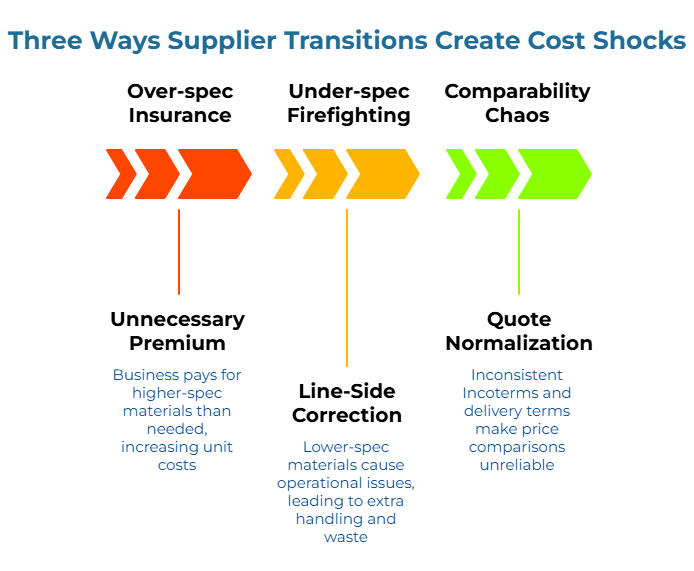
Over-spec insurance. When no one has translated the menu into measurable needs, the “highest spec” starts to look like the safest decision. That is how overbuying happens. The business pays for barrier performance — Kit levels, coating weights, premium pulp—that actual food items never stress. A sandwich wrapper rated for deep-fried chicken represents money spent on capability that sits unused, and the extra spend gets baked into every unit.
Under-spec firefighting and line-side correction. The new paper arrives at a lower unit cost. But it softens under holding lamps or allows grease to bleed through during a 20-minute delivery window. Staff start double-wrapping, adding liners, or handling packs more carefully just to get through the shift. The unit price has not changed. The operating cost has. Extra handling. Extra waste. Extra friction. This is line-side correction—quiet cost accumulation that never appears on the invoice but burns through inventory faster than projected and slows pack-out speed during peak hours.
Comparability chaos. One supplier quotes FCA (seller’s facility). Another quotes CIP (destination). A third quotes EXW. The “lowest price” shifts depending on who pays freight, insurance, and handling charges. Without normalizing every quote to the same delivery basis, procurement compares numbers that measure different things. Understanding how to calculate landed cost and normalize Incoterms® — verify that terms like FCA (Free Carrier) establish risk transfer at the terminal, whereas the common misuse of ‘FOB’ for land-based transport creates insurance gaps before contracts get signed.
The Sourcing Transition Framework: A Margin-Protecting Playbook
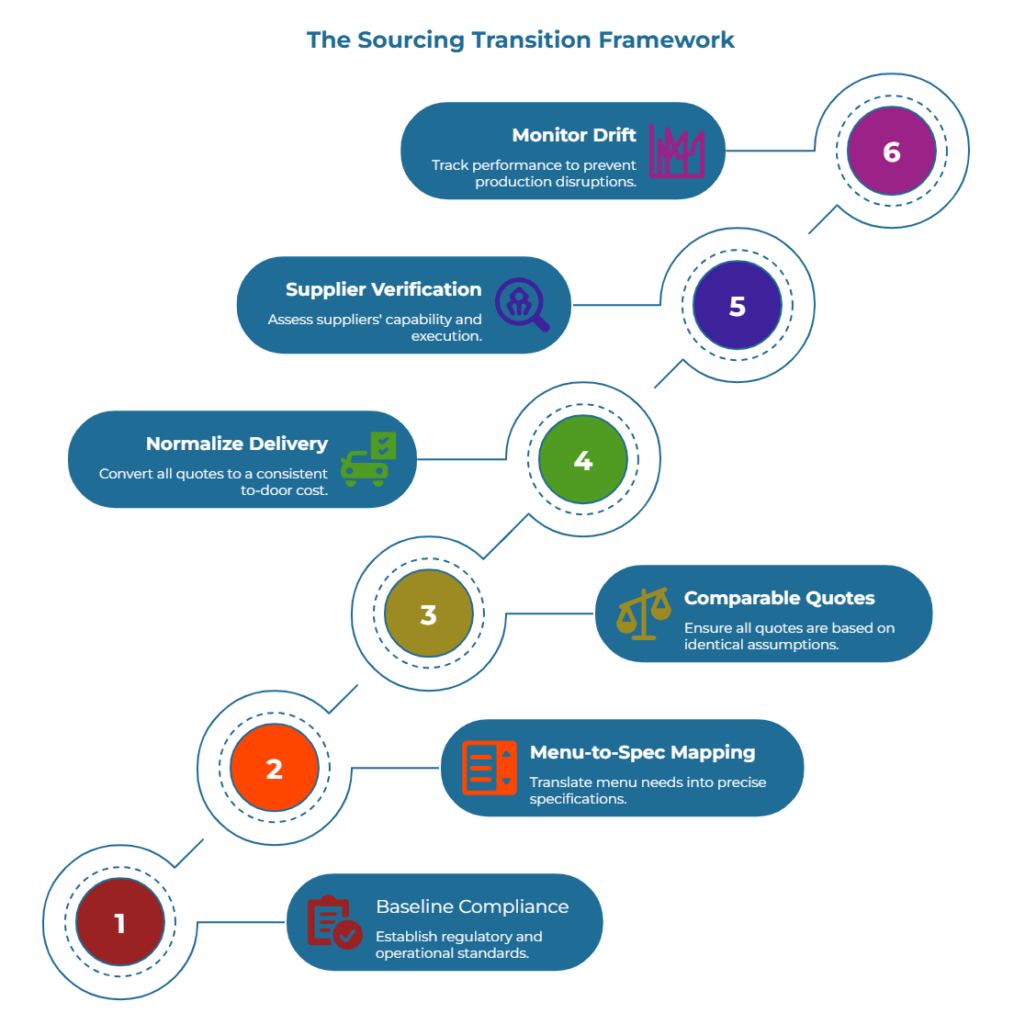
This 6-step framework transforms a reactive supplier switch into a controlled transition. Each step builds on the previous one.
Set compliance baseline + operational non-negotiables
↓
Build menu-to-spec mapping
↓
Lock spec bands + test methods + evidence pack
↓
Normalize comparability across all quotes
↓
Qualify suppliers in two lanes: capability and execution
↓
Monitor drift from day one
Step 1 — Baseline Compliance and Operational Constraints. Start with two questions. First, the compliance baseline: what certifications and standards must the paper meet for your jurisdiction? Regulatory requirements depend on your market and application, so confirm the specific fit for your use case. Many teams reference FDA and ISEGA safety standards as starting points for food service compliance. As general reference points, many teams begin with FDA 21 CFR 176.170 for paper in contact with aqueous and fatty foods, FDA 21 CFR 176.180 for dry food contact, and EU Regulation (EC) No 1935/2004 on food contact materials for European markets. These are useful anchors, not a substitute for application-specific review. Second, the operational baseline: what must never fail on a busy shift? Define this in concrete terms—for example, “wrappers cannot show grease-through after 15 minutes under heat lamps.”
Step 2 — Translate menu realities into specs. Build a simple menu-to-spec map. For each high-volume menu item, document the stress profile and match it to a target specification:
- High grease load plus longer hold time → stronger grease barrier and a defined GSM band
- High steam exposure → coating or barrier choice that holds performance under heat and moisture
- Heavier handling or stacking → stiffness and strength requirements that reflect actual use
- Low-stress applications → avoid upgrading to a premium structure “just in case”
This discipline prevents ordering Kit Level 10 grease resistance for items that only require Kit Level 4. It also prevents the opposite mistake: specifying a lightweight sheet for items that will stress it beyond its limits within minutes of service.
Step 3 — Force comparability at quote time. Require every supplier to quote against identical assumptions: the same specification sheet with GSM tolerances, the same barrier rating, the same test method references, the same Incoterm and named delivery place, and an evidence pack attached (Certificate of Analysis, test reports, compliance documentation). Disqualify any supplier unable to provide this evidence pack; their pricing is a variable, not a quote.
Step 4 — Normalize delivery basis. Convert every quote to the same to-door cost. Log assumptions—freight rate, insurance, handling, duties—in a single worksheet. This eliminates post-award surprises and makes future re-quotes auditable. That one discipline removes a surprising amount of confusion.
Step 5 — Verify suppliers in two lanes before switching volume. Do not award based on quotes alone. Run a two-lane qualification. The capability lane asks: can they hold specifications repeatedly? Request lot-to-lot test data, not just a single sample. The execution lane asks: can they ship on time and document accurately? Check references, delivery history, and paperwork consistency. The supplier capability verification method provides a structured approach for this step. Especially when the pressure to move fast is high, verification before volume prevents costly restarts.
Step 6 — Monitor drift from day one. Incoming inspection starts with the first shipment, not after a problem surfaces. Establish a simple scorecard covering moisture checks, caliper spot-tests, and visual inspection. Track results weekly for the first 90 days to catch drift before it disrupts production.
By mapping unit economics early, food businesses can switch to certified food-grade paper without shock to the P&L. Not because risk disappears. Because guesswork does.
A Copy-Paste Checklist for the Next 7 Days
Day 1–2: Document your last three packaging failures. List your top five menu items by volume and note their heat, grease, and hold-time stress profiles. Write down where the current pack fails, under what conditions, and for which items. Keep the notes concrete. A leaking wrap on hot, greasy items after a 20-minute hold tells you more than a vague complaint ever will.
Day 3: Draft a one-page specification sheet with target GSM (plus or minus tolerance), required barrier or coating type, and method-named test requirements such as TAPPI T 559 for grease resistance. One page is enough to force clarity. It also makes internal alignment easier.
Day 4–5: Send RFQs requiring specification-match and evidence packs. Request samples. Plan a micro-trial on the actual line during a real shift. Small first. Controlled first. That is how you learn without creating new operational noise.
Day 6–7: Normalize all quotes to door-delivered cost. Select two finalists. Draft a staged allocation plan—for example, 20% trial volume before committing to a full switch. Start with limited volume, defined checks, and a simple scorecard for incoming material. Expand only when the paper performs as expected.
A Controlled Supplier Transition Beats a Panic Switch
Switching suppliers does not have to mean margin shock. The difference between a costly gamble and a protected transition comes down to three things: specifications that match menu realities, quotes normalized to the same delivery basis, and verification that proves capability before volume commits.
A margin protection strategy aligns the new paper’s technical specs directly with what the menu actually demands. That is the hinge. Once that is clear, the rest of the transition becomes calmer.
Apply these verification protocols to the next procurement cycle. Start with Step 1 tomorrow. By the end of the week, a specification sheet will force comparable quotes, and a qualification process will filter out suppliers who cannot deliver consistently.
When ready to build a longlist of potential sources, food packaging paper suppliers can be browsed—but only after the specification sheet is drafted. Specifications first, supplier discovery second. Method first.
Disclaimer:
This article provides general information for educational purposes only.
Our Editorial Process:
Our expert team uses AI tools to help organize and structure our initial drafts. Every piece is then extensively rewritten, fact-checked, and enriched with first-hand insights and experiences by expert humans on our Insights Team to ensure accuracy and clarity.
About the PaperIndex Insights Team:
The PaperIndex Insights Team is our dedicated engine for synthesizing complex topics into clear, helpful guides. While our content is thoroughly reviewed for clarity and accuracy, it is for informational purposes and should not replace professional advice.