

📌 Key Takeaways
The fastest way to end the strategy-versus-specs debate is to treat it as a sequencing problem—specs define “what,” strategy defines “who and how,” and neither should advance without the other.
- Sequence Beats Debate: Aligning procurement and engineering requires knowing which lane leads at each project stage, not choosing a winner between them.
- Specs Must Precede Sourcing: Award decisions made before technical specifications are locked create disputes, first-article failures, and suppliers optimized for price instead of protection.
- Hand-Offs Need Artifacts: Each stage should produce a documented deliverable—failure-mode summaries, RFQ packages, first-article reports—that transfers without verbal reinterpretation.
- One Lane Alone Fails: Strategy without specs is guessing on commercial fit; specs without strategy is shopping without governance to enforce performance.
- Start With Two Rows: Identify your current project stage, complete only that output and the next, then schedule a 30-minute cross-functional review to align on hand-offs.
Alignment is the outcome; sequencing is the method.
Industrial packaging engineers and procurement managers facing heavy-duty corrugated failures will gain a shared decision framework here, preparing them for the stage-by-stage implementation guidance that follows.
~ ~ ~ ~ ~ ~ ~ ~ ~ ~ ~ ~ ~ ~ ~ ~ ~ ~
The packaging engineer insists the ECT rating must be locked before anyone talks to suppliers. The category manager pushes back—how can you finalize specs without knowing what the market can actually deliver? Both have a point. Neither is wrong.
This debate plays out in conference rooms across industrial and automotive manufacturing whenever heavy-duty corrugated boxes fail in transit. A pallet of heavy, oily, odd-shaped parts arrives and a few cartons are already slumped—creases where corners should be crisp, seams yawning just enough to snag, maybe a dark tide line where moisture found a way in. These are precisely the damage patterns that signal sourcing failures, not carrier problems. A cracked transmission housing arrives at the Tier-1 assembly plant. The line stops. Fingers point. And the post-mortem frequently reveals a recurring root cause: procurement and engineering were solving different problems on different timelines, with no shared map of who leads when—a coordination gap that strategic sourcing frameworks are designed to eliminate.
Operations sees downtime risk. Engineering sees a design problem. Procurement sees a supplier problem. The debate that follows is predictable: fix sourcing first, or fix specs first?
The stakes extend beyond a single shipment. Production line stoppages cascade into missed delivery windows. Reputational damage with major automotive clients can take years to repair. The pressure to “just fix it” leads teams to skip steps—and skipped steps create the next failure.
This guide provides a sequencing framework that clarifies when the focus belongs on sourcing strategy, when it shifts to technical specifications, and what each stage must produce before the next one begins. The core tool is a decision matrix your team can reference this quarter to stop the guesswork.
Two Lanes, One Goal: Defining Strategy and Specs
Before the matrix makes sense, definitions need to be clear. These terms get used interchangeably, but they describe fundamentally different outputs.
Sourcing strategy answers “who” and “how.” This encompasses the approved vendor list, the qualification criteria, the contract structure, geographic diversification, and the governance model for ongoing supplier performance. It is the architecture of the supply relationship.
Heavy-duty specs answer “what.” This is the physical product definition: the Edge Crush Test (ECT) rating, flute profile, liner weight, burst strength, and moisture resistance required to protect heavy, oily, or odd-shaped parts under real-world stacking and transit conditions. It translates protection needs into measurable, testable parameters.
In shorthand:
Strategy = who/how.
Specs = what.
The winning approach = sequential alignment.
The friction arises when teams talk past each other. Engineering hands over a spec sheet and expects procurement to “find someone who can make this.” Procurement evaluates suppliers and asks engineering to “confirm this one works.” Each function is speaking a different language—one of performance requirements, one of commercial capability. The gap between them is where assumptions live and failures breed.
Two common misconceptions make this worse. The first is that a heavier board always equals better protection—a misconception we address in depth when examining why burst strength isn’t enough for box specification. In practice, increasing board weight is often less effective than optimizing the flute profile to match the actual load and stacking conditions. Furthermore, not all triple-wall corrugated boards offer equivalent performance. Wall construction varies significantly across manufacturers, and without a clear spec, “triple-wall” becomes a marketing term rather than a performance guarantee.
Sequential alignment closes these gaps. It establishes what must be true at each stage before the next stage can begin—and who owns the output.
The Decision Matrix
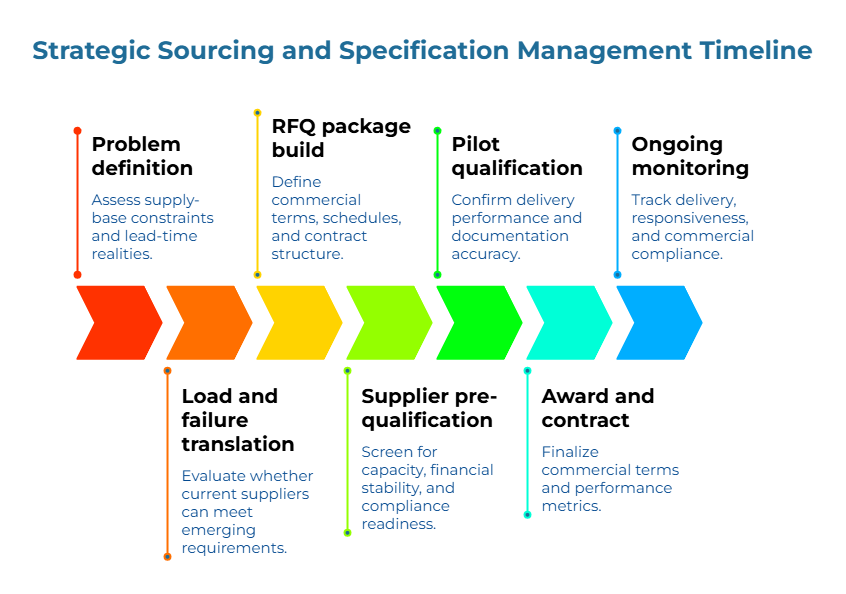
The matrix below maps seven project stages from problem definition through ongoing monitoring. For each stage, it identifies when attention should center on sourcing strategy, when it should center on technical specifications, what artifact the stage must produce, and which function holds primary accountability.
| Stage | Focus: Sourcing Strategy | Focus: Heavy-Duty Specs | Output | Owner |
| 1. Problem definition | Assess supply-base constraints and lead-time realities. | Translate product weight, fragility, and transit conditions into protection needs. | Failure-mode summary + supply context | Cross-functional |
| 2. Load and failure translation | Evaluate whether current suppliers can meet emerging requirements. | Convert field failures into testable parameters (ECT, burst, moisture limits). | Draft performance specification | Engineering |
| 3. RFQ package build | Define commercial terms, schedules, and contract structure. | Finalize technical spec with test methods and tolerances. | Complete RFQ (commercial + technical) | Procurement + Engineering |
| 4. Supplier pre-qualification | Screen for capacity, financial stability, and compliance readiness. | Validate that supplier processes can hold spec tolerances. | Qualified shortlist with evidence | Procurement + Quality |
| 5. Pilot qualification | Confirm delivery performance and documentation accuracy. | Verify physical samples meet spec under actual conditions. | Approved first-article report | Quality + Engineering |
| 6. Award and contract | Finalize commercial terms and performance metrics. | Embed spec references and change-control clauses into contract. | Executed agreement | Procurement |
| 7. Ongoing monitoring | Track delivery, responsiveness, and commercial compliance. | Monitor incoming quality and catch spec drift before failures occur. | Quarterly review + CAPA triggers | Procurement + Quality |
How to use this matrix:
- Identify the current project stage. If technical specifications are not finalized, the project has prematurely entered the quoting phase; regress to Stage 2 to close technical gaps before proceeding.
- Complete the stage output before moving on. Each row produces an artifact that becomes input for the next row. Skipping outputs creates invisible gaps.
- Assign clear ownership. Cross-functional accountability works only when someone holds the pen.
- Use the matrix to diagnose past failures. Walk backward through the stages to find where the process skipped a gate.
For deeper guidance on building RFQ packages that procurement and engineering can both support, see aligning procurement and engineering: a shared checklist for corrugated box RFQs.
The Sequencing Rule That Prevents Rework

A single principle underpins the entire framework: do not source a vendor until you have a spec.
This sounds obvious. In practice, it is routinely violated. Procurement faces pressure to get quotes in before the next budget cycle. Engineering faces pressure to approve samples before the spec is fully locked. The result is a procurement process running on provisional information—and provisional information has a way of becoming permanent by accident.
“Having a spec” at an enterprise level means more than a PDF with target values. A usable heavy-duty corrugated box spec is a controlled definition of performance, construction, and verification. The exact parameters vary by product and distribution reality, but the enterprise-level elements are consistent.
Performance targets tied to failure modes. For stacking collapse, that often means compression-focused thinking rather than relying on burst alone. Edge crush testing is commonly formalized in test method standards such as ISO 3037, and box compression testing follows procedures like ASTM D642. The target is not just “ECT of 32 kN/m” but “ECT per ISO 3037, conditioned per ISO 187 at 23°C and 50% relative humidity.”
Construction definition that a supplier can build repeatedly. This includes flute profile, liner and medium expectations, and build details that affect seam integrity and puncture resistance. Absent technical specifics, ‘triple-wall’ functions as a generic descriptor rather than a verified engineering standard.
Conditioning and test method IDs. Without test method naming, two suppliers can present “passing” results that are not comparable. A target without a tolerance is not a spec—it is a wish.
Acceptance criteria and evidence expectations. “Pass” must be defined: configuration, sampling basis, what constitutes failure. The evidence packet must be part of qualification, not an afterthought.
Revision control. A spec that cannot be versioned cannot be enforced, and drift becomes invisible until damage appears.
When these elements are in place, the spec becomes a contract artifact that can be referenced in disputes, audits, and performance reviews. Without them, the spec becomes a negotiation point rather than a standard.
For a detailed walkthrough of what belongs in an enforceable corrugated box specification, see the quality blueprint: defining and enforcing corrugated box spec.
Hand-Offs That Keep Procurement and Engineering Aligned
The matrix identifies what each stage produces. The hand-off is how that output moves to the next owner without information loss. The matrix works because it treats alignment as a set of handoff artifacts, not a recurring meeting. Each stage should end with something that can be forwarded, reviewed, and approved without reinterpretation.
From problem definition to load translation. The cross-functional team documents failure modes and supply constraints. A short charter names the product family, shipment profile, what failure looks like—collapse, puncture, seam failure, moisture-softening—and what operational risk is being managed. This is also where roles are set: who owns technical definition, who owns supplier governance, and who owns ongoing monitoring. Engineering receives this input and must translate it into a draft spec. If the hand-off is verbal—”we need something stronger”—the spec will be built on assumptions. If it is documented with specific failure modes, photos, weights, and transit data, engineering has the foundation for evidence-based specifications.
From RFQ build to supplier pre-qualification. Procurement and engineering jointly produce the RFQ package. Procurement owns comparability: a single RFQ package that includes the technical spec pack plus the commercial baselines that prevent apples-to-oranges offers. Where Incoterms or delivery bases matter, use a consistent baseline grounded in the ICC’s Incoterms® 2020 rules so price debates do not hide spec ambiguity. If the package is split—commercial terms in one document, technical spec in another—suppliers may respond to mismatched scopes. A unified package ensures every quote responds to the same requirements.
Procurement then screens suppliers against commercial criteria while quality screens against technical capability. Before anyone optimizes unit price, filter for capability to meet the spec reliably. This is where method-named test reports, conditioning controls, and production consistency signals matter. To screen suppliers before the RFQ stage, see how to vet corrugated box suppliers for technical competence (before you send an RFQ).
From pilot qualification to award. Quality and engineering approve the first article. Pilots should not be “it seemed fine.” They should be configured, tested, and documented against the defined acceptance criteria. Where distribution simulation is relevant, recognized test organizations such as ISTA publish procedure frameworks that help teams align on repeatable validation. Procurement then finalizes the contract. If the first-article report is ambiguous—”acceptable with minor deviations”—procurement lacks clarity on what the contract is actually buying. The report should be explicit: sample X passed all spec requirements per test protocol Y, dated Z. That precision becomes a baseline for ongoing performance.
Skipping a hand-off artifact does not save time; it merely defers costs to a stage where failure is more expensive and customer-facing. It relocates the work to a later stage where it costs more to fix and where failures have already reached the customer.
Common Failure Patterns When One Lane Dominates
When sourcing strategy runs ahead of technical specifications, the organization ends up guessing—governance without product truth. Vendors are selected based on commercial fit—capacity, price, geographic convenience—without confirmation that they can meet product requirements, leading to what we identify as sourcing failures rather than logistics issues. The symptoms are predictable: first-article failures, extended qualification cycles, and a supplier base optimized for commercial terms but not for the actual protection needs of the product. Quotes look “comparable” on paper while hiding incompatible constructions and test assumptions—precisely why unit price comparisons fail without total cost analysis. Post-award disputes become subjective because the contract cannot point to a controlled spec and verification test method.
When technical specifications run ahead of sourcing strategy, the organization ends up shopping—technical shopping without procurement controls. RFQs go to any supplier who might be able to make the product, without evaluating capacity, financial stability, or geographic risk. The symptoms are equally predictable: inconsistent quality across suppliers, over-reliance on a single source, and no leverage when performance slips. A technically strong pilot gets approved, then quiet substitutions or process drift erode performance. When failures return, there is no governance mechanism to force corrective action because enforceability was never installed—a gap that robust corrugated box vendor compliance processes help prevent.
“Strategy divorced from specifications is guesswork; specifications without a sourcing strategy are merely a shopping list.”
Both failure patterns share a root cause: one function advanced to the next stage without waiting for the other to complete its deliverable. The matrix prevents this by creating explicit stage gates. Each gate forces the two lanes to synchronize before work proceeds.
For a broader view of how specification discipline fits into a resilient procurement system, see from specs to sourcing: a strategic roadmap for resilient procurement.
Implementation Starter Kit
Starting this week, your team can take three actions that do not require a process overhaul.
Identify your current project stage. Pick one active heavy-duty packaging project. Where is it in the matrix? Be honest about the answer. If the spec is not finalized with test methods and tolerances, the project is still in Stage 2—regardless of how many supplier conversations have occurred.
Complete the outputs for that stage and the next. Focus on two rows only. What artifact is missing from the current stage? What artifact is needed for the next? Assign a single owner to each deliverable with a deadline. Finalize the technical specification before finalizing the contract to prevent scope creep.
Schedule a cross-functional review. Bring procurement and engineering together for 30 minutes. Walk through the two rows. Confirm the outputs exist and are documented. Agree on the hand-off protocol. Then set a date to review the next stage.
This approach scales. Once your team has practiced the sequence on one project, applying it to subsequent projects becomes faster. The matrix becomes a shared language, and the hand-offs become routine rather than negotiated.
Alignment Over Argument
The goal is not to declare a winner between strategy and specs. Both are essential, and the debate about which matters more misses the point. The goal is alignment—knowing which lane leads at each stage, what that stage must produce, and when the hand-off occurs.
When those questions have clear answers, the debate ends and the work moves forward. The next time a packaging failure triggers a post-mortem, the team will have a framework to diagnose where the process broke down—and a path to prevent it from breaking down again.
Disclaimer:
This content is for educational and informational purposes only and does not constitute professional procurement, engineering, or legal advice. Organizations should adapt these frameworks to their specific operational contexts and consult qualified professionals for implementation decisions.
Our Editorial Process:
Our expert team uses AI tools to help organize and structure our initial drafts. Every piece is then extensively rewritten, fact-checked, and enriched with first-hand insights and experiences by expert humans on our Insights Team to ensure accuracy and clarity.
About the PaperIndex Insights Team:
The PaperIndex Insights Team is our dedicated engine for synthesizing complex topics into clear, helpful guides. While our content is thoroughly reviewed for clarity and accuracy, it is for informational purposes and should not replace professional advice.