
📌 Key Takeaways
Chaotic RFQ processes silently drain packaging budgets through scattered costs that no single team ever adds together.
- Vague Specifications Cost Real Money: When RFQs leave room for interpretation, suppliers fill the blanks differently—and you pay for the confusion in disputes, rework, and rush freight.
- Six Hidden Cost Buckets Exist: Clarification hours, dispute handling, rejected materials, emergency shipping, schedule delays, and budget credibility losses all trace back to unclear requirements.
- Fragmentation Hides the Damage: Procurement sees admin drag, QA sees exceptions, operations sees disruption, and finance sees variance—but nobody owns the total picture.
- Your Own Failures Are the Best Data: Auditing your last three packaging incidents reveals recurring patterns and annualized costs more credibly than any industry benchmark.
- Structure Beats Negotiation: Defining quote-ready fields and standardizing requirements before pricing begins prevents the downstream chaos that harder bargaining cannot fix.
The business is already paying for the process it tolerates—the only question is whether anyone has added up the bill.
Procurement managers and packaging buyers facing unexplained budget overruns will find a diagnostic framework here, preparing them for the specification alignment methods that follow.
~ ~ ~ ~ ~ ~ ~ ~ ~ ~ ~ ~ ~ ~ ~ ~ ~ ~
The budget review satisfies nobody.
Three people sit around a table littered with spreadsheets, staring at a packaging spend line that’s $47,000 over plan. Nobody can explain where the money went. The procurement manager points to supplier price increases. The operations lead mentions rejected folding cartons that forced a line stoppage. Finance flags two emergency freight invoices from Q3. Each explanation is true. None of them tells the whole story.
RFQ chaos is the condition where inputs are vague enough that quotes, assumptions, and accountability become unstable. It is like budgeting from five different spreadsheets that all use different assumptions—everyone contributes numbers, but the totals never reconcile.
This article will not pretend to know your annual loss in advance. Instead, it will show you how to find it inside your own packaging workflow by auditing failure categories that most teams never annualize. With the diagnostic worksheet below, you can convert scattered incidents into a single business-case view that finance will actually understand.
Hidden Erosion: The Operational Cost of RFQ Variance
Continuing to run ad-hoc, unstructured RFQs is a hidden tax on your annual packaging spend.
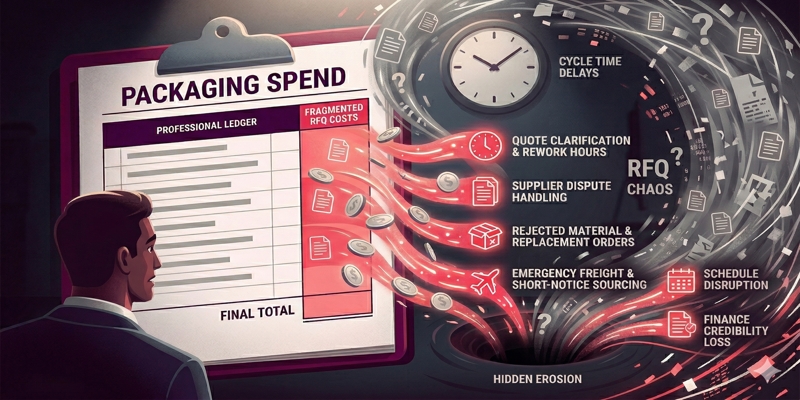
These costs are rarely captured as discrete line items. Instead, they manifest as friction: supplier quotes that can’t be compared because each assumes different specifications, disputes that consume hours of clarification, rejected shipments that trigger replacement orders, and schedule disruptions that ripple through production. Each incident feels isolated. Together, they form a recurring cost structure problem that leadership rarely sees as a single line item.
Beyond administrative waste, process instability is the primary driver of fiscal risk. Poorly defined inputs inevitably yield volatile supplier responses. One supplier assumes a different board grade. Another interprets a tolerance differently. A third prices to a different finish, test method, or compliance expectation. The quotes come back looking comparable, but they are not built on the same baseline.
That is why pushing harder on price rarely fixes the problem. Price becomes meaningful only after comparability exists. Until then, the lowest quote may simply be the least demanding interpretation of your requirement.
The ASQ Cost of Quality framework distinguishes between prevention costs, appraisal costs, and failure costs. Chaotic RFQ processes generate all three. You pay to fix problems after they happen (failure). You pay to inspect incoming materials more rigorously because you don’t trust the specifications (appraisal). And you pay—over and over—because you never invested in preventing the root cause (prevention).
Quality management frameworks, such as those established by ASQ, reinforce what procurement teams already suspect: hidden quality costs deserve structured, data-driven management attention. While prevention and appraisal require upfront investment, the most expensive category is generally failure. And failure costs compound when nobody tracks them as a system.
What “RFQ Chaos” Actually Looks Like in Packaging Procurement
The symptoms are predictable once you know what to look for.
Supplier quotes diverge by 15–25% even though you thought you sent the same specification. When you investigate, you discover each supplier assumed a different board grade, caliper tolerance, or coating standard. One quoted virgin fiber; another quoted recycled. Neither was wrong—your RFQ left room for interpretation, a gap that what proof to request at RFQ stage for folding cartons helps close. Loose specifications let suppliers assume different material baselines, which creates quote variance, disputes, rework, and operational instability—a pattern explored in depth in the danger of vendor-led data sheets: establishing rigid folding carton specification requirements.
Clarification emails multiply. You send a follow-up asking about barrier coatings. The supplier responds with a question about contact conditions. Days pass. Meanwhile, the timeline compresses and the pressure to award increases. APQC’s procurement benchmarks confirm that cycle time—including quote and contract delays—is a measurable performance variable. Their work on contract cycle time treats process friction as measurable business drag rather than background noise. Every round of clarification extends that cycle.
Rejected shipments arrive. The folding cartons meet the supplier’s interpretation of your specification, but they fail at your filling line because the board grade tolerances weren’t locked down—a caliper 0.02 mm thinner than your equipment tolerates. Now you’re negotiating blame, re-ordering material, and explaining the delay to operations.
Emergency expediting kicks in. Air freight replaces ocean freight. Saturday shifts replace Tuesday arrivals. The CFO sees the logistics invoice but has no visibility into why it happened.
Recurring internal blame cycles emerge. Procurement blames suppliers. Operations blames procurement. Finance blames everyone. The pattern repeats because nobody addresses the upstream cause.
The 6 Cost Buckets Most Teams Never Add Together
The hidden costs of a bad RFQ process typically fall into six recurring categories. Most teams experience all of them but never add them together.
Quote clarification and rework hours. Every email thread that circles back to “What exactly do you mean by…” represents labor cost. Multiply by the number of RFQs per year and the average rounds of clarification per RFQ. The hours accumulate quietly.
Supplier dispute handling. When a shipment arrives off-specification, someone must investigate, document, negotiate, and resolve. That’s procurement time, QA time, and sometimes legal review. Even disputes you win cost time.
Rejected material and replacement orders. Material that doesn’t meet production requirements either gets returned, reworked, or scrapped. Replacement orders carry their own lead time, often accelerated at premium cost.
Emergency freight and short-notice sourcing. When the primary order fails, the backup plan is expensive. Expedited shipping can cost three to five times standard rates. Last-minute supplier switches rarely come with favorable pricing.
Schedule disruption, line delay, or launch slippage. Production downtime has a per-hour cost. Launch delays have market cost. Neither shows up on a packaging invoice, but both trace back to material that wasn’t right.
Finance credibility and budget variance escalation. When packaging spend consistently exceeds plan without clear explanation, procurement loses credibility with finance. Future budget requests face more scrutiny. Strategic initiatives stall because leadership doesn’t trust the projections.
These buckets don’t require external benchmarks to quantify. They require internal honesty about what actually happened in your last few failures.
Why These Costs Stay Invisible Until Year-End
Fragmentation is the reason.
Procurement sees the admin drag: endless clarification emails, supplier pushback, and quotes that don’t align. But procurement doesn’t always see what happens downstream. QA sees the exceptions: incoming material that fails inspection, folding cartons that don’t match the approved sample, test results that require escalation. But QA doesn’t always connect those exceptions to the original RFQ.
Operations sees the disruption: line stoppages, rework shifts, schedule compression. But operations blame “supplier quality” without tracing the root cause upstream. Logistics sees the expediting: emergency freight, split shipments, premium carriers. But logistics treats each incident as a one-time exception.
Finance sees the variance: packaging spend that exceeds budget, unexplained overruns, invoice disputes. But finance lacks the operational context to diagnose the cause.
Each department absorbs its slice of the cost. Nobody owns the total. And because nobody owns the total, nobody presents it to leadership as a solvable process problem. That fragmentation is exactly why the chaos survives for too long.
For smaller manufacturers, this matters even more. Teams are lean. Roles overlap. A process flaw that would be annoying in a large organization can become exhausting in a small one. That is one reason operational-improvement bodies such as NIST MEP- Manufacturing Extension Partnership frame process discipline as a resilience issue, not just an efficiency issue. When you don’t have slack in the system, every preventable failure hits harder.
A Diagnostic Worksheet: Audit Your Last 3 Packaging Failures
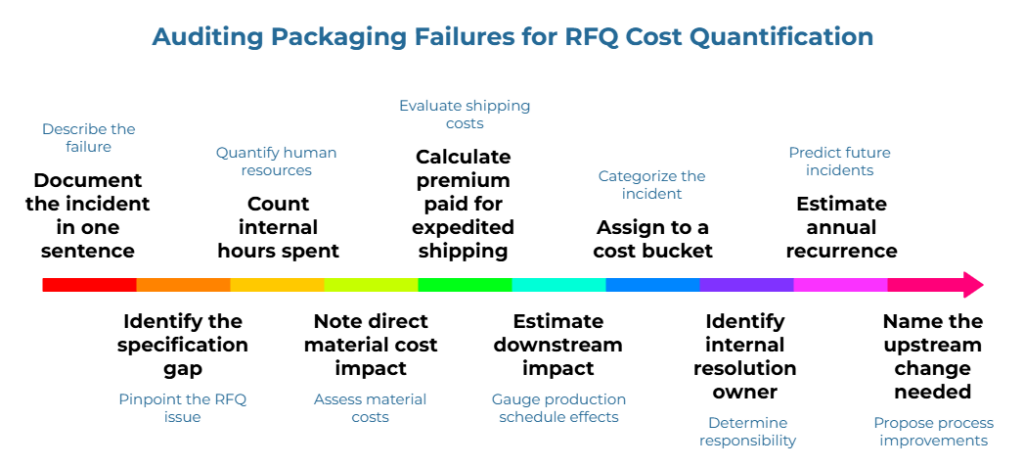
The most effective way to quantify chaotic RFQ costs is to examine your own recent history. This worksheet helps you convert scattered incidents into a single annualized view.
For each of your last three folding carton or packaging failures, document:
- What failed? Describe the incident in one sentence. (Example: “Folding cartons rejected at receiving due to caliper variance.”)
- What was unclear at the RFQ stage? Identify the specification gap that allowed the failure. (Example: “RFQ did not specify caliper tolerance or test method.”)
- How many people got pulled into the problem? Count the internal hours spent on investigation, communication, and resolution.
- Was material rejected, reworked, or re-run? Note the direct material cost impact.
- Was freight accelerated? Calculate the premium paid for expedited shipping.
- Was a production schedule or launch affected? Estimate the downstream impact in hours or days.
- Which cost bucket does this incident belong to? Assign it to one of the six categories above.
- Who owned the resolution internally? Identify the department or role that absorbed the problem.
- How frequently does this type of incident occur? Estimate annual recurrence (e.g., 3–6 times per year).
- What process fix would have prevented it? Name the upstream change needed.
- If this pattern repeated 4–6 times per year, what would the annualized damage look like? Multiply the single-incident cost by a realistic frequency.
When you complete this exercise for three incidents, you’ll have a rough but defensible estimate of your annual cost of RFQ chaos—built entirely from your own data, not from industry averages that may not apply to your operation.
Financial Justification: Presenting the Cost of Ambiguity
Leadership doesn’t need inflated savings projections. They need a clear explanation of where money is leaking and why.
Start with four plain statements:
- This is not a one-off supplier problem. It is a repeatable process-cost problem that shows up every time we send a vague RFQ.
- We are paying for ambiguity many times over.
- The cheapest quote is irrelevant if the quote was built on unstable assumptions. Specification-True Sourcing beats cheapest-quote thinking because comparability must come before price.
- A modest investment in structure reduces recurring loss categories.
Quantify using your own incidents. “In the last 12 months, we had four specification-related failures. Each one cost us an estimated $8,000–$12,000 in rework, expediting, and internal hours. That’s $32,000–$48,000 annually that doesn’t appear on any single invoice.”
Connect the cost to controllable inputs. The damage traces back to RFQs that left too much open to interpretation. The fix is upstream.
Propose a modest investment in structure. A single alignment session before the next RFQ—defining quote-ready fields and standardizing requirements—reduces the interpretation room that causes these failures.
This framing respects leadership’s time, avoids speculative ROI claims, and positions the request as risk reduction rather than cost avoidance guesswork.
The First Structural Fix: Move from Ad-Hoc RFQs to Specification-True Inputs
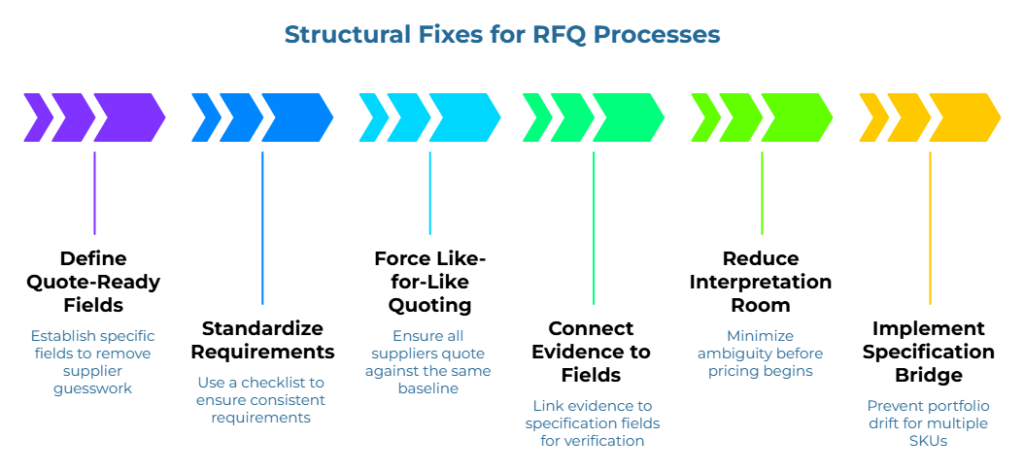
The remedy for chaotic RFQ processes isn’t harder negotiation. It’s an earlier specification alignment. The standard industry approach—send a generic RFQ to multiple suppliers and compare the lowest quoted unit price—is precisely what creates the downstream instability.
Before your next folding carton RFQ goes out, apply these structural fixes:
Define quote-ready fields that remove supplier guesswork: board grade with tolerance bands, barrier requirements with test methods, caliper ranges your equipment tolerates, and proof expectations tied to each field.
Standardize requirements using a specification alignment checklist that covers material, structural, performance, and documentation parameters.
Force like-for-like quoting by ensuring every supplier quotes against the same measurable baseline.
Connect evidence to named specification fields so that incoming material can be verified against documented requirements—a process detailed in the article – from claims to proof: a practical guide to supplier evidence packs for folding cartons.
Reduce interpretation room before pricing begins. When specifications are tight, quote variance drops and disputes become easier to resolve—a principle central to why folding carton clarity matters before supplier review starts.
For operations managing multiple SKUs, a specification bridge prevents portfolio drift as your product line expands.
The upfront investment is modest: one alignment session, one standardized template, one shared understanding of what “acceptable” means. The downstream savings show up in fewer disputes, fewer rejected shipments, and fewer emergency freight invoices that nobody can explain at year-end.
Clarity Eliminates the Friction that Silence Conceals
The year-end budget review doesn’t have to end in confusion. The variance doesn’t have to remain unexplained. The pattern of rejected folding cartons, expedited freight, and supplier disputes doesn’t have to repeat next quarter.
Chaotic RFQ processes create recurring, fragmented costs that hide across departments until someone adds them together. The diagnostic worksheet above gives you a method to do exactly that—using your own data, not industry averages.
The fix starts upstream. Define your baseline packaging parameters before the next RFQ leaves the building. Make suppliers quote against the same measurable baseline. Require proof tied to specification fields, following a staged proof ladder that matches evidence depth to qualification stage. Build a Budget Predictability Architecture that requires upfront investment in specification alignment but yields long-term stability.
Precision in the RFQ stage acts as a hedge against market volatility, ensuring that supplier selection is based on verified performance rather than speculative pricing.
Silence is expensive. Structure is cheaper. The first step is knowing what you’re actually paying for.
Disclaimer
This article is educational and methodology-first. PaperIndex does not sell market intelligence or publish pricing indices. Any examples involving cost or financial impact should be clearly labeled as illustrative or hypothetical, not presented as market guidance.
Our Editorial Process:
Our expert team uses AI tools to help organize and structure our initial drafts. Every piece is then extensively rewritten, fact-checked, and enriched with first-hand insights and experiences by expert humans on our Insights Team to ensure accuracy and clarity.
About the PaperIndex Insights Team:
The PaperIndex Insights Team is our dedicated engine for synthesizing complex topics into clear, helpful guides. While our content is thoroughly reviewed for clarity and accuracy, it is for informational purposes and should not replace professional advice.