

📌 Key Takeaways
Supplier selection fails when specifications and sourcing run on separate tracks until quotes force an awkward collision.
- Freeze Specs Before Quotes: Lock dimensions, GSM, handle type, coatings, print, and packing configuration before contacting suppliers to enable true comparison.
- Map Specs to Supplier Criteria: Each specification decision—strength, print complexity, compliance—should directly determine which supplier capabilities you evaluate and score.
- Stage Qualification to Limit Risk: Move from discovery to samples to pilot orders, verifying capabilities incrementally rather than betting on volume orders upfront.
- Compare Total Landed Cost: Unit price means nothing without MOQ impact, lead time buffers, packing efficiency, freight terms, and defect-handling costs included.
- Use Scorecards in Your Language: Build evaluation criteria that mirror your spec sheet fields so quality, compliance, and logistics align with actual requirements.
Comparable quotes require comparable specifications, measured across the full cost of delivery.
Procurement and operations teams managing wholesale paper bag programs will gain a repeatable framework here, preparing them for the detailed supplier qualification process that follows.
The spreadsheet says one thing. The supplier quotes say another.
Wholesale paper bag sourcing often breaks down in a predictable way: specifications get discussed in one thread, suppliers get contacted in another, and the two streams meet too late—after quotes arrive, or after a “front-runner” is informally chosen. Your team spent weeks defining paper bag specifications—dimensions, GSM, handle types, print requirements, sustainability certifications. Meanwhile, procurement has been collecting quotes from suppliers found through quick searches, trade show contacts, and referrals. Now you’re staring at five quotes that can’t be compared because each supplier interpreted your requirements differently.
This disconnect between specification work and supplier selection is one of the most expensive process gaps in wholesale packaging procurement. The result is usually not a dramatic failure. It is slower, more expensive, and harder to defend internally: apples-to-oranges comparisons, repeated clarifications, last-minute artwork changes, quality surprises, and preventable stock-out risk that damages customer relationships. The root cause isn’t unreliable suppliers—it’s a missing bridge between what you need and how you evaluate who can deliver it.
This guide provides that bridge. You’ll learn how to convert paper bag specifications into supplier-ready evaluation criteria, build a scorecard that uses your own spec language, and qualify suppliers through a staged process that reduces risk without slowing you down. The goal isn’t finding the lowest per-bag price. It’s building a defensible sourcing plan where total landed cost, quality consistency, and operational reliability drive your decisions.
Certainty note (to keep decisions defensible):
Verified from established practice: the workflow focus (specs → shortlist → qualification → comparison), the requirement to remain vendor-neutral, and PaperIndex’s role as a discovery/research platform rather than a transactional intermediary.
Generally accepted practice: using standardized spec sheets, staged qualification (discovery → sample → pilot), and structured scorecards to reduce procurement risk.
Varies by context: the right number of “bag families,” specific acceptance thresholds, sampling plans, and which certifications apply—these depend on product use, jurisdiction, and internal risk tolerance.
Why Specs and Sourcing Drift Apart (and What It Costs)
The most common failure mode is not “bad suppliers.” It is a process gap: suppliers are selected before quote-critical requirements are frozen. Most procurement teams run specifications and supplier selection on parallel tracks. Requirements live in one spreadsheet, managed by operations or brand teams. Supplier options live in another, managed by procurement. The two tracks intersect only when someone needs to “get quotes fast”—usually after timelines have already compressed.
The symptoms of this drift show up throughout the sourcing cycle:
Apples-to-oranges quotes. Without standardized spec sheets, each supplier interprets requirements differently. One quote for 120 GSM paper, another for 150 GSM. One includes handles; another prices them separately. Suppliers interpret “heavy-duty,” “premium,” or “eco-friendly” differently unless measurable fields are locked. Comparing these quotes requires hours of back-and-forth clarification.
Mystery quality issues. A bag that looked fine in samples fails during actual use—handles pull out under load, bottoms give way with moisture exposure, print colors shift between batches. These failures often trace back to specs that were never explicit enough to hold suppliers accountable. When acceptance criteria are not defined, quality becomes a debate instead of a check.
Last-minute artwork changes. Brand teams finalize logos and colors after suppliers have already prepared plates or cylinders. Print complexity, artwork approvals, or coating decisions change late and push timelines. Change orders add cost and delay, sometimes pushing orders into rush freight territory.
Stock-out risk. When specs aren’t locked before supplier selection, lead times stretch unpredictably. A supplier who quoted four weeks may need six once they understand the actual print complexity or coating requirements.
The financial impact compounds. Emergency freight to cover a delayed shipment can erase months of per-bag savings. A quality failure that reaches customers damages brand perception in ways no discount compensates. A more resilient approach treats sourcing as a repeatable discipline—specs, risk controls, and total landed cost—not a race to the lowest per-bag unit quote. The discipline of connecting specs to sourcing criteria before requesting quotes prevents most of these costs.
Start With Bag ‘Families’: The Spec Outputs That Make Supplier Comparison Possible
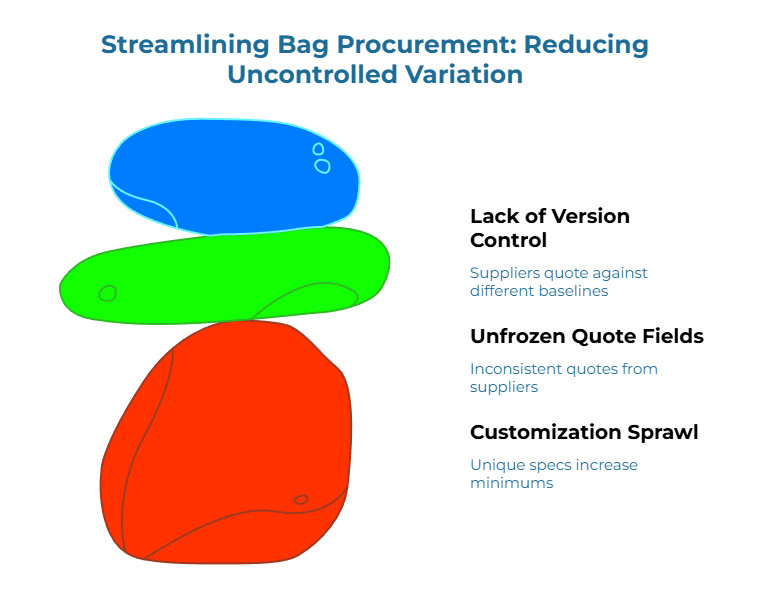
Before evaluating any supplier, define your bag families. A bag family is a standardized SKU group tied to a specific use case—not a unique bag for every product or promotion, but a rationalized set that covers your operational needs while keeping supplier comparison manageable. The point is not to eliminate customization; the point is to reduce uncontrolled variation that explodes MOQs, lead times, and quote noise.
In accordance with the Pareto Principle, most procurement strategies achieve optimal volume efficiencies by rationalizing SKUs into a core set of 3–6 bag families, which typically accounts for over 80% of total packaging throughput. Most e-commerce and delivery operations can consolidate requirements into three to six families based on:
- Load weight: Light (under 2 kg), medium (2–5 kg), heavy (over 5 kg)
- Content type: Dry goods, moist or greasy items, temperature-sensitive products
- Delivery distance: Short (same-day local), medium (regional), long (cross-country or export)
For kraft paper bags specifically—the most common choice for retail and delivery applications—review available kraft paper bag suppliers to understand the range of handle options, printing capabilities, and customization available in the market.
For each family, freeze the quote-critical fields before requesting any supplier quotes:
| Spec Field | What to Lock | Why It Matters |
| Dimensions | Exact width × depth × height (with tolerances) | Affects material usage, shipping carton fit, storage |
| Paper weight | GSM or ply structure with acceptable range | Directly impacts strength, cost, and feel |
| Handle type | Flat, twisted, die-cut, reinforced | Changes production process and per-bag cost |
| Coatings/liners | Grease resistance, moisture barrier, food-contact requirements | Limits supplier pool; affects recyclability |
| Colors, coverage area, finish (matte/gloss), branding elements | Drives plate/cylinder costs, minimum runs, lead time | |
| Packing configuration | Bags per carton, cartons per pallet, palletization requirements | Affects freight cost and warehouse handling |
Create a simple version control approach for each spec sheet: revision number, effective date, and owner. When specs change, update the revision so suppliers quote against the same baseline.
Limiting bag families also limits customization sprawl—the tendency to create unique specs for every product line or campaign. Each unique SKU increases minimum order quantities, extends lead times, and fragments your buying power across more suppliers.
Spec-to-Supplier Mapping: Which Requirements Change Which Supplier Criteria
Once bag families are defined, map each specification category to the supplier capabilities you need to evaluate. This mapping table becomes your bridge—showing exactly which supplier questions, evidence requirements, and scorecard criteria correspond to each spec decision.
A useful way to structure this is to separate each bag family into five sourcing workstreams: capability shortlisting, RFQ comparability, sampling & QA plan, compliance proof, and landed-cost comparability.
Workflow flowchart (text version):
Bag Family Spec Sheet (Rev-controlled)
→ Capability Shortlist (who can meet the must-haves?)
→ Comparable RFQ Package (same fields, same assumptions)
→ Samples + QA Plan (what will be tested/inspected and how?)
→ Compliance & Claim Evidence (what must be verified?)
→ Landed-Cost Comparison (MOQ, lead time, packing, risk)
→ Scorecard + Decision Record (defensible shortlist + backup)
Mapping table: Spec decision → supplier questions/evidence → scorecard criteria
| Spec decision area | Supplier questions / evidence to request | Scorecard criteria (example) |
| Dimensions & tolerances | What tolerances are controlled, and how are in-process checks documented? Provide a capability statement or QC plan excerpt. | Dimensional control approach; clarity of documentation |
| Ply/GSM / strength intent | How is variability controlled (incoming paper checks, process controls)? What failure modes are monitored (handle pull-out, bottom failure, delamination)? | Strength-control discipline; ability to explain controls |
| Handle type & attachment | What handle materials and attachment methods are used? What are the defined defects and rework rules? Provide sample photos and a defect catalogue if available. | Handle capability fit; defect prevention maturity |
| Print complexity | What is the proofing workflow (prepress, approvals)? How is color consistency controlled across runs? What triggers change orders? | Print workflow clarity; change-order risk |
| Coatings/liners performance | What functional performance is being offered (moisture/grease resistance)? Provide material declarations and intended-use constraints. | Performance evidence quality; transparency of limits |
| Compliance/certifications | Provide certificate numbers (if claimed) and scope; confirm willingness to support verification. Buyer verifies via official databases. | Evidence readiness; traceability capability |
| Packing configuration | What are standard pack counts, carton dimensions, and palletization options? How does packing change MOQs or lead times? | Logistics readiness; packing clarity |
| Lead time & capacity | What are normal lead time drivers (print setup, materials, capacity)? How are delays communicated? | Reliability signals; responsiveness |
| Quality system | What is the staged approach to samples, pre-production checks, and inspections? Supplier alignment to attribute-based inspection principles may be referenced through standards such as ISO 2859-1. | Quality system maturity; cooperation with inspections |
Strength and Handling: Translating “Sturdy” Into Measurable Criteria
“Sturdy enough for delivery” isn’t a specification—it’s an aspiration. “Sturdy” is not a sourcing criterion. Translating strength requirements into measurable acceptance criteria requires defining what failure looks like and what testing confirms acceptable performance.
Common failure modes for paper bags include handle pull-out, bottom failure, and delamination. Learn to diagnose specific packaging failures by matching tear patterns to root causes: bottom tears signal base construction issues, while side bursts indicate insufficient burst factor. For each bag family, determine which failure modes matter most based on actual use conditions.
Ask suppliers how they control variability in the factors that drive strength: incoming paper quality checks, process controls during manufacturing, and handle attachment methods. Suppliers with documented quality systems can typically describe their approach; those who can’t may struggle with consistency at scale.
For incoming inspection, consider referencing attribute-based sampling methodologies. ISO 2859-1 provides a widely recognized framework for sampling procedures and inspection by attributes, though the specific acceptance quality levels appropriate for your operation depend on your tolerance for defects and the cost of inspection versus the cost of failures. The point isn’t to prescribe a specific plan but to ensure your approach is systematic rather than arbitrary.
For deeper guidance on translating paper properties into bag performance requirements, explore our guide on understanding kraft paper grades for paper bags, which maps retail use cases to specific kraft grade bands.
Print and Brand Requirements: Managing Workflow and Lead-Time Risk
Print complexity affects more than aesthetics. It changes minimum order quantities, lead times, and the risk profile of every change order. Print requirements influence supplier selection less through “can they print” and more through process discipline.
Artwork approvals, proofing, and plate or cylinder preparation all occur before production begins. Suppliers who invest in prepress setup expect to amortize that cost across a production run. Short runs or frequent design changes increase per-bag costs and extend lead times.
To keep print requirements comparable across suppliers, standardize what you can control:
- File formats and color specifications: Define acceptable file types, resolution requirements, and whether you’re specifying Pantone, CMYK, or both.
- Proofing expectations: Determine whether you need physical proofs, digital proofs, or press proofs for color-critical applications. Clarify what “approval” means (proof approval vs production approval).
- Change order protocols: Establish how changes are requested, approved, and priced before production begins. Define change-order triggers and timelines.
Color consistency across batches—and across suppliers if you’re dual-sourcing—requires explicit attention. Ask suppliers how they control color from run to run and what tolerances they commit to. Without this conversation, “brand blue” may drift noticeably between deliveries.
Coatings and Liners: Balancing Performance With Recyclability
Functional coatings and liners address real operational needs: grease resistance for food delivery, moisture barriers for items that may encounter condensation, and heat resistance for warm food applications. But the language around these features often conflates marketing claims with technical specifications.
Before evaluating suppliers, clarify the functional requirement driving each coating decision. Is grease resistance necessary for product protection, or is it a nice-to-have that adds cost? Does the moisture barrier need to perform for hours or days? What temperature range must the bag withstand?
Request material declarations from suppliers that specify what coatings are used and their intended-use constraints. Common practice is to request a plain-language performance intent (what the coating or liner is expected to do), material declarations, and intended-use constraints (what the supplier is not claiming).
For food-contact applications, review food-grade certification standards to understand which regulatory frameworks apply to your markets, including how to request Declarations of Compliance naming FDA 21 CFR 176 or EU 1935/2004. The U.S. FDA provides an overview of how it regulates substances in food packaging, though requirements vary by jurisdiction, and this guidance is educational rather than legal advice.
Document the trade-offs explicitly. When specifying paper weight and grade, consider whether virgin or recycled kraft paper better suits your load requirements. Virgin kraft typically handles 5+ kg loads, while recycled kraft works well for 3-4 kg applications. This decision directly impacts both your sustainability positioning and your bag’s functional performance. Some coatings that improve functional performance may complicate recyclability claims. Performance improvements may affect recyclability expectations, lead time, or packaging handling. If sustainability messaging matters to your brand, ensure suppliers can evidence both the functional performance and the end-of-life characteristics of their coatings. The goal is documentation clarity rather than a single universal choice.
Compliance and Sustainability: Requiring Proof, Not Promises
Sustainability claims carry regulatory and reputational risk. Stating that bags are ‘eco-friendly’ or ‘sustainably sourced’ without proper evidence can trigger greenwashing allegations and, in some jurisdictions, regulatory action.
Distinguish between required and preferred claims in your specifications. Required claims—those you’ll make publicly or that affect regulatory compliance—need documented evidence. Preferred claims—those that inform supplier selection but don’t appear in customer-facing materials—may require less rigorous verification.
For chain-of-custody claims like FSC or PEFC certification, ask suppliers for certificate numbers and verify them directly through official databases. The FSC certificate database and PEFC certificate database allow you to confirm whether a supplier’s certification is active and covers the products they’re offering.
When defining claim language for your own use, reference established guidelines. The U.S. FTC Green Guides outline principles for environmental marketing claims that, while U.S.-focused, reflect broadly applicable standards for avoiding deceptive practices. In European markets, compliance must align with the Packaging and Packaging Waste Regulation (PPWR), which mandates specific recyclability grades and minimum recycled content percentages, superseding the previous Directive 94/62/EC.
To translate your brand’s sustainability values into actionable RFQ specifications that suppliers can quote against, use our sustainable sourcing framework with certificate scope checks, evidence ladders, and governance protocols.
The PaperIndex Academy provides a compliance integration checklist that pairs each sourcing action with compliance tasks to prevent rejected shipments.
Build a Supplier Scorecard That Uses Your Spec Language
A scorecard is only useful if it speaks the same language as your spec sheets. When spec fields use one set of terms and the scorecard uses generic procurement language, the evaluation process loses its connection to actual requirements. A scorecard works when it reflects the spec sheet fields and translates them into decision criteria.
Structure your scorecard around the categories that matter for each bag family:
| Section | What it measures | Example weight (illustrative) |
| Spec fit (bag family must-haves) | Ability to meet frozen quote-critical fields; does the supplier’s standard offering match your locked spec fields, or does fulfilling your requirements require customization? | 30% |
| Quality system & QA cooperation | Sample readiness, inspection support, defect handling discipline; documented procedures rather than vague assurances | 20% |
| Capacity & lead time reliability | Ability to meet timing expectations and communicate risk; track record on on-time delivery | 15% |
| Compliance & evidence readiness | Certificates/claims proof, declarations, documentation clarity; ability to provide the certificates, test reports, and declarations your required claims demand | 15% |
| Packing & logistics readiness | Packing clarity, configuration flexibility, damage risk reduction; alignment with your warehouse and freight requirements | 10% |
| Responsiveness & professionalism | RFQ clarity, turnaround, issue ownership; how quickly the supplier responds to inquiries | 10% |
Customization isn’t disqualifying, but it affects lead time and minimum quantities. Assign weights to each category based on failure impact and business priorities. If brand consistency is critical, weight print capability heavily. If you’re sourcing for a price-sensitive channel, weight cost factors more—but never weight cost so heavily that quality and reliability become afterthoughts.
Weighting is context-dependent. A food delivery program with performance coatings may weight compliance and performance evidence higher; a high-volume retail program may weight capacity and lead time reliability higher. Consider using one scorecard per bag family, or one scorecard with family-specific thresholds where performance requirements differ.
Qualify Suppliers With a Staged, Low-Regret Process
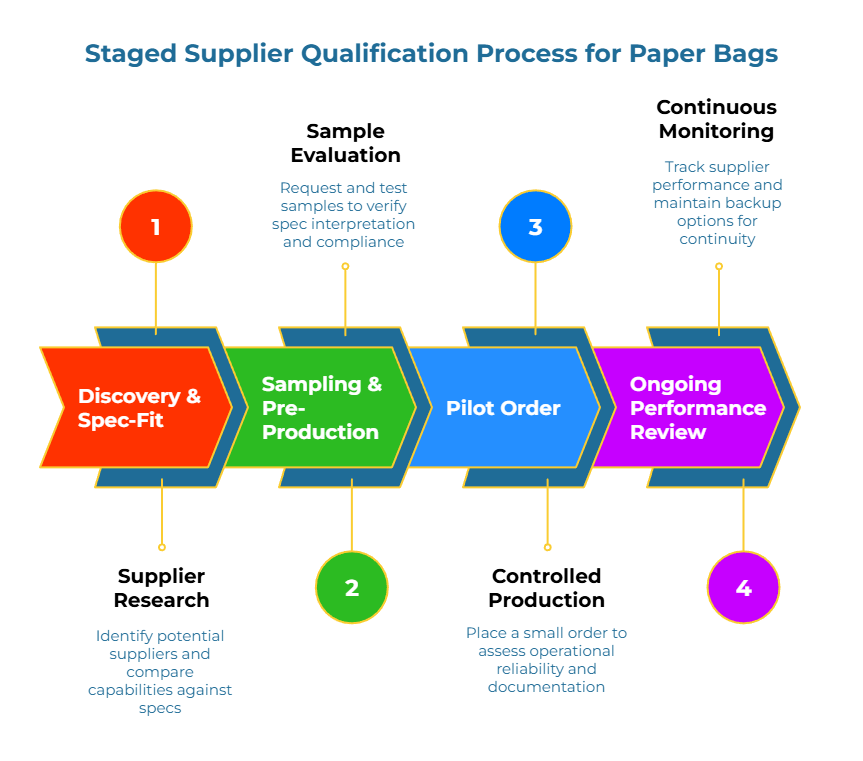
Rushing from discovery to volume orders is where sourcing plans most often fail. A staged qualification process lets you verify supplier capabilities incrementally, limiting exposure at each stage. This staged approach is widely used because it limits downside while building evidence.
Stage 1: Discovery and spec-fit. Start with supplier research to build a long list of candidates who appear to meet your basic requirements. Browse the supplier directory to identify wholesale paper bag suppliers, then review their profiles for relevant capabilities. Request capability sheets or catalogs and compare them against your bag family specs using a consistent capability checklist. Narrow to a shortlist of three to five suppliers worth deeper evaluation.
For a structured approach to evaluating suppliers remotely, the PaperIndex Academy offers a remote audit checklist for wholesale paper bag suppliers. When sourcing internationally, apply additional verification layers using our international paper bags supplier verification checklist, which covers registration checks, digital footprint validation, and payment term safeguards before wiring funds.
Stage 2: Sampling and pre-production checks. Request samples for each bag family from shortlisted suppliers, applying systematic supplier capability verification across two lanes: capability (can they hold specs repeatedly?) and execution (do they ship and document reliably?). Define what you’re testing before samples arrive—strength under load, print quality, coating performance, dimensional accuracy. Document results systematically. Samples validate that the spec is interpreted correctly. Pre-production alignment reduces late surprises. This stage should also include verification of compliance certificates through official databases.
Stage 3: Pilot order. Place a small controlled order with the one or two suppliers who performed well in sampling. A pilot converts “sample success” into a repeatability check. Inspection and paperwork discipline matter here. Inspect the pilot shipment against your acceptance criteria. Review shipping documentation for accuracy and completeness. A pilot order reveals operational realities that samples can’t: how the supplier handles actual production, packing, and logistics.
Stage 4: Ongoing performance review. After moving to regular orders, track supplier performance against your scorecard criteria. Schedule periodic reviews—quarterly for strategic suppliers, annually for backups. Maintain a second-source posture for critical families where operational continuity matters. Single-source dependencies create three hidden risks: fulfillment paralysis during disruptions, 15-30% cost spikes from emergency expediting, and brand erosion from stockouts. Keep at least one qualified backup supplier warm through occasional small orders or maintained contact, so you’re not starting from scratch if your primary supplier encounters problems.
The PaperIndex Academy’s guide on wholesale paper bags sourcing verification methodology provides a 5-step verification framework with measurable specs, production samples, certification scope checks, and drift monitoring.
Connect the Framework to Total Landed Cost
Per-bag price is one input to sourcing decisions, not the decision itself. Total landed cost captures the full expense of getting usable bags into your operation—and sometimes the supplier with the lowest quoted price has the highest total cost. Total landed cost becomes comparable when suppliers quote against the same assumptions and when “risk cost” is acknowledged as part of operational reality.
Factors that affect landed cost beyond unit price include:
- Minimum order quantities: Higher MOQs tie up working capital and warehouse space; MOQ and the cash/space impact of inventory
- Lead times: Longer lead times require larger safety stock or more frequent reordering; lead time and the cost of schedule buffers
- Packing configuration: How bags are packed affects freight cost and handling efficiency; cartonization and palletization assumptions
- Freight terms: Who arranges and pays for shipping, and at what Incoterm? Freight, duties, and destination charges can represent 20-35% of your total landed cost
- Defect rates and rework: Bags that fail inspection or underperform in use cost more than their purchase price, often erasing months of per-unit savings through failure costs; defect handling including replacements, rework, and operational disruption
- Payment terms and cash flow: How supplier payment terms (deposits, Net 30/60/90) and order lead times affect your working capital requirements and cash conversion cycle
A comprehensive Total Landed Cost (TLC) model must quantify the unit price, logistics, and duties, while also incorporating regulatory costs such as the Carbon Border Adjustment Mechanism (CBAM) for non-compliant paper imports into specific jurisdictions.
Consider an illustrative scenario: Supplier A offers bags at a lower per-unit price than Supplier B and provides a modest unit-price reduction. But Supplier A’s lead time is three weeks longer, requires a higher MOQ, their defect rate in pilot orders was higher, provides limited clarity on packing configuration, and their packing configuration doesn’t fit your standard pallets. To meet a demand spike, you’d need to order earlier (tying up cash), absorb more defects (wasting product and labor), and repack shipments for your warehouse (adding handling cost). A single delayed shipment or a single batch quality dispute forces expedited replenishment and internal rework. Supplier B’s higher unit price may deliver lower total landed cost. The “cheaper” unit quote becomes less relevant once disruption cost is recognized.
When collecting quotes, request the information needed to make landed cost comparable: packing specifications, lead times at various order quantities, freight terms offered, and how defects are handled. Without this information, you’re comparing labels rather than actual costs.
Track your supply chain’s resilience using a fragility scorecard that measures supplier concentration, lead time buffers, MOQ flexibility, and quality consistency. Scores of 7-14 indicate critical fragility; 25-35 signal resilient supply chains.
How to Use PaperIndex in This Workflow
PaperIndex functions as a discovery and research platform—a starting point for identifying wholesale paper bag suppliers globally and gathering initial capability information. It is not a broker, agent, or transactional intermediary. PaperIndex does not negotiate terms, guarantee supplier performance, process payments, or handle logistics. Buyers and suppliers connect directly and set their own terms.
Within the framework described in this guide, PaperIndex fits into Stage 1 of supplier qualification. Use the platform to find wholesale paper bag suppliers matching your general requirements, review supplier profiles for capability indicators, and build an initial shortlist for deeper evaluation.
To make outreach efficient, prepare your spec sheets before contacting suppliers. Once your specifications are locked, you can submit RFQs to multiple qualified suppliers simultaneously through PaperIndex’s free RFQ system.. A clear spec sheet—with bag family definitions, quote-critical fields locked, and evaluation criteria defined—reduces back-and-forth and ensures you receive comparable quotes using structured RFQs and comparable quote requests.
For additional context on available paper bag types and specifications, you can also browse paper bag products listed on the platform.
The due diligence process—sampling, pilot orders, certificate verification, and ongoing performance tracking—remains your responsibility as the buyer. Discovery platforms accelerate the search for candidates; they don’t replace the qualification work that separates reliable suppliers from risky ones.
For broader educational resources on procurement, international trade, and supplier evaluation, visit PaperIndex Academy.
Want to put this framework into motion? Use PaperIndex to discover wholesale paper bag suppliers, then apply spec sheets and a scorecard to build a defensible shortlist.
Ready to begin sourcing? Explore PaperIndex’s paper bag supplier listings to build a shortlist, then request samples and quotes directly from suppliers.
Frequently Asked Questions
How many bag families should we standardize first?
Start with three to five families that cover your highest-volume use cases. A small set that covers most shipments is usually sufficient. Focus on the few that create the most operational risk when wrong (high volume, high load, or performance-critical use cases). Trying to rationalize every possible bag type at once creates analysis paralysis. Lock the spec fields for your core families, run the sourcing process, and expand later based on what you learn.
What should be fixed in the spec before asking for quotes?
At minimum: dimensions with tolerances, paper weight (GSM or ply), handle type, any required coatings or liners, print specifications (colors, coverage, finish), and packing configuration. Freeze quote-critical fields including dimensions, ply/GSM intent, handle type, coatings/liners intent, print assumptions, and packing assumptions. If these fields aren’t locked, quotes won’t be comparable. Anything left ambiguous is likely to reappear as non-comparable quoting.
How do we compare local versus overseas suppliers fairly?
Normalize to total landed cost, not unit price. Use the same bag family spec sheets and the same landed-cost inputs (MOQ, lead time assumptions, packing configuration, and quality/inspection expectations). Include freight, duties, lead-time implications for inventory, and the cost of quality issues that are harder to resolve across distance and time zones. Risk tolerance and time-to-replenish often drive the final weighting. A local supplier with higher per-bag cost may deliver lower total cost when these factors are included. The PaperIndex Academy’s checklist for verifying international paper bag suppliers provides guidance specific to cross-border evaluation.
What should we do if we’re already in a stockout crisis?
If you’re facing immediate stockouts, follow a two-phase crisis response: secure 7-10 days of bridge inventory immediately through expedited orders, then build a diversified supplier base over 30-90 days to prevent recurrence.
What proof should we ask for sustainability claims?
Request certificate numbers for any chain-of-custody claims (FSC, PEFC, recycled content certifications) and verify them through the issuing organization’s public database. Define required versus preferred claims, request certificate numbers where applicable, and verify via official databases such as FSC and PEFC. For environmental marketing claims, ask for the specific evidence supporting each claim and ensure the language you use aligns with regulatory guidance on environmental marketing. Align internal claim language governance to authoritative guidance such as FTC Green Guides or EU Directive 94/62/EC where relevant.
Disclaimer: This article is provided for general informational purposes only and does not constitute legal, regulatory, financial, or procurement advice. Requirements, standards, and compliance obligations can vary by product, market, and jurisdiction. Always validate specifications and claims with your suppliers and appropriate professionals.
Our Editorial Process:
Our expert team uses AI tools to help organize and structure our initial drafts. Every piece is then extensively rewritten, fact-checked, and enriched with first-hand insights and experiences by expert humans on our Insights Team to ensure accuracy and clarity.
About the PaperIndex Insights Team:
The PaperIndex Insights Team is our dedicated engine for synthesizing complex topics into clear, helpful guides. While our content is thoroughly reviewed for clarity and accuracy, it is for informational purposes and should not replace professional advice.