

📌 Key Takeaways
FSC and PEFC labels prove chain-of-custody participation, not blanket sustainability—verification requires checking certificate status, scope, and entity match before accepting claims.
- Certificates Have Boundaries: Valid FSC or PEFC certificates only cover specific legal entities, sites, products, and activities explicitly listed in the scope—nothing beyond that list is certified.
- Entity Mismatch Breaks Claims: The certificate holder’s legal name must match the invoicing party exactly; parent company certificates don’t automatically cover subsidiaries or different country registrations.
- Documentation Consistency Matters: Certification claims appearing only in brochures or artwork without matching text on quotes, purchase orders, and invoices lack defensible proof for that transaction.
- Comprehensive Sustainability Isn’t Certified: Forest certification addresses defined sourcing and traceability rules but doesn’t verify carbon neutrality, complete biodiversity protection, labour conditions across all tiers, or recyclability outcomes.
- Registry Verification Prevents Greenwashing: Checking current certificate status in official registries (search.fsc.org for FSC) catches expired, suspended, or scope-mismatched claims that supplier PDFs miss.
Labels signal system participation—verification reveals actual coverage.
Procurement managers sourcing certified paper and packaging will gain a practical interpretation framework here, preparing them for the detailed verification workflows that follow.
A label is not a warranty. It’s a claim system.
Picture this: a supplier’s brochure lands on your desk, prominently featuring an FSC logo. That settles it, you think. We can put “sustainably sourced” on our packaging now. Three months later, a customer’s compliance team asks for documentation—the kind of verification workflow detailed in avoiding greenwashing: how to verify supplier sustainability claims. You request the certificate. The entity name doesn’t match your invoice. The scope covers printing papers—but you ordered a packaging board.
That green logo just became a liability.
FSC and PEFC labels verify adherence to specific chain-of-custody standards, not comprehensive environmental performance. Understanding precisely what these claims can and cannot verify protects your procurement decisions from greenwashing exposure and documentation gaps. By the end of this article, you’ll have a clear interpretation framework—what to trust, what to question, and the minimum checks to run before repeating any supplier’s certification claim.
What FSC and PEFC Actually Are
The Forest Stewardship Council (FSC) and the Programme for the Endorsement of Forest Certification (PEFC) operate as certification systems supporting chain-of-custody claims for forest-based products. Neither functions as a universal sustainability stamp.
Chain-of-custody, in procurement terms: a documented system of tracking and segregation rules ensuring certified material isn’t mixed with uncertified material or misrepresented as it moves through the supply chain. When suppliers hold valid chain-of-custody certificates, they attest to following these rules—but only for products, sites, and activities explicitly listed in their certificate scope. This scope verification becomes critical during kraft paper supplier qualification, where certificate coverage must match your specific requirements.
FSC operates a single global standard verified by accredited bodies. PEFC works differently—it endorses national certification schemes meeting its sustainability benchmarks through mutual recognition. Both systems undergo third-party audits, and both require certificate holders to follow specific rules for making on-product and off-product claims.
What neither system certifies: carbon neutrality or end-of-life recyclability. While both schemes have updated their standards to verify core labor requirements (such as freedom from forced labor and child labor) for chain-of-custody holders, they remain primarily material sourcing standards rather than comprehensive social compliance audits like SA8000. The schemes focus on forest management practices and material traceability; broader ESG outcomes often require separate verification.
The Claim Types You’ll Actually See
FSC Claims
Three label categories appear on FSC-certified products:
FSC 100% indicates all material originates from FSC-certified forests. Straightforward in meaning—but verification still requires confirming the certificate covers your supplier, your product category, and your specific order.
FSC Mix signals a combination of inputs: material from FSC-certified forests, recycled content, and/or FSC Controlled Wood. That last category—Controlled Wood—refers to material from non-certified forests meeting FSC’s risk-management requirements. These inputs must not be illegally harvested, sourced from areas violating traditional or civil rights, from forests with threatened high conservation values, or from land being converted from forest to other uses. “Mix” doesn’t mean diluted. It means the supplier follows FSC’s blending rules for different input categories.
FSC Recycled indicates all material comes from reclaimed sources, whether post-consumer or pre-consumer waste.
Official FSC label guidance provides detailed specifications for each claim category.
PEFC Claims
PEFC on-product messaging varies depending on the endorsed national scheme and product type. Common language includes “PEFC Certified” or statements referencing “sustainably managed forests and controlled sources.”
Because PEFC operates through mutual recognition of national schemes, claim wording doesn’t map directly onto FSC categories. Read the actual label text. Check the certificate scope. Don’t assume equivalence.
The Verification Gap: Provenance vs. Performance
What a Valid Claim Proves
A legitimate FSC or PEFC claim, properly documented, demonstrates that:
The supplier participates in the scheme’s sourcing and traceability rules, subject to valid certificate status and matching scope
The claim language corresponds to a defined category with auditable requirements—not generic marketing terms like “eco-friendly” or “green”
An accredited third party has audited the supplier’s chain-of-custody system
What It Does Not Prove
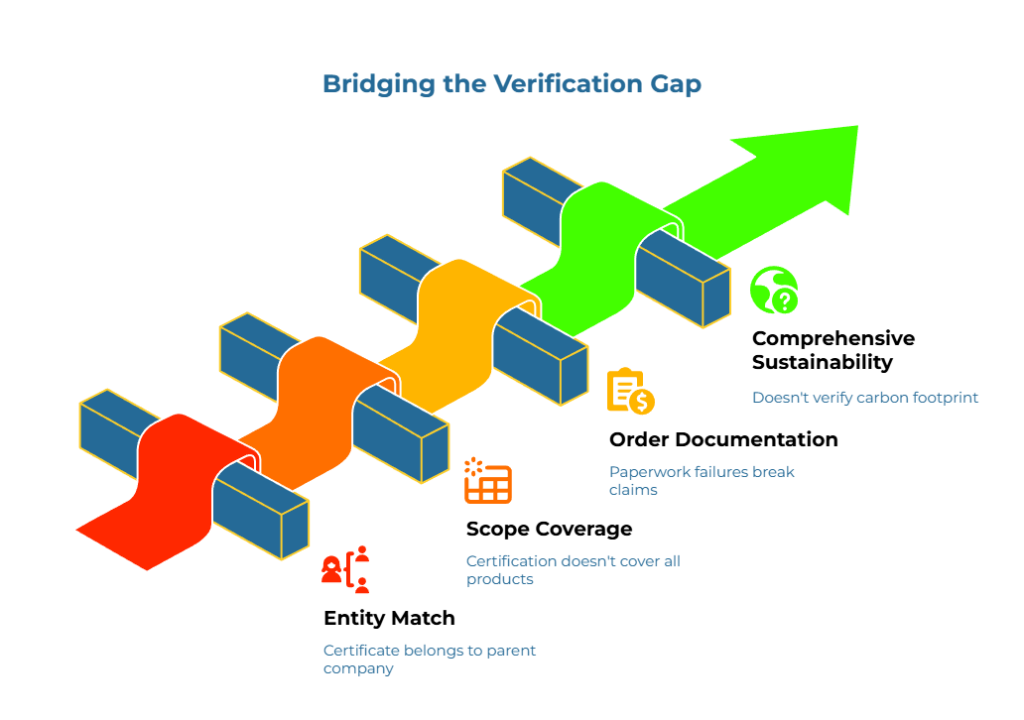
Entity match. The certificate might belong to a parent company, a different subsidiary, or a separate legal registration than the party on your invoice. A valid certificate somewhere in a corporate group doesn’t automatically cover the specific entity you’re paying.
Scope coverage. Certification for printing papers doesn’t extend to packaging grades. A certificate for one manufacturing site doesn’t cover production at another facility. The scope lists specific products, activities, and locations—nothing beyond that list is certified.
Order-level documentation. Paperwork failures break claims even when valid certificates exist. If the certification claim appears on marketing materials but not on your purchase order and invoice, you lack defensible documentation for that specific transaction.
Comprehensive sustainability. Forest certification addresses defined forest management practices and chain-of-custody traceability. It doesn’t verify carbon footprint calculations, guarantee zero biodiversity impact, certify labour conditions across all supply chain tiers, or ensure recyclability outcomes.
These verification gaps explain why supplier capability verification requires evidence beyond certifications alone—certificates prove participation in a scheme, not operational performance or quality consistency.
Comparison Table: What the Label Can and Can’t Prove
| Attribute | FSC Standard | PEFC Standard | Verified Fact | Unverified Risk | Procurement Control |
| Claim categories | FSC 100%, FSC Mix, FSC Recycled | “PEFC Certified,” “PEFC Recycled, “From sustainably managed forests and controlled sources” | Supplier uses defined claim category with auditable rules | Claim applies to your order without supporting documentation | Capture exact claim text from quote, PO, and invoice |
| Certificate status | Valid, suspended, or terminated | Valid, suspended, or terminated | Certificate was valid at audit date | Certificate remains valid today for your order | Verify current status in official registry |
| Scope | Specific products, sites, activities | Specific products, sites, activities | Supplier holds certification for listed scope | Your product/site/activity falls within that scope | Confirm scope explicitly covers your requirements |
| Entity | Legal entity name and registration | Legal entity name and registration | Named entity is certified | Invoicing entity matches certified entity | Cross-check certificate entity against invoice |
| Label vs marketing | FSC trademark rules govern use | PEFC trademark rules govern use | On-product label follows scheme rules | Generic “sustainable” claims are scheme-approved | Distinguish certified claims from marketing copy |
| Failure modes | Expired, suspended, scope mismatch, entity mismatch | Expired, suspended, scope mismatch, entity mismatch | System works when documentation aligns | System automatically catches all errors | Check registry, scope, and entity match per order |
When building internal paper bag spec sheets, include a dedicated certification field specifying required claim type (FSC 100%, Mix, or Recycled) and verification evidence (certificate code, entity name, scope confirmation) to prevent ambiguity during supplier quoting.
Quick Buyer Checklist and Red Flags
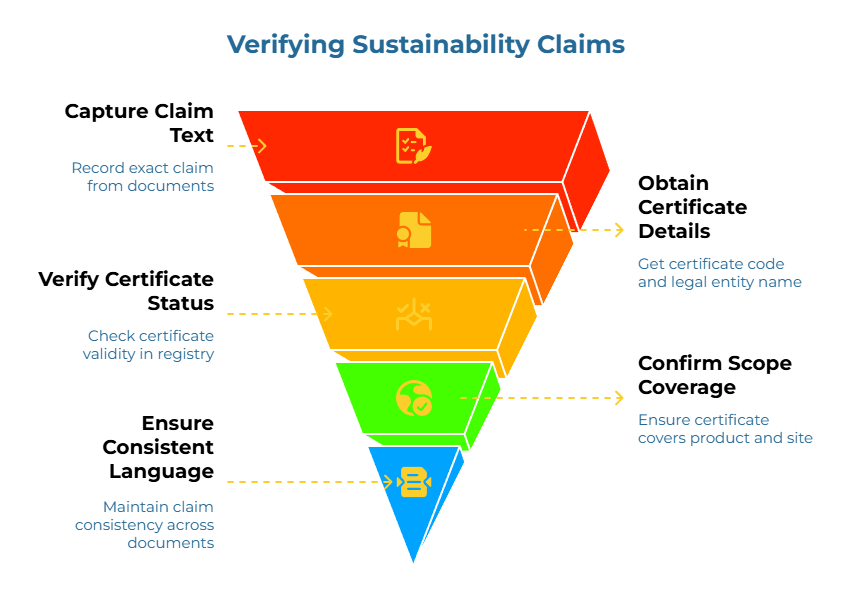
This checklist establishes minimum interpretation standards. For the complete verification workflow, see avoiding greenwashing: how to verify supplier sustainability claims. When sourcing paper bags specifically, greenwashing alert: how to verify FSC claims on paper bag orders provides a product-specific checklist.
Before accepting any certification claim:
- Capture the exact claim text from commercial documents—quote, purchase order, invoice. Paraphrased claims aren’t defensible claims.
- Obtain the certificate or licence code plus the legal entity name exactly as registered.
- Verify certificate status in the official registry: FSC Certificate Search for FSC claims, or the relevant PEFC registry.
- Confirm scope coverage for your specific product category, site, and activity. Assumptions create gaps.
- Require consistent claim language across all transaction documents. Brochure-only claims lack documentation integrity.
Red flags warranting additional scrutiny:
- “FSC compliant” or “PEFC compliant” without specific claim category—these phrases aren’t defined scheme terminology
- Certificate evidence limited to screenshots or PDFs without live registry verification
- Certificate entity differs from invoicing party (parent company, different subsidiary, different country registration)—a common issue when evaluating kraft paper exporters, where corporate structures often span multiple legal entities
- Claim appears at artwork or sample stage but disappears from commercial documentation
For a detailed walkthrough of FSC verification specifically, see greenwashing alert: how to verify FSC claims on paper bag orders.
Frequently Asked Questions
Is FSC better than PEFC?
Context determines fit. FSC operates a single global standard; PEFC endorses national schemes meeting its benchmarks. Some brand owners and retailers specify FSC exclusively; others accept both. Geographic availability varies—certain regions have stronger PEFC scheme presence, others favour FSC. Rather than declaring a universal winner, match scheme selection to your customer requirements, supplier capabilities, and target markets. What matters more: verifying that whichever claim your supplier makes is actually supported by valid, in-scope certification with consistent documentation.
What does FSC Mix mean?
FSC Mix indicates the product contains material from FSC-certified forests combined with recycled content and/or FSC Controlled Wood. Controlled Wood undergoes risk assessment to exclude illegally harvested sources, material from areas with violated rights, forests with threatened conservation values, and land undergoing conversion. The “Mix” designation reflects FSC’s rules for blending certified and controlled inputs—not a weakened or partial certification.
What does PEFC certified mean on packaging?
A PEFC label indicates material sourced according to sustainability benchmarks verified through chain-of-custody auditing. Because PEFC endorses national certification schemes rather than operating a single global standard, specific claim wording varies. Common messaging references “sustainably managed forests and controlled sources.” As with any certification claim, the label’s value depends on certificate validity, scope alignment with your product, and entity match with your supplier.
Does FSC mean sustainable?
FSC certification means the supplier follows FSC’s defined rules for forest management practices and chain-of-custody traceability. It does not mean the product achieves sustainability across every dimension. Carbon neutrality, comprehensive biodiversity protection, fair labour throughout all supply chain tiers, and end-of-life recyclability fall outside FSC’s certification scope. Claiming blanket sustainability based solely on FSC certification overstates what the scheme verifies. For comprehensive sustainability sourcing frameworks, see recycled vs. virgin kraft paper: choosing the right bag material for eco-compliance, which addresses how certifications interact with material selection, recycled content verification, and compliance documentation.
How do I verify an FSC or PEFC certificate?
For FSC, use the public certificate database. Enter the certificate code or company name, confirm “valid” status (not suspended or terminated), and verify the scope covers your product category while the legal entity matches your supplier. For PEFC, access the relevant national scheme registry and follow equivalent steps: status, scope, entity. Never rely solely on supplier-provided documents—always verify against live registry records.
Ready to connect with verified paper suppliers? Find paper suppliers and exporters with FSC/PEFC certifications on PaperIndex, or submit an RFQ specifying your certification requirements to receive quotes free. Before awarding contracts, use our 5-step paper bag supplier verification checklist to validate certificate scope and entity match. For more procurement guidance, explore PaperIndex Academy.
Background reading: What Is FSC Certified Paper? and How to Spot Greenwashing in Paper Supplier Claims. For retailers navigating packaging compliance, see the retailer’s guide to sustainable packaging compliance: navigating bans and certifications. Converters should review sustainable sourcing of bag paper: aligning packaging with brand values for translating sustainability requirements into RFQ specifications.
Disclaimer: This article provides informational content only and does not constitute legal or compliance advice. Certification requirements and claim rules vary by scheme, product category, and jurisdiction. Always verify certificate status and scope in official registries and confirm claim language on commercial documents.
Our Editorial Process:
Our expert team uses AI tools to help organize and structure our initial drafts. Every piece is then extensively rewritten, fact-checked, and enriched with first-hand insights and experiences by expert humans on our Insights Team to ensure accuracy and clarity.
About the PaperIndex Insights Team:
The PaperIndex Insights Team is our dedicated engine for synthesizing complex topics into clear, helpful guides. While our content is thoroughly reviewed for clarity and accuracy, it is for informational purposes and should not replace professional advice.