

📌 Key Takeaways
Food packaging paper compliance protects your brand on two fronts: passing inspections and preventing the viral photo of a greasy, failed wrapper.
- Compliance Is Insurance: A small investment in verified documents and organized files prevents costly brand damage, inspection failures, and legal trouble.
- Paper Thickness Doesn’t Stop Grease: GSM measures paper weight, but Kit Level measures grease resistance—heavy paper without barrier treatment still soaks through fast.
- Three Documents Keep You Audit-Ready: A Letter of Guarantee, technical data sheet, and batch traceability records let you answer inspector questions in minutes, not hours.
- Paperwork Fails Silently: Even organized files break down when test conditions don’t match your menu, coatings aren’t covered, or suppliers quietly change ingredients.
- Upgrade Proof Before Upgrading Paper: When food packaging paper fails, fix your documentation first—then adjust materials with confidence.
The right paperwork today prevents the wrong headline tomorrow.
Restaurant owners, food service managers, and procurement teams responsible for packaging decisions will find practical compliance safeguards here, preparing them for the detailed verification steps that follow.
~ ~ ~ ~ ~ ~ ~ ~ ~ ~ ~ ~ ~ ~ ~ ~ ~ ~
It is 12:15 PM during the lunch rush. A customer slides a burger bag back across the counter. The bottom has gone translucent with grease, leaving a dark stain spreading across the branded wrapper. The customer pulls out a phone.
That photograph will be online within the hour.
Meanwhile, at another location across town, it is 9:00 AM on inspection day. The manager is frantically searching for a Letter of Guarantee that does not exist. The health inspector waits, clipboard in hand, while the filing cabinet yields nothing useful. Both scenarios share a root cause: the discrepancy between utilizing food-contact materials and possessing the verifiable documentation required to validate compliance with safety standards.
This is why compliance functions as insurance. The premium is small: verified food packaging paper suppliers, organized documentation, a system for matching what arrives to what can be proven. The potential loss—brand erosion, inspection findings, legal exposure—is disproportionately large.
Why is food packaging paper compliance important? Food packaging paper compliance protects a business on two fronts: regulatory and reputational. It enables operators to prove—within minutes, not hours—that the paper touching customer food meets documented safety standards. Compliance reduces the risk of inspection failures, costly recalls, and the viral photograph of a failed wrapper that damages brand trust faster than any fine.
The High Stakes of Brand Integrity
Two micro-moments define compliance risk for food service operators.
The lunch-rush failure. A paper bag absorbs grease and begins to disintegrate. The customer photographs it. The image spreads through a local Facebook group or appears in a Google review with dozens of helpful votes. No health code was technically violated—but the brand damage is already done. As a blunt rule of thumb, one viral photo of a greasy, failed paper bag can create a serious, location-level threat to a franchise.
The inspection-day scramble. An inspector requests documentation proving the wrapper in use is safe for direct food contact. The manager knows the paper came from a supplier claiming food-grade status, but cannot produce a Letter of Guarantee, a technical data sheet, or any traceability linking current inventory to a specific batch. The inspector notes the gap. A follow-up gets scheduled.
Certified food packaging paper signals quality to customers before they even taste the food. When that signal fails—through grease stains, tears, or documentation gaps—the business absorbs the cost. For a deeper look at the reputational stakes, see beyond the fine: the reputation risk of non-compliant food packaging paper.
What Compliance Protects (and What It Does Not)
In practical terms, compliance means the ability to demonstrate—quickly and with documentation—that food-contact packaging paper meets relevant safety standards. In the United States, this typically involves FDA food-contact regulations, including 21 CFR 176.170 for paper and paperboard. In the European Union, framework regulation (EC) No 1935/2004 establishes general requirements for all materials intended to contact food. However, unlike plastics, there is currently no harmonized EU regulation specifically for paper and paperboard. Instead, operators generally rely on the overarching framework combined with specific national legislation, such as the widely recognized German BfR Recommendation XXXVI for paper and board. For operators importing food packaging paper, verifying international certifications requires additional scrutiny.
Compliance does not guarantee that nothing will ever go wrong. It reduces risk, improves audit readiness, and creates a defensible paper trail. What it does provide is a structure for accountability: when something fails, the business can trace it. When an inspector asks a question, the business can answer. When a customer complains, there is evidence of due diligence.
This distinction matters. Compliance is not bureaucracy—it is asset protection.
The False Diagnosis Trap: Why Thicker Paper Does Not Stop Grease
A common misconception leads operators astray: believing that thicker paper (higher GSM) stops grease, when actually treated paper (higher Kit Level) is required. GSM measures weight and affects stiffness. Kit Level measures grease resistance. A heavy 80 GSM sheet without barrier treatment will soak through faster than a lighter 60 GSM sheet with proper grease-resistant coating. A simple grease spot test can verify barrier performance at receiving.
Similarly, not all brown kraft paper is food safe. The assumption that natural-looking paper must be safe for food contact has no basis in material science. Food-contact compliance depends on what the paper contains and how it was treated—not its color or appearance. For the technical breakdown, see food packaging paper gsm explained: how to match paper weight to your menu items.
Why Cheap Paper Becomes Expensive
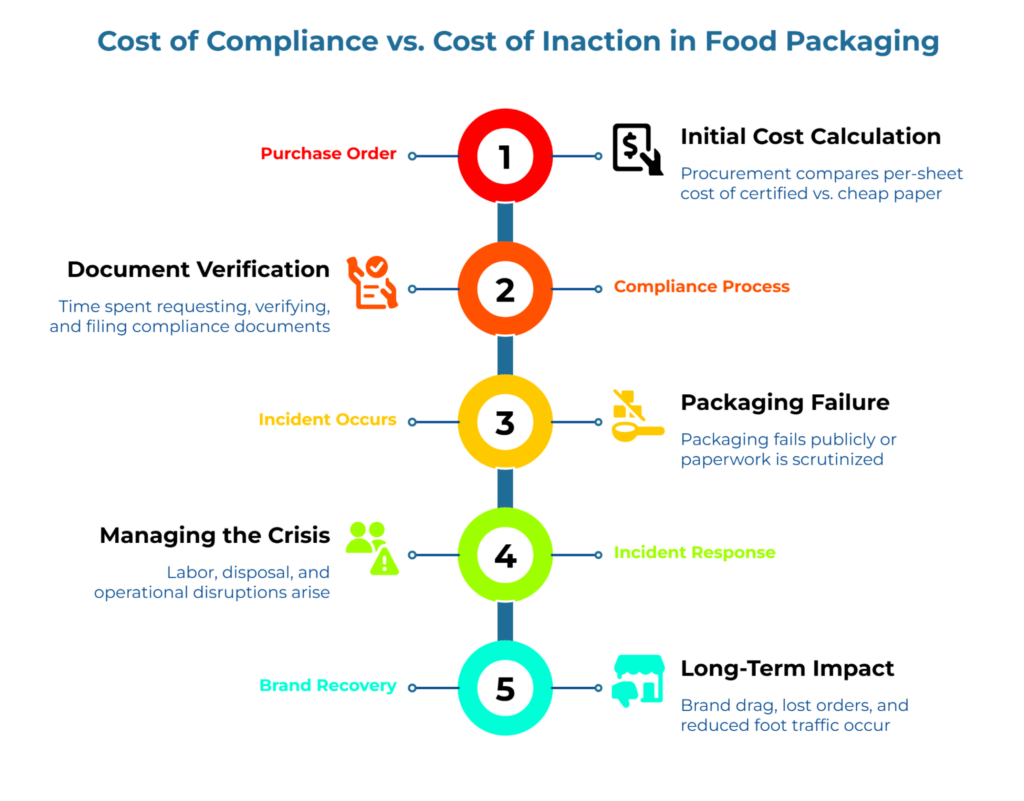
The deeper intent behind most compliance research is a simple question: Is it worth paying extra for certified food packaging paper?
A useful way to frame this decision is to weigh the Cost of Compliance (CoC) against the potential Cost of Inaction (CoI).
Cost of Compliance includes the time to request documents, verify scope, file them, and re-check after supplier changes. This is the small premium—predictable and manageable.
Cost of Inaction emerges when food packaging paper fails publicly or paperwork fails under scrutiny. A simple model captures the main categories:
COI per incident = R + L + D + O + B
- R — Refunds and remakes
- L — Labor and manager time managing the incident
- D — Disposal of suspect inventory
- O — Operational disruption (temporary shutdowns, rush orders for replacement food packaging paper)
- B — Brand drag (complaints, lost repeat orders, reduced foot traffic, potential loss of catering contracts)
The arithmetic of cutting corners on food packaging paper appears simple until the first incident arrives. While a lower per-sheet cost appears advantageous on a purchase order, these savings are often offset by downstream liabilities—such as disposal fees and brand recovery—that remain invisible to procurement.
Certified, well-documented food packaging paper rarely pays off in a single dramatic moment. More often, it quietly reduces preventable incidents and shrinks disruption—especially O and B. The cost of a recall or lawsuit dwarfs the cost of the paper itself.
What Audit-Ready Looks Like: The Minimum Proof Stack
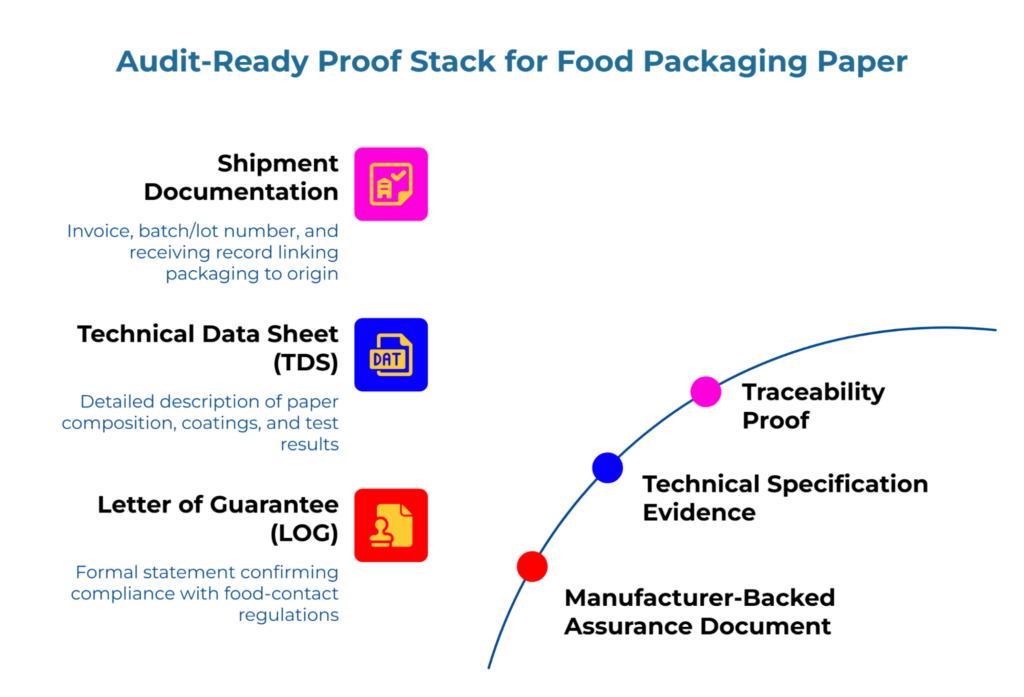
Being audit-ready does not require a legal department or a dedicated compliance officer. It requires a system—simple enough for any operator to maintain—that links food packaging paper to proof. The minimum proof stack consists of three elements:
A manufacturer-backed assurance document. Often called a Letter of Guarantee (LOG), this is a formal statement confirming that the material complies with relevant food-contact regulations. The LOG should name specific standards—such as FDA 21 CFR 176.170 or EU Regulation (EC) No 1935/2004—rather than using vague language like ‘food safe’ without reference to a framework.
Technical specification evidence. A technical data sheet (TDS) or certificate of analysis tied to the exact material in use, describing paper composition, coatings or treatments, and relevant test results such as grease resistance measured by Kit level.
Traceability proof. Documentation linking the food packaging paper currently in use to a specific shipment: invoice, batch or lot number, and receiving record. This answers the question: where did this specific roll or case come from, and when?
For a practical guide to organizing these documents, see food packaging paper trail: 3 documents you need to pass a health inspection.
Critical Vulnerabilities in Compliance Documentation
Documentation exists. The folder is organized. Yet compliance can still fail silently through three common patterns.
Scope mismatch. Documentation covers a material tested under conditions that do not match actual use. Paper tested for dry goods at room temperature may not be suitable for hot, greasy fried chicken held for 12 minutes. If test conditions in the TDS do not reflect menu demands, the compliance claim does not fully apply. A menu-match matrix helps align paper specifications with actual use conditions.
Missing layers. The LOG covers base paper but not coatings, inks, or adhesives applied to it. Food-contact compliance applies to the finished article—the complete food packaging paper item as used—not just one component.
Supplier drift. The supplier changes a mill, formulation, or coating chemistry, and paperwork lags behind. The LOG on file may reference a product version that no longer matches what is being shipped—a pattern known as compliance decay.
A common performance mismatch is the wrong wrapper being used for heat or grease. See the wax paper trap: why generic wraps fail high-heat tests.
The 5-Question Risk Exposure Quiz
Use this self-assessment to gauge compliance exposure.
- Can the business produce a current Letter of Guarantee for the exact paper or board in use within 5 minutes?
- Do supplier documents clearly name the relevant food-contact framework (FDA 21 CFR paper provisions or EU food-contact regulation) rather than using vague “food safe” claims?
- Is there lot or batch traceability (invoice, batch/lot number, receiving record) for each food packaging paper item currently in use?
- Do documents cover all relevant layers (paper plus coatings plus inks or adhesives, if applicable), not just the base paper?
- Is there a documented re-check trigger when suppliers change mills, formulations, coatings, or manufacturing sites?
Risk Profile Assessment:
0-1 “no” answers (Low Risk): Documentation and traceability are in place. Keep the folder current and re-check when anything changes.
2-3 “no” answers (Medium Risk): Some controls exist, but gaps could create audit-day scrambling. Close the missing pieces before the next inspection cycle.
4-5 “no” answers (High Risk): Compliance exposure is significant. Prioritize getting audit-grade documents and verified supplier evidence immediately.
Implementation Protocol
When something fails, the instinct is to swap materials fast. A safer sequence is to upgrade proof first, then adjust performance specifications with confidence. Upgrading the proof does not require replacing the entire food packaging paper lineup. Start with documentation for what is already in use.
Request missing documents. Contact the current supplier and ask for a Letter of Guarantee and technical data sheet that names specific regulatory frameworks. Suppliers who fail compliance verification often cannot produce these documents—and that gap is useful information..
Verify scope. Check that documents match the exact material in use—not a generic product family—and that test conditions reflect actual menu items. For a systematic approach, see how to verify food contact compliance beyond certificates.
Organize a retrieval-ready file. Create one named folder per food packaging paper item containing the LOG, TDS, and at least one invoice or receiving record linking documentation to inventory on hand.
Add a re-check trigger. Build a simple rule: whenever the supplier changes mills, formulations, coatings, or manufacturing sites, request updated documentation before the next order ships.
These steps take less than an hour to start. They convert vague ‘food safe’ claims into the kind of proof that protects a brand when it matters most. For operators ready to source from verified suppliers with documented compliance capabilities, explore food packaging paper suppliers on PaperIndex.
References
[1] 21 CFR 176.170 – Components of paper and paperboard in contact with aqueous and fatty foods. U.S. Electronic Code of Federal Regulations. https://www.ecfr.gov/current/title-21/chapter-I/subchapter-B/part-176/subpart-B/section-176.170
[2] Regulation (EC) No 1935/2004 – Materials and articles intended to come into contact with food. EUR-Lex. https://eur-lex.europa.eu/eli/reg/2004/1935/oj/eng
[3] Commission Regulation (EU) No 10/2011 – Plastic materials and articles intended to come into contact with food. EUR-Lex. https://eur-lex.europa.eu/eli/reg/2011/10/oj/eng
[4] Food contact materials testing. ISEGA. https://www.isega.de/Test-Laboratory/Food-contact-materials/EN_index_1746.html
Disclaimer:
This article is for educational purposes only.
Our Editorial Process:
Our expert team uses AI tools to help organize and structure our initial drafts. Every piece is then extensively rewritten, fact-checked, and enriched with first-hand insights and experiences by expert humans on our Insights Team to ensure accuracy and clarity.
About the PaperIndex Insights Team:
The PaperIndex Insights Team is our dedicated engine for synthesizing complex topics into clear, helpful guides. While our content is thoroughly reviewed for clarity and accuracy, it is for informational purposes and should not replace professional advice.