

📌 Key Takeaways
Verify the evidence behind a “recycled” paper bag claim — not just the label — before approving the supplier.
- Define the Claim First: Ask the supplier exactly what “recycled content” means — percentage, basis, which bag parts it covers, and whether it’s pre- or post-consumer material.
- Split Claim From Performance: A recycled-content statement does not replace testing for strength, moisture, print quality, or handle durability — treat them as two separate approvals.
- Track Paperwork End to End: If the recycled claim appears on the brochure but vanishes from the invoice, you may not have the proof you need for audits or customer-facing statements.
- Match the Certificate to the Bag: A supplier’s certification logo does not automatically cover every product, location, or entity — confirm the certificate scope matches the exact bags you are buying.
- Use a Question Matrix Before Approval: A structured checklist covering claim basis, certificate scope, test reports, transaction wording, and change-notification rules prevents gaps that are harder to close after shipment.
Approve the evidence package, not the sustainability label.
Procurement teams sourcing recycled-content paper bags will gain a clearer supplier-qualification framework here, preparing them for the detailed documentation and RFQ guidance that follows.
~ ~ ~ ~ ~ ~ ~ ~ ~ ~ ~ ~ ~ ~ ~ ~ ~ ~
A supplier’s quote says “recycled kraft paper bags.” The sustainability team flags it as a win. Operations wants to know whether the bags will perform under load. Legal asks what proof exists if a customer challenges the claim. And procurement — the team that actually has to collect the documentation — needs to figure out what the supplier is claiming and whether the evidence will hold from the quote to invoice.
Recycled-content paper bags can support sustainability-oriented sourcing conversations, but the claim is not self-explanatory. A recycled-content percentage on a quote is not a material specification. A certificate on a supplier’s website is not transaction-level proof. Buyers who treat the claim and the bag’s performance as separate checks — and require documentation for both — are better positioned to approve suppliers without creating downstream disputes, audit gaps, or customer-facing risk.
That distinction matters because recycled-content documentation and bag performance are separate checks. A bag may include recycled fiber, but buyers still need to verify claim basis, certificate scope, transaction paperwork, batch consistency, print quality, moisture behavior, handle strength, and any food-contact requirements that apply.
This is especially important when sustainability goals come from leadership, but documentation collection falls to procurement. Suppliers may use terms such as “eco,” “green,” “recycled kraft,” or “sustainable” differently. A disciplined buying process turns those terms into explicit supplier requirements prior to vendor qualification.
Start By Defining What the Supplier Means by “Recycled Content”
What exact recycled-content claim is the supplier making?
A useful answer should define the claim’s basis. Ask whether the recycled content is stated as a percentage by weight or another documented basis. Confirm whether the claim applies to the paper substrate only or to the whole finished bag. A finished paper bag may include handles, adhesive, coatings, inks, reinforcements, liners, or other components. The claim should make clear which parts are included.
Buyers should also ask whether the recycled material is pre-consumer, post-consumer, or a mix. The meaning may matter for internal sustainability reporting, customer-facing statements, and claim documentation. Unless the supplier ties the terms to an official standard or certification scheme, treat them as claim fields that need definition rather than assumptions.
ISO 14021 is a relevant high-authority reference because it addresses self-declared environmental claims and verification methodology. Procurement teams do not need to turn every RFQ into a standards document, but they should ask suppliers to define the claim clearly enough that sustainability, QA, and compliance teams can review it.
Also confirm whether the claim is consistent across SKU, lot, production site, mill, converter, and supplier entity. A recycled-content statement that applies to one paper grade or one production route may not automatically apply to every paper bag quoted by the supplier.
Separate Sustainability Claims from Bag Performance
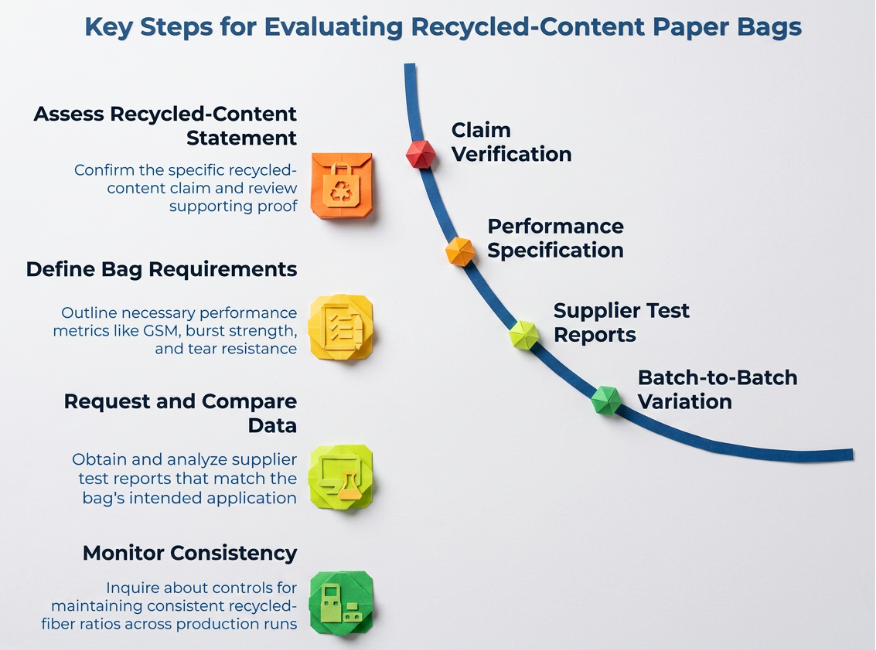
A recycled-content claim does not replace a paper bag specification. Buyers should treat the claim and the material specification as two separate checks.
The claim answers: what recycled-content statement is being made, and what proof supports it?
The performance specification answers: will the bag work for the intended application?
Depending on the use case, procurement and packaging teams may need to request GSM or basis weight with tolerance, burst strength, tear strength, tensile data, handle attachment details, base construction, moisture-resistance evidence, Cobb-related information where relevant, print surface consistency, and batch-to-batch variation controls. These are generally accepted paper bag procurement checks, but the exact test requirements should depend on the bag design, filling weight, storage environment, printing method, and handling conditions.
Do not assume recycled-content material is weaker by default, nor should you assume it will perform identically to a virgin-fiber option. The practical position is narrower and safer: verify performance against the intended use case. Ask the supplier for test reports that match the bag’s intended application and compare the results against the specification, not against assumptions about recycled fiber.
Batch-to-batch variation is a separate concern. If the supplier blends recycled and virgin fiber, the ratio may shift depending on feedstock availability. Ask what controls are in place to maintain consistency across production runs and whether the supplier will notify the buyer if the composition changes beyond a stated tolerance.
A simple internal review split can help:
| Review area | Main question | Typical owner |
| Recycled-content claim | What is being claimed, and what evidence supports it? | Procurement, sustainability, compliance |
| Bag performance | Will the bag hold, print, store, and handle as required? | Packaging engineering, QA, operations |
| Transaction records | Does the claim remain consistent from quote to invoice? | Procurement, supplier management, audit team |
Example scenario: a retailer receives two quotes for “recycled kraft bags.” One supplier provides only a marketing claim. Another provides the recycled-content basis, certificate scope where applicable, material specifications, test reports, and invoice claim wording. The second quote is easier to evaluate before price comparison because the buyer can connect the claim to both product evidence and transaction documents.
For buyers comparing paper inputs, related durability and grade questions may also apply when evaluating virgin vs. recycled kraft paper.
Ask for Documentation That Follows the Claim Through the Transaction
Recycled-content paper bag procurement becomes risky when the claim appears in a brochure but disappears from commercial paperwork. If the claim matters for internal reporting, customer communication, or audit readiness, it should be traceable through the buying process. Gaps in documentation are harder to close after shipment.
Start with the supplier’s declaration or technical data sheet. Request a recycled-content statement that identifies what the claim covers, the calculation basis, the material category, and the product or SKU to which it applies. If a chain-of-custody certificate is involved, ask for the certificate holder, certificate scope, current status, product group, and the claim that can appear on transaction documents.
Then compare the quote, purchase order, invoice, delivery note, and batch or lot documents. The wording does not need to be long, but it should be consistent. If the quote states “recycled-content paper bags,” but the invoice contains no matching claim, product reference, or certificate-linked wording, the buyer may not have the documentation continuity needed later.
This is where structured paperwork matters. Buyers working with FSC or PEFC-related claims can review FSC and PEFC claim wording on quotes, POs, and invoices and use a chain-of-custody document checklist to reduce quote-to-invoice gaps.
Ask suppliers to explain what changes trigger buyer notification. Relevant changes may include fiber source, mill, converter, recycled-content basis, coating, adhesive, ink system, or certificate status. Without a change-control expectation, a supplier may continue using similar claim language even when the evidence behind that claim has changed.
Check Whether Certification Scope Actually Covers the Bag You Are Buying
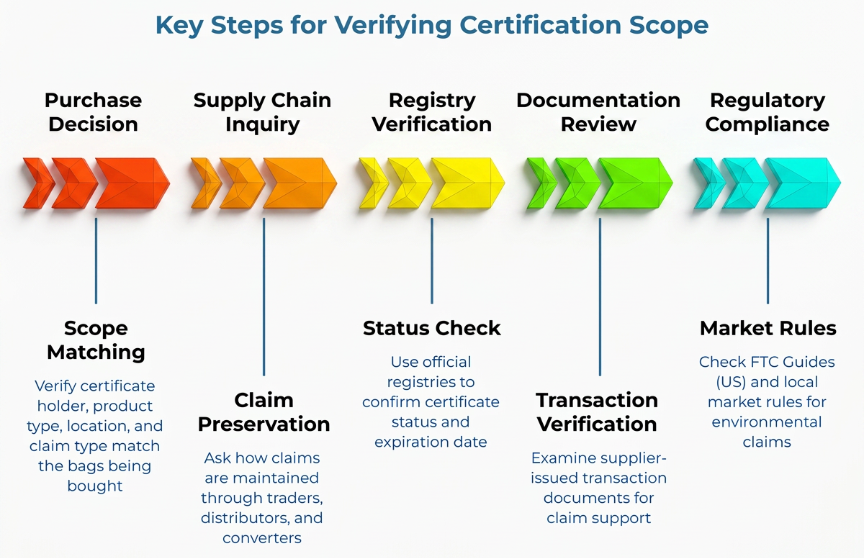
Certification can support a claim, but it does not remove the need for scope verification. A supplier’s certificate, logo, or general sustainability statement should not be treated as automatic proof that a specific paper bag shipment carries a specific recycled-content or chain-of-custody claim.
The Forest Stewardship Council describes chain-of-custody certification as connecting material requirements through the supply chain for finished-product claims. The PEFC Chain of Custody standard covers requirements for organizations making PEFC claims about forest and tree-based products, including recycled material and controlled sources.
For procurement, the key task is scope matching. Verify whether the certificate holder is the same entity quoting or invoicing the bags. Check whether the product type, product group, location, and claim type are covered. If a trader, distributor, converter, or multiple supplier entities are involved, ask how the claim is preserved through each party. A certificate held by a parent company may not automatically extend to a subsidiary or a subcontracted converter.
Do not rely on a certificate image alone. Use official scheme registries, current certificate records, and supplier-issued transaction documents. Verify the certificate’s current status and expiration date through the scheme’s official registry. For a deeper review, buyers can use guidance on certificate scope for FSC/PEFC claims.
For the US environmental marketing context, the Federal Trade Commission (FTC) Guides for the Use of Environmental Marketing Claims (16 CFR Part 260) outline requirements for business-to-business transaction compliance. Global buyers should still verify the rules that apply in their own markets before making customer-facing or jurisdiction-specific claims.
Use a Recycled-Content Supplier Question Matrix Before Approval
A question matrix helps procurement avoid approving a sustainability claim without quality evidence, or approving a quality specification without claim documentation. Use the matrix before supplier approval and before customer-facing claim language is finalized.
| Question to ask | Why it matters | Evidence to request | Red flag | Decision owner |
| What exact recycled-content claim are you making? | Prevents vague “recycled” language | Supplier declaration or technical data sheet | Only marketing language is provided | Procurement |
| Is the claim for the paper only or the whole finished bag? | Clarifies component coverage | Component-level claim statement | Handles, adhesives, coatings, or inks are not addressed | Packaging engineering |
| What percentage and calculation basis are used? | Makes supplier claims comparable | Recycled-content statement with a basis | Percentage appears without calculation basis | Sustainability / procurement |
| Is the content pre-consumer, post-consumer, or mixed? | Supports accurate claim interpretation | Material category statement | Supplier cannot define the category | Sustainability |
| Which mill, converter, or supplier entity is covered? | Checks whether the evidence matches the quoted product | Certificate, declaration, or supplier documentation naming the entity | Certificate names a different entity with no explanation | Supplier management |
| Which certificate, if any, applies? | Separates certification participation from transaction proof | Current certificate and scope details | Certificate is expired, unrelated, or out of scope | Compliance / procurement |
| Can the same claim appear on the quote, PO, invoice, and delivery documents? | Protects audit trail continuity | Sample transaction wording | Claim disappears from invoice | Procurement / audit team |
| What quality test reports support the intended use case? | Connects material performance to real handling conditions | Test reports, tolerances, and sample approval records | Supplier refuses relevant quality data | QA / packaging engineering |
| What changes trigger buyer notification? | Controls batch, source, and claim drift | Change-control clause or notification process | No notification process for material-source changes | Supplier management |
A practical next step is to use this matrix to update the next paper bag RFQ. If preparing supplier outreach, buyers can use supplier-discovery resources for bag suppliers and kraft bag suppliers. Supplier claims, certificates, food-contact status, and technical fit should still be verified directly with the supplier, relevant certification body, regulator, or qualified technical expert.
Red Flags That Should Pause Approval
Pause approval when the evidence does not match the claim. A pause does not always mean rejection; it means the buyer needs clarification before relying on the claim.
Watch for vague terms such as “eco,” “green,” “sustainable,” or “recycled” without a defined basis. Be cautious when the recycled claim appears only in marketing material and not on the quote, PO, invoice, or delivery documents.
Other red flags include certificates that do not match the supplier entity, product type, SKU, mill, converter, or transaction; no product-level or batch-linked documentation; refusal to provide relevant quality data; and no change-control process for fiber source, mill, composition, coating, adhesive, or claim wording.
Food-service use requires extra caution. Recycled content alone does not prove food-contact suitability. Buyers should request use-case-specific food-contact documentation for the relevant contact surfaces, coatings, liners, inks, adhesives, and handling conditions.
How to Turn Questions into an RFQ Requirement
The best time to control recycled-content documentation is before suppliers quote. Add the required fields directly into the RFQ so every supplier responds against the same claim and quality framework.
Define the recycled-content field. Ask suppliers to state the claim, percentage and basis where applicable, material category, components covered, SKU coverage, certificate scope if relevant, and transaction wording. Attach the evidence list so suppliers know which documents must support the claim.
Create a separate quality section. Ask for material specifications, tolerances, relevant test evidence, print and surface expectations, handle and base construction details, and any use-case limitations. This keeps the sustainability review from replacing the bag’s functional approval.
Require consistent wording across quote, PO, invoice, and delivery documents. Ask for buyer notification before changes to fiber source, mill, converter, recycled-content basis, certificate status, coating, adhesive, or ink system. Keep unsupported sustainability language out of customer-facing copy until the claim has been reviewed.
One step that procurement teams often overlook: Make sure any sustainability language used in downstream customer-facing material is supported by the supplier’s documentation. If the evidence does not support a claim, that claim should not appear on packaging, marketing, or product pages. For teams converting broad environmental language into supplier-ready specifications, this related PaperIndex Academy resource on translating “eco-friendly” into paper bag specs may help structure the RFQ language.
Frequently Asked Questions
Does recycled content automatically make a paper bag more sustainable?
No. A recycled-content claim describes the fiber source — it does not prove an environmental outcome. Whether a specific bag delivers a sustainability benefit depends on the fiber source, the manufacturing process, the supply chain, and other factors that vary by supplier, product, and use case. Broad environmental superiority claims need suitable evidence and may be subject to local claim-substantiation rules. Treat recycled content as one input into a broader evaluation, not as proof of sustainability.
Can a supplier certificate prove the recycled-content claim?
A certificate may support a claim, but buyers should verify the certificate scope, entity, status, product coverage, and transaction documents. A certificate alone may not prove that the specific bag, SKU, shipment, or invoice carries the claim. A valid, in-scope certificate combined with consistent transaction documentation provides stronger support than a certificate alone.
Should procurement ask for recycled-content claims on invoices?
Yes, when the claim matters for audit, reporting, or customer-facing substantiation. Invoice wording helps preserve transaction-level continuity, especially when chain-of-custody or certification-linked claims are involved. Gaps in documentation are harder to close after shipment. A chain-of-custody document checklist can help standardize the documentation requirements across suppliers.
Can recycled-content paper bags be used for food packaging?
Only if the supplier provides appropriate food-contact and use-case documentation. The review should cover the relevant contact surface, liner, coating, ink, adhesive, and handling conditions, which may include migration testing results or declarations of conformity depending on the jurisdiction and application. Do not assume food-contact suitability from recycled-content status alone.
Approve the Evidence, Not the Label
Recycled-content paper bag sourcing works best when procurement verifies the claim, matches the bag to the use case, and preserves documentation across the transaction. The strongest supplier response is not the one with the most polished sustainability language. It is the one that connects recycled-content claims, material specifications, certificate scope, transaction paperwork, and change-control discipline into one reviewable evidence package.
After defining recycled-content and documentation requirements, buyers can use those fields to submit a more complete RFQ and compare supplier responses on evidence, not labels alone. Find paper bag suppliers on PaperIndex to begin evaluating suppliers against these requirements.
Disclaimer:
This article is for general informational purposes only and does not constitute compliance, safety, technical, legal, or professional advice. Requirements, risks, and best practices may vary by jurisdiction, supplier, product specification, certification scheme, and use case. Confirm important decisions with the appropriate qualified professional, certification body, regulator, supplier, or technical expert.
Our Editorial Process:
Our expert team uses AI tools to help organize and structure our initial drafts. Every piece is then extensively rewritten, fact-checked, and enriched with first-hand insights and experiences by expert humans on our Insights Team to ensure accuracy and clarity.
About the PaperIndex Insights Team:
The PaperIndex Insights Team is our dedicated engine for synthesizing complex topics into clear, helpful guides. While our content is thoroughly reviewed for clarity and accuracy, it is for informational purposes and should not replace professional advice.