
📌 Key Takeaways
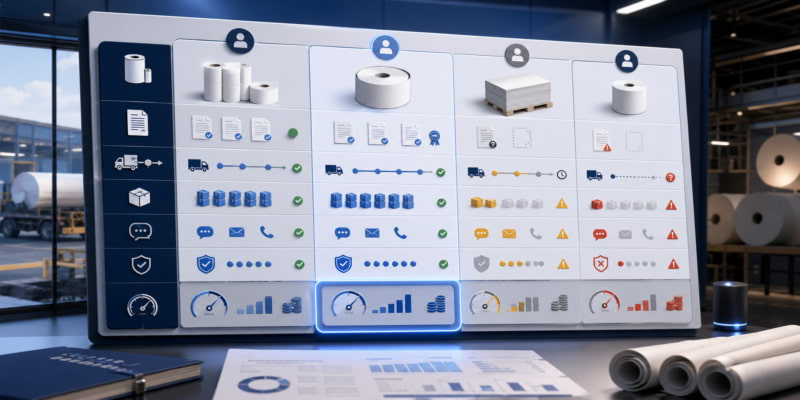
The cheapest paper quote only saves money if the supplier can actually deliver what they promised, on time, with the right paperwork.
- Price Without Proof Is a Gamble: A low quote means nothing if the supplier can’t confirm the exact grade, quantity, documents, and delivery date in writing.
- Vague Answers Are Warning Signs: When a supplier says “should be available” or “approximately 3–4 weeks,” they’re shifting risk onto you without saying so.
- Track Patterns, Not One-Offs: A single late reply isn’t a dealbreaker, but the same supplier giving vague answers across three orders reveals a deeper problem.
- AI Organises, You Decide: AI can line up supplier responses side by side against your checklist, but it can’t tell you which supplier will actually deliver.
- Ask Sharper Questions: “Can you confirm full quantity, dispatch window, and document readiness?” beats “Can you deliver?” every time.
The best buying decisions weigh price and proof of execution together — not one without the other.
Paper buyers and traders managing customer-facing deadlines will sharpen their supplier vetting process here, preparing them for the detailed checklist and framework that follows.
~ ~ ~ ~ ~ ~ ~ ~ ~ ~ ~ ~ ~ ~ ~ ~ ~ ~
Two quotes sit in your inbox. One is 6% cheaper. The supplier behind it took three days to respond, offered a vague stock confirmation, and still hasn’t sent the mill test certificate you requested last week—the kind of specification gap AI can help paper buyers catch before an order is placed. The spreadsheet is open, the customer deadline is fixed, and someone on your team is already asking which supplier you’re going with.
What happens to the customer commitment if this order doesn’t land on time?
Price matters in paper trading — a lower cost per metric ton directly protects margin. But price alone says nothing about whether the supplier can actually execute: ship the right grade, in the confirmed quantity, with correct documentation, inside the delivery window your customer expects. Supplier-side uncertainty — the gap between what a quote promises and what the fulfillment process actually delivers — is where buyers absorb the most avoidable risk.
The following framework outlines actionable checkpoints: reliability questions to ask before committing, a lightweight scorecard to compare suppliers beyond price, and a look at how AI can help organize supplier information without replacing your judgment.
What Supplier-Side Uncertainty Looks Like Before an Order
Unreliable fulfillment rarely starts with a dramatic failure. It builds through small signals that are easy to overlook under deadline pressure.
A delayed response to a straightforward availability question is one such signal. So is a reply confirming “stock is available” without specifying grade, GSM tolerance, quantity ceiling, or packaging format. Then there’s partial availability — where the supplier confirms 60% of the volume you need and promises to “arrange the rest.” In an illustrative paper-trading scenario, a supplier might confirm 15 metric tons [or tonnes] from current stock and say the remaining 10 tonnes ‘can be arranged.’ That is a partial commitment, not a full order confirmation. Each of these gaps is manageable on its own. Stacked together, they paint a picture of a supplier whose execution capability doesn’t match the confidence of their quote.
Documentation gaps are especially telling. A supplier who quotes a price in 24 hours but takes eight days to produce a mill test certificate is revealing something about internal process quality. Missing documents don’t always signal unreliability, but they can mean downstream obligations — customs clearance, quality requirements, regulatory compliance — face delays the quoted price never accounted for. When these hidden costs surface after commitment, they expose the gap between quoted price and true landed cost.
Inconsistent answers from different contacts within the same organization also deserve attention. When the sales contact confirms full availability while the logistics coordinator flags a delay, you’re absorbing coordination risk that should have been resolved before the quote reached your desk.
Warning signs worth noting before you commit: delayed or non-specific replies to direct questions, vague availability language (“should be possible”), partial stock confirmation without a plan for the balance, missing or delayed documentation, conflicting information from different supplier contacts, and no defined process for handling order exceptions—that is, changes to stock, schedule, or specifications after confirmation.
Why Lowest Price Should Be Weighed Against Fulfillment Confidence
Experienced paper buyers know how to read a competitive quote. A lower price deserves serious consideration — it isn’t automatically a warning sign. The risk shows up when price becomes the sole decision input for an order that carries customer-facing consequences.
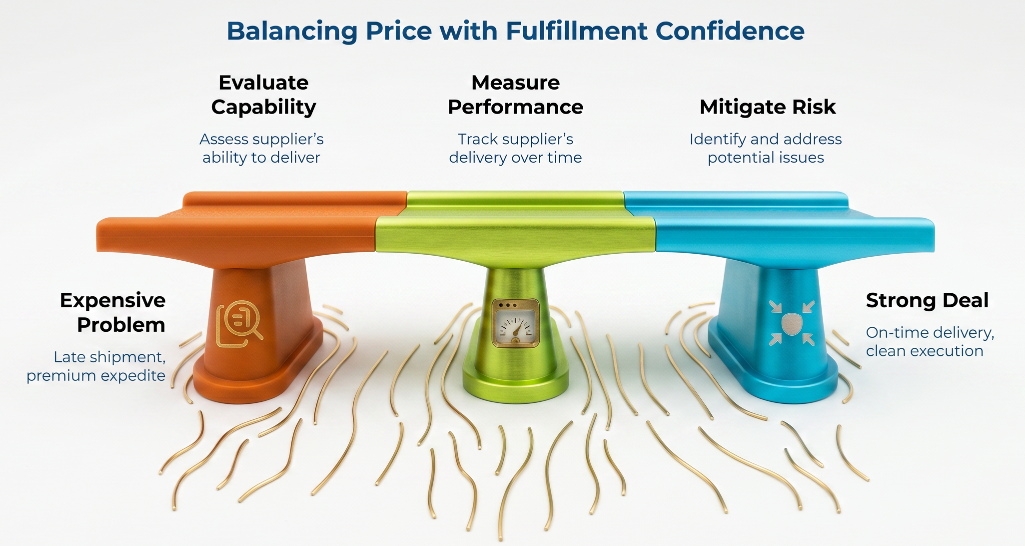
Fulfillment confidence — the buyer’s reasonable expectation that the supplier will deliver the confirmed grade, quantity, and documentation within the agreed timeline — is what separates a strong deal from an expensive problem. A quote saving approx. $14 per metric ton loses its advantage when the shipment arrives nine days late, forces an emergency expedite at a premium, or reaches the customer with paperwork that doesn’t match the purchase order.
Procurement rarely carries these consequences alone. Sales manages the customer promise. Operations manages receiving, storage, and dispatch planning. Logistics manages movement and timing. Finance may approve the order based on a margin that assumes clean execution. When quotes arrive in different formats and Incoterms, even the margin calculation can mislead — a reason why AI-assisted quote comparison treats price as only one part of the decision. When a supplier’s answers stay vague, each downstream team inherits uncertainty that the buyer accepted at the point of commitment.
The Chartered Institute of Procurement & Supply (CIPS) describes supplier evaluation as a continual process covering capability, capacity, quality, and risk mitigation — not price alone. That principle applies directly to paper trading, where keeping customer commitments depends on the supplier’s ability to deliver what the quote describes. Separately, CIPS supplier performance management guidance reinforces a broader idea: supplier performance is something buyers manage, measure, and review over time — not something assumed from a single positive interaction.
Spending 13 minutes on a structured pre-commitment check costs far less than spending three days managing a fulfillment exception after the order is placed.
Reliability Questions to Ask Before Committing
The questions below are designed to surface execution risk before it becomes a fulfillment problem. They work best when applied consistently across suppliers so you’re comparing capability, not just cost.
For context: an order exception is any deviation from originally confirmed terms — a quantity change, a delayed shipment, a substituted grade, or missing documentation. A supplier scorecard is a structured way to compare suppliers on criteria beyond price, such as responsiveness, delivery track record, documentation completeness, and exception history.
Supplier Reliability Checklist
| Criterion | Question to Ask | Strong Answer | Risk Signal |
| Response Clarity | Can you confirm the order details in writing? | Clear reply covering grade, size, quantity, packing, and terms | Verbal reassurance or scattered answers across multiple messages |
| Availability | Can you confirm the exact quantity and grade available today? | Clear confirmation with grade, GSM, quantity ceiling, and conditions | Vague or conditional: “should be available,” “we can arrange” |
| Delivery | What is the realistic delivery timeline, including loading and transit? | Specific dates or ranges with named dependencies | “Should be possible” or “approximately 3–4 weeks” without detail |
| Documentation | Which documents can you provide, and when? | Full list with expected delivery dates per document | Missing items, delayed timelines, or “we will check” |
| Exceptions | What happens if stock or schedule changes after confirmation? | Named escalation process or defined notification window | No clear plan, deflection, or silence |
| Communication | Who is the point of contact for order changes? | Named individual with response-time commitment | Multiple conflicting contacts or no escalation path |
| Fit for Current Order | Is this supplier suited to this grade, volume, destination, and timing? | Evidence matches the exact order requirement | Good reputation, but weak fit for this specific order |
This isn’t a pass-fail test, and it’s not an industry standard. It’s a practical method for organizing what you already know — and spotting what you don’t yet know — about each supplier’s ability to execute a specific order. You can expand it with criteria like past performance references or capacity checks depending on order complexity.
That final row — fit for the current order — is where familiar-supplier bias often enters. “We already know them” is a useful context, but it isn’t enough. A supplier that performs well on standard domestic lots may still be a poor fit for a special grade, mixed shipment, tight customer deadline, or documentation-heavy export order. Verifying supplier capability beyond the price list — testing whether they can hold specs repeatedly and document reliably — is what separates familiarity from fitness. Test the current requirement on its own facts, not on the comfort of past transactions.
A common pitfall is asking broad questions and accepting broad confidence. “Can you deliver?” invites “Yes.” A sharper version — “Can you confirm the full quantity, dispatch window, document readiness, and named contact for changes?” — creates a decision record. That record protects the buyer when the order moves from quote comparison to customer commitment.
A supplier who answers clearly and promptly is demonstrating operational readiness. One who responds slowly or inconsistently isn’t necessarily unqualified — but they’re offering less confidence for the same commitment. That difference matters when your name is on the purchase approval and your customer is waiting for delivery.
If your supplier history is incomplete, start anyway. The first scorecard doesn’t need years of clean data. It can begin with the current quote, the latest communication, and any known exceptions from recent orders. The habit matters because the next decision will have a better record than the last one.
For buyers still normalizing price, freight, and specification fields before comparing offers, how to standardize paper supplier quotes before using AI to compare them covers that preparatory step in detail.
How AI Can Help Organize Supplier Reliability Checks
AI can’t verify whether a supplier’s claims are accurate. It can’t predict whether a shipment will arrive on time. What it can do is help organize information you already have and surface patterns that are difficult to spot when you’re comparing multiple quotes under deadline pressure.
Consider a common scenario: you’ve received email threads, availability confirmations, and delivery estimates from four suppliers for the same order. Reading each independently is manageable. Comparing all four against the same criteria — availability clarity, documentation completeness, delivery specificity, exception handling — is harder to do consistently under time pressure, which is why paper RFQs are difficult to compare manually and where AI can assist first.
AI can help with that step. Paste supplier communications into an AI tool and ask it to summarize responses against your checklist. The output can highlight where one supplier gave a specific delivery date while another gave an estimate, where documentation timelines differ, or where exception handling was left unaddressed. It can also draft follow-up questions when a supplier’s confirmation was vague.
Example technical input: “Summarize these four supplier responses against the following criteria: availability confirmation, delivery timeline specificity, documentation completeness, exception handling process, and communication clarity. Separate confirmed facts from unclear claims. Flag any criteria where information is missing or vague, and draft follow-up questions for those gaps. Do not choose the supplier.”
Keep in mind that AI outputs depend entirely on the quality and completeness of the input data. Incomplete inputs produce incomplete summaries. The NIST AI Risk Management Framework serves as a high-authority reminder that AI use should be managed with attention to risk, context, and human oversight — a principle that applies even to something as straightforward as summarizing supplier emails.
Treat AI-generated comparisons as a starting point for review, not a final assessment. If the AI summary says “quantity confirmed,” verify that the supplier actually confirmed the full quantity — not only a partial stock position. For a deeper look at how evidence-based verification can replace promise-based supplier vetting, PaperIndex Academy explores a structured decision-gate approach.
Watch for Repeat Exception Patterns, Not Just One-Off Problems
A single delayed response doesn’t make a supplier unreliable. Port congestion, production scheduling conflicts, and internal miscommunication happen in every trading relationship. The signal worth tracking is repetition.
When the same supplier shows a pattern of vague availability confirmations across three consecutive inquiries, that pattern reveals more than any single slow reply. Repeated partial fills — where the supplier consistently confirms 70–80% of requested volume and promises to ‘source the balance’ — point to a structural gap between quoting capacity and actual inventory reach. This pattern of supplier opacity — the distance between what is claimed and what can be proven — is often more costly than any price premium. One partial fill could reflect a temporary stock constraint. Three suggest a limitation that won’t change for your specific order.
Documentation delays that recur across multiple orders deserve separate attention. A supplier who consistently sends mill test certificates seven to ten days after shipment may have a process limitation that follow-up alone won’t resolve. That delay becomes part of your operational reality.
The practical step: maintain a lightweight exception log — by supplier name, order type, and exception category. A shared spreadsheet with date, supplier, exception type, and resolution status is enough structure to make repeat patterns visible over time. Keep it simple enough that a busy buyer will actually use it. A spreadsheet line after each exception is better than a perfect scorecard that nobody maintains.
One qualifier worth keeping in mind: supplier behavior changes by order, season, stock position, destination, and internal workload. History is context, not a prediction machine. Use past performance to inform the current decision, then test the current order on its own facts.
When to Proceed, Pause, or Ask for More Confirmation
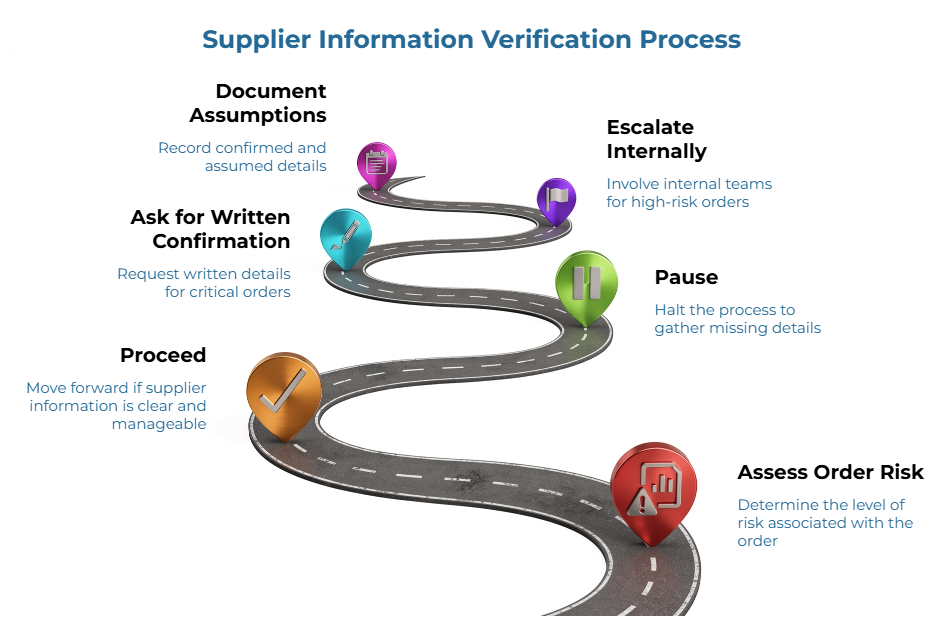
Not every gap in supplier information demands the same response. Match your level of verification to the risk the order carries.
- Proceed when the supplier has answered your reliability questions clearly, documentation timelines are defined, and the delivery commitment aligns with your customer’s expectations. Some residual uncertainty is normal — what matters is whether the remaining unknowns are manageable.
- Pause when key details are missing. If the supplier hasn’t confirmed the exact grade, has offered only a vague delivery estimate, or hasn’t addressed exception handling, you’re committing without enough information to evaluate the real cost. Pausing isn’t walking away — it’s asking for specifics before the commitment becomes binding.
- Ask for written confirmation when the order involves a customer-facing deadline, a precise specification, or a supplier you haven’t worked with before. Request written details on quantity, grade, delivery date, and documentation timeline — treating the confirmation as a specification-matching exercise rather than a formality. If the supplier hesitates to put specifics on paper, that reluctance is itself a data point.
- Escalate internally when customer commitments are at stake and supplier responses leave significant gaps. Sales, operations, and account managers need to know if sourcing behind a customer promise carries unresolved questions — because the buyer chooses the supplier, but downstream teams absorb the consequences if fulfillment fails. Surfacing uncertainty early protects the entire chain.
When internal pressure demands speed despite gaps, document what is confirmed, what is assumed, and who accepted the risk. A softer commitment can help: “Proceed only after written stock and dispatch confirmation.” That keeps the decision tied to evidence rather than hope, and gives the buyer a defensible record if circumstances change after approval.
Use Price and Reliability Together
The lowest paper quote isn’t a trap. The highest-priced supplier isn’t automatically the safest choice. What separates a confident buying decision from a reactive one is the quality of the questions asked before commitment.
Better pre-commitment questions reduce the gap between what a quote promises and what the fulfillment process delivers. A lightweight reliability checklist makes that evaluation repeatable. AI can help organize the comparison, but your judgment — shaped by experience and the specific requirements of the order — remains the final filter.
Use this checklist before your next supplier commitment to compare price against reliability, availability, and fulfillment confidence. Where the answers are clear, you’ve earned your confidence. Where they’re vague, you’ve earned the right to ask for more.
For broader supplier discovery and paper procurement learning, PaperIndex Academy offers educational resources across the sourcing lifecycle, and find suppliers across 188 countries. Use those resources as part of a careful buying process, not as a substitute for order-level verification.
Frequently Asked Questions
Should paper buyers always avoid the lowest supplier quote?
No. A low quote can reflect genuine cost efficiency, competitive sourcing, or favorable market conditions. The question isn’t whether the price is low, but whether the supplier can reliably execute the order at that price. Evaluate the quote alongside availability clarity, delivery specificity, documentation readiness, and communication quality before deciding.
What is a supplier reliability scorecard?
A supplier reliability scorecard is a practical method for comparing suppliers on criteria beyond price — typically responsiveness, availability confirmation quality, delivery track record, documentation completeness, and exception-handling history. The checklist above is a suggested starting point, not a formal industry standard, and can be adapted to specific procurement workflows.
Can AI determine which paper supplier to choose?
No. AI can help organize supplier communications, compare responses against defined criteria, and draft follow-up questions. It cannot verify whether claims are accurate, assess real-world execution capability, or weigh relationship factors that experienced buyers consider. Treat these automated summaries as preliminary data maps prior to human verification.
Should buyers switch suppliers after one issue?
Not automatically. One delayed reply or document issue may reflect a temporary constraint — port congestion, a production scheduling conflict, or an internal handoff delay. Repeated vague answers, partial availability, late documents, or changed delivery commitments are more meaningful signals. Track the pattern before changing a supplier relationship.
What is the biggest warning sign before committing to a paper supplier?
Repeated inconsistency is the strongest practical warning sign. A single delay or vague response isn’t necessarily disqualifying, but a pattern — recurring vague availability confirmations, documentation delays across multiple orders, or conflicting answers from different contacts — points to structural limitations that are unlikely to change for your specific order. Tracking patterns over time provides a much clearer picture of supplier capacity than reacting to a single delayed shipment. A supplier reliability scorecard formalizes that tracking across booking lead times, documentation accuracy, and lane coverage.
Disclaimer:
This article provides general procurement education for paper buyers and traders. It does not constitute legal, contractual, or compliance advice. Supplier reliability assessment should combine documentation review, communication history, pattern tracking, and buyer judgment. AI outputs depend on the quality and completeness of input data and should be reviewed before acting on them.
Our Editorial Process:
Our expert team uses AI tools to help organize and structure our initial drafts. Every piece is then extensively rewritten, fact-checked, and enriched with first-hand insights and experiences by expert humans on our Insights Team to ensure accuracy and clarity.
About the PaperIndex Insights Team:
The PaperIndex Insights Team is our dedicated engine for synthesizing complex topics into clear, helpful guides. While our content is thoroughly reviewed for clarity and accuracy, it is for informational purposes and should not replace professional advice.