
Plan procurement budgets and optimize cost.
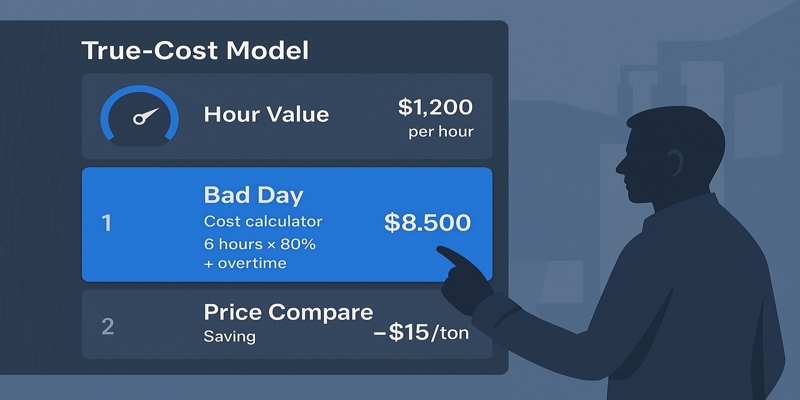
The High Cost of “Cheap” Paper: How Quality Variance Kills Production Margins
📌 Key Takeaways Quality variance in kraft paper erodes production margins through waste, downtime, and customer complaints that dwarf any headline price savings. Cheap paper costs most when machines stop running. SME paper bag manufacturers and packaging converters balancing tight margins with quality risk will find a practical three-step modeling ... Read More
Why ‘Insurance’ Isn’t a Strategy for Paper Importers: The Hidden Cost of Claim-Reliance
📌 Key Takeaways Insurance claims recover money but leave most damage costs—lost time, customer trust, and operational chaos—uncompensated. Insurance is a seatbelt, not a driving strategy. Small business paper importers and procurement managers will gain a practical framework for calculating true damage costs and shifting to prevention-first sourcing, preparing them ... Read More
A Comparative Decision Matrix for Low-Volume Sourcing: Marketplace vs. Mill Direct vs. Local Distributor
📌 Key Takeaways The MOQ Barrier forces small converters to choose between channels that don’t fit their reality—but a neutral decision matrix turns that problem into a documented, defensible sourcing strategy. Most sourcing decisions fail because they optimize for the wrong variable at the wrong time—this framework ensures your choice ... Read More
A Shared Framework for Supply Agility: Aligning The Pragmatic Business Owner and The Procurement Manager
📌 Key Takeaways Internal friction between business owners and procurement managers often costs more than supplier complexity—delaying decisions until crisis forces expensive reactive choices. Structured alignment protects both cash and customer service simultaneously. SME packaging converters and kraft paper buyers managing MOQ barriers will find this framework actionable here, preparing ... Read More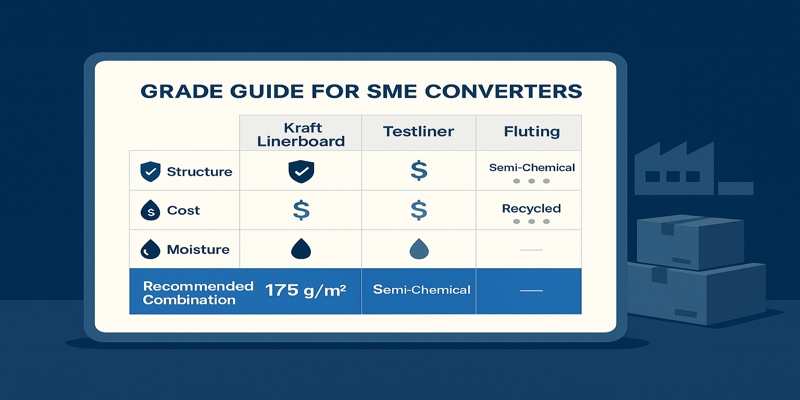
Kraft Paper Grade Guide for SME Converters: Choose the Right Grade for Every Job
📌 Key Takeaways Grade confusion costs SME converters money in over-specified materials and lost customers from under-specified failures. Clear grade specifications prevent MOQ traps and inventory bloat while enabling confident supplier negotiations. SME packaging converter owners and procurement managers will find a systematic framework here, preparing them for the detailed ... Read More
How to Source Low-MOQ Kraft Paper When Your Cash Flow is Tight
📌 Key Takeaways High minimum order quantities trap small converters in a costly squeeze between rigid supplier requirements and scarce working capital—forcing choices between over-buying inventory or walking away from profitable orders. Prepared = protected capital and operational agility. Small and medium-sized packaging converters managing tight working capital will gain ... Read More
Is “Inventory Overload” the Silent Killer of Your Working Capital?
📌 Key Takeaways The warehouse is full, but the bank account is empty—a pattern that quietly destroys working capital for small packaging converters. Strategic purchasing decisions require balancing three objectives simultaneously: competitive pricing, operational flexibility, and healthy working capital. SME packaging paper converters and procurement managers will gain practical frameworks ... Read More
Payment Terms Design for Kraft Paper Suppliers & Customers: A One-Page Terms Summary You Can Share with Your Team and Bank
📌 Key Takeaways The gap between paying kraft paper suppliers and collecting from customers locks up working capital that could fuel growth instead of just funding timing mismatches. Visibility precedes control—one page can transform working capital from a constant source of stress into something the business actively manages. Finance and ... Read More
Why “Agility” is the New Scale: Rethinking Paper Procurement for SMEs
📌 Key Takeaways Chasing volume discounts through oversized MOQs drains working capital, locks inventory for months, and turns “scale” into a strategic trap for small converters. Small and mid-sized packaging converters, procurement managers, and business owners in the kraft paper converting industry will find their strategic framework here, preparing them ... Read More
From Volume Constraints to Agility: A Guide to Overcoming the MOQ Barrier
📌 Key Takeaways High minimum order quantities in kraft paper force small converters to choose between volume discounts and operational flexibility—a choice that quietly drains working capital and warehouse space. Small and mid-sized packaging converters managing 20-50 tons of monthly kraft paper consumption will find this framework immediately applicable, preparing ... Read More
Payment Terms Design for Kraft Paper Suppliers & Customers: Mini-Scenarios Showing How 15-Day Changes Shrink the Cash Gap
📌 Key Takeaways A 15-day shift in payment terms can free tens of thousands in trapped working capital—or quietly tighten the cash squeeze until month-end becomes a crisis. Prepared finance and procurement teams can use these mini-scenarios the same day they read them—no complex models required. Finance, procurement, and sourcing ... Read More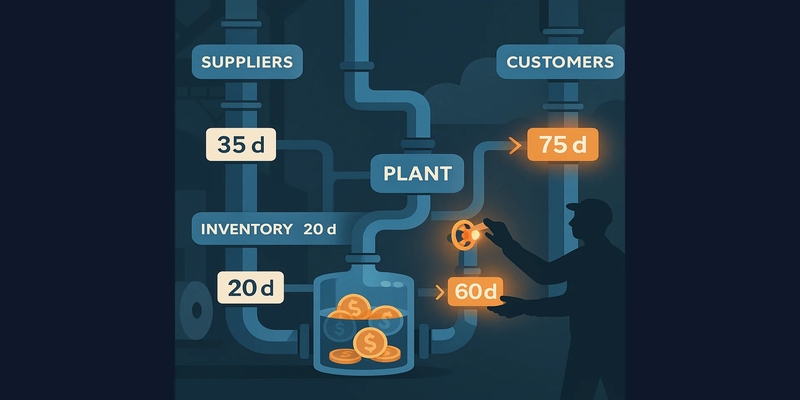
Payment Terms Design for Kraft Paper Suppliers & Customers: A Simple Playbook to Align Cash In and Cash Out
📌 Key Takeaways Payment terms you inherited years ago are quietly designing your cash flow—whether anyone designed them or not. Design payment terms intentionally, and growth stops feeling like suffocation. Small and mid-sized packaging converters juggling kraft paper suppliers and demanding customers will find a practical roadmap here, preparing them ... Read More
Working Capital Strain from Payment Terms: Inventory Days, Overdraft Stress, and How Much Cash is Stuck in Kraft Paper
📌 Key Takeaways Overdraft limits stay pinned near maximum not because sales are weak, but because cash sits idle in warehouse reels while supplier and customer payment terms pull in opposite directions. Visibility first, then targeted action—not sweeping cuts. SME packaging converters juggling tight bank limits and volatile kraft paper ... Read More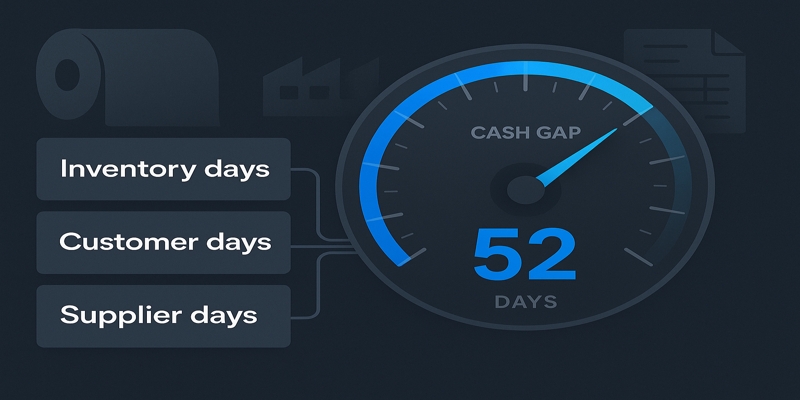
Working Capital Strain from Payment Terms: How Much Working Capital Limit Do You Need for Kraft Paper?
📌 Key Takeaways Your working capital limit for kraft paper isn’t a guessing game—it’s a calculation you can do in three steps using numbers you already have. Prepared discussions lead to appropriate limits and calmer banking relationships. Small and mid-sized packaging converters will find a practical calculation method here, preparing ... Read More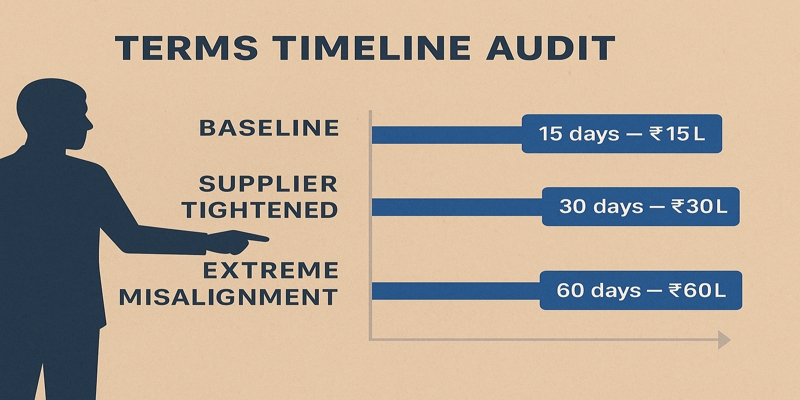
Working Capital Strain from Payment Terms: Simple Examples Showing How Fifteen Days Change Your Cash Flow Gap
📌 Key Takeaways A 15-day shift in payment terms isn’t a minor adjustment—it can double or eliminate your working capital needs entirely. Show the numbers, not just the stress. SME packaging converters buying kraft paper—especially owners, finance heads, and procurement leads—will find concrete scenarios here, preparing them for the actionable ... Read More
Working Capital Strain from Payment Terms: A Simple Guide to Seeing and Fixing Your Kraft Paper Cash Flow Gap
📌 Key Takeaways Cash flow problems aren’t always caused by poor sales—they’re often caused by poor timing between when you pay suppliers and when customers pay you. Map it once, measure it quarterly, adjust one lever at a time—that’s how converters move from overdraft anxiety to cash control. SME packaging ... Read More
Working Capital Strain from Payment Terms: A Beginner’s Cash Conversion Cycle Map for Kraft Paper Buyers
📌 Key Takeaways Working capital strain isn’t a temporary crisis—it’s a structural timing gap between when you pay kraft paper suppliers and when customers pay you, and it can be mapped and managed. The map you build today creates the foundation for deliberate working capital management instead of perpetual crisis ... Read More
Aligning Owner and Operations Priorities for Stronger Paper Negotiations
📌 Key Takeaways Internal friction costs more than supplier leverage ever will. Shared decision frameworks turn supplier negotiations from internal battles into coordinated strategy. Procurement and sourcing managers, for example, at small and mid-sized packaging converters will find a practical implementation roadmap here, preparing them for the step-by-step alignment framework ... Read More
Kraft Paper Price Volatility as an Excuse: Red Flags in Supplier Increase Emails SMB Buyers Should Question
📌 Key Takeaways Every supplier email that cites “volatility” deserves the same question: Can you prove it? A structured approach transforms each “volatility” email from a crisis into routine budget input—no drama, just data. Procurement and sourcing managers at small and mid-sized packaging converters will find a practical framework here, ... Read More