
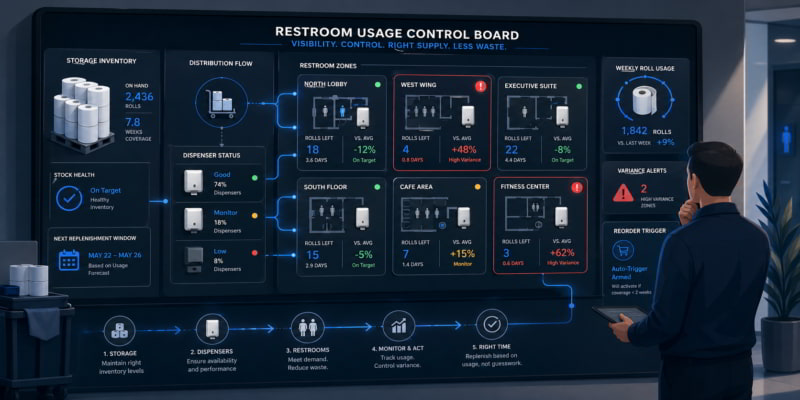
📌 Key Takeaways
Tracking how toilet tissue actually gets used — not just what you ordered — is the key to cutting restroom supply costs.
- Track Real Usage, Not Orders: Purchase records hide waste, overstock, and emergency buys — only restroom-level counting shows true demand.
- Find Problem Restrooms Fast: Comparing each restroom’s usage against a baseline reveals where waste, dispenser damage, or misuse is driving up costs.
- Compare Cost Per Use, Not Case Price: A cheaper case can cost more if rolls empty faster, users pull more sheets, or replacements happen too often.
- Stop Overstocking “Just in Case”: Set stock limits based on actual weekly use and supplier lead time — not fear, promotions, or round numbers.
- Train Custodial Teams as Partners: Staff who know when to swap rolls, how to rotate stock, and what to report can prevent waste that no purchasing decision can fix.
Buy the right amount, use it fully, and let usage data — not habit — drive every restroom supply decision.
Procurement teams and facilities managers overseeing offices, hotels, schools, or healthcare restrooms will gain a clear cost-control framework here, preparing them for the detailed guide that follows.
~ ~ ~ ~ ~ ~ ~ ~ ~ ~ ~ ~ ~ ~ ~ ~ ~ ~
Toilet tissue looks like a simple line item.
Open the janitorial closet at any mid-sized office, hotel, or school, and the operational reality is far more nuanced. Half-open cartons sit stacked on damp shelving. A Tuesday delivery arrived before the previous order was half-used. Downstairs, the lobby restroom ran out before mid-morning, triggering a rush call to the distributor.
You’ve compared quotes. You’ve negotiated the case price down. And yet, restroom supply spending stays stubbornly high—or keeps climbing—without a clear explanation. The problem is rarely the price on the purchase order. It’s everything that happens after the cases arrive.
For away-from-home operators in offices, hotels, schools, healthcare facilities, and retail properties, toilet tissue cost control depends on understanding how product moves from storage to dispenser to user. A usage-based approach helps procurement and facilities teams reduce unnecessary consumption and inefficient purchasing without compromising restroom availability or hygiene. The goal is not to cut back on restroom supplies—it’s to build a repeatable process for managing toilet tissue as a controllable operating cost, whether you run a single small facility, a multi-restroom building, or a procurement program spanning multiple sites.
Why Case Price Alone Does Not Control Toilet Tissue Cost
Case price is visible. Total cost is less obvious.
A buyer may choose an economical case and still overspend if rolls are replaced too early, partial rolls are discarded, cartons are damaged in storage, or emergency orders keep interrupting the normal buying cycle. Actual expenditure is a function of logistical efficiency and site-specific demand volatility. “Cheaper” and “lower cost” are not the same thing. A lower-priced product can become more expensive if it increases roll changes, user consumption, complaints, or stockout risk. A higher-capacity or better-matched product can sometimes reduce waste, but only when it fits the restroom’s traffic pattern and dispenser setup.
For buyers comparing products, AFH toilet tissue specification basics can help connect end use, dispenser fit, and acceptance rules before price comparison begins.
Cost control starts with visibility. Without it, the facility is not managing consumption. It is only reacting to the next shortage.
Start With Actual Usage Data, Not Purchase History
Purchase records show how much toilet tissue was ordered. They don’t show how much was actually consumed in restrooms.
This distinction is the foundation of any cost-control effort. Purchase history may reflect overordering, seasonal stockpiling, emergency buys, vendor minimums, or poor storage discipline—none of which represent true restroom demand. A facility that ordered 24 cases last quarter didn’t necessarily use 24 cases. Some of that volume may still be in storage, tying up working capital or risking damage from poor environmental conditions. Some may have been damaged or diverted to non-restroom uses before reaching a dispenser.
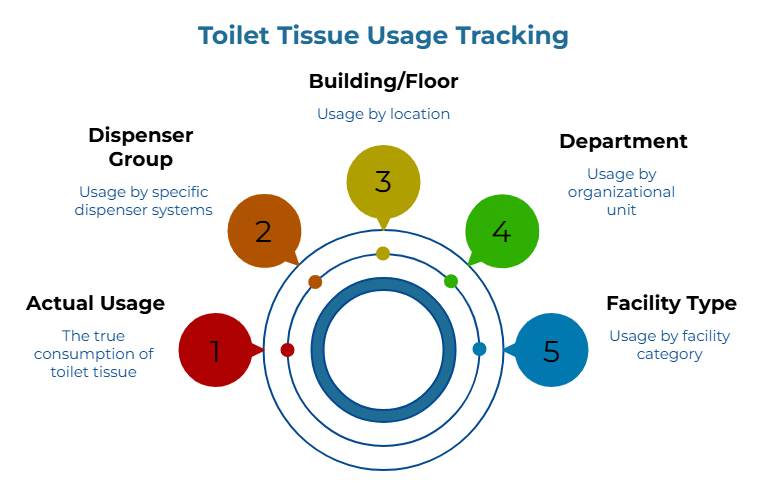
Actual usage should be measured by restroom, building, floor, department, facility type, or dispenser group when possible. For larger operations, this granularity reveals which areas drive cost and which run efficiently. For smaller facilities, even a weekly inventory count can reveal patterns that purchase orders obscure.
A building may use two dispenser systems. If usage is not separated by dispenser group, the buyer may blame traffic when the real driver is the dispensing setup.
A practical tracking system doesn’t require software or complex spreadsheets. Start with five data points:
- Cases received into storage
- Rolls issued from storage to restrooms
- Rolls installed in dispensers
- Rolls remaining in inventory
- Reorder dates
Record beginning inventory and ending inventory each week. Compare usage by week, by month, and by traffic level. When unusual events occur—conferences, school terms, holidays, peak hotel occupancy, public events—log them separately so they don’t distort the baseline consumption figure. These are not necessarily waste. They are demand signals that should be labeled before the next forecast is built.
Differentiating procurement volume from real-time depletion provides the empirical baseline required for precision modeling. For a deeper look at how commercial toilet tissue inventory management supports restroom operations, the PaperIndex Academy covers FIFO methods and route-based restocking in detail.
Track Usage Variance Across Restrooms and Locations
Usage variance is the difference between expected toilet tissue consumption and actual toilet tissue consumption at a specific restroom or location. Tracking it is what turns a facility-wide consumption average into a diagnostic tool that pinpoints where problems actually occur.
Variance can stem from restroom type, traffic volume, user behavior, dispenser type, cleaning shift, or physical location within a building. Some variance is normal—a lobby restroom with heavy public foot traffic will naturally consume more than a staff restroom on an upper floor, and patient or guest restrooms may follow different patterns than employee facilities. The issue isn’t that variance exists. The issue is when it goes untracked, because overspending in one area gets hidden inside the facility-wide average.
A practical approach to variance tracking follows four steps:
- Establish a baseline usage rate by averaging consumption across comparable restrooms over a four- to six-week period.
- Compare each restroom or location against that baseline on a consistent schedule.
- Flag locations where consumption runs notably above or below the average.
- Investigate the cause before adjusting purchase quantities or changing products.
High usage may point to dispenser damage, misuse, theft, early roll replacement, or traffic spikes. Low usage may point to under-serviced restrooms, inaccurate counts, blocked access, or a location that receives less traffic than assumed.
Consider this scenario: two restrooms serve similar traffic volumes, but one uses twice as many rolls per week. The excess may trace back to a damaged dispenser allowing uncontrolled sheet pull, custodial staff replacing rolls too early on that floor, misuse, theft, or inconsistent servicing practices across cleaning shifts. The correct response is rarely “order more for that restroom”; it is “find and fix the root cause.”
Identify the Main Sources of Toilet Tissue Waste
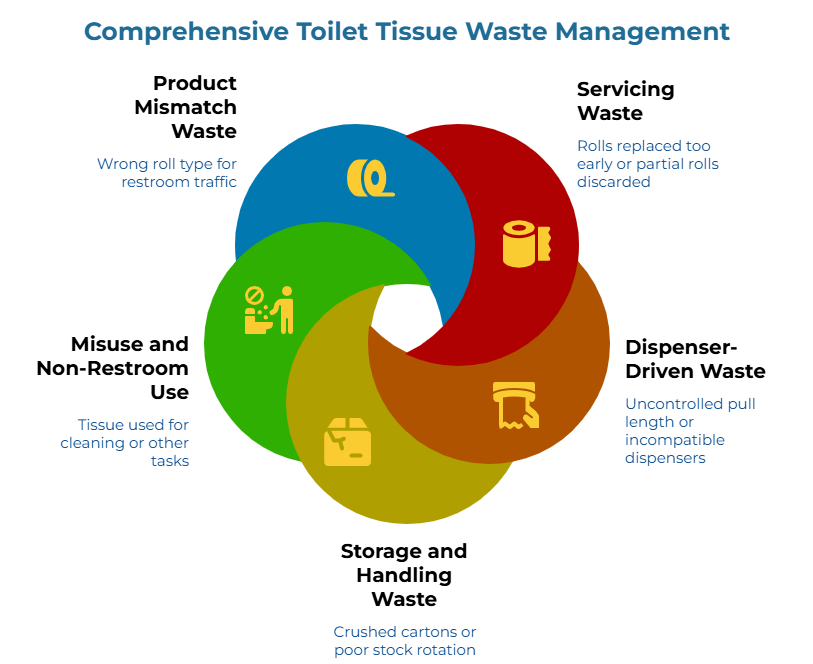
Waste in commercial toilet tissue programs accumulates from multiple directions—user behavior, custodial practices, storage conditions, procurement decisions, and dispenser design. Treating waste as only an end-user problem overlooks some of the largest levers a facility can control.
A practical waste review can group the problem into five categories.
Servicing waste includes rolls replaced before they are sufficiently depleted and partial rolls discarded instead of being moved to appropriate lower-traffic locations.
Dispenser-driven waste includes uncontrolled pull length, damaged dispensers, incompatible rolls, or mechanisms that make users take more product than needed.
Storage and handling waste includes crushed cartons, wet or dusty rolls, poor stock rotation, and overstocked closets that encourage careless handling.
Misuse and non-restroom use includes staff taking toilet tissue for cleaning tasks, breakroom spills, or other purposes where it is no longer counted against restroom consumption.
Product mismatch waste appears when roll type does not fit restroom traffic. Using a standard-capacity roll in a high-traffic restroom that depletes it within hours creates unnecessary replacement labor and partial-roll waste. Oversized formats in low-traffic spaces may tie up stock without adding practical value.
This approach is consistent with general international waste-prevention principles that reducing waste at the source is preferable to managing it after it occurs; for instance, the U.S. EPA, like many global environmental frameworks, describes source reduction and reuse as the preferred strategies in its waste-management hierarchy.
Addressing these drivers starts with practical changes. Set a clear replacement threshold so custodial teams know when a roll is “done.” Train staff to relocate partial rolls rather than discard them. Enforce FIFO inventory rotation in storage. Monitor high-traffic restrooms separately. Review dispenser condition and compatibility at least quarterly, since a jammed or worn dispenser can silently drive waste for months.
Proper storage environment standards also matter here. Rolls that absorb moisture or get crushed in a poorly organized closet represent purchased product that never serves a restroom user.
Reduce Shrinkage, Misuse, and Unexplained Product Loss
Shrinkage is inventory loss that cannot be explained by normal restroom usage. Every facility of meaningful size encounters it, and addressing it is a standard inventory management practice—not a punitive exercise.
Shrinkage may result from product being moved to unauthorized areas without documentation, staff taking supplies for non-restroom uses, damaged stock written off without records, inaccurate inventory counts, poor storage controls, or theft. In most commercial facilities, the larger issue is weak process controls rather than intentional misconduct. When nobody tracks what leaves the storage closet, product loss stays invisible until the quarterly budget review reveals unexplained overruns.
Recommended controls focus on process visibility:
- Limit access to bulk storage areas to authorized personnel.
- Keep a simple issue log that records cases or rolls removed from storage, by whom, and when.
- Store toilet tissue separately from general-use paper supplies when possible, so each category’s consumption can be tracked independently.
- Avoid leaving excess cartons in unsecured restroom areas or hallways.
- Assign responsibility for inventory counts to a specific person or team, with a consistent schedule.
- Investigate repeated discrepancies between rolls issued from storage and observed restroom demand before assuming the baseline consumption rate needs adjusting.
Inaccurate counts deserve special attention. A facility may assume product is disappearing when the real issue is mixed storage locations, unclear counting units, or inconsistent weekly checks. Count by the same unit each time. If the log uses rolls, count rolls. If it uses cases, count cases and record partial cases clearly.
Good storage discipline also supports workplace housekeeping and broader toilet tissue storage standards for compliance, risk reduction, and quality control. In the United States, OSHA’s general walking-working surfaces rule requires places of employment, including storerooms and service rooms, to be kept clean, orderly, and in a sanitary condition—a standard mirrored by most international occupational health bodies.
The pattern behind unexplained product loss is usually a process gap—not a personnel problem. Treating shrinkage control as routine inventory discipline keeps the conversation productive and the controls sustainable. The PaperIndex Academy’s guide on toilet tissue storage requirements for commercial janitorial programs provides additional detail on structuring storage access and controls.
Use Cost Per Use Instead of Case Price Alone
Case price is the number most buyers compare first. It’s also the number most likely to mislead.
Products differ in sheet count, roll length, ply, durability, dispensing compatibility, and consumption behavior. A lower-priced case may cost more per actual restroom use if the tissue is thinner, if users pull more sheets per visit, or if rolls need to be replaced more frequently. Two cases at different price points can serve dramatically different numbers of restroom visits before they’re depleted. The cheapest quote doesn’t always produce the lowest cost once real-world usage enters the picture.
Cost per use reframes the comparison around the metric that actually drives budget outcomes:
- Formula 1: Cost per Use = Cost per Roll / (Sheets per Roll / Average Sheets per Use)
For roll-level analysis:
- Formula 2: Cost per Use = Cost per Roll / Estimated Uses per Roll
These formulas produce estimates, not exact figures—and that’s appropriate. Precision improves over time as the facility gathers usage data. Early estimates can use observed roll changes and traffic patterns. Later estimates can incorporate restroom-level usage, dispenser group data, and complaint history. The important shift is moving from “which case costs less to buy?” to “which product costs less to deploy in the restroom?”
Cost per use should also be evaluated alongside service outcomes. A product with a marginally higher cost per use may deliver better overall value if it produces fewer stockouts, fewer complaints, less custodial labor, and fewer emergency orders. A product that looks efficient in a spreadsheet but creates service failures is not a good operating-cost decision.
Prevent Overstocking in Small Commercial Facilities
Overstocking feels like preparation. In practice, it creates hidden costs that compound quietly over time.
Small facilities are especially vulnerable to overbuying. Common triggers include distributor minimum order quantities, fear of stockouts, infrequent ordering cycles, and promotional pricing. The consequences accumulate: crowded janitorial closets, increased damage risk, obscured inventory visibility, and working capital tied up in product that won’t reach a dispenser for weeks.
A small office that uses one case every four weeks, for example, generally does not need three months of toilet tissue on-site—unless supplier lead times are genuinely unreliable or storage conditions are adequate to protect that volume without degradation. That inventory level is less defensible if the closet is cramped, humid, dusty, or difficult to count.
Practical overstock prevention relies on a few consistent habits:
- Set minimum and maximum stock levels based on actual weekly usage, not on round numbers or past habits. The minimum should cover normal usage during supplier lead time, plus a controlled safety-stock allowance. The maximum should reflect realistic storage capacity and expected consumption, not anxiety.
- Calculate average weekly consumption and use it as the anchor for all ordering decisions.
- Size safety stock based on supplier lead time and demand variability, not on fear.
- Avoid purchasing more product than storage conditions can protect from moisture, dust, or physical damage.
- Review slow-moving inventory monthly. If stock is not moving, the issue may be excessive ordering, weak rotation, a product change, or a demand assumption that no longer holds.
- Coordinate ordering cadence with actual consumption rather than arbitrary calendar dates or leftover schedules from a previous manager.
Storage environment standards for commercial toilet tissue inventory can help buyers think through damage prevention, packaging protection, and inventory visibility when setting those maximum stock levels.
Align Replenishment Frequency With Consumption Patterns
Unnecessary replenishment costs typically come from poor timing rather than high usage.
Ordering too frequently increases administrative burden and delivery costs. Ordering too infrequently forces overstocking or triggers emergency orders when an unexpected usage spike occurs. Neither pattern reflects actual demand. Both reflect habit.
The fix is reviewing reorder points against real consumption data. The planning variables that matter most are:
- Average weekly roll or case usage
- Supplier lead time
- Minimum order requirements
- Available storage space
- Traffic variability (daily, weekly, seasonal)
- Seasonal or event-driven demand shifts
- Tolerance for stockout risk
Facilities with stable, predictable usage—a corporate office with consistent headcount—often do well with scheduled replenishment at fixed intervals. Facilities with variable traffic—hotels, event venues, schools—typically need usage-triggered reorder points that flex with demand. A fixed schedule that works during a slow season can cause stockouts during a busy one. The PaperIndex Academy’s guide on why linear restocking leads to washroom outages explores how fixed cadences fail under variable conditions.
Emergency orders should be reviewed as a diagnostic signal. One emergency order may reflect an unusual event. Repeated emergency orders usually point to weak reorder points, poor inventory visibility, supplier lead-time assumptions that no longer hold, or delayed communication between custodial and procurement teams. Treating emergency orders as data rather than noise helps the facility tighten its replenishment logic over time.
Build a Toilet Tissue Budget Based on Actual Restroom Usage
Usage data turns restroom supply budgeting from guesswork into a controllable forecast.
Traditional ‘plus-percentage’ budgeting fails to account for idiosyncratic fluctuations in occupancy and supply chain volatility, resulting in unexplained variance during quarterly reconciliations.
Product changes deserve extra care in this context. Switching ply, sheet count, roll length, dispenser system, or supplier specification can reset historical usage assumptions. A budget based on last year’s cases may not hold after a dispenser change or a shift in building occupancy.
A usage-based budget draws on a defined set of inputs: average monthly cases consumed, cost per case, cost per roll, estimated cost per use, high-traffic periods and their anticipated impact, facility occupancy or guest count projections, expected distributor price changes, emergency order history, and waste or shrinkage adjustments derived from tracking data. Facilities that want to sharpen their demand projections can also explore how to forecast commercial toilet tissue usage before stockouts occur.
The forecasting process follows a clear sequence:
- Calculate average monthly consumption from tracking data.
- Adjust for anticipated seasonality or occupancy changes.
- Multiply by current product cost.
- Add a controlled safety-stock cost allowance.
- Apply a ‘Friction Multiplier’ (typically 1.15x to 1.25x) to the baseline to account for observed waste and shrinkage.
- Review actual spending against the forecast monthly or quarterly.
The budget should be reviewed periodically—not set once per year and ignored. Each review cycle sharpens accuracy because the comparison between forecast and actual spending reveals where estimates were off. Budget control improves when the facility knows why spending changed.
Train Custodial Teams on Cost-Control Procedures
Procurement teams cannot control toilet tissue waste through purchasing decisions alone. The best case price and the most precise reorder point still depend on what happens at the restroom level.
Custodial teams influence when rolls are replaced, how partial rolls are handled, how supplies move from storage to dispensers, and how inventory counts are maintained. These decisions happen dozens of times per shift across every restroom. They also see dispenser damage, visitor surges, stockroom clutter, and recurring restroom complaints before most managers do.
Training should be simple, repeatable, and built into daily servicing routines rather than treated as a separate program. A practical routine may look like this: check the dispenser, replace only when the roll meets the agreed threshold, move usable partial rolls to the assigned location, report unusual usage, and record stock pulled from storage.
Core training topics include:
- When to replace a roll, based on a defined threshold rather than visual judgment
- What to do with partial rolls (relocate to lower-traffic restrooms, not discard)
- How to report unusual usage or suspected dispenser problems
- How to record stock taken from storage
- How to handle and transport cases without damaging packaging
- How to follow FIFO rotation so older inventory gets used first
- How to identify dispenser issues—jams, broken covers, misaligned mechanisms—that increase waste
The tone of this training matters as much as its content. Custodial teams are not the source of cost problems. They are essential to executing cost-control standards. Framing training as a shared operational improvement—one that makes their daily work more structured and less reactive—is what earns consistent follow-through. A good procedure should reduce judgment calls during a busy shift. If the process requires too much extra walking, unclear forms, or inconsistent interpretation, it will fade. Make the correct action easy to repeat.
Use Dispenser Choice as a Waste-Control Lever
The dispenser format installed in each restroom directly affects how much product users consume per visit, how frequently rolls need replacing, and how much partial-roll waste the facility generates.
Controlled-use dispensers can limit excessive pull length, reducing the volume of tissue taken per visit. Jumbo or high-capacity dispensing systems reduce the frequency of roll changes in high-traffic restrooms, cutting both custodial labor and premature replacement waste. For a detailed look at how bath tissue dispenser format and roll type affect replenishment planning, the PaperIndex Academy covers format-to-traffic matching in depth. Twin-roll dispensers lower stockout risk by keeping one roll available while the other empties, which also allows each roll to be used more fully before removal. Coreless systems may reduce stub-roll waste in settings where short remnants are a recurring loss category.
No single dispenser type is the best choice for every restroom. The right match depends on traffic level, restroom layout, labor availability, and purchasing goals. A high-capacity jumbo system suited to a busy hotel lobby may be unnecessary in a small office restroom with light, predictable usage. A twin-roll unit may help reduce early replacement, but only if staff allow the reserve roll to function as intended.
Dispenser conditions should be reviewed before changing purchase quantities. A cracked cover, loose spindle, jammed mechanism, or incompatible roll can make usage look abnormal. Sometimes the issue is not demand. It is hardware.
When evaluating options, connect the choice to usage tracking data. Which restrooms carry the highest cost per use? Where does partial-roll waste concentrate? Where are stockouts most frequent? The answers identify which restrooms would benefit from a dispenser change and which are already working efficiently.
Monitor Results and Adjust the Program Over Time
Cost control is not a one-time project. It produces better results the longer it runs—provided the results are actually reviewed.
Facilities should monitor a core set of metrics on a regular cadence:
- Cases used per month
- Rolls consumed per restroom
- Cost per use
- Stockout incidents
- Emergency orders placed
- Product loss or shrinkage
- Overstock days on hand
- Restroom complaints related to supply availability
- Damaged or unusable inventory
Monthly reviews are generally sufficient for small facilities with stable usage patterns. Larger or high-traffic operations benefit from weekly monitoring, especially during peak seasons, after product changes, or following dispenser upgrades.
Damaged inventory should not be treated as a minor storage issue. Crushed, wet, dusty, or misplaced rolls are part of the cost picture, as are cartons that cannot be counted quickly because the closet is overcrowded.
The metrics don’t need to be precise from day one. Consistency matters more than precision at the start. A rough weekly count reviewed monthly provides more cost-control value than a detailed report nobody reads. Over time, consumption trends become visible, seasonal patterns emerge, and the gap between forecast and actual spending narrows.
When conditions change—a new product, a new dispenser, a shift in occupancy or staffing—recalibrate the baseline. Treating cost control as a living system rather than a static policy is what keeps savings compounding quarter after quarter.
The best cost-control program balances savings with restroom reliability. Reducing waste should never mean understocking restrooms or creating a poor experience for the people using them.
From Reactive Purchasing to Usage-Based Control
Toilet tissue cost control in AFH facilities starts with visibility. When buyers know how much product is actually consumed, where variance occurs, and how inventory moves through the facility, purchasing and replenishment decisions become defensible rather than habitual.
Tracking usage, reducing waste, preventing shrinkage, avoiding overstock, and budgeting from real consumption data all reinforce each other. None of these steps require expensive technology or dramatic operational changes. They require consistency, a few simple tracking habits, and the willingness to manage a routine supply as a controllable operating cost.
For procurement teams and facility operators, the goal is not simply to buy less toilet tissue. The goal is to buy the right amount, use it efficiently, and maintain a supply program that supports both operational control and restroom service quality. That shift—from chasing the cheapest case to managing total cost across the storage-to-dispenser-to-user chain—is where lasting savings take root.
Ready to compare product options and connect with verified suppliers? Browse AFH toilet tissue suppliers on PaperIndex, or visit the PaperIndex Academy for more guides on procurement, inventory management, and restroom supply planning.
Frequently Asked Questions
How can commercial facilities reduce toilet tissue waste?
Commercial facilities can reduce toilet tissue waste by tracking actual usage per restroom, setting clear roll replacement thresholds, training custodial teams on partial-roll handling, using dispensers matched to traffic levels, protecting inventory in storage with FIFO rotation, and identifying restrooms with unusually high consumption for targeted investigation.
Why does cost per use matter more than case price?
Cost per use reflects how long a product lasts in actual restroom conditions. A cheaper case may not reduce costs if users consume more sheets per visit, if rolls require more frequent replacement, or if the dispenser system generates partial-roll waste. Cost per use captures those variables; case price does not.
What causes toilet tissue usage variance in AFH restrooms?
Usage variance can result from differences in restroom traffic, building occupancy, dispenser type, user behavior, custodial replacement practices, product quality, cleaning shift patterns, shrinkage, or special events that temporarily increase restroom demand.
How do facilities identify toilet tissue shrinkage?
Facilities can identify shrinkage by comparing inventory issued from storage against expected restroom consumption. Repeated discrepancies, unexplained stock depletion, excessive supply movement between areas, or consumption spikes that don’t match traffic data may indicate shrinkage or misuse.
How much backup toilet tissue should a small facility keep?
A small facility should keep enough backup stock to cover normal usage during supplier lead time, plus a reasonable safety-stock allowance for demand spikes or delivery delays. The exact volume should be based on average weekly consumption and available storage space—not on promotional pricing or fear of stockouts.
How often should toilet tissue usage be reviewed?
Small facilities may review usage monthly. Larger or high-traffic facilities generally benefit from weekly tracking. Usage should also be reviewed after product changes, dispenser changes, occupancy shifts, or repeated stockout incidents to ensure baselines remain accurate.
Can dispenser choice reduce toilet tissue waste?
Yes. Dispenser choice influences how much product users take per visit, how frequently rolls are replaced, and how much partial-roll waste occurs. Controlled-use, twin-roll, jumbo, or coreless systems can help reduce waste when matched correctly to restroom traffic volume and servicing routines.
What is the best way to prevent overstocking toilet tissue?
Set minimum and maximum inventory levels based on actual consumption, supplier lead time, safety stock needs, minimum order requirements, and available storage capacity. Avoid ordering based solely on promotions, vendor minimums, or assumptions about future demand. Review slow-moving inventory monthly and align ordering cadence with real usage data.
How should toilet tissue budgets be forecasted?
Toilet tissue budgets should be built from average monthly consumption data, adjusted for expected occupancy or traffic changes, seasonal demand, current product pricing, supplier cost changes, and historical emergency order patterns. Comparing forecast against actual spending monthly or quarterly improves accuracy over each review cycle.
Disclaimer:
This article is for educational purposes only. The information provided here is intended as general guidance and should be evaluated in the context of each facility’s specific operations, suppliers, and requirements.
Our Editorial Process:
Our expert team uses AI tools to help organize and structure our initial drafts. Every piece is then extensively rewritten, fact-checked, and enriched with first-hand insights and experiences by expert humans on our Insights Team to ensure accuracy and clarity.
About the PaperIndex Insights Team:
The PaperIndex Insights Team is our dedicated engine for synthesizing complex topics into clear, helpful guides. While our content is thoroughly reviewed for clarity and accuracy, it is for informational purposes and should not replace professional advice.