
📌 Key Takeaways
Toilet tissue storage fails when humidity, airflow, or handling breaks down — not when the product itself is defective.
- Humidity Is the Biggest Threat: Keep storage areas between 30% and 50% relative humidity, and never let it stay above 60%.
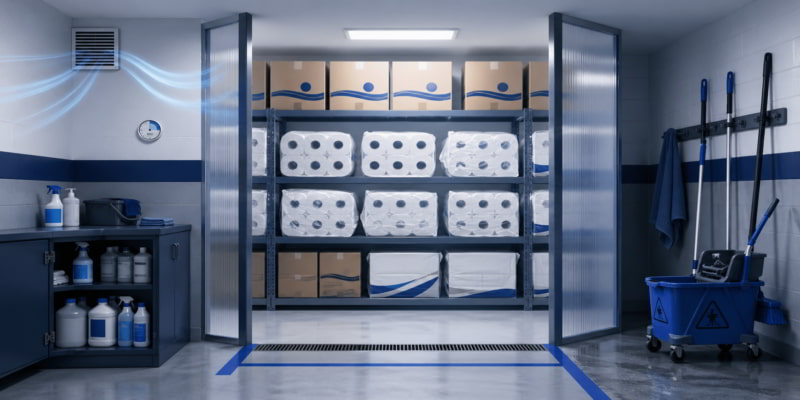
- Separate Clean from Dirty: Store paper goods away from chemicals, wet mops, drains, and dirty carts in clearly zoned areas.
- Packaging Is Protection: Leave rolls in their original cartons until use — torn or open packaging exposes tissue to dust, moisture, and contamination.
- Clean Hands, Clean Rolls: Staff should never restock dispensers with gloves used for cleaning, chemical mixing, or handling waste.
- Audit the Closet Regularly: Check four things: room conditions, chemical separation, packaging condition, and staff handling habits.
Dry stock, clean hands, and intact packaging prevent most storage failures before they start.
Facility managers, janitorial supervisors, and procurement teams responsible for restroom supply quality will find actionable storage controls here, preparing them for the detailed guidance that follows.
~ ~ ~ ~ ~ ~ ~ ~ ~ ~ ~ ~ ~ ~ ~ ~ ~ ~
A damp carton changes everything.
The janitorial closet looks orderly at first glance: stacked cases, labeled shelves, a mop bucket pushed against the wall. Then someone lifts the top case and finds a softened corner, a faint musty smell, and rolls that no longer feel clean enough for a public restroom. That was supposed to be backup stock.
Commercial toilet tissue rolls are a low-cost consumable, but poor storage can turn usable inventory into waste. Because toilet tissue is a paper-based product, it responds to humidity, stagnant air, temperature swings, dust, light, and contaminants before it ever reaches the dispenser.
The storage standard is simple: ensure inventory remains moisture-resistant, physically shielded, and isolated from environmental contaminants. For most commercial janitorial programs, that means a conditioned indoor room, stable airflow, intact packaging, and relative humidity in the 30% to 50% range. The EPA recommends keeping indoor relative humidity below 60%, ideally between 30% and 50%, while the CDC advises keeping humidity no higher than 50% all day long and allowing air to flow freely.
That target gives facility teams a practical operating rule. Store toilet tissue rolls in a clean, dry, conditioned area where humidity is monitored, airflow is not blocked, and paper goods are separated from wet tools, chemicals, drains, and damaged packaging.
Are There Official Storage Requirements for Commercial Toilet Tissue?
Most facilities will not find a single federal rule written specifically for commercial toilet tissue storage. That does not mean storage can be casual. It means the standard is built from broader sanitation, indoor-air-quality, chemical-storage, and contamination-prevention principles.
OSHA’s sanitation rule establishes the broader expectation that workplace facilities must be maintained in a sanitary condition. CDC cleaning guidance requires safe use and proper storage of cleaning and disinfection products. These are not toilet-paper-specific storage rules, but they create a defensible baseline for janitorial closet setup and clean-supply handling.
In the absence of tissue-specific mandates,secondary sanitation protocols establish the baseline: restroom paper products should be stored cleanly, kept dry, protected from contamination, and separated from chemical or wet-work risks.
Ideal Temperature and Humidity for Storing Commercial Toilet Tissue Rolls
Humidity matters more than chasing an exact thermostat number.
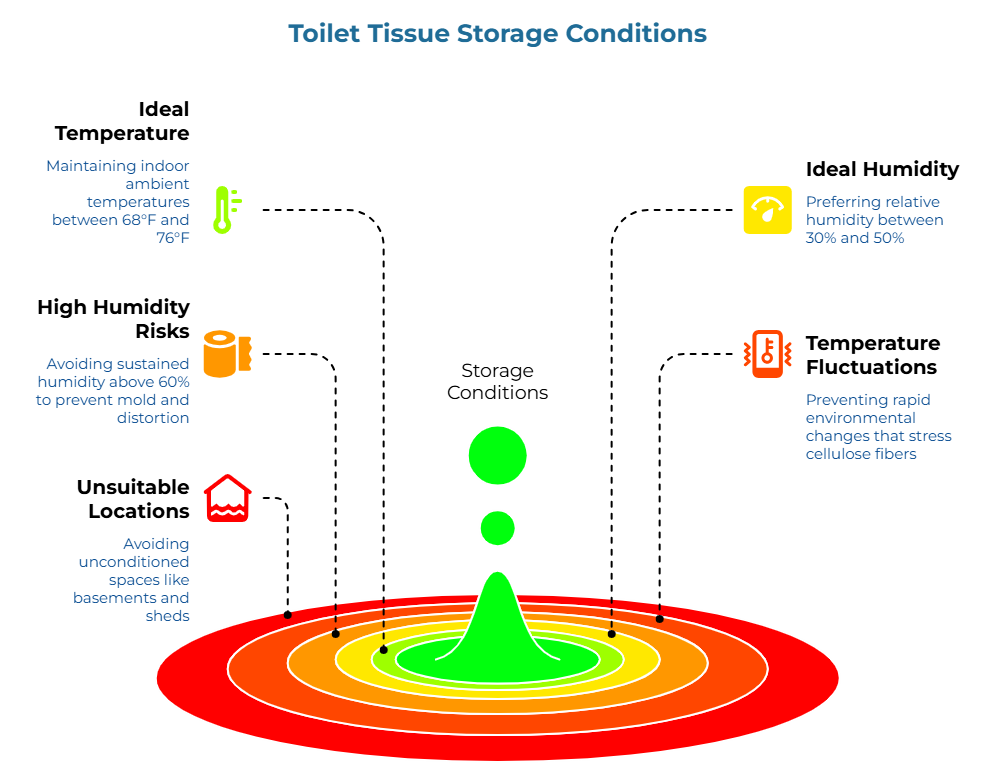
Maintain indoor ambient temperatures between 68°F and 76°F. While OSHA does not mandate storage temperatures for paper consumables, this range (suggested in OSHA’s indoor air quality guidelines) prevents the thermal fluctuations that stress cellulose fibers, and supports preservation research showing that excessively warm conditions, high humidity, and rapid environmental fluctuations accelerate damage in paper-based materials. The firmer control point is relative humidity: 30% to 50% is preferred, and sustained humidity above 60% should be avoided.
Paper absorbs moisture when surrounding air is damp and releases moisture when the air dries. The Northeast Document Conservation Center (NEDCC) explains that high humidity causes paper-based materials to absorb moisture and that fluctuations can lead to distortion. Warm temperatures combined with high relative humidity promote mold growth, while cycling between wet and dry conditions can warp and weaken paper fibers over time.
In a janitorial stockroom, that mechanism shows up as softened rolls, warped shape, clinging sheets, wrapper failure, or musty odor. A small hygrometer is a useful control. It turns ‘the room feels dry’ into a visible reading that supervisors can check during routine stockroom inspections. The EPA and CDC both point to humidity monitoring as part of moisture and mold prevention, integrating this practice into high-volume inventory management.
Commercial toilet tissue storage should avoid unconditioned basements, hot back rooms, exterior sheds, and closets that also trap mop moisture and condensation. If the space cannot maintain stable conditions, it is not suitable for restroom paper product storage.
Best operating target: 30%–50% RH, below 60% at all times, in a conditioned indoor space.
What Clean, Dry, and Protected Storage Actually Means
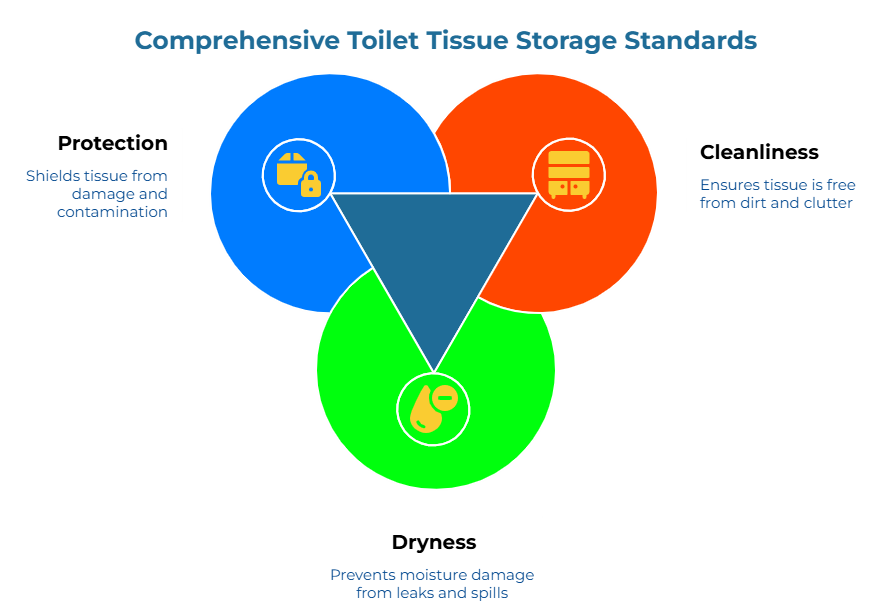
“Clean” means toilet tissue is not stored beside soiled tools, trash, used cloths, dirty mop heads, or visibly dusty shelving. It also means cases are not squeezed into high-touch clutter where wrapping tears and cartons crush.
“Dry” means stock is kept away from sink splash, wet floors, plumbing leaks, open drains, mop-drip areas, condensation-prone corners, and recently rinsed equipment. Water exposure is one of the fastest ways to compromise restroom paper inventory.
“Protected” means the product is shielded from splash, dust, accidental handling, torn packaging, and mixed clean/dirty traffic. A sealed case on a dry upper shelf away from the utility sink is protected. An opened carton under the sink beside dripping tools is not.
That difference is the whole storage standard in miniature.
How Moisture Exposure Damages Restroom Paper Products
Moisture damage rarely starts with a dramatic failure. It usually begins with small physical changes.
The roll feels softer than expected. The carton sags at one corner. The sheets cling during a test pull. The wrapper feels damp, wrinkled, or loose. A faint odor appears when the case is opened. None of these signs should be dismissed as cosmetic.
Toilet tissue is a cellulose-based paper product — and understanding how moisture interacts with tissue fiber is critical well beyond the storage closet. For converters sourcing parent rolls globally, the same moisture dynamics that damage finished inventory in a stockroom can also ruin toilet tissue parent rolls in transit. When relative humidity rises, paper absorbs moisture and expands. When the air dries out, paper releases moisture and shrinks. The NEDCC warns that wide environmental swings can distort paper-based materials, while sustained warmth and humidity increase mold risk.
For a janitorial team, that translates into rolls that soften, lose shape, tear poorly, unwind badly, or feel less hygienic to end users. These degradation factors directly impact operational costs through inventory loss and increased replacement labor — a dynamic that mirrors how specification misalignment drives hidden costs upstream in toilet tissue parent roll procurement.
Once tissue is damp or stored in persistently humid air, the issue moves from product quality to sanitation. The EPA states that humidity or dampness can supply enough moisture for mold growth, and OSHA identifies mold, cleaning supplies, and other airborne chemicals among common indoor air quality concerns in buildings. Damp or musty tissue should be quarantined before it reaches dispensers — the risk is not just cosmetic damage but odor pickup, wrapper failure, mold contamination, and inventory that should be pulled rather than issued to restrooms.
What moisture damage to paper products looks like in practice:
- Softened rolls and a warped or ovalized shape
- Sheets that cling together and weak tear performance
- Damp packaging, musty odor, or visible spotting and staining
These symptoms are consistent with how paper responds to moisture, pollutants, and mold-prone conditions, according to the NEDCC’s preservation guidelines.
Why Ventilation Matters in Janitorial Supply Storage Areas
Ventilation is part of inventory protection.
In a supply room, airflow helps control humidity, reduce stagnant damp pockets, dilute contaminants, and limit odor buildup. OSHA’s indoor air quality guidance identifies temperature, humidity, poor ventilation, mold from water damage, dust, and chemicals as workplace indoor-air-quality concerns. OSHA also explains that a well-designed HVAC system controls temperature and relative humidity, supplies outdoor air, and dilutes and removes odors and other contaminants. The CDC advises making sure indoor air flows freely as part of mold prevention.
That matters because janitorial closets often combine clean paper inventory with wet carts, drains, plumbing chases, chemical bottles, mop sinks, and floor machines. A room can look tidy but still have poor air exchange, hidden dampness, or trapped odors. Dead air is not a storage control. Tissue should be stored in a space with active airflow — not in a sealed dead-air closet or directly beside wet mops, recently rinsed equipment, or leak-prone walls.
Facility teams should keep vents and returns unblocked, avoid stacking cases tightly against airflow paths, and investigate musty smells or recurring condensation early. The fix may be as simple as moving stock away from a damp wall or as involved as correcting ventilation in the room. These steps follow directly from OSHA and CDC guidance on airflow, humidity control, and contaminant reduction.
Light, Dust, and Air-Quality Considerations for Tissue Storage
Humidity is the main risk, but light and airborne contamination still matter when storing restroom paper products.
The Library of Congress notes that all light damages paper to some degree — not just ultraviolet light — and that visible and UV exposure can contribute to fading, yellowing, and weakening over time. Commercial toilet tissue usually turns faster than archival paper, but long dwell times in exposed shelving or sunlit stockrooms can still accelerate deterioration, especially for outer packaging and top layers of exposed rolls.
Dust and pollutants are a quieter problem. The Library of Congress explains that pollutant gases contribute to paper deterioration, while the Canadian Conservation Institute notes that boxes and enclosures help protect paper from light, dust, atmospheric pollutants, and accidental damage. The practical rule for janitorial programs: keep toilet tissue in its original carton or wrapper until needed, and avoid storing it loose on open shelves near chemical concentrates, renovation dust, printer exhaust, or traffic-heavy utility areas.
Product information for specific lines of Tork’s commercial bath tissue—particularly their premium or healthcare-focused conventional rolls—reinforces the hygiene side of storage by highlighting individually wrapped rolls to maximize cleanliness and prevent cross-contamination. Packaging is not decoration. It is the first protection layer.
Preventing Contamination in Janitorial Closets
Contamination often happens before the roll reaches the restroom.
The janitorial closet becomes the risk point when clean paper supplies share space with wet tools, leaking bottles, dirty workflows, torn packaging, and open cartons. For facilities managing away-from-home toilet tissue across multiple sites, contamination risks compound when storage standards are not standardized across locations. A roll does not need to fall into a mop bucket to be compromised. It only needs repeated exposure to splash, dirty cart shelves, chemical residue, or damp storage air.
Closet zoning prevents much of this. Keep clean restroom consumables in one clearly protected zone. Keep chemicals in a separate zone. Keep wet tools and equipment in another. The World Health Organization advises that cleaned equipment should be stored dry in a designated storage area or cupboard, which supports the broader operational principle of separating dry clean supplies from wet cleaning workflows.
This does not require a perfect stockroom. It requires repeatable layout, clear staff expectations, and routine inspection.
Why Toilet Tissue Should Be Separated from Chemicals and Disinfectants
Toilet tissue should not be stored where chemicals can leak, spill, aerosolize, splash, or transfer residue onto clean paper goods.
The concern is not ordinary chemical reactivity. The concern is quality control. Toilet tissue is a clean-use paper product, and facilities sourcing from bathroom tissue suppliers expect the product to arrive and remain in hygienic condition through to the dispenser. Nearby chemical bottles, wet-gloved handling, or spray residue can compromise the product’s hygiene and presentation before anyone installs it in a restroom.
CDC guidance says facilities should ensure the safe use and proper storage of cleaning and disinfection products, including secure storage and appropriate PPE. In practice, that supports a simple standard: maintain physical separation between clean restroom consumables and chemical storage, even when both are housed in the same janitorial room.
A marked shelf, closed cabinet, or separate side of the closet can be enough in many facilities. The goal is clean separation, not overengineering.
Packaging Integrity Requirements for Stored Paper Products
The carton, sleeve, or wrap is the product’s first contamination barrier.
Once that barrier is torn, wet, crushed, dusty, or left open in a dirty area, the storage condition changes. The rolls may still look usable, but the protection system has already failed.
Keep master cases and inner wrap intact until the rolls are transferred into dispensers or into a protected reserve area. If a case is opened, partial stock should stay in a clean bin, cabinet, or protected shelf location. Loose rolls should not sit exposed near wet tools or chemical stock.
Compromised packaging includes water staining, softened cartons, ripped plastic, dusty open cartons, crushed cases, torn inner wrap, and wrappers left exposed beside wet equipment. “Looks mostly fine” is not a strong enough standard when the protective barrier has clearly been damaged.
Employee Handling Practices That Protect Restroom Supply Hygiene
Storage conditions matter. Staff workflow matters just as much.
A well-stored roll can still be compromised by poor handling during restocking. Staff should not handle clean tissue rolls with gloves used for restroom cleaning, chemical mixing, wet waste tasks, or dirty cart work. Clean rolls should not be placed on the floor, on visibly dirty cart shelves, or loose beside wet tools.
The sequence should be simple. Finish the chemical-heavy or dirty task. Remove contaminated gloves. Clean hands or change to uncontaminated gloves as appropriate. Then handle clean restroom consumables.
This expectation should be written into training for teams that both clean restrooms and restock paper supplies. CDC environmental-cleaning guidance emphasizes policies, procedures, checklists, logs, and job aids for cleaning programs, making written workflow expectations a practical management tool rather than an administrative extra.
How to Set Up a Janitorial Closet for Hygienic Paper-Product Storage
A good closet layout is easy to understand at a glance.
Use one clean zone for restroom paper inventory. Use a separate zone for chemicals and disinfectants. Use another area for wet tools and equipment. In a small closet, this may mean upper shelves for clean paper goods, a lower or enclosed chemical area, and a clearly separated wet-tool corner. In a larger storage room, it may mean dedicated shelving bays.
Avoid exact floor-clearance or shelf-distance rules unless local code, internal policy, or product documentation provides them. A defensible general rule is enough for many facilities: keep tissue dry, protected, low-exposure, and away from obvious moisture or contamination risks.
Open cases need special attention. Once the outer carton is broken, the remaining rolls should stay enclosed or otherwise protected. Major manufacturers, such as Kimberly-Clark Professional, generally advise that their paper consumables have a practically indefinite shelf life subject to environmental stability. Consequently, the efficacy of the storage environment—rather than the date of manufacture—dictates the product’s lifecycle.
Signs That Toilet Tissue Inventory Has Been Compromised
Inspection should be fast, specific, and repeatable.
Janitorial teams should inspect tissue inventory the same way they inspect any other vulnerable consumable: by checking for moisture, odor, deformation, contamination, and packaging failure. Upstream, converters and procurement teams apply a parallel discipline when verifying toilet tissue parent roll mill specifications remotely before buying. Paper products stored in poor environmental conditions are more likely to absorb moisture, distort, pick up pollutants, and support mold growth. Visual and sensory checks should be a standard part of inventory rotation.
Check the carton first. Look for water staining, softened corners, sagging cardboard, torn wrap, crushed edges, dust buildup, and signs the case sat on a wet surface. Then check the rolls. Feel for dampness, distorted shape, softened edges, sheets that cling, and weak tear performance. Smell the case if there is any concern. Musty odor is a warning sign.
The EPA ties mold risk to moisture control, the NEDCC links high humidity and fluctuations to damage in paper materials, and the Library of Congress identifies light and pollutants as contributors to deterioration. If the roll itself is damp, odorous, stained, or mold-suspect, it should be removed from service rather than installed in a restroom.
Quarantine inventory if:
- The rolls feel damp
- The package smells musty
- The carton shows water staining
- Mold or spotting is visible
- Sheets stick together or dispense poorly
These conditions indicate likely compromise from moisture, poor air quality, or prolonged exposure.
Do not solve a storage failure by moving it into a dispenser.
Common Mistakes That Compromise Toilet Tissue Storage
The problems most likely to fail an internal quality check are usually ordinary habits.
Toilet tissue gets stored under sinks because the space is convenient. Open cartons sit beside concentrated chemicals because shelves are crowded. Loose rolls ride on the bottom of a janitorial cart beside wet tools. Staff restock clean dispensers with gloves that were just used for chemical work.
These mistakes persist because of space pressure, rushed workflows, and the absence of a written standard. They are also easy to correct once supervisors define the standard clearly.
Start with the highest-risk areas: under-sink storage, chemical co-storage, open cartons, damp walls, blocked airflow, and dirty cart surfaces. Fix those first.
What to Include in a Janitorial Closet Audit
A closet audit turns vague hygiene expectations into visible conditions.
Review four areas. First, check the storage environment: humidity, airflow, dampness, leaks, condensation, dust, and exposure to direct light. Second, check chemical separation: bottles, sprays, concentrates, and disinfectants should not threaten clean paper goods through leaks, splash, or residue. Third, check packaging conditions: cartons and wrappers should be intact, dry, clean, and protected. Fourth, check employee handling workflow: clean restocking should be separated from dirty cleaning tasks.
Document deficiencies and retrain staff where needed. If one closet repeatedly fails, treat it as a layout or process problem, not a one-time housekeeping lapse.
Best Practices for Storing Commercial Toilet Tissue in Janitorial Programs
A strong storage program for commercial toilet tissue is straightforward: keep inventory in a conditioned room, maintain relative humidity in the 30% to 50% range, prevent sustained RH above 60%, preserve airflow, and protect cartons from dust, splash, and contaminants.
Store cases off the floor, away from exterior walls if dampness is possible, and away from sinks, floor drains, chemical mixing areas, and recently cleaned wet equipment. Keep clean restroom consumables separate from chemicals, wet equipment, dirty tools, and waste-handling workflows. Packaging must remain intact until use, and opened stock must stay in a clean, protected location.
Programs should use FIFO rotation, inspect stock routinely, and document any leak, flood, or HVAC incident that may have affected stored paper goods. For operations that also manage raw material procurement, a complementary discipline is toilet tissue raw material inventory liquidity planning, which prevents overstocking from tying up working capital. These recommendations align with EPA moisture-control guidance, CDC airflow guidance, OSHA ventilation guidance, and paper-preservation best practices for controlling light, pollutants, and environmental fluctuation.
Keeping Storage Standards Practical and Defensible
Commercial toilet tissue storage is not complicated, but it does require discipline.
The safest and most defensible standard is to keep inventory clean, dry, protected, packaged, ventilated, and separated from chemicals and dirty workflows. Humidity control protects the paper. Airflow protects the room. Packaging protects the roll. Clean handling protects the restroom experience.
Audit the janitorial closet, separate clean paper goods from chemical-risk storage, and standardize restroom supply handling in writing. When janitorial teams hold to these controls, they reduce waste, protect restroom presentation, and avoid the operational headache of stocking compromised rolls.
Facilities that source bathroom tissue rolls from verified suppliers through platforms like PaperIndex and then protect that investment with proper storage conditions get the full value from every case they purchase.
Frequently Asked Questions
What humidity is too high for storing commercial toilet tissue?
The preferred operating target is 30% to 50% relative humidity. Sustained humidity above 60% should be avoided, based on EPA moisture-control guidance. CDC mold guidance is stricter and recommends keeping indoor humidity no higher than 50% all day long.
Can commercial toilet tissue be stored in the same closet as cleaning chemicals?
Yes, if there is clear physical separation and the tissue is protected from leaks, splash, residue, aerosols, and contaminated handling. Clean paper goods should not share the same shelf, drip zone, or handling area as chemical-risk items.
How long can commercial toilet tissue remain in storage?
Shelf life depends heavily on storage conditions — a principle that also governs toilet tissue parent roll specifications at the converting stage, where environmental stability determines runnability. Kimberly-Clark Professional states that toilet paper and hand towels have unlimited shelf life when stored in a clean, dry area. In practical terms, clean and dry storage is the controlling factor — not calendar time.
Can toilet tissue be used if only the carton is damaged?
Possibly, if the rolls inside are dry, clean, intact, odor-free, and protected from contamination. A crushed dry carton is different from a water-stained carton with softened corners. The bigger concern is whether moisture, dust, pollutants, or mold reached the paper itself. Moisture, odor, staining, torn wrap, or visible spotting should trigger quarantine.
Why should tissue stay in its original packaging until use?
Because packaging helps shield it from dust, light, pollutants, accidental damage, and hygiene issues during storage and handling. Conservation guidance from the Canadian Conservation Institute and commercial product packaging practices both support that principle.
Does ventilation really matter in a dry-looking storage room?
Yes. Ventilation helps regulate humidity, remove odors and contaminants, and reduce stagnation that can hide moisture issues. OSHA explicitly connects HVAC performance to humidity control and contaminant removal.
Should janitorial staff wear gloves when restocking toilet tissue?
The key requirement is clean handling. Gloves used for dirty restroom cleaning, chemical tasks, wet waste, or mop work should not touch clean tissue stock. Staff should remove contaminated gloves and handle clean rolls with clean hands or uncontaminated gloves.
What should staff do after a leak near stored paper products?
Inspect immediately. Isolate exposed cartons, check for dampness and odor, and remove any roll that is wet, stained, distorted, musty, or mold-suspect. Document the incident and correct the leak or storage layout before returning stock to the area. The EPA’s mold guidance centers on moisture control and fast response after wetting events.
For more guidance on sourcing and specifying commercial toilet tissue, explore the PaperIndex Academy or connect with verified tissue paper manufacturers and toilet tissue suppliers across 195 countries.
Disclaimer: This article is published by the PaperIndex Academy for educational purposes. PaperIndex is a neutral, non-transactional B2B marketplace and does not buy, sell, or broker products. The storage guidance provided here draws from publicly available government and institutional sources and is informational in nature. Facility teams should verify local code requirements and consult qualified professionals for site-specific compliance decisions.
Our Editorial Process:
Our expert team uses AI tools to help organize and structure our initial drafts. Every piece is then extensively rewritten, fact-checked, and enriched with first-hand insights and experiences by expert humans on our Insights Team to ensure accuracy and clarity.
About the PaperIndex Insights Team:
The PaperIndex Insights Team is our dedicated engine for synthesizing complex topics into clear, helpful guides. While our content is thoroughly reviewed for clarity and accuracy, it is for informational purposes and should not replace professional advice.