

📌 Key Takeaways
Protection depends on matching insert geometry to distribution hazards, then validating through testing—not on material superiority claims.
- System Thinking Beats Material Labels: Protection outcomes depend on five interconnected factors—product fragility, distribution hazards, insert geometry, outer box performance, and consistent pack-out—working together as a validated system.
- Immobilization Prevents Most Damage: Products that move more than a few millimeters during transit experience rattle-induced abrasion and accelerated impact forces, regardless of whether the insert is molded pulp or die-cut corrugated.
- Test Standards Anchor Decisions: References to ASTM D4169 sequencing, ISTA procedures, and specific drop/vibration/compression methods transform vague “protective packaging” discussions into comparable, defensible specifications that suppliers can quote against consistently.
- Sustainability Requires Documentation: Both molded pulp and die-cut corrugated support paper recycling streams, but coatings, wet-strength additives, and barrier treatments change end-of-life pathways—verify supplier statements on recyclability before making certification claims.
- Tooling Economics Drive Iteration: Molded pulp’s higher mold costs slow design changes; die-cut corrugated’s faster, cheaper tooling supports rapid refinement when product specifications or distribution profiles shift mid-program.
Geometry, clearance, and validated testing determine protection—material choice follows from those decisions.
Packaging engineers and procurement managers selecting cushioning for electronics shipments will gain decision frameworks and validation workflows here, preparing them for the specification and supplier selection processes that follow.
If you’re selecting internal packaging for electronics, “protects better” depends on what you’re defending against—shock, vibration, or compression. Here’s a clear way to choose between molded pulp and die-cut corrugated inserts, then validate the choice with a simple test plan.
Damage is rarely a failure of the outer container alone; it is a failure of the internal system. Products shift, rattle, or take direct hits because the cushioning didn’t match the hazard. A common mistake? Trying to solve breakage by buying “thicker” corrugated boxes instead of better-engineered inserts. The real question isn’t which material is superior—it’s which one fits your product’s fragility, your distribution environment, and your willingness to test before scaling.
Protection outcomes come down to a five-part system: product fragility + distribution hazards + insert geometry + outer box performance + consistent pack-out. The most reliable approach treats the insert as one component in this system, then confirms the decision with prototypes and testing that matches shipping reality.
When Each Material Tends to Win
Use this table as a starting point for discussion, not a final verdict.
| Feature | Molded Pulp Application | Corrugated Application |
| Vibration damping | Lighter electronics needing close-fitting cradles | Can compensate through geometry and foam additions |
| Shock absorption | Controlled deformation in snug designs | Engineered load paths for heavier items |
| Compression/stacking | Only with reinforcement ribs | Structural rigidity from flute orientation |
| Heavy products (Generally >5–7 kg, though high-density pulp can exceed this) | Often requires hybrid approaches | Preferred for load distribution |
| Moisture tolerance | Lower unless coated (affects recyclability) | Better inherent stiffness retention, though both materials are paper-based and moisture-sensitive |
| Recyclability | Paper stream; compostable variants exist | Paper stream; easy to flatten and sort |
| Tooling cost/speed | Higher mold cost; slower iteration when design changes | Lower die cost; faster design iteration |
| Packing labor | Drop-in simplicity | May require folding or assembly |
Mechanical Performance Under Stress
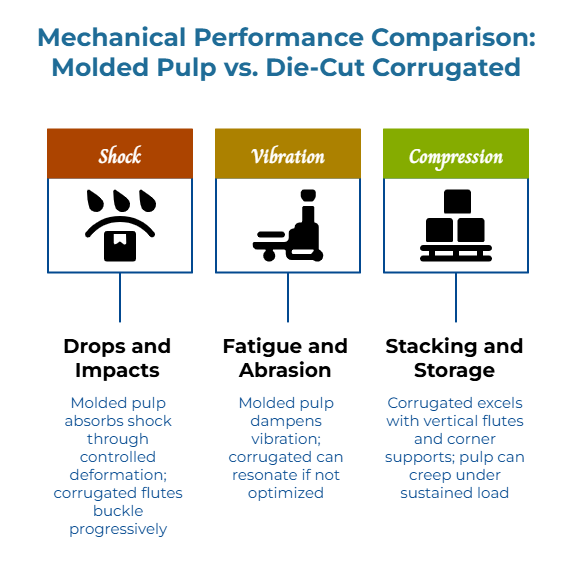
Shock: Drops and Impacts
When packages drop, energy transfers through cushioning to the product. Molded pulp absorbs shock through controlled deformation—the fibrous structure compresses and doesn’t fully spring back. This works effectively when the insert cradles the product tightly while leaving deliberate clearance (generally 10–25 mm) between the product and outer box wall. That clearance provides crush space.
Die-cut corrugated handles shock differently. The flutes act as small columns that buckle progressively under load. Packaging engineers can design specific load paths through engineered rails or posts that keep products off box walls and route impact forces into stronger contact areas. For heavier electronics, this structural approach often performs well because it distributes impact forces rather than absorbing them through material deformation alone.
The critical variable isn’t the material—it’s clearance and immobilization. Too little clearance means the product bottoms out against the box. Too much allows acceleration before impact with the insert.
Vibration: The Hidden Damage Source
Vibration during truck transport or air freight fatigues components over time. Vibration damage usually comes from repeated micro-impacts, abrasion, or resonant motion inside the package. Molded pulp’s fibrous structure tends to dampen vibration effectively, particularly for lighter items where the insert maintains snug contact throughout transit.
Die-cut corrugated can resonate at certain frequencies if not optimized. Adding foam pads, adjusting flute direction, or incorporating ribbing can compensate. The key is ensuring the insert’s natural frequency doesn’t match the product’s vulnerability range and that free play is eliminated—something distribution testing protocols from organizations like ISTA help quantify. Designs that remove rattle typically outperform designs that rely on “softness” alone.
Compression: Stacking and Storage
Warehouse stacking puts sustained load on packages. Compression and stacking stresses reward predictable load paths. Die-cut corrugated often excels here because flutes can be oriented vertically with corner supports that transfer load directly to outer box walls, creating internal columns and frames that act as structural reinforcement.
Molded pulp under sustained compression can creep—slowly deforming over hours or days. For stack-sensitive applications, pulp designs typically need reinforcement ribs or hybrid approaches combining pulp cradles with corrugated corner posts.
Design Variables That Matter More Than Material
Experienced packaging engineers recognize that geometry typically trumps material selection. A poorly designed molded pulp insert will fail where a well-designed corrugated insert succeeds. Focus specification efforts here:
Fit and immobilization. Products shouldn’t move more than a few millimeters in any direction. Rattle causes abrasion and allows acceleration during drops. Both materials can achieve tight fit, but pulp’s ability to conform during molding sometimes makes complex geometries easier to produce.
Edge and corner protection. Corners absorb the worst abuse. Concentrate material where impact probability is highest. For corrugated, this means corner pads or wrap-around tabs. For pulp, thickened corner pockets.
Thickness and ribbing. Thicker isn’t always better. Excessive wall thickness can over-stiffen the insert, transmitting shock rather than absorbing it. Ribbing adds stiffness without excess mass—particularly useful for corrugated designs needing rigidity without weight.
Moisture sensitivity. Both materials are paper-based and affected by moisture exposure. Pulp absorbs moisture, losing stiffness. Global shipping involves varying humidity levels and rough handling at ports. If distribution crosses climate zones or includes ocean freight, consider coatings—but recognize that barrier treatments can affect recyclability for both molded pulp and corrugated. Corrugated maintains stiffness better in humidity but isn’t immune.
Pack-out consistency. Can warehouse teams install the insert correctly every time? Molded pulp’s drop-in simplicity reduces assembly errors. Complex corrugated designs with multiple folds increase incorrect installation risk. This human error pattern—failing to specify cushioning clearly when you submit RFQs—leads to “in-spec” boxes that still fail in the field.
Cost Drivers: Where Procurement Gets Surprised
Cost comparisons between these materials often miss the real drivers.
Tooling. Molded pulp requires metal molds that can represent significant upfront investment depending on complexity. Die-cutting tools typically cost less and arrive faster. For iterating designs or running limited volumes, corrugated’s lower tooling barrier matters considerably.
Volume and MOQs. Pulp suppliers often require higher minimum order quantities to justify mold setup. Corrugated box manufacturers can frequently accommodate smaller runs. At high volumes, this advantage diminishes.
Freight and weight.Molded pulp material is denser by volume. However, the final pack weight depends on design efficiency. For small, complex electronics, molded pulp often yields a lighter total insert because it contours strictly to the product, whereas corrugated may require multiple folds and extra material to create equivalent void space. Conversely, for larger items requiring structural rigidity, corrugated’s high strength-to-weight ratio typically offers a lighter solution than the thick-walled pulp required to support the same load.
Assembly time. If packing lines value speed, pulp’s drop-in design can reduce labor cost per unit. Corrugated designs require folding or tab insertion slow throughput.
The misconception that “a cheaper unit price always equals lower total procurement cost” causes repeated problems. Total landed cost includes tooling amortization, reject rates, assembly labor, and damage claims—not just per-piece material price.
Sustainability: Addressing the Preference for Molded Pulp
Many procurement teams face internal pressure to choose molded pulp specifically for sustainability reasons. This preference from sustainability-focused stakeholders is often valid—but the details matter.
Why molded pulp aligns with sustainability goals. Most molded pulp uses recycled fiber, often with high post-consumer content. End-of-life pathways include paper recycling streams and, for uncoated variants, industrial composting. The material communicates well in sustainability reporting.
Where die-cut corrugated holds its own. Corrugated is a mono-material paper system with established global recycling infrastructure. It flattens easily for collection. Local sourcing can reduce transport emissions compared to specialized pulp suppliers.
Watch-outs for both. Coatings and wet-strength additives on molded pulp can contaminate recycling streams or disqualify compostability claims. Mixed-material assemblies—pulp trays plus foam corner pads—complicate end-of-life. Barrier treatments change recyclability pathways for both materials. Overbuilding inserts adds fiber, weight, and emissions without improving protection if the geometry is wrong. Neither material is automatically “sustainable” without verification.
Practical guidance. Specify recycled content minimums in sourcing documents. Request supplier statements on recyclability or compostability certification. Reference FSC chain-of-custody requirements if certified fiber sourcing matters. Don’t assume “paper-based” means “recyclable everywhere”—verify pathways for your specific markets.
How to Validate: A Low-Friction Workflow

Material selection means nothing without testing. A straightforward validation workflow prevents scaling designs that fail in distribution.
Define the hazard. What’s the most likely damage scenario? A drop onto a corner from typical handling height? Vibration during extended truck routes? Stacking multiple pallets for weeks? Reference distribution data or start with test procedures matching your shipping profile. ASTM D4169 provides a sequencing framework for combining hazards; drop methods include ASTM D5276 and ISO 2248; vibration guidance appears in ASTM D999; compression checks use ASTM D642. For small-parcel programs, many teams reference ISTA test procedures such as ISTA 3A (available directly through the International Safe Transit Association (ISTA) or authorized partners).
Prototype variants. Build two or three design variants in each material under consideration. Vary thickness, fit tolerance, or reinforcement strategy. This investment prevents expensive failures after volume commitment.
Run a basic test plan. Full certification-level testing isn’t always necessary for initial screening. Start with drop tests at expected drop heights. Add vibration simulation if distribution includes long road transport. Document results with photos and damage descriptions. Where instrumentation exists, transmitted shock (g-force) can serve as a useful diagnostic—not a standalone guarantee.
Set acceptance criteria before testing. Define what “pass” means. No visible damage? Functional operation post-test? Write criteria down before testing to avoid rationalizing marginal results afterward.
Lock specifications into sourcing documents. Once validated, document exact design parameters—wall thickness, clearances, material grade—so suppliers quote consistently.A shared procurement-engineering checklist helps prevent specification drift between teams. Consider contractually enforcing cushioning requirements as part of your supplier agreements. When sourcing packaging materials, connect with verified suppliers through platforms that pre-screen for quality and capability.
Frequently Asked Questions
Is molded pulp always better for fragile electronics?
Not necessarily. Molded pulp provides excellent protection for lighter electronics when designed as a close-fitting cradle, but heavier items often benefit from die-cut corrugated structural load paths. Protection depends on design quality and testing, not material alone.
When do corrugated inserts outperform molded pulp?
Corrugated tends to become more cost-effective and structurally efficient when products exceed approximately 6–8 kg, when stacking loads are significant, when moisture exposure is likely, or when rapid design iteration is needed due to lower tooling costs.
How does moisture affect the decision?
Both materials are paper-based and moisture-sensitive. Molded pulp loses stiffness when wet. For distribution including humidity swings or ocean freight, either specify coated pulp (verifying recyclability impact) or favor corrugated’s slightly better moisture resistance. Barrier treatments affect recyclability for both materials, so moisture resistance should be treated as a system requirement and validated under realistic conditioning when possible.
What tests should suppliers provide?
Request drop test results per ISTA 1A, 3A, or equivalent ASTM/ISO standards appropriate to your distribution profile. For vibration-sensitive products, request random vibration test data. Ensure test conditions match actual distribution environments. At minimum, ask which standard methods are used for drop, vibration, and compression, and whether tests were run on the full pack-out (product or representative dummy load + insert + outer box).
Can mono-material packs be achieved for easier recycling?
Yes, with either material. Uncoated molded pulp without adhesives enters paper recycling or composting streams. Corrugated without plastic tape or foam inserts recycles in standard paper streams. Specify mono-material requirements explicitly in sourcing documents when working with paper bag suppliers or corrugated box suppliers. However, moisture barriers and cosmetic protection layers may introduce tradeoffs. Require suppliers to provide third-party end-of-life certifications for any barrier-coated components.
What design mistake causes damage even with quality inserts?
Allowing movement. Insufficient clearance between product and outer box means inserts need crushed space to absorb energy. Without adequate clearance, impact transmits directly to the product regardless of material quality. Excess clearance allows run-up before impact and converts vibration into abrasion and fatigue. Inserts that look robust can still fail if they don’t control rattle, protect corners, and keep fragile surfaces away from box walls. Geometry and pack-out consistency usually matter more than material labels.
How many prototypes are needed before scaling?
Plan for two or three design variants per material, with enough samples per variant for meaningful test results. One iteration round is common; budget time accordingly before production commitment. The goal is to eliminate movement and failure modes early, then lock tolerances and process controls before volume orders.
Resources
- Integrating cushioning requirements into sourcing contracts
- Understanding corrugated flute and wall types
- Procurement-engineering alignment checklist for box specifications
Making the Decision Stick
Material selection is the beginning, not the conclusion. The path to reliable protection runs through understanding hazards, designing geometry that addresses them, and validating with real tests before committing volume.
Whether the choice is molded pulp or die-cut corrugated, the insert that protects best is the one engineered for your specific product, your specific distribution reality, and your specific acceptance criteria—then tested to confirm it works.
For more guidance on protective packaging specifications and supplier discovery, explore the educational resources at PaperIndex Academy.
Explore our guides covering packaging procurement, supplier verification, and specification development for the global paper and packaging industry.
CRA Infographic Specification: Molded Pulp vs. Die-Cut Corrugated Pros & Cons
Format: Split-screen or two-column comparison infographic
Comparison Axes:
| Metric | Molded Pulp | Die-Cut Corrugated |
| Cost | Higher tooling investment; better at high volumes; drop-in assembly saves labor | Lower tooling cost; faster iteration; may require assembly labor |
| Protection | Strong vibration damping; cradle-fit shock absorption; compression needs reinforcement | Structural rigidity; engineered load paths; handles heavy items and stacking |
| Sustainability | Often preferred by sustainability stakeholders; recycled fiber content; compostable variants available; verify coatings don’t compromise recyclability | Mono-material paper system; established recycling infrastructure; easy to flatten; local sourcing options |
Design Note: Explicitly acknowledge that sustainability-focused stakeholders often prefer molded pulp for its recycled content and end-of-life pathways. Include call-out: “Verify coatings, additives, and end-of-life documentation with suppliers before claiming recyclability or compo
Disclaimer:
This content is for educational and informational purposes only.
Our Editorial Process:
Our expert team uses AI tools to help organize and structure our initial drafts. Every piece is then extensively rewritten, fact-checked, and enriched with first-hand insights and experiences by expert humans on our Insights Team to ensure accuracy and clarity.
About the PaperIndex Insights Team:
The PaperIndex Insights Team is our dedicated engine for synthesizing complex topics into clear, helpful guides. While our content is thoroughly reviewed for clarity and accuracy, it is for informational purposes and should not replace professional advice.