

📌 Key Takeaways
Marketplaces expand supplier options without sacrificing control when you treat discovery as the start of a gated qualification process.
- Control Gates Prevent Chaos: A five-stage funnel—Discovery, Screening, Qualification, Trial, Onboarding—requires suppliers to meet explicit criteria before advancing to the next stage.
- RFQ Comparability Comes First: Defining bag specifications, MOQ bands, lead times, and shipping terms before marketplace outreach generates comparable quotes instead of incompatible responses.
- Scorecards Beat Unit Price: Evaluating suppliers across nine weighted criteria—capability fit, lead time reliability, communication quality, risk flags—separates reliable partners from cheap quotes.
- Trial Orders Validate Reality: Small controlled trials with documented acceptance criteria reveal supplier performance gaps that profiles and documentation cannot expose before scaling orders.
- Discovery Scale, Internal Method: Marketplaces efficiently expand shortlists across regions and capabilities while internal qualification gates, documentation checks, and trial protocols maintain procurement control.
Process discipline transforms marketplace noise into qualified supplier options.
E-commerce procurement teams and delivery operations managers navigating capacity constraints will find actionable qualification frameworks here, preparing them for the step-by-step marketplace discovery guide that follows.
The spreadsheet has 47 supplier names. Some responded in hours; others went silent after one email. Three quotes use different units. And the operations team needs a decision by Friday.
Unstructured marketplace discovery scales operational noise faster than it scales supply. Without a rigorous intake method, the resulting data variance creates a ‘comparison trap’—delaying decisions while risks accumulate. But avoiding marketplaces entirely means missing access to suppliers who could solve capacity constraints, reduce regional risk, or improve total landed cost.
The solution isn’t choosing between discovery and control. It’s bringing a disciplined process to the discovery channel. What follows is a checklist-driven approach to using marketplaces as the top of a structured sourcing funnel—without letting the process devolve into quote chaos.
Glossary of Procurement Controls
- RFQ (Request for Quotation): A structured request that makes supplier quotes comparable.
- Supplier Directory: A searchable database where buyers browse supplier profiles by product category, region, or capability and initiate contact directly.
- RFQ Board: A platform where buyers post requirements and suppliers respond with proposals—discovery driven by inquiry rather than browsing.
- Control Gate: A checkpoint requiring specific criteria to be met before advancing to the next sourcing stage. Gates prevent premature commitment.
- MOQ (Minimum Order Quantity): The smallest order a supplier will accept for a given specification.
- Lead time: Time from order confirmation to readiness for shipment (may vary by season and capacity).
- Incoterms: Global standard terms defining the allocation of costs, tasks, and risk transfer between buyer and seller in shipping (Incoterms® 2020).
- Total landed cost (or Total Cost of Ownership): The sum of unit price, freight, customs duties, taxes, and insurance. Note: For strategic sourcing, this often includes an ‘error-adjustment’ factor for quality fallout and administrative handling.
Why Marketplaces Feel Risky—And Why Buyers Use Them Anyway
Growth-stage e-commerce and delivery teams face a tension that doesn’t resolve itself. On one side: the real risks of opening a marketplace search—dozens of suppliers with inconsistent documentation, varying response quality, and no easy way to separate credible partners from noise. On the other: the operational reality that existing supplier relationships can’t always solve capacity ceilings, lead-time gaps, or the need for backup options when primary suppliers stumble.
Marketplaces increase volume and variability. More suppliers means more quote formats, more missing details, and more time spent reconciling apples-to-oranges offers. Some suppliers respond with “we can do everything” instead of evidence. Internal stakeholders—procurement, operations, brand—may anchor on different priorities: price, reliability, or print quality.
And yet marketplaces remain useful for growth-stage buyers because discovery scale matters. A broader shortlist helps when capacity is tight or lead times fluctuate, expansion requires new regions or alternate factories, a backup source is needed to reduce stock-out risk, or current suppliers are “fine,” but benchmarking is required to regain leverage and clarity.
The failure is not the channel, but the lack of a qualification protocol. Treat marketplace responses as raw leads, not pre-vetted solutions. When procurement jumps from “interesting profile” to “let’s get a quote” to “approved supplier” without structured gates, chaos follows. The hidden costs of ad-hoc buying—expediting premiums, quality failures, lost negotiating leverage—accumulate faster than most teams realize.
What “Marketplace” Means in B2B Paper Bags (And What It Does Not)
The term covers several distinct models. Supplier directories function as organized databases—buyers search by product type or region, review profiles, and reach out directly. RFQ boards invert the process: buyers post requirements, suppliers respond with proposals. Transactional platforms add payment processing or logistics coordination, which can streamline operations but may limit direct supplier relationships.
Regardless of model, one principle holds: discovery does not equal qualification, and qualification does not equal contract. Each stage requires distinct work. Conflating them is where control erodes. A structured approach to wholesale paper bag sourcing separates these stages deliberately—treating each marketplace response as a lead requiring verification, not a decision waiting for approval.
The Control Model: Marketplaces as the Top of a Disciplined Sourcing Funnel
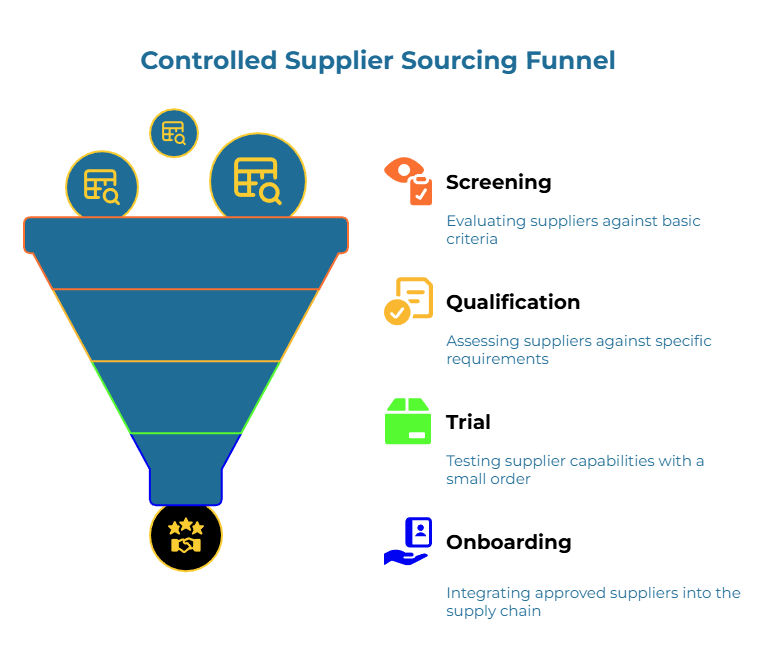
A controlled sourcing approach uses a simple funnel with gates:
Discovery → Screening → Qualification → Trial → Onboarding
Between each stage sits a control gate—conditions that must be satisfied before advancing. For example, the gate between Screening and Qualification might require: MOQ within operational range, lead time compatible with demand cycles, and documented export capability to target regions. If a supplier doesn’t meet gate criteria, they don’t advance—regardless of how attractive the unit price appears.
This structure prevents drift. Without explicit gates, the path from “found on marketplace” to “approved supplier” becomes a negotiation of convenience rather than a verification of fit.
Step-by-Step: Discovering Suppliers Without Losing Control
Step 1: Make Your RFQ Comparable
Before opening any marketplace, define requirements at a practical level. Vague specs generate vague quotes that can’t be compared. The goal isn’t perfection—it’s comparability. For matching specs to use-cases, see right bag for the job: a playbook for paper bag specs and use-case matching.
RFQ Readiness Mini-Template (use as-is)
- Bag type (e.g., flat handle / twisted handle / SOS)
- Size (W × G × H) and tolerance expectations (if critical)
- Paper type preference (only if known) and strength expectations (general)
- Handle specification (type + attachment expectation)
- Print: number of colors, coverage, inside/outside, finishing
- Target MOQ bands (e.g., “quote at 10k / 50k / 100k”)
- Target lead time window (e.g., “best estimate + range”)
- Specified Incoterm (e.g., FCA [Named Place], FOB [Named Port of Shipment], or DDP [Named Place of Destination] per Incoterms® 2020). For cost comparison guidance, see navigating global logistics: duty and freight factors in sourcing paper bags
- Required proof (samples, photos, certificates, test reports—if applicable). Mandatory: State all prices in [Currency] per [Normalized Unit, e.g., 1,000 units] to ensure comparability
A common failure pattern is sending a vague request (‘paper bags, printed, please quote’) and then trying to force structure after quotes arrive. A better approach is to define the ‘bag family’ first: what the bag is for, what it must survive, and which variables can change. Some details will vary by use-case and supplier capability. That is normal. The goal is comparability, not perfection.
Step 2: Capture Leads Consistently
Treat marketplace searches as structured data collection. For each relevant supplier, log consistent fields: company name and location, stated product range, MOQ and lead-time indications, response time and communication quality, and any initial constraints or concerns. A spreadsheet works—the discipline is consistency, not sophistication.
First-Contact Message Script (standardize outreach)
“Requesting a quote for wholesale paper bags. Please confirm (1) bag types you produce, (2) MOQ by size, (3) typical lead time range, (4) print capabilities, and (5) what proof you can share (recent production photos, samples, certifications, test reports if available). Quotes are easier to compare if provided in a single table with MOQ/lead time assumptions stated.”
Step 3: Fast Screen for Fit
Before investing in detailed qualification, apply quick filters. Can they produce the required bag types? Do MOQs and lead times fit operational constraints? Can they export with appropriate documentation? Do they signal quality approaches—certifications mentioned, samples offered, references available? For comprehensive international supplier verification, see verifying international paper bags suppliers: a checklist for safe online sourcing
This screen should reduce the list to 3–6 candidates worth deeper evaluation. A fast screen is not an audit. It is a capability filter. If a supplier cannot answer basic questions clearly, it usually gets worse under pressure later.
Step 4: Ask for Proof Early
Once candidates pass initial screening, request evidence appropriate to context: product samples, production photos, copies of relevant certifications (FSC, PEFC, food-contact compliance, ISO 9001), business registration documents, and references from comparable buyers. For remote verification methods, see how to vet wholesale paper bag suppliers: a remote audit checklist. When specifications are critical, verify supplier capability through both capability and execution lanes.
The goal is separating suppliers who substantiate claims from those who can’t. Move away from claims and toward evidence—opacity gaps between supplier claims and proof cost more than price savings. The depth of proof should match the risk of the program—high-volume, brand-critical, or safety-sensitive programs require more diligence. For food-contact packaging, verify food-grade certification standards naming FDA 21 CFR 176 or EU 1935/2004.
Step 5: Compare With a Scorecard
Unit price alone is a weak decision signal. A simple scorecard forces comparison across dimensions that matter: capability fit, MOQ and lead-time alignment, quote completeness, quality approach, logistics readiness, and communication reliability. Weight factors based on priorities—if delivery reliability is critical, weight it accordingly.
Price matters, but it is only one variable. A disciplined comparison separates “cheap” from “reliable and repeatable.” (For detailed supplier evaluation criteria, see from specs to sourcing: how paper bag requirements drive wholesale supplier selection.)
Supplier Screening Scorecard
| Category | Weight (1-5) | Supplier A | Supplier B | Supplier C |
| Quote clarity (assumptions stated) | 4 | |||
| MOQ fit for program | 5 | |||
| Lead time reliability (range + logic) | 5 | |||
| Bag capability match (type/size/handle) | 5 | |||
| Print capability match | 4 | |||
| Sample quality / proof quality | 5 | |||
| Communication responsiveness | 3 | |||
| Logistics readiness (Incoterms comfort) | 3 | |||
| Risk flags (inconsistencies, evasiveness) | 5 |
Weights vary by context. For example, a brand-heavy program may weight print higher; a peak-season program may weight lead time higher.
Step 6: Run a Trial Order

Strong qualification on paper doesn’t guarantee real-world performance. A limited trial—small enough to contain risk, large enough to test production capability—provides evidence that documentation can’t.
A trial order is most effective when paired with simple acceptance criteria: dimensions, handle integrity, print alignment, packaging condition on arrival. Consider the working capital implications using payment term negotiation strategies for cash-flow management. Document delivery timing, packaging condition, product quality against specifications, and communication throughout. This is where assumptions meet reality. It reduces surprises and gives both sides a learning cycle before volume.
Step 7: Onboard With Lightweight Governance
A successful trial marks the beginning of supplier management, not the end of evaluation. A supplier is “onboarded” when the program can run without heroics.
For creating a repeatable sourcing process your team can stick to, establish version-controlled specs, a periodic review cadence, defined triggers for corrective action, and backup supplier protocols. Lightweight governance usually includes a single controlled spec sheet version (with change history), a clear ordering cadence and forecast signal (even if rough), and a trigger list for corrective action (late deliveries, repeated defects, missed communication). This structure prevents drift and maintains control over time.
For a repeatable operating model, see: from fragmented quotes to a sourcing program: a framework for wholesale paper bag sourcing.
Marketplace-to-Shortlist Control Checklist
Before Discovery
- Bag family and use-case defined
- Specification template completed
- MOQ and lead-time expectations documented
During Discovery
- Lead capture template in use
- Initial screening criteria applied
- Shortlist reduced to 3–6 candidates
Before Commitment
- Documentation and samples requested
- Scorecard completed
- Trial order parameters defined
After Selection
- Version-controlled spec shared
- Review cadence established
- Backup supplier identification in progress
When Marketplaces Are a Good Fit (And When They’re Not)
Marketplaces work well when teams need backup suppliers to reduce single-source risk, are expanding into new regions without existing relationships, want to benchmark current supplier pricing, or face capacity constraints that existing partners can’t solve.
They’re less suited as a standalone approach when specifications remain unclear, there’s no operational tolerance for trial orders, timelines are urgent without a buffer for qualification, or highly regulated requirements demand extensive pre-qualification that generic profiles can’t satisfy.
The decision framework is straightforward: use marketplaces with strict internal gates when there’s capacity to qualify candidates properly. Default to existing suppliers when bandwidth or clarity for a proper discovery-to-onboarding process is lacking.
| Situation | Marketplaces are a strong fit when… | Rely more on incumbents when… |
| Growth and expansion | New regions/suppliers needed to scale | The spec is still unclear |
| Risk management | Backup suppliers are required | Timelines are too urgent for trials |
| Benchmarking | Current prices/terms need reality checks | Internal alignment is weak |
| Capability search | Niche bag types/printing needed | Quality fallout would be catastrophic |
What-If Scenario: Expanding Supplier Options Without Losing Control
A delivery brand plans to add a second distribution region and needs a backup paper bag supplier for peak periods. The team uses a marketplace to identify 12 potential suppliers, but only 5 respond with complete RFQ tables. Of those, 2 fail the fast screen due to MOQs that do not fit the program.
The remaining 3 are asked for samples and a proof pack. Two suppliers provide usable samples and clear lead time ranges, so they move to a small trial order with documented acceptance checks. One supplier passes and is onboarded as a backup with a locked spec version and a simple reorder cadence.
The key outcome is not “finding the cheapest supplier.” It is building a controlled second source without destabilizing the supplier and is ‘onboarded’ when the program can run operations.
What If a Supplier Looks Perfect on Paper but Fails the Trial?
This happens—and it’s precisely why the trial gate exists. A supplier might present strong documentation, responsive communication, and competitive pricing, then deliver late, with quality variance, or with incomplete paperwork. The trial reveals what profiles can’t. Use a verification methodology for brand consistency with 5 steps including measurable specs (ISO 536, ISO 2758) and drift monitoring.
When this occurs, document the specific failures, communicate clearly with the supplier about gaps, and decide whether a second trial with corrective commitments makes sense—or whether to advance an alternative candidate from the shortlist. The sunk cost of a failed trial is far lower than the ongoing cost of an unreliable supplier relationship.
Myth: “If It’s on a Marketplace, It Must Be Safe (or Cheap)”
Neither assumption holds. A marketplace presence signals that a supplier created a profile—nothing more. Safety is validated by process: documentation verification, sample testing, trial performance. Price is evaluated in context: total landed cost including freight, duties, defect rates, and administrative overhead—not unit price in isolation.
Similarly, “verified” badges mean different things on different platforms. Treat them as one signal among many, not as a substitute for independent due diligence. Definitions vary; the verification process that earned the badge may not cover the dimensions that matter most for a specific sourcing need.
Channel presence is not a guarantee. Safety and competitiveness come from methods: a structured RFQ, evidence-based qualification, and gated progression to trials and onboarding.
Frequently Asked Questions
How many suppliers should be shortlisted from a marketplace?
Three to six typically balances thoroughness with manageability. Fewer limits comparison options; more creates evaluation fatigue. A common approach is to start broad (8–15) at discovery, then narrow to 3–5 after screening, and 1–2 for trials. The exact number depends on volume, risk tolerance, and internal bandwidth.
What should be requested before samples or a trial order?
Business registration, relevant certifications, production capability documentation, and references. At minimum: a quote table with assumptions, MOQ and lead time ranges, and proof aligned to the requested bag type (photos, production examples, and documentation where relevant). Specific requirements depend on risk profile and regulatory context.
How can operations and marketing stay aligned during supplier discovery?
Share the RFQ template and scorecard criteria before discovery begins. Include representatives from each function at screening and trial gates. Agree early on the “must-not-fail” requirements (durability, lead time, print quality, packing integrity) and use one scorecard so every stakeholder evaluates the same evidence. Alignment breaks down when requirements surface after selection rather than before.
How should buyers avoid anchoring on the lowest unit price?
Weight total landed cost—including freight, duties, defect rates, and overhead—not unit price alone. Compare total landed cost drivers and reliability indicators, and require a trial gate before scale. The scorecard forces this comparison. The scorecard structure prevents a single variable from dominating the decision too early. A supplier with higher unit cost but better reliability often delivers lower total cost.
Discovery Scale, Internal Control
Marketplaces offer access to suppliers that single relationships can’t match—across regions, product variations, and capability levels. The risk of losing control is real, but it stems from process gaps, not from the channel itself.
Marketplaces can be an efficient way to discover wholesale paper bag suppliers, especially when building backups or expanding regions. The control risk is real, but it is manageable. A staged funnel with explicit control gates transforms marketplace discovery from a source of chaos into a structured input.
Use the checklist above to bring methods to discovery. Browse paper bag suppliers on PaperIndex to expand the shortlist—and keep qualification, contracting, and governance firmly in internal hands.
Using PaperIndex for Supplier Discovery
PaperIndex functions as a discovery and research platform—a specialized directory connecting buyers with paper bag suppliers globally. The platform helps expand shortlists, organize outreach, and compare candidates against internal criteria.
What it doesn’t do: PaperIndex doesn’t broker deals, set prices, guarantee outcomes, or participate in transactions. All commercial terms remain directly between buyer and supplier.
This positioning matters for how the platform fits into a sourcing process. Treat it as one input to qualification—a way to identify candidates efficiently—not as a substitute for the screening, documentation, and trial steps outlined above. Discovery scale is the platform’s value; internal method provides the control.
Practical, controlled use cases include browsing and filtering supplier profiles to build an initial shortlist, sending structured inquiries or RFQs using the same RFQ template across suppliers, and comparing supplier responses using the scorecard and control gates above.
Disclaimer:
This article provides general educational guidance on supplier discovery and sourcing processes. It does not constitute legal, financial, or regulatory advice.
Our Editorial Process:
Our expert team uses AI tools to help organize and structure our initial drafts. Every piece is then extensively rewritten, fact-checked, and enriched with first-hand insights and experiences by expert humans on our Insights Team to ensure accuracy and clarity.
About the PaperIndex Insights Team:
The PaperIndex Insights Team is our dedicated engine for synthesizing complex topics into clear, helpful guides. While our content is thoroughly reviewed for clarity and accuracy, it is for informational purposes and should not replace professional advice.