
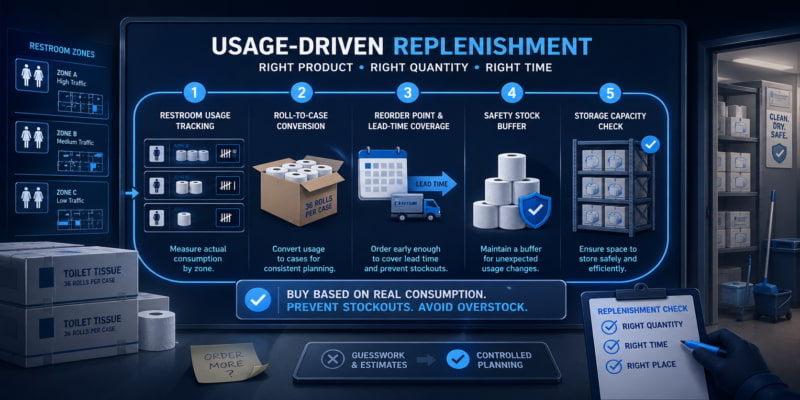
📌 Key Takeaways
Buying toilet tissue based on real usage—not past invoices or gut feelings—prevents both stockouts and wasted storage space.
- Track What You Use, Not What You Bought: Past invoices show what was ordered, not what was needed, so basing future orders on them repeats every old mistake.
- Match Order Timing to How Fast You Run Out: Weekly, biweekly, or monthly orders should reflect actual consumption speed and storage space, not just what’s convenient.
- Don’t Let Bulk Deals Override Your Closet Space: A volume discount backfires when cases block hallways, absorb moisture, or sit unused for weeks.
- Group Locations by Traffic, Not by Contract: Multi-site buyers should adjust order sizes for each building’s restroom traffic and storage, even under one shared supplier deal.
- Review Your Numbers Every Quarter: Usage shifts when occupancy changes, floors open, or seasons turn—so reorder points need regular updates to stay accurate.
Consistent restrooms start with procurement plans built on real numbers, not sticky-note guesses.
Facility managers, office coordinators, and procurement teams responsible for restroom supplies will gain a practical ordering framework here, preparing them for the detailed planning guide that follows.
~ ~ ~ ~ ~ ~ ~ ~ ~ ~ ~ ~ ~ ~ ~ ~ ~ ~
When a Low-Cost Supply Creates High-Visibility Problems
Seven cases left.
The janitorial closet door swings open, and there it is—a sticky note, curling at the edges, scrawled in all caps: ORDER MORE. LAST TIME WE RAN OUT ON A FRIDAY. The procurement manager flips through last quarter’s invoices, looking for a pattern. Three emergency distributor orders in two months. One bulk purchase that sat untouched for six weeks, blocking access to cleaning supplies and quietly absorbing moisture from a nearby utility pipe. Wasted storage space, excess carrying costs, and still two stockouts that sent a custodian to a retail store at 6:47 AM.
There has to be a better way to do this.
You’ve been here. Toilet tissue is one of the lowest-cost consumables in a facility budget, yet it creates some of the most visible operational failures. A single stockout in a hotel lobby restroom, a hospital corridor, or a school hallway affects every person who walks through the door. Procurement teams often treat it as a routine reorder—something too simple to deserve real planning. That assumption is where overordering, storage strain, and waste begin.
The goal is not simply to buy more products. The goal is to buy the right quantity, at the right interval, through the right distributor arrangement, based on real usage patterns. A commercial toilet tissue procurement strategy built around actual facility consumption—connecting case quantity planning, ordering cadence, contract purchasing, distributor coordination, small-facility constraints, consolidated multi-site purchasing, and vendor-managed inventory—gives your team the ability to prevent stockouts without the carrying costs and storage problems that come from guesswork.
Procurement planning that connects three functions—usage forecasting, storage capacity, and distributor ordering strategy—is what separates reactive purchasing from reliable restroom readiness.
Start With Consumption Before Deciding Purchase Quantities
Toilet tissue purchasing should begin with facility-level consumption data. Before deciding order sizes, buyers need a credible answer to one question: how many rolls or cases does this facility actually use per week or month?
Consumption varies by facility type, restroom traffic, occupancy levels, shift patterns, visitor volume, and dispenser format. A school campus with 1,200 students and scheduled break periods uses toilet tissue in a pattern that looks nothing like a hotel with variable nightly occupancy, a hospital running 24-hour patient care across multiple wings, or a single-floor commercial office with predictable weekday-only traffic. Even buildings with a similar number of restrooms can require very different ordering models.
Buyers should track usage by restroom group or facility zone where possible. For smaller facilities, even simple weekly counts—a tally sheet on the inside of the supply closet door—can dramatically improve purchasing accuracy over time. Larger operations can pull data from custodial restocking logs, dispenser sensor readings, or receiving records—techniques explored in more detail in our guide on how to forecast commercial toilet tissue usage before stockouts occur. The goal is not perfect precision. It’s a credible estimate that replaces guesswork with something measurable.
The considerations that shape a useful consumption baseline include average rolls replaced per restroom per week, the total number of restrooms and stalls, the distinction between high-traffic areas like lobby restrooms and lower-traffic back-of-house facilities, seasonal peaks such as hotel summer occupancy or flu season in healthcare settings, the guest, patient, student, employee, or visitor counts that drive demand, dispenser format and roll capacity (compact dispensers empty faster than jumbo-roll units), and historical purchase and invoice records as a cross-reference.
That last point deserves emphasis. Past invoices show what was bought, not what was used. The gap between the two is where most procurement miscalculations live. An invoice for eight cases last quarter might reflect an emergency reorder, not a stable consumption pattern. When procurement teams base future orders on purchase history alone, they carry forward every past mistake instead of correcting it.
For a closer look at how linear restocking schedules cause recurring outages when usage spikes outpace calendar logic, review standard continuous review inventory models and their application to high-turnover consumables.
How AFH Buyers Should Calculate Toilet Tissue Case Quantities
Once a consumption baseline exists, the next step is translating roll-level usage into case-level procurement quantities. Procurement teams order in cases. Consumption happens one roll at a time inside a dispenser. The job of toilet tissue case quantity planning is to convert expected roll usage into realistic order sizes that account for lead time, safety stock, storage limits, and order minimums.
The planning formulas are straightforward:
- Monthly case requirement = monthly roll usage ÷ rolls per case
- Reorder point = expected usage during lead time + safety stock
For a step-by-step workflow that applies these formulas to smaller AFH operations, see how to set AFH toilet tissue reorder points and replenishment cycles.
To illustrate: the facility needs three cases per month for consumption. With a one-week lead time (0.75 cases) and one week of safety stock (0.75 cases), the reorder point should be 1.5 cases. The facility should maintain an average inventory of 2.25 cases to avoid storage strain.
These numbers are illustrative. Actual consumption differs substantially by facility type, dispenser system, traffic level, and seasonal patterns. The formulas provide a starting structure, not a universal answer.
Safety stock itself is a widely accepted inventory buffer designed to protect against demand variation, delivery delays, and forecast error. ASCM describes safety stock as inventory carried specifically to reduce stockout frequency—while also cautioning that excess safety stock can strain both storage capacity and capital budgets. That balance—enough buffer to prevent gaps, not so much that it creates new problems—is exactly the tension toilet tissue procurement teams need to manage.
Case quantity planning must be driven by expected consumption rather than budget cycles or distributor promotions. When order quantities are driven by a quarterly purchasing schedule or a volume discount offer rather than by how fast restrooms actually consume product, procurement creates drift between what’s purchased and what’s needed. That drift is the root cause of both stockouts and overstock.
Set an Ordering Cadence That Matches Usage and Lead Time
Ordering cadence—the frequency with which a facility places commercial toilet tissue orders, whether weekly, biweekly, monthly, or as part of a broader janitorial supply delivery schedule—is the second half of the replenishment equation. Getting the quantity right matters less if orders arrive at the wrong frequency.
Poor cadence creates three distinct problems. Ordering too frequently increases administrative workload: purchase orders, approvals, receiving labor, and invoice processing all scale with order count. Ordering too infrequently creates storage strain and raises the stockout risk if a demand forecast proves wrong. Ordering reactively—only when someone notices stock is low—leads to emergency purchases at inconsistent pricing and breaks the procurement team’s ability to plan ahead.
Cadence should reflect five factors: consumption rate, distributor delivery schedules, minimum order requirements, internal receiving capacity (dock availability, staffing, operating hours), and available storage.
Weekly ordering works best for high-traffic sites with limited storage or volatile usage patterns. Hotels with fluctuating occupancy and event venues are common examples. Smaller, more frequent deliveries keep stock fresh without overwhelming the janitorial closet.
Biweekly ordering suits facilities with moderate, relatively predictable consumption and reliable distributor service windows. Most mid-sized office buildings and retail locations fall here.
Monthly ordering fits stable, lower-variation environments where storage space is adequate and usage patterns don’t swing much. A single-shift office with steady headcount is a reasonable candidate.
Contracted or scheduled delivery makes sense when demand is predictable enough that procurement can step out of the manual ordering loop. This is where toilet tissue contract buying and vendor-managed inventory begin to overlap with cadence planning.
The following summary captures how each cadence option fits different facility profiles and what risks to watch:
| Ordering Cadence | Best Fit | Main Risk to Watch |
| Weekly | High-traffic sites, limited storage, volatile usage | More ordering and receiving work |
| Biweekly | Moderate usage with predictable distributor service | Requires regular stock checks |
| Monthly | Stable, lower-variation facilities with enough storage | Higher exposure if usage spikes |
| Scheduled or Contracted Delivery | Predictable demand and standardized product needs | Commitments may drift away from actual usage |
The key test for any cadence: does the order arrive before the facility runs out, without requiring more storage than the building can safely accommodate?
Align Distributor Orders With Broader Janitorial Supply Purchasing
Toilet tissue is rarely the only item on a restroom supply order. Most AFH facilities purchase it alongside paper towels, hand soap, trash liners, cleaning chemicals, and other janitorial consumables. Procurement teams should evaluate whether toilet tissue fits naturally into an existing distributor delivery cycle—or whether forcing it into that rhythm creates risk.
Consolidated toilet tissue distributor ordering has clear advantages. Fewer purchase orders mean less administrative processing. Fewer receiving events reduce dock labor and scheduling complexity. Combined shipments may meet a distributor’s freight or delivery fee thresholds more easily, and invoice management simplifies when fewer orders flow through accounts payable. If the distributor already delivers janitorial supplies biweekly, adding toilet tissue to that shipment makes sense—as long as the cadence matches actual tissue consumption.
The risk shows up when it doesn’t. If the biweekly janitorial delivery cycle works for soap and liners but is too infrequent for toilet tissue in a high-traffic building, folding tissue into that schedule means the facility either overstocks to cover the gap between deliveries or accepts a higher probability of running short.
When coordinating with a distributor, procurement should review minimum order quantities and whether tissue alone meets them, freight or delivery thresholds, case-pack configurations and whether mixed pallets are available, order cut-off times relative to the internal procurement cycle, lead time variability during peak demand periods, receiving dock or storage access limitations, and whether toilet tissue consumption naturally aligns with the reorder timing for other restroom supplies.
Sometimes consolidation is the right answer. Sometimes toilet tissue needs its own ordering track. The deciding factor is whether the combined cadence actually serves tissue consumption or simply makes purchasing more convenient at the cost of restroom readiness.
Toilet Tissue Contract Buying: Align Volume Commitments With Real Usage
Contract purchasing helps facilities secure consistent pricing, product availability, and stable specifications across deliveries. For organizations with predictable toilet tissue usage and standardized products, toilet tissue contract buying reduces the number of procurement decisions made per year and provides some protection against supply disruptions. It is not, however, the only viable approach.
As-needed ordering—placing purchase orders individually based on current inventory levels and immediate demand—can work for small or variable facilities that lack stable usage patterns, large storage areas, or reliable demand forecasts. The trade-off is that pricing, availability, and administrative workload may be less predictable. When emergency orders become common or pricing swings erode budget control, as-needed purchasing signals that the facility may have outgrown the approach and should evaluate a contract structure.
The risk with contracts sits in the volume commitment. Contracts built on estimated usage that doesn’t reflect reality—because the estimate was optimistic, because occupancy patterns changed, or because no one revisited the numbers after signing—create problems in both directions. Overcommitting means excess inventory that crowds storage, risks product damage from prolonged holding, and ties up working capital in cases that sit unused for months. Undercommitting means off-contract emergency purchases at higher cost, which defeats the purpose of contracting in the first place.
| Buying Approach | Useful When | Less Effective When |
| Contract Buying | Usage is predictable, SKU standardization matters, distributor service is reliable | Traffic is unstable, storage is limited, dispenser formats are changing |
| As-Needed Ordering | Demand varies, storage is tight, purchasing volume is low | Emergency orders become common or pricing becomes inconsistent |
| Scheduled Delivery | Usage patterns are stable and replenishment can be planned | Inventory thresholds are not reviewed or adjusted |
Before signing a volume commitment, procurement should verify historical annual usage across all covered locations, expected changes in occupancy, headcount, or facility operations, whether the contracted SKU is standardized across all facilities or whether exceptions will require separate purchasing, distributor lead time and delivery frequency under the contract terms, available storage and receiving capacity at each site, minimum annual volume thresholds and the consequences of falling short, price protection terms and escalation clauses, and substitution rules if the contracted product becomes temporarily unavailable.
Substitution rules deserve more attention than they often receive. If a contracted SKU is unavailable, the replacement must still fit the dispenser, align with the case-pack plan, and meet the restroom service expectation. A substitute that creates refill problems or custodial workarounds is not a true substitute—it’s a disruption wearing a different label.
Contract buying works well when usage is stable, the product is standardized, and the facilities served have adequate storage and receiving infrastructure. It’s less effective when a facility has unstable traffic, frequently changes dispenser systems, or has limited visibility into actual consumption—because the contract locks in a volume that the building may not be able to absorb, store, or use before the next scheduled delivery arrives.
For broader procurement terminology and shared supply-chain language, the ASCM Supply Chain Dictionary provides a common reference for terms like safety stock, lead time, reorder point, and vendor-managed inventory that appear throughout this procurement planning process.
Ordering Strategy for Small Facilities With Limited Storage
Small businesses, satellite offices, single-location retailers, and small clinics face a fundamentally different version of the procurement problem. These buyers typically don’t have large janitorial closets, dedicated receiving docks, or specialized procurement staff. The person ordering toilet tissue may also be the office manager, the business owner, or a facilities coordinator juggling dozens of other responsibilities. Their biggest challenge is balancing stockout prevention with limited physical storage space.
For these facilities, smaller, more frequent orders generally work better than bulk purchasing. Buyers should also consider products with higher roll capacity or more efficient case configurations—compact cases that hold the same number of rolls in a smaller footprint, or higher-sheet-count rolls that last longer per dispenser load—provided they’re compatible with the installed dispensers.
Practical steps for small-facility toilet tissue inventory planning:
- Track weekly roll usage for at least four to six weeks before establishing a regular order size. Even a simple tally on a clipboard gives procurement a credible baseline.
- Keep a minimum stock threshold. Determine how many cases represent a comfortable buffer—enough to cover one full distributor lead time plus a few extra days—and reorder when stock hits that number.
- Don’t buy more cases than the storage area can protect. Toilet tissue absorbs moisture and odors readily, and cases stored in inappropriate conditions can suffer physical degradation that generally undermines the initial financial benefits of bulk cost savings—a problem explored in detail in our guide to toilet tissue roll storage requirements for commercial janitorial programs.
- Check distributor delivery frequency before committing to bulk orders. If the distributor delivers weekly, there’s no need to stockpile a month’s worth.
- Use clearly labeled storage areas to separate active stock from backup stock. Even in a small closet, distinct zones prevent the first-in-first-out confusion that leads to degraded products sitting behind newer cases.
- Avoid storing cases in damp areas, high-foot-traffic corridors, or spaces adjacent to cleaning chemicals. Proper storage conditions—including structured inspections and custodial SOPs—are essential for maintaining product quality between deliveries, as outlined in our guide to toilet tissue storage standards for compliance, risk reduction, and quality control.
For more detail on temperature, humidity, and chemical separation standards, refer to standard OSHA material handling guidelines or storage environment standards for commercial toilet tissue inventory.
For small facilities, procurement efficiency is not always about buying the lowest unit price. It is about maintaining reliable supply within the real storage, labor, and space constraints of the building.
Consolidating Toilet Tissue Orders Across Multiple Facility Locations
Multi-location operators—school districts, healthcare networks, hotel groups, property management companies, retail chains—can often improve purchasing control by consolidating orders, standardizing SKUs, and coordinating distributor relationships across sites. Multi-location restroom supply procurement introduces both opportunities and complications that single-site purchasing doesn’t face.
The benefits of consolidation are meaningful: better volume visibility across the portfolio, potential pricing leverage from aggregated demand, SKU standardization that simplifies specification management, fewer distributor relationships to maintain, easier reporting and budget tracking, and a more consistent restroom experience for guests, patients, students, or tenants across every building in the network.
But consolidation also carries risks. Different locations may have dramatically different restroom traffic volumes. Storage capacity varies from building to building. Local distributor delivery schedules may not align with a centralized ordering rhythm. And a single ordering model designed around the highest-traffic facility will almost certainly overstock every smaller site in the network.
The more effective approach groups locations by consumption profile rather than treating all facilities the same:
| Location Profile | Procurement Treatment |
| High-traffic locations (large hotels, hospital campuses, busy retail) | More frequent delivery and tighter stock review |
| Moderate-use locations (standard offices, schools during session) | Standard cadence with monthly or quarterly checks |
| Low-use locations (satellite offices, seasonal facilities) | Smaller order quantities and lower backup stock |
| Limited-storage locations | Smaller deliveries and stricter storage limits regardless of consumption level |
| Seasonal or event-driven locations | Flexible cadence tied to expected occupancy or attendance peaks |
This structure lets procurement standardize where it makes sense—same SKU, same distributor, same contract terms—while adjusting order quantities and cadence to reflect how each building actually operates. When evaluating commercial toilet tissue suppliers across a multi-location portfolio, confirming that a single supplier can support varying delivery schedules across different site profiles is a practical step that prevents consolidation from becoming a source of new supply gaps.
For product-fit decisions across different facility types, Away-From-Home toilet tissue supplier verification for multi-site buying provides useful context on verifying supplier performance across diverse facility sectors.
Vendor-Managed Inventory for AFH Toilet Tissue Programs
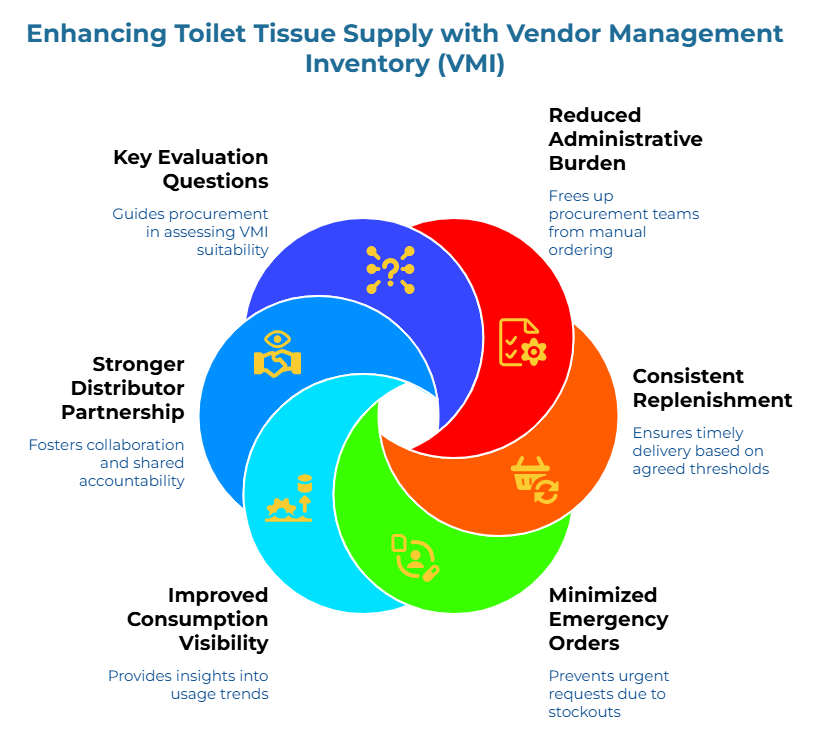
Vendor-managed inventory, or VMI, shifts part of the replenishment responsibility from the buyer to the distributor or supplier. Instead of the procurement team placing manual orders on a fixed schedule, the distributor monitors inventory levels—through on-site counts, usage reports, or electronic tracking—and replenishes products based on agreed minimum and maximum thresholds. SAP defines VMI as a collaborative strategy where the vendor maintains inventory levels at the customer’s site based on agreed min/max replenishment parameters.
For larger facilities and multi-site operations, VMI for toilet tissue can reduce administrative burden, deliver more consistent replenishment timing, reduce emergency orders, and give the distributor better visibility into consumption trends. Over time, a strong VMI arrangement can also build a stronger distributor partnership, with shared accountability for maintaining supply levels and catching demand shifts before they create gaps.
VMI is not a set-and-forget arrangement. It requires accurate usage data, clear service-level expectations, and good communication between the facility and distributor. Before agreeing to a VMI arrangement, procurement should evaluate several key questions:
| VMI Evaluation Question | Why It Matters |
| Does the facility have predictable and measurable usage? | VMI works better when thresholds are based on stable consumption patterns |
| Is the distributor already delivering frequently enough to make monitoring practical? | Infrequent delivery windows limit the distributor’s ability to respond to threshold triggers |
| Can the distributor track inventory accurately at each location? | Poor counts create poor replenishment decisions |
| Are minimum and maximum stock levels documented and agreed upon? | Prevents both stockouts and overstock by defining the operating range |
| Who bears responsibility when a stockout occurs under the VMI agreement? | Avoids responsibility gaps that leave the facility exposed |
| How often will usage data and order accuracy be reviewed together? | Keeps thresholds aligned with current consumption and catches drift early |
| What reports will the buyer receive? | Maintains visibility and accountability even when the distributor manages replenishment |
For deeper guidance on connecting inventory visibility with restocking processes, commercial toilet tissue inventory management for janitorial operations covers FIFO methods, backup stock formulas, and route-based restocking systems that complement a VMI arrangement.
Build a Practical Procurement Planning Model
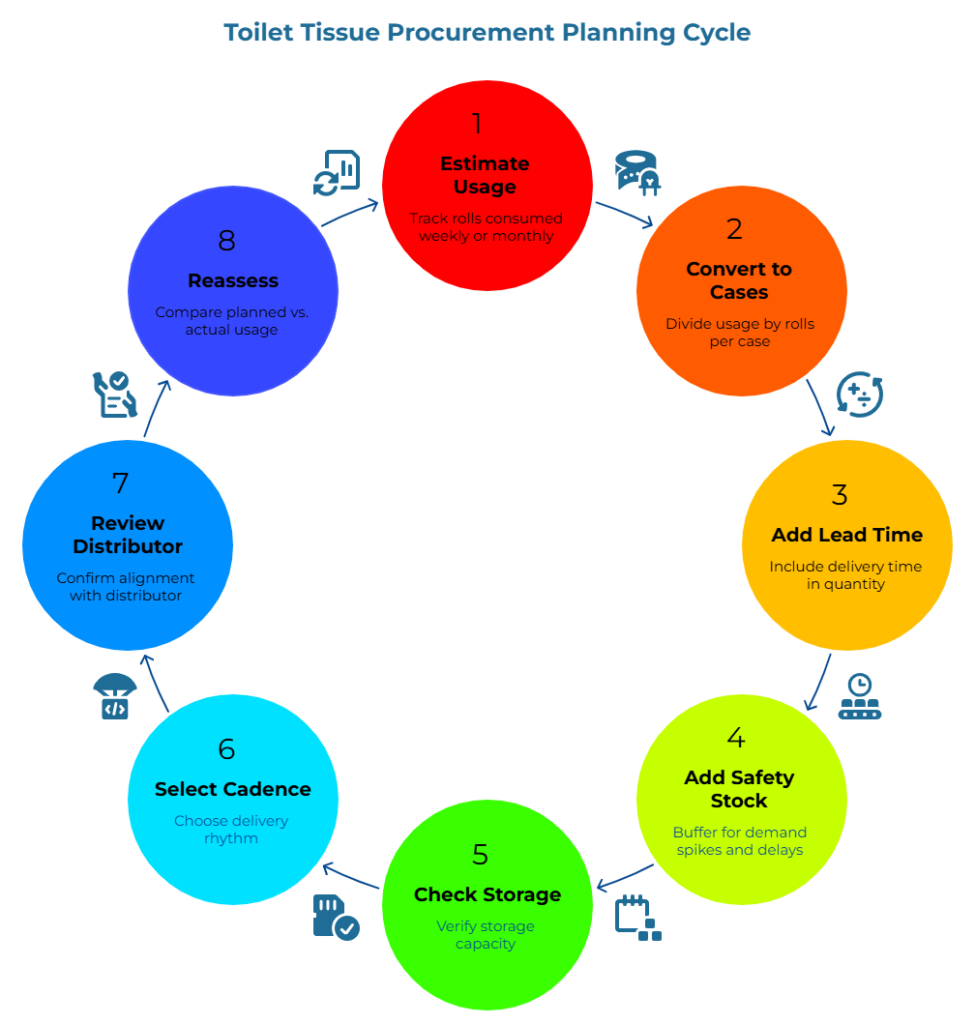
Everything covered so far—consumption tracking, case quantity calculation, cadence selection, distributor coordination, contract evaluation, storage awareness—can be distilled into a repeatable toilet tissue replenishment planning process. The goal isn’t a perfect forecast. It’s an operating rhythm that runs consistently enough to prevent avoidable stockouts and catch wasteful ordering before it compounds.
Here’s the planning sequence:
- Estimate average usage. Track rolls consumed weekly or monthly per facility or restroom group.
- Convert to case quantities. Divide expected roll usage by the number of rolls per case.
- Add lead-time coverage. Determine how many cases the facility needs to bridge the gap between placing an order and receiving delivery.
- Add safety stock. Build a buffer for demand spikes, delivery delays, or forecast errors.
- Check storage capacity. Verify that the planned quantity fits safely in available storage without creating handling problems or product damage.
- Select ordering cadence. Choose a weekly, biweekly, monthly, or scheduled delivery rhythm that balances consumption rate against administrative workload and receiving capacity.
- Review distributor requirements. Confirm that order sizes meet minimums, delivery schedules align, and case configurations are compatible.
- Reassess monthly or quarterly. Compare planned quantities against actual usage. Adjust for occupancy changes, seasonal shifts, or facility expansions.
| Planning Step | Procurement Question |
| Usage estimate | How many rolls are used weekly or monthly? |
| Case conversion | How many cases does that equal? |
| Lead time | How long does the distributor take to deliver? |
| Safety stock | How much backup inventory is needed? |
| Storage check | Can the facility store the planned quantity safely? |
| Cadence | Should orders be weekly, biweekly, monthly, or scheduled? |
| Review | Are usage patterns changing? |
Example Procurement Scenario
Consider a 40-person office with four restrooms, each fitted with a standard twin-roll dispenser. Over a six-week tracking period, the office manager counts an average of 48 rolls replaced per week across all restrooms. Cases from the current supplier contain 96 rolls each, so the office needs roughly one case every two weeks.
The distributor’s lead time is five business days. The office has a single janitorial closet that can safely store three cases at a time. Using the planning model above, the office manager sets a reorder point at one case remaining (roughly one week of coverage) and places a biweekly order of two cases. That provides enough stock to cover the lead time plus one week of backup—without exceeding the closet’s capacity.
When the office adds a new floor with two more restrooms six months later, the same model recalibrates: weekly usage rises, the reorder point shifts, and the cadence may tighten to weekly ordering. The process stays the same. Only the numbers change.
Procurement Planning Checklist
Before placing the next toilet tissue order, procurement teams should confirm these ten data points:
- Average weekly roll usage
- Rolls per case (for the current SKU)
- Distributor lead time
- Minimum order quantity
- Storage capacity (number of cases the facility can safely hold)
- Safety stock target
- Delivery cadence
- Contract volume commitment (if applicable)
- Location-specific usage differences (for multi-site operations)
- Review frequency (monthly or quarterly)
The strongest procurement teams treat this checklist as a living document—not a one-time exercise. Usage shifts. Distributors change schedules. Buildings open, close, or renovate. A quarterly review keeps the model honest.
Common Procurement Mistakes to Avoid
Even well-intentioned procurement teams fall into patterns that look reasonable on paper but break down in practice. Recognizing these common mistakes is the fastest way to improve ordering accuracy.
- Ordering based only on past purchase history. Purchase records show what was bought, not what was needed. If last year’s orders included two emergency buys and one oversized bulk purchase that sat in storage for weeks, repeating those numbers perpetuates the problem rather than solving it. Start with consumption data, not invoice history.
- Ignoring distributor lead times. A facility might have adequate stock today and still face a stockout next week if the reorder signal comes too late and the distributor needs seven business days to deliver. Lead time awareness belongs in every reorder calculation—not as an afterthought, but as a structural input that determines when to place the order, not just how much to order.
- Buying in bulk without checking storage capacity. A large order at a volume discount sounds efficient until the cases block the janitorial corridor, sit on a damp loading dock, or get damaged because there’s no climate-appropriate storage space. Procurement’s job includes verifying that the building can receive, protect, and rotate what is being ordered.
- Treating every location the same. Multi-location organizations that apply one ordering template across all sites inevitably overstock some and underserve others. A 400-room hotel and a 30-person satellite office don’t share a consumption profile, even if they share a distributor contract. Grouping locations by usage profile, as described in the consolidation section above, prevents this.
- Failing to review case pack and dispenser compatibility. Not every roll fits every dispenser. Ordering a new SKU—even at a better price—without confirming that the roll format, diameter, and sheet count are compatible with installed dispensers creates waste, returns, and frustrated custodial staff who are left troubleshooting a mismatch that procurement could have caught at the ordering stage. For related specification planning, Away-From-Home (AFH) toilet tissue specification framework basics covers the field groups procurement teams should define before comparing suppliers.
- Letting contract volumes drift away from actual usage. Annual volume commitments should be reviewed against real consumption data at least once a year. A contract that made sense when a building was at full occupancy may not fit if occupancy dropped, floor plans changed, or dispenser systems were replaced. Contracts that go unreviewed quietly generate overstock or force off-contract emergency purchasing.
Procurement as the Foundation of Restroom Readiness
That sticky note on the inside of the closet door was never a procurement strategy. It was a symptom—of ordering by instinct, reacting instead of planning, and treating toilet tissue like something too routine to deserve real attention.
Toilet tissue procurement is an operational planning function. When it works, procurement teams maintain supply continuity, control spending, reduce emergency orders, and support the custodial teams who depend on consistent product availability to keep restrooms functional for every occupant and visitor.
You now have the tools to measure what your facility actually uses, convert roll counts into case quantities, set an ordering cadence that reflects real consumption, and evaluate whether contract buying or vendor-managed inventory fits your operation. Multi-location organizations have a method for grouping sites by consumption profile. Small facilities have a clear path to reliable supply that doesn’t require a warehouse.
A strong commercial toilet tissue procurement strategy is not built around buying the most cases at once. It is built around aligning purchasing quantities with actual consumption, distributor lead times, storage limits, and the facility service expectations that define what “restroom ready” means for your building.
Consistent restrooms start with consistent procurement. And consistent procurement starts with the decision to replace the sticky note with a plan.
Need help aligning restroom paper supply with actual facility usage? Review your toilet tissue case quantities, distributor cadence, and storage capacity to build a replenishment plan that supports consistent restroom readiness—starting with a four-week consumption count at your highest-traffic location. To explore verified toilet tissue suppliers or submit an RFQ and receive quotes free, visit PaperIndex.
Frequently Asked Questions
How Should AFH Buyers Calculate Toilet Tissue Case Quantities?
Start by estimating how many rolls the facility uses in a typical week or month. Divide expected roll usage by the number of rolls in each case. Then adjust the result for distributor lead time, safety stock needs, order minimums, and available storage capacity. The formula provides a baseline; specific facility constraints shape the final number.
How Often Should Commercial Facilities Order Toilet Tissue?
Ordering frequency depends on usage rate, available storage space, distributor lead time, and restroom traffic levels. High-traffic facilities with limited storage often need weekly or biweekly orders. Smaller, predictable environments may manage well with monthly deliveries. The best cadence prevents stockouts without creating excess inventory that the building can’t store safely.
Should a Facility Buy Under Contract or Order as Needed?
Contract buying works well when usage is predictable, products are standardized, and distributor service is reliable. It provides price consistency and product availability. As-needed ordering may suit smaller or more variable facilities where demand fluctuates and storage is tight. The better choice depends on actual consumption volume, storage limits, lead-time reliability, and whether emergency orders are becoming a recurring pattern.
How Can Buyers Avoid Both Stockouts and Overstock?
Buyers should set reorder points using expected usage during the distributor’s lead time plus a safety stock buffer. They should also cap order quantities against available storage capacity. This creates a controlled inventory range: enough stock to maintain restroom readiness, but not so much that product crowds the facility, degrades in storage, or ties up working capital unnecessarily.
Is Contract Buying a Good Option for Toilet Tissue Procurement?
Contract buying works well when a facility has predictable usage, standardized products, and a stable supplier relationship. It provides price consistency and product availability. However, volume commitments that exceed actual usage or available storage capacity create their own problems, including crowded storage, product damage, and budget inefficiency.
How Much Backup Toilet Tissue Should a Facility Keep?
Backup stock should cover expected usage during the distributor’s lead time plus a reasonable safety buffer. Facilities with high restroom traffic, longer or less reliable delivery windows, or seasonal demand swings typically need a larger buffer than small, predictable operations.
What Should Small Facilities Consider When Ordering Toilet Tissue?
Storage limits, order frequency, and realistic usage estimates are the primary concerns. Smaller, more frequent orders usually work better than bulk purchasing when closet space is limited. A simple reorder threshold—restocking when inventory drops to a defined minimum—prevents both stockouts and overcrowded storage areas.
How Can Multi-Location Organizations Improve Toilet Tissue Purchasing?
Standardize SKUs and consolidate distributor relationships where possible, but group locations by usage profile rather than applying one order template everywhere. Each site’s restroom traffic, storage capacity, and delivery logistics should influence its specific order quantities and cadence, even under a shared contract.
What Is Vendor-Managed Inventory for Toilet Tissue?
Vendor-managed inventory is a replenishment arrangement where the distributor monitors stock levels and reorders based on agreed minimum and maximum inventory thresholds. It reduces manual ordering workload but requires accurate usage data, clearly defined service expectations, and regular performance reviews to work effectively.
What Causes Toilet Tissue Overordering?
Overordering commonly results from relying on bulk discounts, outdated purchase history, or annual contract targets without verifying actual consumption and storage capacity. The consequences include crowded storage areas, damaged products, and inefficient use of working capital—costs that often exceed whatever savings the bulk purchase was supposed to deliver.
How Do Distributor Lead Times Affect Toilet Tissue Purchasing?
Lead time determines how far in advance a facility must place its reorder. If a distributor takes one week to deliver, the facility needs enough on-hand inventory to cover that week plus additional safety stock for unexpected delays or demand spikes. Longer or inconsistent lead times require larger buffers and more careful reorder point calculations.
Should Toilet Tissue Be Ordered With Other Janitorial Supplies?
Combining toilet tissue with other janitorial supply orders can simplify purchasing and receiving logistics. But the combined order cycle must still align with actual tissue consumption. If the facility uses toilet tissue faster than it uses soap or liners, forcing tissue into a slower delivery cadence increases stockout risk.
Disclaimer:
This article is intended for educational and informational purposes only. Procurement strategies, ordering cadences, and inventory planning methods should be adapted to the specific operational requirements, distributor agreements, and facility constraints of each organization. Recommendations provided here represent general guidance and widely accepted procurement principles, and should not be treated as prescriptive for any individual facility.
Our Editorial Process:
Our expert team uses AI tools to help organize and structure our initial drafts. Every piece is then extensively rewritten, fact-checked, and enriched with first-hand insights and experiences by expert humans on our Insights Team to ensure accuracy and clarity.
About the PaperIndex Insights Team:
The PaperIndex Insights Team is our dedicated engine for synthesizing complex topics into clear, helpful guides. While our content is thoroughly reviewed for clarity and accuracy, it is for informational purposes and should not replace professional advice.